


You're probably looking for a forex risk management course because you've heard the stats, right? That 72% to 89% of retail traders lose money.

David van der Merwe
新兴市场交易员 ·  South Africa
☕ 11 分钟阅读
您将学到:
- 1Why Most South African Traders Fail (It's Not What You Think)
- 2The Non-Negotiable Rules: Position Sizing is Everything
- 3The South African Context: use, ZAR, and Local Brokers
- 4The Psychology: Managing Emotional Risk
- 5Building Your Risk Management Plan: A Template
- 6Advanced Tools for Discipline (Beyond the Basics)
- 7Putting It All Together: Your Lifelong Practice
You're probably looking for a forex risk management course because you've heard the stats, right? That 72% to 89% of retail traders lose money. Maybe you've already felt that sting. I'm not here to sell you another expensive webinar. I'm here to give you the only course that matters: the one built on 12 years of watching traders, including myself, get it wrong before we got it right. This is the unvarnished, regulation-specific, Rand-focused truth about not blowing up your account.
Let's cut through the noise. The main reason traders in Johannesburg, Cape Town, and Durban fail isn't a lack of a fancy strategy. It's a fundamental misunderstanding of risk in our specific market. We treat trading like gambling at Sun City, not like running a business.
The FSCA didn't cap use at 30:1 for fun. They did it because, without that rule, the average South African trader would be wiped out in days. Yet, I still see guys chasing 'offshore' brokers offering 1:500, thinking they've found a loophole to riches. That's not a loophole, it's a suicide pact. When the USD/ZAR moves 200 pips in a day (which it does), 1:500 use turns a R1,000 trade into a R5,000 loss before you can say 'eish'.
Here's the brutal math most courses won't show you. Let's say you start with R20,000. A bad week with three losing trades of just 2% each doesn't sound bad, right? Wrong. That's a 6% loss. To get back to R20,000 from R18,800, you need a 6.38% return. String together a few of those weeks, and you're in a hole that requires heroic gains to climb out of. This is the compounding effect of losses, and it's the silent account killer. Most traders focus on the prize, not the probability of ruin. Your first job isn't to make money, it's to not lose the money you have. Everything in a proper forex risk management course starts with that mindset.
“Your position size determines your fate, not your entry price.”
This is the core of any real forex risk management course. If you remember one thing, remember this: Your position size determines your fate, not your entry price.
The 1% Rule is Your Starting Point, Not Your Goal
You've heard it: never risk more than 1% of your capital per trade. For a South African trading a ZAR-denominated account, this is crucial. On a R50,000 account, that's R500 per trade. But here's where it gets practical. Is 1% of a R5,000 account (R50) even feasible with our brokers' minimums and spreads? Sometimes, no. The rule isn't gospel, it's a guideline. The principle is: define a maximum risk per trade that, if you hit a losing streak, won't destroy your account. For smaller accounts, that might be 2%. For larger ones, it should shrink to 0.5%. I personally never go above 1.5%, even on my highest-conviction plays.

Example: Account: R100,000 Risk per trade: 1% = R1,000 Trade: Buy EUR/USD at 1.0850, Stop Loss at 1.0820 (30 pips risk) Pip value needed: R1,000 / 30 pips = R33.33 per pip On a standard lot (USD/ZAR ~R16.34), 1 pip = ~R16.34. So, you'd trade roughly 2 mini lots (20,000 units).
The Stop Loss is Sacred
Your stop loss isn't a suggestion, it's a law. Placing it based on where you 'can't afford to lose' is a recipe for disaster. It must be placed at a technical level that invalidates your trade idea. If that distance means you'd risk 3%, you don't move the stop. You walk away from the trade or reduce your position size. This is the discipline 90% lack. I learned this the hard way in 2015 trading GBP/JPY. I moved my stop three times 'just to give it room.' A 1% planned loss became a 7% nightmare. That trade alone took me two months to recover from emotionally and financially.
Using a position size calculator religiously removes emotion. You input your account size, risk percentage, stop loss in pips, and it tells you the exact lot size. Do this for every single trade, no exceptions.

💡 Winston 小贴士
The market's job is to find the price where you will abandon your plan. Your job is to not be that person. Write your rules down. Sign them. It sounds silly, but it creates a contract with yourself.
“The FSCA's 30:1 use cap isn't a restriction, it's a life jacket.”
Trading from SA isn't the same as trading from London or New York. Our rules, our currency, and our cost structures create a unique risk profile.
The FSCA's 30:1 use Cap is a Gift
I mean it. That 30:1 limit is the best risk management tool forced upon you. It prevents you from doing something catastrophically stupid. Compare it to the 1:500 offered by some unregulated entities. At 30:1, to blow a R10,000 account, you'd have to be wrong by about 333 pips on a full position. At 1:500, you're wiped out by 20 pips. The FSCA is literally saving you from yourself. Always verify your broker's FSP number on the FSCA website. If they're not regulated, your funds aren't protected. It's that simple.
Trading the ZAR Pairs (USD/ZAR, EUR/ZAR)
This is our home game. The USD/ZAR is wildly volatile. A 100-pip move is a quiet Tuesday. This volatility is a double-edged sword: bigger potential profits, but exponentially bigger risks if you're sloppy.

Warning: Never trade ZAR pairs with the same position size as you would EUR/USD. The pip value is massive. One pip on a standard lot of USD/ZAR is roughly R16.34 (at USD/ZAR 16.34). On EUR/USD, it's about $10 (roughly R163). Wait, that seems backwards? It's not. The quote currency matters. A move in USD/ZAR directly impacts the Rand value of that pip in a way that requires careful calculation. Most platforms calculate it for you, but you must check.
My rule: I cut my standard position size by at least 50% when trading USD/ZAR compared to a major pair. The swings will eat you alive otherwise. I learned this after a 'small' R200 loss on a test trade turned into a R1,200 loss faster than I could react during a SARB announcement.
Costs Matter: Spreads and Funding
Those 'low spread' ads? Look closer. The USD/ZAR spread can be 80-150 pips during off-hours. That's your first hurdle. If your broker's spread is 100 pips, you're already down R1,634 on a standard lot before the trade moves. You need a much larger target just to break even. This makes scalping strategy on ZAR pairs nearly impossible for most. Stick to majors like EUR/USD for short-term plays, where spreads can be under 1 pip.
Funding your account with ZAR via local gateways like Ozow is smart - it avoids bank forex fees. Use brokers like Exness or XM that offer ZAR accounts and local payment methods. It saves 2-3% on currency conversion every time you deposit or withdraw.
“The FSCA's 30:1 use cap isn't a restriction, it's a life jacket.”
You can have all the rules in the world, but if you can't follow them, you're bankrupt. Emotional risk is the hardest to manage. I've broken every one of my rules during a losing streak, trying to 'make it back.' It never works.
The Two Most Dangerous Days
- After a Big Win: You feel invincible. You start sizing up, taking sloppier entries, ignoring your stop. This is how a 10% gain turns into a 5% net loss by the end of the week.
- After a Big Loss: Revenge trading. You jump back in immediately with a larger size to recoup the loss. This is the fastest path to a margin call.
My hard rule now: After a trade that hits my daily profit target or loss limit, I close the platform for at least two hours. I go for a walk. I need to reset the chemical rush in my brain. Trading on dopamine is a guaranteed loss.
Journaling is Not Optional
You think you'll remember why you took a trade. You won't. Keep a journal. Entry, exit, position size, why you entered, how you felt. Review it weekly. You'll see patterns - like losing more on trades you took after 10 PM, or consistently misreading support on GBP/USD. This data is more valuable than any indicator. It's a mirror showing you your own flaws.
💡 Winston 小贴士
In South Africa, your biggest economic risk isn't a bad trade, it's the banking fees on currency conversion. Use a broker with a ZAR account and local EFT. Saving 3% on deposits is a guaranteed return your trading might not match.
“Trading on dopamine is a guaranteed loss.”
Here's your actionable plan. Copy this, fill in your numbers, and stick it next to your screen.
1. Daily Loss Limit: This is your circuit breaker. Mine is 3% of my account. If I lose 3% in a day, I'm done. No 'one more trade.' The platform gets shut. This prevents a bad day from becoming a catastrophic week.
2. Weekly Loss Limit: 6%. Hit it, take the rest of the week off. Go analyze what went wrong.
3. Per-Trade Risk: As discussed. For accounts under R25k: Max 2%. For accounts R25k-R100k: 1%. Over R100k: 0.5%-1%. Use the position size calculator.
4. Maximum Open Exposure: How many trades can you have open at once? And what's your total risk? If your per-trade risk is 1%, and you have 3 trades open, you're risking 3%. That's okay if your daily limit is 3%? No, it's not. You have no room for error. I never have total open risk above 2.5%. If I have two trades open at 1% risk each, I won't open a third until one closes.
5. Broker & Account Specifics:
- Broker: FSCA-regulated only (e.g., Pepperstone, IC Markets via their authorized entities).
- Account Type: Consider a Raw/ECN account for tighter spreads if you trade frequently. The commission is worth it.
- use: Set it to 10:1 or 15:1 in your platform settings, even if 30:1 is available. Give yourself more headroom.
This plan is boring. It's mechanical. That's the point. Your trading shouldn't be exciting. Excitement means you're gambling.
“Trading on dopamine is a guaranteed loss.”
Once you've mastered the rules, you can use tools to enforce them and find an edge.
Trailing Stops and Breakeven Orders
These are risk management tools, not profit-maximization tools. Moving your stop to breakeven once a trade is in profit by 1.5x your initial risk protects you from a winner turning into a loser. A trailing stop locks in profits while giving the trade room to run. The key is to set the trail based on market structure (e.g., a percentage, or a set number of pips below the recent swing low), not an arbitrary number.
Correlation Risk
You might think you have three different trades: Long EUR/USD, Long GBP/USD, and Short USD/CHF. In reality, you're just long the US Dollar Index three times over. If the dollar rallies, you get hit on all three. Understand correlations. Don't have all your eggs in one currency basket.
Volatility Adjustments
Don't trade the same size during a SARB interest rate announcement as you do on a quiet Tuesday afternoon. If the Average True Range (ATR) of the USD/ZAR has expanded by 50%, I reduce my position size by 30-40%. Lower size, wider stop. It's about keeping the monetary risk constant in a more volatile environment.

Pro Tip: The best indicator for risk management isn't the RSI or MACD. It's the economic calendar. Know when high-impact news (CPI, Interest Rates, Employment) is due for the currencies you trade. Either close positions before the event, or be prepared for massive slippage and widen your stops significantly. Trading through major news is not investing, it's gambling.
💡 Winston 小贴士
If you wouldn't risk the same amount of money on a single hand of blackjack at a casino, you shouldn't risk it on a single forex trade. The house edge in forex is the spread and your own psychology.
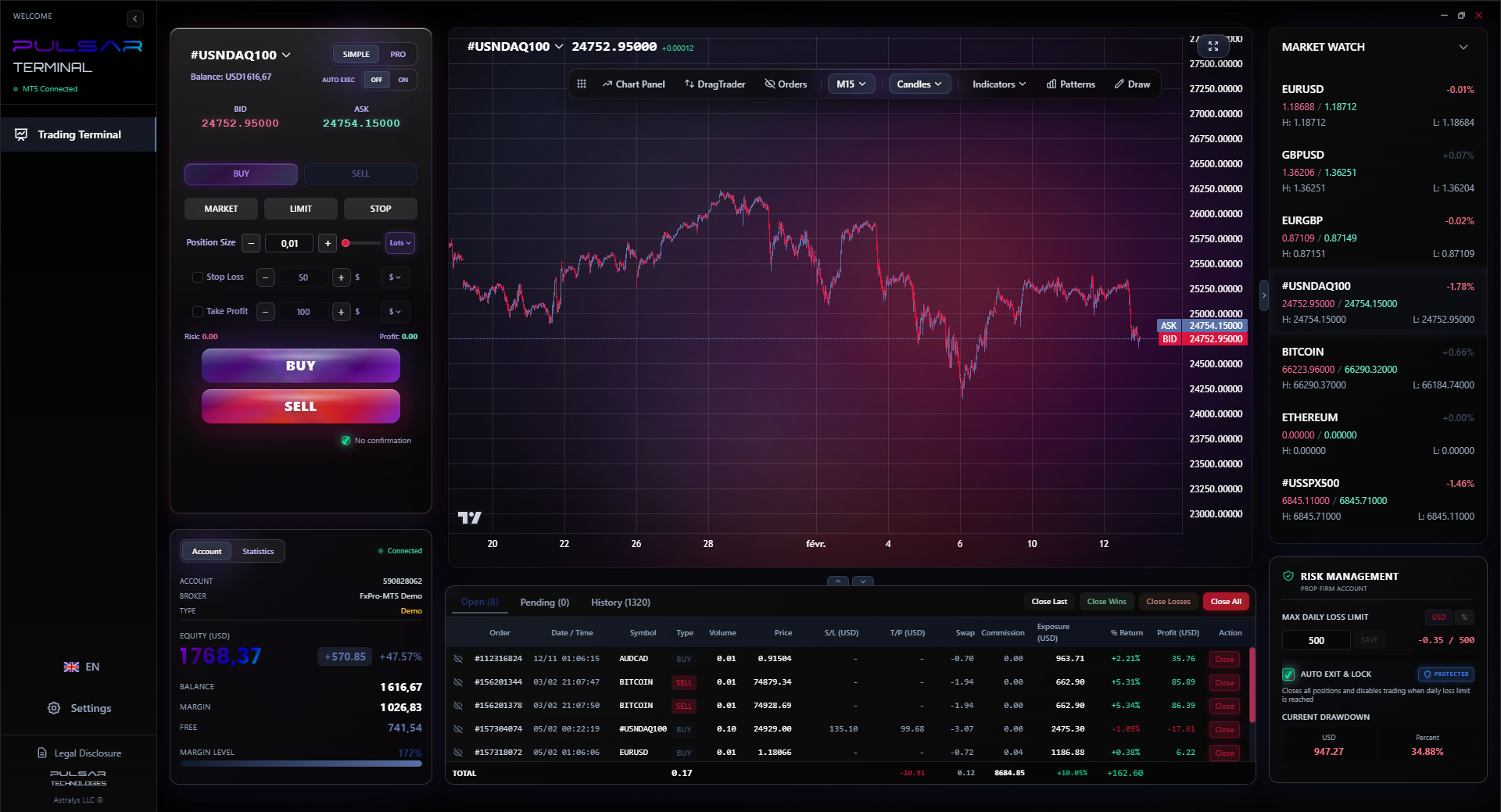
Manually moving stops to breakeven and managing multiple trades is where discipline fails; Pulsar Terminal automates these risk rules directly on your MT5 platform.
Pulsar Terminal
MT5一站式工具:拖拽下单、多重止盈/止损、追踪止损、网格交易、成交量分布图和自营交易保护。每日1000+交易者使用。
“Your edge isn't a secret indicator. It's your discipline.”
A forex risk management course isn't something you complete. It's a practice you maintain every single time you click 'buy' or 'sell.' It's the boring, repetitive, unsexy work that separates the 10% who survive from the 90% who fund their profits.
Start tomorrow with a demo account if you're new. But don't demo trade with R1,000,000 fake money. Demo with R50,000, the amount you'd really start with. Practice your plan for three months. Your goal isn't profitability in the demo, it's consistency in following your rules. Can you hit your daily loss limit and stop? Can you take a 5% winning week and not increase your size the next Monday?
Then, go live with the smallest amount your broker allows. For XM, that's $5 (about R82). Seriously. Trade that account until you double it. Then, and only then, add more capital. The market isn't going anywhere. The USD/ZAR will still be there, swinging wildly, next month and next year.
Your edge isn't a secret indicator. It's your discipline. It's your ability to lose small and win big over hundreds of trades, while everyone else is doing the opposite. In South Africa, with our unique challenges and opportunities, that disciplined approach is the only real course you'll ever need.
FAQ
Q1Is 1% risk per trade really enough to make money in South Africa with a small account?
It's not about getting rich quick, it's about surviving long enough to let compounding work. On a R10,000 account, 1% is R100. It feels small. But if you can consistently win 1.5% (R150) while risking 1%, you're building. The goal is to grow the account to where the 1% in Rand terms becomes meaningful. Blowing the account trying to make 10% per trade is why small accounts fail. Patience is the use you can't buy.
Q2Should I use a South African broker or an international one?
Always prioritize an FSCA-regulated broker for the fund segregation and legal protection. Many 'international' brokers like Pepperstone or IC Markets have FSCA-authorized entities. The key is checking the specific entity you're signing up with. Avoid brokers with no local regulation just for higher use; you're trading your capital security for a faster way to lose.
Q3How do I calculate my position size for USD/ZAR?
Don't do it manually. Use your trading platform's calculator or a dedicated online tool. Input your account balance in ZAR, your risk percentage (e.g., 1%), your stop loss distance in pips, and select USD/ZAR. The tool will calculate the correct lot size, factoring in the current exchange rate. The pip value changes with the USD/ZAR rate, so recalculating for every trade is non-negotiable.
Q4What's more important: a tight stop loss or a correct stop loss?
A correct stop loss, 100%. A tight stop placed arbitrarily to 'minimize risk' will just get hit by market noise. Your stop must be placed where the reason for your trade is no longer valid. If that's 50 pips away, you either accept that distance and size your position accordingly (risking your 1%), or you don't take the trade. Forcing a 20-pip stop on a trade that needs 50 is poor risk management, not good.
Q5I hit my daily loss limit. Can I switch to a demo account to keep trading?
No. Absolutely not. The point of the limit is to stop you emotionally. Switching to demo to 'practice' after a loss is just revenge trading in a sandbox. It reinforces bad habits. When you hit your limit, walk away. The market will be there tomorrow. Use the time to review your journal, not to chase the feeling of a win.
Q6Does risk management change if I'm scalping vs. swing trading?
The principles don't change, but the application does. For scalping strategy, your stops are tighter, so your position size can be larger for the same monetary risk. However, you must account for wider spreads as a cost. For swing trading, stops are wider, so position sizes must be smaller. The key is that the Rand amount you risk (e.g., R500) should remain consistent for your chosen risk percentage, regardless of your time frame.
Winston 教授的课程
要点总结:
- ✓Risk 1% or less per trade, always.
- ✓FSCA regulation is non-negotiable for capital safety.
- ✓Cut ZAR pair position sizes by 50% vs. majors.
- ✓A daily loss limit of 3% is your emergency brake.
- ✓Journal every trade to see your own flaws.
这篇文章对您有用吗?
点击星星评分
每周交易洞察
免费每周分析与策略。无垃圾邮件。
关于作者
David van der Merwe
新兴市场交易员
约翰内斯堡交易者,11年新兴市场货币经验。专注于ZAR货币对、FSCA监管交易和南非市场分析。
评论
风险提示
金融工具交易存在重大风险,可能不适合所有投资者。过往业绩不代表未来表现。本内容仅供教育目的,不构成投资建议。在交易前请务必自行研究。
您可能还喜欢

Cara Trading Forex Sukses: 7 Prinsip dari Trader Profesional
Cara trading forex sukses dengan 7 prinsip trader pro: manajemen modal, disiplin, journal trading, backtest. Data nyata, bukan janji profit palsu.
Jam Trading Forex Terbaik untuk Trader Indonesia: Panduan Lengkap dengan Tabel Waktu
Panduan jam trading forex untuk trader Indonesia. Tabel 4 sesi dunia, jam emas 20:00-00:00, sesi mana yang harus dihindari. Data akurat + tips dari trader berpengalaman.
Top 5 Sàn Forex Uy Tín Nhất 2026: Review Jujur dari Trader Indonesia
Top 5 sàn forex uy tín 2026 untuk trader Indonesia. Review jujur: spread, deposit, withdraw, dukungan lokal. Exness, XM, IC Markets & lebih.
