


Here's a statistic that should make you pause: over 90% of retail traders who rely solely on paid forex signals end up blowing their accounts within two years.

Olumide Adeyemi
西非交易先驱 ·  Nigeria
☕ 10 分钟阅读
您将学到:
Here's a statistic that should make you pause: over 90% of retail traders who rely solely on paid forex signals end up blowing their accounts within two years. I know, because I was almost one of them. When you search for 'forex signals com' from Lagos or Abuja, you're bombarded with promises of easy money. The reality? It's a minefield. This guide isn't about bashing the industry; it's about giving you the tools to navigate it with your eyes wide open, using my own costly mistakes as your lesson plan.
At its core, a forex signal is just a trade suggestion. Someone, or some algorithm, tells you: "Buy EUR/USD at 1.0850, stop loss at 1.0820, take profit at 1.0900." That's it. The entire 'forex signals com' industry is built on selling you that line of text.
When I started, I thought I was buying expertise. What I was really buying was hope, and a way to outsource my anxiety. I'd get a signal, execute it blindly, and then watch the charts with a knot in my stomach, completely disconnected from the market's logic. I wasn't learning; I was renting a crutch.
Signals come in a few flavors. Manual signals are sent by a human analyst (or someone claiming to be one). Automated signals are generated by software or trading bots. Then there are copy trading and PAMM accounts, which are a different beast - they automatically mirror trades from a master account into yours. Each has its own set of promises and pitfalls.

Warning: A signal is just an opinion with a price tag. It doesn't know your account size, your risk tolerance, or your psychology. Blindly following it is like letting a stranger drive your car with your life savings in the trunk.

💡 Winston 小贴士
If you wouldn't risk your own money on a trading idea, selling it as a signal is just monetizing your doubt. Never trust a provider who doesn't trade their own signals with real capital.
“A signal is just an opinion with a price tag. It doesn't know your account size, your risk tolerance, or your psychology.”
Trading is huge here. We're the second-largest retail forex market in Africa, and everyone with a smartphone seems to be looking for an edge. This demand has created a wild west for signal providers. Regulation? Forget it. The SEC doesn't explicitly oversee this space, and the CBN's new FX Code is for wholesale banks, not some guy on Telegram selling 'guaranteed' GBP/NGN signals.
This regulatory gray area means caveat emptor - buyer beware - is the only rule. I've seen providers pop up overnight, make outrageous claims during a trending market, collect subscriptions, and vanish when the market turns. There's no ombudsman to complain to.
The True Cost Beyond Naira
Let's talk numbers. You might pay $50, $100, or even $300 a month for a premium signal service. But that's just the entry fee. The real cost is in the execution. If a signal service partners with a specific broker (offering 'free' signals if you deposit), you're often stuck with their spreads and conditions. I once followed a signal into a fast-moving EUR/USD trade on a broker with a 2-pip spread, while my main account with IC Markets had 0.1. That extra 1.9 pips of cost ate directly into my potential profit on every single trade.
And don't forget the taxman. That 10% capital gains tax applies to profits you make from following signals, same as any other trading. If you're not setting aside that 10%, you're building a future liability.
“I thought I was buying expertise. What I was really buying was hope, and a way to outsource my anxiety.”
I need to be honest about my failures. They taught me more than any winning streak.
Mistake 1: The 'Prop Firm' Signal Scam. Around 2021, I paid $150/month for a service that specialized in signals to pass prop firm challenges. The seller showed verified myfxbook results. The first week, I made 8% on a $100k challenge account using their signals. I was hooked. Then came a USD/CAD signal. Entry: 1.2650. SL: 1.2620. TP: 1.2720. It looked good. I took the trade. Price dipped to 1.2625, teased me, then shot down to 1.2580. I lost 3% in minutes and breached the daily loss limit. The provider's response? "Market volatility. Unlucky." I later realized their myfxbook was likely a demo account or cherry-picked. The lesson? Verified past performance is easily faked. I should have paper-traded their signals for a full month first.
Mistake 2: Ignoring My Own Position Size Calculator. A gold (XAU/USD) signal came in. It suggested a 50-pip stop loss. My standard risk was 1% of my account. But 50 pips on gold is a much bigger dollar amount than 50 pips on EUR/USD. In my laziness, I just entered the lot size the signal suggested. It was a 3% risk trade for me. The trade went south. That single loss set me back two weeks of careful profits. The signal wasn't entirely wrong; my position sizing was reckless. A tool like a position size calculator is non-negotiable, signal or no signal.

Pro Tip: Before paying a kobo, demand a one-month live signal history (not screenshots) with entries, exits, and reasoning. Then, simulate following it on a demo account with your own strict risk management. If they won't provide this, walk away.
💡 Winston 小贴士
The 'spread' is the silent killer of signal profits. A signal that looks good on a 0.1-pip ECN account can be a loser on a standard account with a 2-pip spread. Always factor in your broker's real costs.
“I thought I was buying expertise. What I was really buying was hope, and a way to outsource my anxiety.”
After my burns, I developed a checklist. If a provider fails any of these, I move on.
- Transparency Over Hype: Do they show real, live account statements (like a proper myfxbook link that shows drawdown, not just profit)? Can they explain their strategy in simple terms? If their pitch is all Lamborghinis and 'secret algorithms,' it's a scam.
- Risk Disclosure: Do they clearly state the average stop loss size, win rate, and risk-reward ratio? A provider boasting a 90% win rate is usually hiding enormous losses on the 10% of losing trades. A realistic 60-70% win rate with a consistent 1:1.5 risk-reward is far more credible.
- Live Communication: Are they accessible? I once joined a Discord channel where the 'guru' only posted signals and never answered questions. Red flag. A legitimate provider should have some forum for discussion.
- Broker Agnostic: Be wary of providers who insist you use one specific broker to get signals. This is often a rebate scheme (they get paid for your volume). Your best interest is using a reputable, low-cost broker like Pepperstone or Exness.
- Track Record Length: Anyone can get lucky for a month. Look for providers with a track record of at least 6-12 months through different market conditions (ranging, trending, high volatility).
| What to Look For | Green Flag | Red Flag |
|---|---|---|
| Performance Proof | Verified, multi-month myfxbook/cTrade link showing all trades. | Screenshots of profits only, no loss trades shown. |
| Risk Management | States max risk per trade (e.g., 2% of capital), uses stop losses on every signal. | Says 'rarely use stops,' or encourages martingale/over-leveraging. |
| Cost Structure | Clear monthly fee. Free trial available. | Huge upfront 'lifetime' fee, or fees hidden in required broker spreads. |
“Your job is to be the skeptic. Do the work. Learn to read the charts yourself.”
This is the most important section. Signals should be a tool in your toolbox, not the entire workshop. Here’s how I use them now.
I treat signals like a second opinion. I have my own core strategy based on swing trading support/resistance and the MACD indicator. If I'm looking at a potential buy on GBP/USD and a signal provider I respect also posts a buy signal in the same direction, it adds conviction. But if my analysis says 'sell' and their signal says 'buy,' I follow my plan. Always.
I also use signals as an educational reverse-engineering tool. When I get a signal, I don't just execute it. I pull up my chart and ask: Why here? Why now? Is this based on a breakout, a divergence on the RSI indicator, a Fibonacci retracement? This process has taught me more about chart patterns and market structure than any course.
Finally, I adjust every single signal to my own risk parameters. Their stop loss might be 30 pips. If my analysis says key support is 35 pips away, I move my stop. I always, always recalculate the position size using my fixed 1% risk rule. This turns their generic suggestion into my personalized trade.
💡 Winston 小贴士
One month of profitable signals proves nothing. One month of losses can destroy your account. Demand a track record that shows survival through a market downturn.
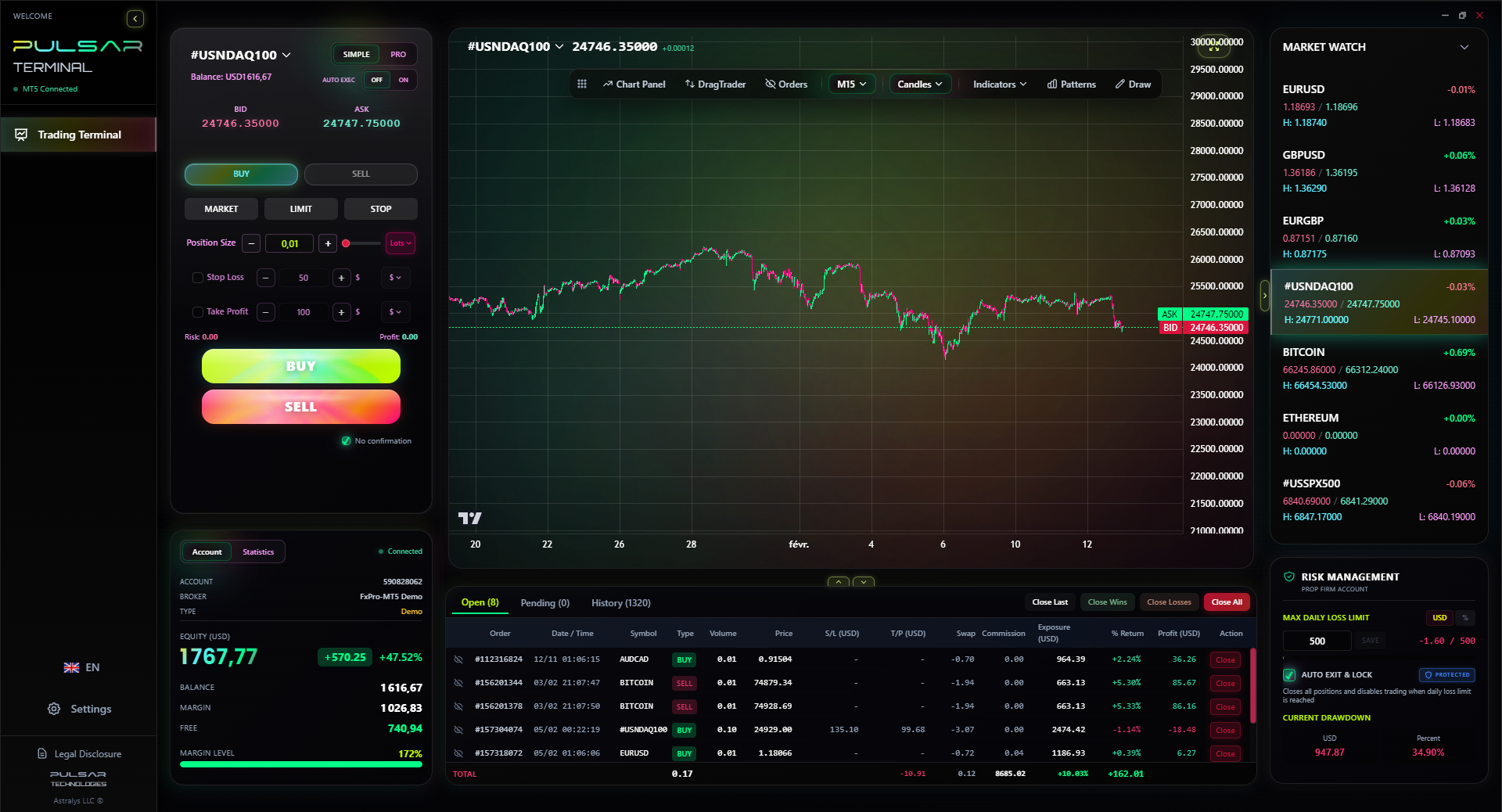
When managing multiple signals or prop firm challenges, manually moving stops to breakeven is a hassle; Pulsar Terminal automates breakeven and trailing stop functions directly on your MT5 charts.
Pulsar Terminal
MT5一站式工具:拖拽下单、多重止盈/止损、追踪止损、网格交易、成交量分布图和自营交易保护。每日1000+交易者使用。
“Your job is to be the skeptic. Do the work. Learn to read the charts yourself.”
Before you swipe your card, consider these.
Free Alternatives:
- Broker Analysis: Many good brokers like XM or HFM provide daily market analysis and trade ideas for free. They won't give you exact entry points, but the directional bias and fundamental reasoning are valuable.
- Social Trading/Forums: Platforms like TradingView have a social feed. You can see what other traders are thinking. The key is to follow the rationale, not the call.
- Build Your Own Scanner: This is the ultimate goal. Learn to use basic indicators to scan for opportunities yourself. A simple scanner for MACD crossovers on the 1-hour chart can give you a starting point for your own analysis.
When Paid Might Make Sense: Only if you treat it as tuition, not a money-printing machine. Pay for a service for 3 months with the sole goal of dissecting every signal to understand the provider's strategy. Once you've learned it, cancel the subscription and apply the principles yourself. The one exception might be for very specialized, low-frequency strategies (like weekly XAU/USD trades) that you don't have time to research, but you must vet the provider relentlessly.

Example: Let's say a paid service costs $80/month. You have a $2,000 account. That fee is 4% of your capital. You now need to make at least 4% profit monthly just to break even on the cost. That's a huge hurdle before you even start making real money.
“The most valuable investment you can make is not in a monthly signal subscription. It's in education.”
So, should you use a 'forex signals com' service? My answer is a cautious 'maybe,' but only under strict conditions.
For 95% of beginners, paying for signals is a shortcut to losing money faster. You skip the essential, painful learning phase. You won't understand why trades work or fail, so you can't adapt when the provider's strategy inevitably hits a losing streak (and they all do).
For a more experienced trader who has a solid foundation, a vetted signal service can be a source of ideas or a way to explore a new asset class. But even then, it's an assistant, not a boss.
The most valuable investment you can make is not in a monthly signal subscription. It's in:
- Education (books, credible courses).
- A reliable internet connection and a decent device.
- A demo account where you can fail for free for 6-12 months.
- Eventually, a funded account with a broker known for good execution, like the ones we've reviewed.
The forex market in Nigeria is full of opportunity, but it's also full of people trying to sell you the dream. Your job is to be the skeptic. Do the work. Learn to read the charts yourself. It's harder, slower, and often frustrating. But the knowledge you gain becomes an asset no one can ever take from you, and the only signal you'll ever need to trust is your own validated judgment.
FAQ
Q1Is using forex signals legal in Nigeria?
Yes, using forex signals is legal. The activity isn't specifically regulated by the SEC or CBN for retail traders. However, you are legally required to pay a 10% capital gains tax on any profits you make from trading, including profits generated from following signals.
Q2What is a realistic win rate to expect from a good signal provider?
Be extremely skeptical of anyone claiming over 80%. A realistic, sustainable win rate for a good provider is between 55% and 75%. The more important metric is the risk-reward ratio. A provider with a 60% win rate and an average risk-reward of 1:2 (risking 1% to make 2%) is far more profitable in the long run than one with an 80% win rate and a 1:0.5 ratio.
Q3How much do forex signal services typically cost in Nigeria?
Costs vary wildly. You can find free signals (often tied to using a specific broker), trial plans, monthly subscriptions from $20 to $100, and expensive 'premium' services charging $200+ per month. Some also charge separately for different asset classes (e.g., forex vs. crypto signals).
Q4Can I use forex signals to pass a prop firm challenge?
You can try, but it's incredibly risky. Prop firm challenges have strict daily and overall loss limits. A short string of losing signals from a provider can blow your challenge instantly. If you attempt this, you must adjust every signal's position size to fit the challenge's risk rules, not the provider's suggestion. Using a tool that automates daily loss protection is almost mandatory in this scenario.
Q5What's the difference between forex signals and copy trading?
Forex signals are manual suggestions; you choose whether and how to execute them. Copy trading is automatic; once you subscribe to a master trader, their trades are copied into your account in real-time, with proportional position sizing. Copy trading removes your discretion but also your ability to adjust risk or filter bad trades.
Q6I'm a complete beginner. Should I start with signals?
Absolutely not. Starting with signals is like learning to drive by sitting in the passenger seat with a blindfold on. You need to understand the basics first: what a pip is, how spreads work, and fundamental risk management. Spend at least 3-6 months on a demo account learning the mechanics before even considering an external signal.
Winston 教授的课程
要点总结:
- ✓Vet providers with a 6-month verified track record.
- ✓Always recalculate position size for your own risk (max 1-2%).
- ✓Factor in broker spreads; they can turn winning signals into losers.
- ✓Treat signals as educational tools, not profit guarantees.
- ✓Pay 10% capital gains tax on all signal-generated profits.
这篇文章对您有用吗?
点击星星评分
每周交易洞察
免费每周分析与策略。无垃圾邮件。
关于作者
Olumide Adeyemi
西非交易先驱
尼日利亚最活跃的外汇交易教育者之一。从拉各斯出发有8年交易经验。专注于低资金策略和面向非洲交易者的自营公司挑战。
评论
风险提示
金融工具交易存在重大风险,可能不适合所有投资者。过往业绩不代表未来表现。本内容仅供教育目的,不构成投资建议。在交易前请务必自行研究。
您可能还喜欢

Cara Trading Forex Sukses: 7 Prinsip dari Trader Profesional
Cara trading forex sukses dengan 7 prinsip trader pro: manajemen modal, disiplin, journal trading, backtest. Data nyata, bukan janji profit palsu.
Jam Trading Forex Terbaik untuk Trader Indonesia: Panduan Lengkap dengan Tabel Waktu
Panduan jam trading forex untuk trader Indonesia. Tabel 4 sesi dunia, jam emas 20:00-00:00, sesi mana yang harus dihindari. Data akurat + tips dari trader berpengalaman.
Top 5 Sàn Forex Uy Tín Nhất 2026: Review Jujur dari Trader Indonesia
Top 5 sàn forex uy tín 2026 untuk trader Indonesia. Review jujur: spread, deposit, withdraw, dukungan lokal. Exness, XM, IC Markets & lebih.
