


Thinking about buying forex signals in South Africa? You're probably wondering if they're the shortcut to easy money or just another way to lose your hard-earned rand.

David van der Merwe
新兴市场交易员 ·  South Africa
☕ 9 分钟阅读
您将学到:
Thinking about buying forex signals in South Africa? You're probably wondering if they're the shortcut to easy money or just another way to lose your hard-earned rand. I get it. The promise is tempting: someone else does the analysis, you just copy the trades. But after 12 years in this game, and after wasting more money on signal services than I care to admit early on, I've learned the hard truth. This guide isn't about selling you a dream. It's about giving you the real, unfiltered lowdown on forex signals South Africa style - what to look for, what to run from, and how to actually make them work for you, not against you.
At their core, forex signals are just trade suggestions. Someone, or some algorithm, says "Buy EUR/USD at 1.0850, stop loss at 1.0820, take profit at 1.0900." You get that alert on your phone, you hop into your trading platform, and you place the trade. Sounds simple, right?
The reality is more nuanced. Signals come in a few flavours. Manual signals are sent out by a human trader or analyst who's supposedly watching the charts. Automated signals are generated by a computer program or Expert Advisor (EA). Then you have the hybrid ones, which is often just a fancy name for an EA with a human sometimes checking in.
Here's the first cold shower: a signal is just an entry, stop loss, and target. It tells you nothing about the market context, the risk management rationale, or what to do if the trade goes sideways for three days. Blindly following them is like letting a stranger drive your car with your eyes closed. I learned this in 2017. I was following a popular signal service, placing every trade on my XM review account. I had a 70% win rate for two months, felt like a genius, then gave back all the profits plus 15% of my capital in one bad week because I didn't understand why the trades were being placed. The signals didn't change; the market did. I was just along for the painful ride.

Trading from South Africa adds specific layers you need to consider, especially with signals.
The ZAR Factor
Most forex signals focus on major pairs like EUR/USD or GBP/USD. That's fine, but your capital is in rand. You need to be hyper-aware of the USD/ZAR exchange rate. A signal service might boast a 50% return in USD terms, but if the rand strengthens significantly against the dollar during that period, your actual return in rands could be much lower, or even negative. I once made a tidy $2,000 profit on a signal-driven EUR/USD guide run, only to see a big chunk of it vanish when I converted back to ZAR because of a sudden political announcement that boosted our currency.
Broker Costs & Execution
South African traders often use international brokers like IC Markets review or Pepperstone review for better spreads and regulation. When using signals, especially for scalping strategy, the spread is critical. A signal might suggest buying at 1.0850, but if your broker's spread is 2 pips on that pair, your real entry is 1.0852. On a short-term trade, that can kill the edge before you even start. Always factor in the cost of the spread definition and any potential slippage, which can be worse during volatile SA market hours (when London opens).

Warning: Many international signal providers don't account for the specific deposit/withdrawal fees or currency conversion delays that SA traders face. That "weekly return" they advertise doesn't include the R100 wire fee and the 2-day wait to get your money back to your FNB account.

💡 Winston 小贴士
A signal without a clearly explained edge is just noise. If they can't articulate the 'why' in simple terms, your money is funding their marketing budget, not their trading acumen.
“Your risk management is sacred. A signal provider's suggested stop loss is a suggestion, your capital is your commandment.”
The signal industry is riddled with charlatans. Here’s how to spot them, with a local twist.
The "Guaranteed" Profit. Anyone guaranteeing profits in trading is lying. Full stop. It's not just unethical, it's impossible. The market doesn't give guarantees.
The Fancy Car/Instagram Lifestyle. If their main marketing is pictures of them on the Camps Bay strip next to a Lamborghini, run. Real profitable traders are usually boring and focused on charts, not photoshoots. I fell for this once, paying R800 per month to a "guru" whose main analysis seemed to be the background of his luxury shots.
No Verifiable Track Record. A real track record is a detailed, time-stamped list of trades, often from a third-party service like Myfxbook. It shows the drawdowns (the losing periods) as well as the wins. If they only show screenshots of a few winning trades, it's cherry-picking. Ask for a live, real-money account statement you can verify.
Pressure to Deposit More. A classic scam is the "your account is too small to follow our premium signals, deposit $5,000 to access the VIP room." This is a direct funnel to a margin call. Legitimate services have a set monthly fee, period.
The "Prop Firm Passing" Service. This is a huge one now. Companies offer to "pass" your prop firm challenge for a fee using their signals or trading for you. This almost always violates the prop firm's rules, and you'll likely get your account banned and lose the challenge fee. It's a shortcut that leads to a dead end.
Let's say you've weighed the risks and still want to try a signal service. Here’s a pragmatic checklist.
-
Transparency Over Hype: Look for a service that explains the strategy behind the signals. Are they swing trading based on support/resistance? Are they using a specific MACD indicator crossover? If they won't tell you the general approach, they're selling magic beans.
-
Risk Disclosure: A good service states their average risk per trade (e.g., 1-2% of capital) and shows their maximum historical drawdown. If their worst drawdown was 40%, you better have the stomach for that.
-
Cost Structure: Is it a flat monthly fee (R500 - R2000 is common) or a percentage of profits? Percentage models can align interests, but make sure you understand how they calculate it. Flat fees are simpler.
-
Trial Period: Any credible service offers a short, cheap, or free trial. Use it to watch the signals in a demo account. Don't just look at wins/losses. See how they manage losing trades. Do they move stop losses? Do they provide updates?
-
Community & Support: Is there a Telegram group or Discord where the provider interacts? Reading how they answer questions during a losing trade is very telling. Silence is a bad sign.

Example: Let's do maths. A service costs R1000/month. You have a R20,000 account. That's a 5% monthly overhead just on fees. You need to make at least 5% net just to break even on the cost. This forces you to either over-use or have an unrealistically high win rate. Use a position size calculator to work out if the suggested trade sizes even make sense for your capital after the fee.
💡 Winston 小贴士
The most valuable signal you'll ever get is the one generated by your own disciplined analysis. It's slower, but it's permanent.
“The best signal service is the one you eventually outgrow.”
This is the most important part. Using signals shouldn't be a passive activity. Your goal should be to learn from them, not just blindly follow.
The Hybrid Approach: This is what saved me. Use the signals as an idea generator, not an order. When a signal comes in for Gold (XAU/USD), don't just click buy. Pull up your own chart. Can you see the support level they're buying at? Does the RSI indicator show oversold conditions like their analysis mentioned? Use your own tools to confirm. This turns a signal into a learning lesson. I started doing this with a XAU/USD guide signal service, and within 3 months, I was spotting my own setups on gold without their alerts.
Start Small & Journal: If you decide to follow a signal, start with a position size so small you won't feel emotional about it. Use 0.01 lots on a $10,000 account. For every signal you take, write down in a journal: The reason given, your own chart observation, the outcome, and what you learned. This journal is worth more than the signals themselves.
Manage Your Own Risk: Never let a signal provider dictate your risk. Their signal might suggest a 50-pip stop loss, but if that represents 5% of your account and your personal rule is to never risk more than 1%, you must adjust the position size down. Your risk management is sacred. This is non-negotiable.
, the best signal service is the one you eventually outgrow. It should be a crutch you use while you learn to walk on your own, not a wheelchair you become dependent on.
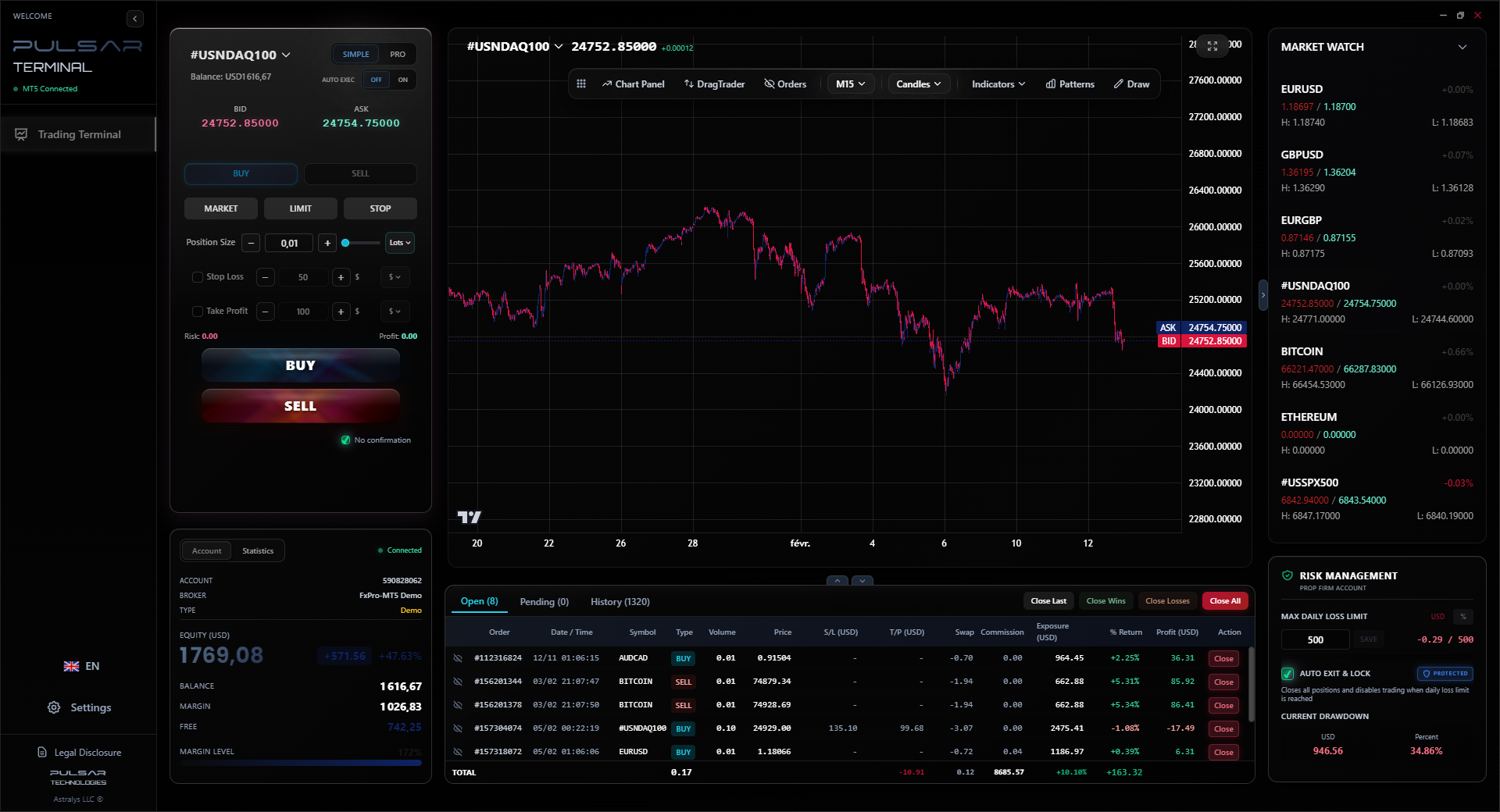
When testing or following signals, managing multiple trades with precise stop losses and take profits is much easier with a tool that lets you drag-and-drop orders directly onto your MT5 chart.
Pulsar Terminal
MT5一站式工具:拖拽下单、多重止盈/止损、追踪止损、网格交易、成交量分布图和自营交易保护。每日1000+交易者使用。
Before you type in your credit card details, consider these paths. They're harder work, but they build real, lasting skill.
Build Your Own Screening Process: Instead of paying for entry signals, learn to screen for potential trades yourself. Learn one or two simple concepts really well. For example, learn how to identify a strong trend on the 4-hour chart, then use the 1-hour chart to find a pullback to a moving average. That's a foundational strategy you can use forever, for free. There are more free, quality educational resources online now than ever before.
Join a Trading Community (Carefully): Look for communities focused on education and sharing charts, not just shouting "BUY NOW!" In these groups, you'll see other traders' analyses and can discuss ideas. You learn the thought process, which is infinitely more valuable than a set of coordinates. The goal is to develop your own conviction.
Paper Trade a Strategy: Pick a documented strategy - like a simple moving average crossover or support/resistance bounce. Paper trade it religiously for 100 trades. Record every result. This will teach you about the strategy's win rate, its drawdowns, and, most importantly, whether you have the discipline to follow a system. This data is your own personal, trustworthy signal.
The truth is, there is no secret code. The market is the same for everyone in Sandton as it is in Singapore. The edge doesn't come from a subscription; it comes from your own screen time, discipline, and continuous learning. I made more consistent progress in one year of focused self-study than in three years of hopping between different "forex signals South Africa" providers hoping for the holy grail.
FAQ
Q1Are forex signals legal in South Africa?
Yes, using or providing forex signals is legal. However, the provider is not allowed to give financial advice or manage your money without being a licensed financial service provider (FSP) with the FSCA. You, as the trader, are solely responsible for your own trading decisions and outcomes.
Q2What is a realistic monthly cost for a forex signal service in ZAR?
Costs vary wildly. You can find basic Telegram groups for R200-R500 per month. More established services with detailed analysis and support typically range from R800 to R2500 per month. Any service charging significantly more (R5000+) should have an exceptionally transparent and verifiable track record to justify it.
Q3Can I use forex signals with a South African broker like EasyEquities or GT247?
You could, but it's not ideal. Most local CFD providers have wider spreads and different trading conditions than dedicated international forex brokers. For accurate signal execution, especially on major pairs, an international broker like Exness review or IC Markets is usually better suited due to tighter spreads and faster execution, which is critical for short-term signals.
Q4How much starting capital do I need to use forex signals effectively?
Effectively' is key. If you have less than R20,000, the monthly fee becomes a huge percentage of your capital, forcing you to take excessive risk. A more realistic minimum is R50,000-R100,000. This allows you to use proper position sizing (risking 1% or less per trade) and absorb the cost of the service without it crippling your potential returns.
Q5What's the biggest mistake new traders make with signals?
Two tied for first: 1) Over-leveraging because they trust the signal too much and want to make up for the monthly fee quickly, and 2) Not understanding the strategy. They follow a winning trend-following signal in a ranging market, or a ranging strategy in a trending market, and blow up their account because they didn't know what they were actually doing.
Q6Do any signal providers offer a free trial for South Africans?
Many do, but be cautious. A true free trial lets you see the actual signals in real-time, often in a view-only Telegram channel. Avoid trials that require you to deposit money with a specific broker first - that's usually a broker affiliate scheme, not a genuine trial of the signal quality.
Winston 教授的课程
要点总结:
- ✓Signals are a learning tool, not a profit machine.
- ✓Always convert USD returns to ZAR for the real picture.
- ✓A 40% historical drawdown means you must survive a 40% loss.
- ✓The monthly fee must be a small fraction of your capital.
这篇文章对您有用吗?
点击星星评分
每周交易洞察
免费每周分析与策略。无垃圾邮件。
关于作者
David van der Merwe
新兴市场交易员
约翰内斯堡交易者,11年新兴市场货币经验。专注于ZAR货币对、FSCA监管交易和南非市场分析。
评论
风险提示
金融工具交易存在重大风险,可能不适合所有投资者。过往业绩不代表未来表现。本内容仅供教育目的,不构成投资建议。在交易前请务必自行研究。
您可能还喜欢

Cara Trading Forex Sukses: 7 Prinsip dari Trader Profesional
Cara trading forex sukses dengan 7 prinsip trader pro: manajemen modal, disiplin, journal trading, backtest. Data nyata, bukan janji profit palsu.
Jam Trading Forex Terbaik untuk Trader Indonesia: Panduan Lengkap dengan Tabel Waktu
Panduan jam trading forex untuk trader Indonesia. Tabel 4 sesi dunia, jam emas 20:00-00:00, sesi mana yang harus dihindari. Data akurat + tips dari trader berpengalaman.
Top 5 Sàn Forex Uy Tín Nhất 2026: Review Jujur dari Trader Indonesia
Top 5 sàn forex uy tín 2026 untuk trader Indonesia. Review jujur: spread, deposit, withdraw, dukungan lokal. Exness, XM, IC Markets & lebih.
