


Here's a brutal truth most Nigerian traders learn the hard way: you can be right about the direction of a currency pair and still lose money.

Olumide Adeyemi
西非交易先驱 ·  Nigeria
☕ 10 分钟阅读
您将学到:
- 1What Exactly Is a Forex Strength Meter?
- 2How It Actually Works (And Why It Matters for Naira Traders)
- 3The Best Strength Meters and Where to Find Them
- 4Real Trading Strategies Using the Meter
- 5Mistakes Every Nigerian Trader Makes (Including Me)
- 6Making It Work With Your Other Tools
- 7Choosing a Broker & The Execution Reality
- 8The Final Word for the Naija Trader
Here's a brutal truth most Nigerian traders learn the hard way: you can be right about the direction of a currency pair and still lose money. I've seen it a thousand times. You buy EUR/USD because the chart looks good, but the US Dollar is secretly strong against everything else that day. Your trade gets crushed by a hidden tide. That's where a forex strength meter comes in. It's not magic, but it's the closest thing you'll get to a cheat sheet for spotting which currency is the bully in the market and which one is getting pushed around.
Forget the fancy name. A forex strength meter is just a visual dashboard that shows you, in real-time, which major currencies are strong and which are weak. It compares them all against each other, usually on a scale from 0 to 10 or with colored bars (green for strong, red for weak).
Think of it like a football league table. You don't just know that Manchester City won; you see they're top of the table, crushing everyone. The strength meter does that for the US Dollar, Euro, British Pound, and the rest. It aggregates price action from multiple timeframes and pairs to give you a single, clear score.
The biggest mistake I made early on was trading in a vacuum. I'd analyze GBP/JPY for hours, completely ignoring that the Japanese Yen was rallying against the USD, EUR, and AUD at the same time. My fancy GBP/JPY setup failed because I missed the broader Yen strength. A strength meter would have flashed a big red warning on the Yen.

Warning: A strength meter is a secondary tool. It confirms a story, it doesn't write it. Never enter a trade based solely on a green or red bar. Always use it with your primary scalping strategy or swing trading plan.

💡 Winston 小贴士
The weekly strength reading trumps the daily, and the daily trumps the hourly. Align your trades with the higher timeframe trend for smoother sailing.
Most meters work by calculating the relative performance of a currency across several major pairs. If the USD is up against the EUR, GBP, JPY, and AUD, its strength score goes up. It's that simple.
Why This is Crucial for Us
As Nigerian traders, we're often trading with a currency (the Naira) that isn't on these global meters. We're watching USD/NGN, but the meter shows USD strength against the majors. This is vital context. If the meter shows the Dollar is weak globally, but USD/NGN is shooting up, you know that move is likely driven by local Nigerian factors - CBN policy, oil prices, pure demand - not broad Dollar strength. That tells you a different story about the trade's sustainability.
I remember a trade in late 2025. USD/NGN was climbing, and everyone was piling into buying Dollars. The global forex strength meter, however, showed the USD index (DXY) was actually falling sharply. The USD was weak everywhere except against the Naira. That was a huge red flag. I stayed out. Sure enough, a few days later, some positive local news hit, and the Naira recovered a chunk of those losses against a broadly weak Dollar. The meter saved me from a nasty margin call scenario.

Pro Tip: When trading USD/NGN, always cross-reference the Dollar's strength on the meter with the EUR/USD and GBP/USD charts. If USD is strong globally and against NGN, the trend is powerful. If USD is weak globally but strong vs NGN, be very cautious - that's a fragile, local move.
“A strength meter won't make you rich overnight, but it will make you a more disciplined, aware, and , a more profitable trader.”
You don't need to pay for this. The best tools are free.
- MyFXbook Forex Strength Meter: This is the industry standard. It's free, web-based, and updates in real-time. You can view strength by the hour, day, week, or month. This is my go-to. I have it open in a browser tab all day.
- MT4/MT5 Indicators: Search the MetaTrader Market or forums for "Currency Strength" indicators. Hundreds exist. Some draw neat histograms right on your chart. Be careful - some are poorly coded and lag. Test them on a demo first.
- Broker Tools: Some brokers like IC Markets and Pepperstone build similar tools into their client dashboards or partner with third-party providers like TradingView, which also has strength meter scripts.
A quick story on cost: I once paid $150 for a "pro" strength meter indicator that promised secret algorithms. It was slower and less accurate than the free MyFXbook version. Don't get scammed. Start free.
Here’s a comparison of two common approaches:
| Tool | Format | Best For | Cost |
|---|---|---|---|
| MyFXbook | Website / Widget | Quick daily & weekly analysis | Free |
| MT4/MT5 Indicator | On your chart | Seeing strength alongside price action | Free - $50 (stick to free) |
This is where we make money. The meter gives you two golden pieces of info: the strongest currency and the weakest currency. Your job is to pair them.
Strategy 1: The Trend Follower's Confirmation You're looking at a nice uptrend on EUR/USD. Before you buy, check the meter. Is the Euro (EUR) in the top 3 strongest currencies? Is the USD in the bottom 3 weakest? If yes, you have a high-probability trend trade. The meter confirms the underlying dynamic. If the meter shows EUR is weak and USD is strong, that uptrend is suspect - it might be about to reverse. I use this to filter out 30% of my potential trades.
Strategy 2: The Divergence Hunter This is more advanced but incredibly powerful. Look for when price action and strength diverge. Example: The USD/JPY price is making a new high, but the strength meter shows the USD's strength score is actually declining (making lower highs). This is a bearish divergence. It suggests the price rally is running out of steam. I caught a 180-pip drop on USD/CAD using this in Q1 2026. Price was creeping up, but the CAD strength bar was growing taller every day. I shorted the pair and rode it down.
Strategy 3: Finding the Cleanest Pair The meter stops you from trading messy pairs. Say you want to trade the strong US Dollar. Should you buy USD/CHF or USD/JPY? Check the meter. If the CHF is also strong (green bar) and JPY is weak (red bar), then USD/JPY is the cleaner trade. It's strong vs. weak. USD/CHF would be strong vs. strong - a recipe for a choppy, frustrating grind.
Always, always combine this with your position size calculator. A high-probability setup is not an excuse to bet the farm.
💡 Winston 小贴士
If two currencies are both showing strong green bars, avoid trading the pair between them. That's a choppy, range-bound knife fight. Look for strong vs. weak.
“The meter's power is in its simplicity. Strong vs. Weak. That's it.”
I've blown up accounts with this tool, not because it's bad, but because I used it badly. Learn from my losses.
Pitfall 1: Chasing the Extremes. Just because a currency hits a strength score of 10 doesn't mean you should instantly sell everything against it. It's often most extreme at a turning point. I once shorted EUR/GBP because the EUR hit a 10. It stayed at 10 for three more days, and the pair rallied another 80 pips against me. Extreme readings can mean a parabolic, exhausted move.
Pitfall 2: Ignoring the Timeframe. MyFXbook lets you toggle between hourly, daily, and weekly strength. The hourly might show GBP is weak, but the weekly shows it's in a massive uptrend. Which one wins? Usually the higher timeframe. If you're a swing trader, trade in the direction of the weekly strength. If you're a scalper, the hourly matters more. Mismatching these is a surefire way to get stopped out.
Pitfall 3: Overcomplication. Don't start drawing trendlines on the strength meter itself. Don't apply the RSI indicator to it. You're adding layers of lag and confusion. The meter's power is in its simplicity. Strong vs. Weak. That's it.
Pitfall 4: Forgetting the Naira Reality. Our local currency volatility is insane. A global strength meter won't predict a sudden CBN circular that moves USD/NGN by 200 pips in an hour. Use the meter for global context, not as a crystal ball for your local pair. Manage your risk for local volatility first.
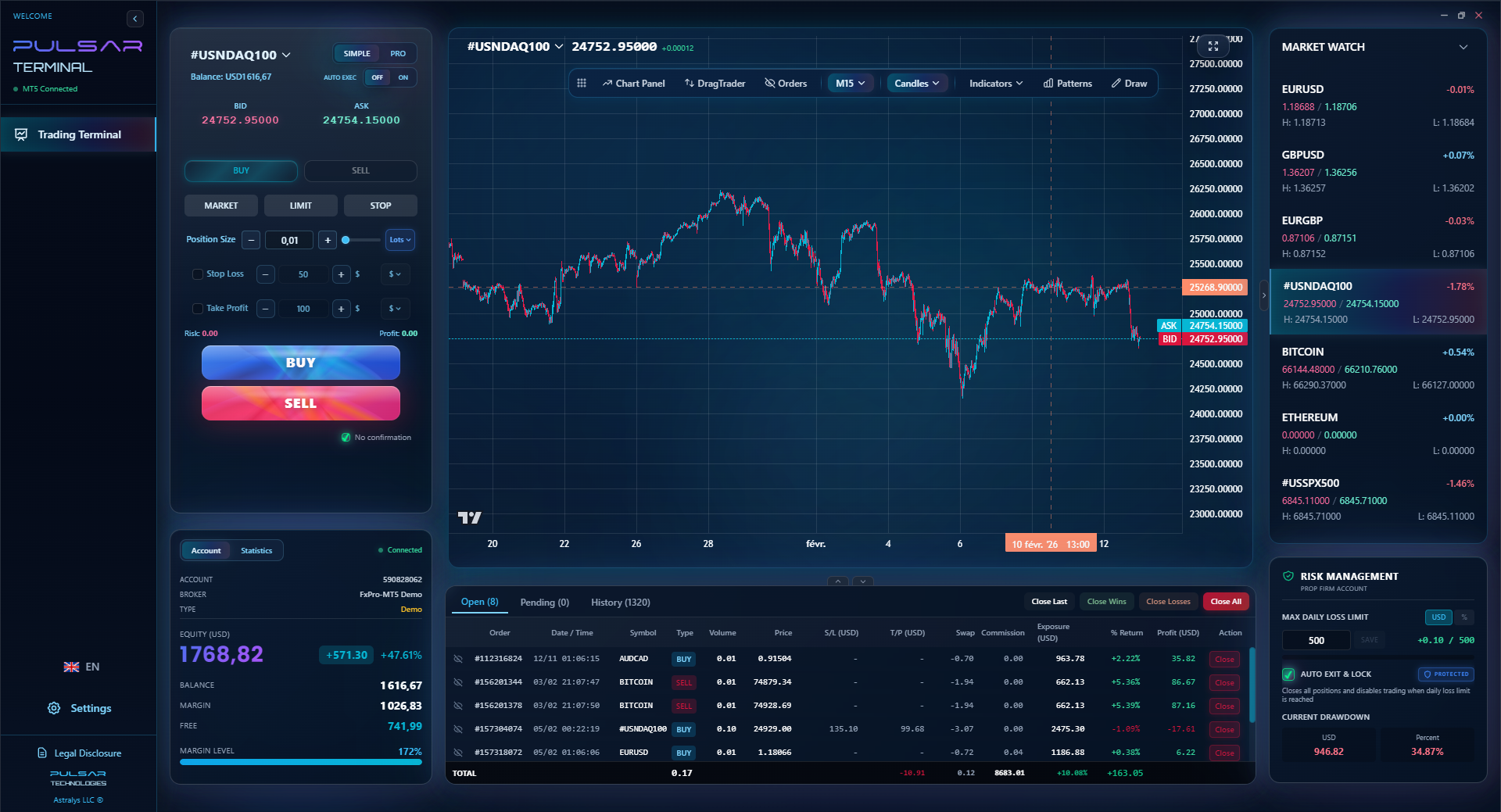
Managing multiple trades based on currency strength is easier with tools that automate your exits, like Pulsar Terminal's multi-Take Profit and trailing stop features on MT5.
Pulsar Terminal
MT5一站式工具:拖拽下单、多重止盈/止损、追踪止损、网格交易、成交量分布图和自营交易保护。每日1000+交易者使用。
A strength meter is a team player. It needs friends.
With Price Action: Find a key support level on AUD/USD. The strength meter shows AUD strength rising and USD strength falling. That's a confluence. That's your signal to watch for a bullish pin bar or engulfing candle at that support. The meter told you why price might bounce (fundamental strength), price action tells you when.
With the MACD indicator: Use the meter to bias your MACD signals. If MACD gives a buy signal on GBP/USD, but the meter shows USD is the strongest currency overall, treat that buy signal with suspicion. It's likely to fail. Only take MACD signals that align with the broader strength/weakness picture.
For Gold (XAU/USD) Traders: This is a big one. Gold (XAU) is priced in USD. When the US Dollar is shown as extremely weak on the meter, it often provides a strong tailwind for Gold prices. It's not a direct correlation every time, but a persistently weak Dollar on the daily/weekly meter is a great fundamental backdrop for looking for long entries on Gold.
The goal is to build a filter. The strength meter is your first filter. Does this potential trade have a strength/weakness story? No? Move on. Yes? Now apply your other technical tools.
“As Nigerian traders, we're often trading with a currency that isn't on these global meters. That context is everything.”
Using a strength meter is pointless if your broker's execution sucks or you can't fund your account. Here's the Nigerian reality check.
Funding is Your Biggest Hurdle. The CBN's restrictions are real. Funding a $500 account with your Naira card can be a multi-day nightmare of failed transactions. This is why brokers with solid local payment options are king.
- Brokers like Exness and HFM offer direct Naira deposits via bank transfer and local e-wallets. This is a game-saver. You deposit NGN, it converts at a decent rate, and you're trading.
- XM and IC Markets are fantastic platforms, but you'll likely need to use an international payment method like crypto (USDT) or Skrill. Factor in the cost and hassle of getting that crypto first.
Why Execution Matters for This Strategy: When you're trading strength divergences or momentum confirmations, you often need to enter quickly as a new bar forms. A broker with slow execution or massive spreads will kill your edge. You see the strong EUR signal, you click buy, and you're filled 3 pips higher because of slippage and a wide spread. That's your profit gone.

Example: Let's say your strategy needs an average EUR/USD spread under 1.2 pips to be profitable. A broker offering a 1.4-pip standard spread is eating 17% of your potential edge before you even start. Check the live spreads on a broker's demo account during your most active trading hours (often London session, 9 AM - 12 PM Nigerian time).
💡 Winston 小贴士
A currency can be 'weak' but not falling. It might just be consolidating. Don't short a weak currency that's clearly holding a major support level on its chart.
Is a forex strength meter the holy grail? Absolutely not. There is no holy grail. But is it one of the most useful, free, sanity-checking tools you can add to your arsenal? 100% yes.
For us trading from Nigeria, with all our unique challenges - power, internet, currency volatility, funding issues - we need tools that give us clarity, not more noise. The strength meter cuts through the noise of 28 different currency pairs and tells you the simple story of who's winning and who's losing.
Start today. Open MyFXbook in a tab. Just watch it for a week. Don't trade from it. Just observe how when EUR is strong and USD is weak, EUR/USD trends up. See how when strength is mixed, the market is choppy. Internalize that pattern.
Then, slowly, start using it as your first filter. Let it guide you toward the trades with the wind at their back and away from the trades swimming against a hidden current. It won't make you rich overnight, but it will make you a more disciplined, aware, and , a more profitable trader. And in this game, that's everything.
FAQ
Q1Is using a forex strength meter legal in Nigeria?
Yes, completely. It's just an analytical tool, like a chart or an indicator. The legality concerns in Nigeria are about funding your trading account and using regulated brokers, not about the tools you use for analysis.
Q2What's the best free forex strength meter?
MyFXbook's Forex Strength Meter is the most reliable and widely used free option. It's web-based, updates in real-time, and lets you view multiple timeframes. Don't waste money buying one.
Q3Can I use a strength meter to trade USD/NGN?
Indirectly. The meter won't show NGN strength. But it will show you if the US Dollar's movement is part of a global trend (USD strong/weak everywhere) or an isolated local event. This context is crucial for understanding the sustainability of a USD/NGN move.
Q4How often should I check the strength meter?
It depends on your style. Swing traders should check the daily and weekly readings at the start of the day. Scalpers might monitor the hourly or 4-hour readings. Don't stare at it minute-by-minute; you'll get whiplash.
Q5Why did my trade fail even though the strength meter confirmed it?
The meter shows relative strength, not timing or price levels. Your trade could have failed because you entered at a terrible price (like a overbought resistance), you ignored a major news event, or your stop loss was too tight. The meter is one piece of the puzzle, not the whole picture.
Q6Do Nigerian brokers offer built-in strength meters?
Some international brokers popular in Nigeria, like IC Markets or Pepperstone, might offer similar tools through their platforms or integrated with TradingView. However, the dedicated, standalone meters like MyFXbook's are usually superior and broker-agnostic.
Q7What's the biggest mistake beginners make with this tool?
Trading the extremes. They see a currency hit a strength of 10 and immediately sell all pairs against it, expecting an instant reversal. Markets can stay extreme far longer than you can stay solvent. Use it for trend confirmation, not as a reversal signal.
Winston 教授的课程
要点总结:
- ✓Use the meter as a filter, not a signal generator.
- ✓Weekly strength trend overrides hourly noise.
- ✓Pair the strongest with the weakest currency.
- ✓A score of 10 can mean exhaustion, not opportunity.
- ✓Always check strength before trading EUR/USD or GBP/USD.
这篇文章对您有用吗?
点击星星评分
每周交易洞察
免费每周分析与策略。无垃圾邮件。
关于作者
Olumide Adeyemi
西非交易先驱
尼日利亚最活跃的外汇交易教育者之一。从拉各斯出发有8年交易经验。专注于低资金策略和面向非洲交易者的自营公司挑战。
评论
风险提示
金融工具交易存在重大风险,可能不适合所有投资者。过往业绩不代表未来表现。本内容仅供教育目的,不构成投资建议。在交易前请务必自行研究。
您可能还喜欢

Cara Trading Forex Sukses: 7 Prinsip dari Trader Profesional
Cara trading forex sukses dengan 7 prinsip trader pro: manajemen modal, disiplin, journal trading, backtest. Data nyata, bukan janji profit palsu.
Jam Trading Forex Terbaik untuk Trader Indonesia: Panduan Lengkap dengan Tabel Waktu
Panduan jam trading forex untuk trader Indonesia. Tabel 4 sesi dunia, jam emas 20:00-00:00, sesi mana yang harus dihindari. Data akurat + tips dari trader berpengalaman.
Top 5 Sàn Forex Uy Tín Nhất 2026: Review Jujur dari Trader Indonesia
Top 5 sàn forex uy tín 2026 untuk trader Indonesia. Review jujur: spread, deposit, withdraw, dukungan lokal. Exness, XM, IC Markets & lebih.
