


Ever feel like you're missing the big moves while glued to the five-minute chart? That's what pushed me toward swing trading years ago.

James Mitchell
高级交易分析师
☕ 11 分钟阅读
您将学到:
- 1What Is Forex Swing Trading, Really?
- 2The US Rules You Can't Ignore (And How They Shape Your Trades)
- 3Finding Swing Setups That Actually Work
- 4Brokers & Costs: What Matters for US Swing Traders
- 5Risk Management: This Is the Real Game
- 6Building Your Swing Trading Routine
- 7Common Pitfalls & How to Avoid Them
Ever feel like you're missing the big moves while glued to the five-minute chart? That's what pushed me toward swing trading years ago. In the US, with our unique rules and market rhythms, this style isn't just a strategy, it's a sanity saver. But it's also where I've made some of my most expensive mistakes. Let's talk about how to do it right, what the regulations really mean for you, and how to build a process that doesn't require you to watch the screen all day.
Forget the textbook definitions. Forex swing trading is about catching the meat of a trend move over several days to weeks. You're not trying to scalp every pip, and you're not holding for months based on interest rates. You're aiming for those 100-300 pip swings that happen when a currency pair finds a rhythm.
I think of it as the 'sweet spot' for retail traders. Day trading can be a grind, and long-term positioning requires a different kind of capital and patience. Swing trading fits around a normal life. The catch? You need to be okay with leaving money on the table overnight, sometimes over a weekend. That's where psychology and a solid understanding of US rules come in.

Warning: Swing trading is not 'set and forget.' It's 'plan and monitor.' The biggest mistake I see is traders entering a swing trade and then ignoring it for days. Price doesn't care about your schedule.
My first successful swing trade was a lesson in patience. I bought EUR/USD at 1.0850 based on a weekly support bounce and a bullish MACD indicator crossover on the daily chart. I held it for eight days through three separate intraday pullbacks that would have stopped me out on a lower timeframe. I finally closed at 1.1040 for a 190-pip gain. The profit wasn't the main lesson. The lesson was sitting through those pullbacks without interfering.

💡 Winston 小贴士
The market's job is to make you feel stupid. Your job is to not act on that feeling. A swing trade needs time to breathe. Interference is usually regret in disguise.
“Swing trading fits around a normal life. The catch? You need to be okay with leaving money on the table overnight.”
Trading in the US means playing by a specific set of rules designed for protection. They change the game, especially for swing traders.
The 1:50 use Cap: This is the big one. On major pairs like EUR/USD, your max use is 1:50. For minors, it's 1:20. Coming from an international broker years ago where 1:500 was common, this felt restrictive. Now, I see it as a forced risk management tool. At 1:50, a 2% move against you wipes out 100% of your margin. It forces you to size correctly. You can't just throw a tiny margin at a trade and hope for the best. You need real capital behind your ideas. I use a strict position size calculator for every single entry.
FIFO (First-In, First-Out): You can't choose which lot to close. If you have two long positions on EUR/USD, closing any part of your position will always close the oldest one first. This kills a common swing trading tactic: scaling in. If you add to a losing position to lower your average entry, you're locked into that first, worst entry until you close the entire trade. It forces cleaner entries. One entry, one stop, one target.
No Hedging: You can't have a long and a short position open on the same pair at the same time. This eliminates another potential 'rescue' tactic. Your trade decision is binary: you're either long, short, or out. It simplifies things, but it also means you can't temporarily hedge a swing position against short-term news.
These rules create a cleaner, if less flexible, trading environment. They've honestly made me a more disciplined trader. You have to be right on direction, and you have to manage that single position well.
“Trading in the US means playing by a specific set of rules designed for protection. They change the game.”
This is where the rubber meets the road. You need a repeatable process for spotting opportunities. I focus on the daily chart (D1) for the primary trend and direction, and the 4-hour chart (H4) for precise entry timing.
The Core Concept: Structure
I'm looking for breaks in market structure. A simple example: EUR/USD makes a series of higher highs and higher lows (an uptrend). Then, it makes a lower low. That's the first sign the swing might be turning. I wait for a pullback to a key level - like the old broken support that's now resistance - and look for a price rejection candle (a pin bar, a bearish engulfing) to consider a short swing trade.
The Indicators I Actually Use
I keep it stupid simple. I use a 20-period and 50-period Exponential Moving Average (EMA) on the daily chart to gauge trend. Price above both? Bias is up. I use the RSI indicator not for overbought/oversold signals, but for divergence. If price makes a new high but RSI makes a lower high, that's a powerful warning the swing momentum is fading. That's saved me from chasing tops more times than I can count.
A Real Trade Example (And a Failure)
The Good: In early 2024, GBP/USD was in a clear daily downtrend. It rallied back to a previous support zone around 1.2750, which had become resistance. The daily candle formed a clear bearish pin bar right at that level, with RSI showing bearish divergence. I entered a short at 1.2740. My stop was above the pin bar at 1.2820 (80 pips). My target was the prior swing low near 1.2600. I held for 11 days and exited at 1.2615 for a 125-pip gain.
The Bad: I once tried to force a swing trade on USD/JPY because I was 'bored.' There was no clear structure break, just a feeling it was 'too high.' I shorted it. It kept going up. I moved my stop loss further away, violating my own rules. I finally took a 220-pip loss, my largest that month. The market doesn't care about your boredom.

Pro Tip: Draw horizontal lines at the most recent major swing highs and lows on your daily chart. These are your battle zones. Most swing moves start or end there. Don't get fancy with Fibonacci or complex patterns until you can see these plain levels.
💡 Winston 小贴士
US use limits aren't a handicap; they're a governor on a powerful engine. They stop you from driving your account off a cliff before you've learned to steer.
“Trading in the US means playing by a specific set of rules designed for protection. They change the game.”
Your broker choice directly impacts your swing trading profitability through spreads, swaps, and platform stability.
Spreads & Commissions: Since you're holding for days, the entry spread matters less than for a scalping strategy. But it still adds up. Look at the average spread on the pairs you trade during your session (often the US afternoon/evening when I do my analysis). A broker like FOREX.com might offer tight spreads on majors, while OANDA provides consistent pricing. The key is predictability, not just the lowest number.
The Silent Killer: Swap Rates: This is the big one for swing traders. Holding a position overnight incurs a swap fee or credit. For some pairs (like going long AUD/JPY), you might get a small credit. For others (like shorting EUR/JPY), you pay a daily fee. Over a 10-day trade, this can be the difference between profit and loss. Always check the swap rates on your broker's platform before entering. I once held a short GBP/JPY swing trade for two weeks and paid more in swaps than I made in profit. A brutal lesson.
Platforms & Tools: You need reliable charting. Most US-regulated brokers offer MT4 or their own platform. I prefer MT4/MT5 for its charting and the ability to use tools like Pulsar Terminal for advanced order management. Since we can't hedge, tools that help you manage partial closures and trailing stops become even more valuable.
Here’s a quick comparison based on my experience and recent data:
| Broker | Key Feature for Swing Traders | My Note |
|---|---|---|
| tastyfx (IG US) | Low FX fees, 91 pairs. | Excellent for variety if you trade exotics. Platform is solid. |
| OANDA | $0 min deposit, reliable execution. | My go-to for years. Their economic calendar integration is top-notch. |
| FOREX.com | Strong research, multiple platforms. | Good if you like their proprietary tools alongside MT4/MT5. |
| Interactive Brokers | Very low commissions. | Best for large accounts/professionals. Forex access can be limited for small retail. |
“The temptation to move your stop loss further away 'just this once' is the siren song of the swing trader.”
Swing trading without strict risk management is donating money to the market. Here’s my non-negotiable framework.
The 1% Rule: I never, ever risk more than 1% of my trading account capital on a single swing trade. This is sacred. If my account is $10,000, my maximum loss per trade is $100. This lets me survive a string of losses without blowing up. You can find calculators to help with this, but the formula is simple: (Account Balance x 0.01) / (Stop Loss in Pips) = Position Size in Lots.
Stop Loss Placement: Your stop isn't a suggestion. It's a lifeboat. I place my stop loss beyond the key level that invalidates my trade idea. If I'm selling a resistance, my stop goes above the recent swing high. Not 5 pips above, but a safe distance to avoid market noise. This often means my risk is 50-80 pips, sometimes more. That's why position sizing is critical.
Take Profit Targets: I use a minimum 1:1.5 risk-to-reward ratio. If I risk 60 pips, I want a target that offers at least 90 pips of potential. I often use previous swing points as targets. Sometimes I'll take partial profit at the first target (e.g., 50% of position) and trail the rest. This is where the FIFO rule is annoying, as you have to close the entire position and re-enter to 'bank' profit, which is why tools that automate partial closures are so useful.
Warning: The temptation to move your stop loss further away 'just this once' is the siren song of the swing trader. It's how a 1% risk trade turns into a 5% disaster. Write your stop level down when you enter. Don't touch it unless you have a predefined plan to move it to breakeven.
The memory of a margin call from my early days, triggered by not respecting these rules on a GBP/USD swing trade, is what keeps me disciplined now.
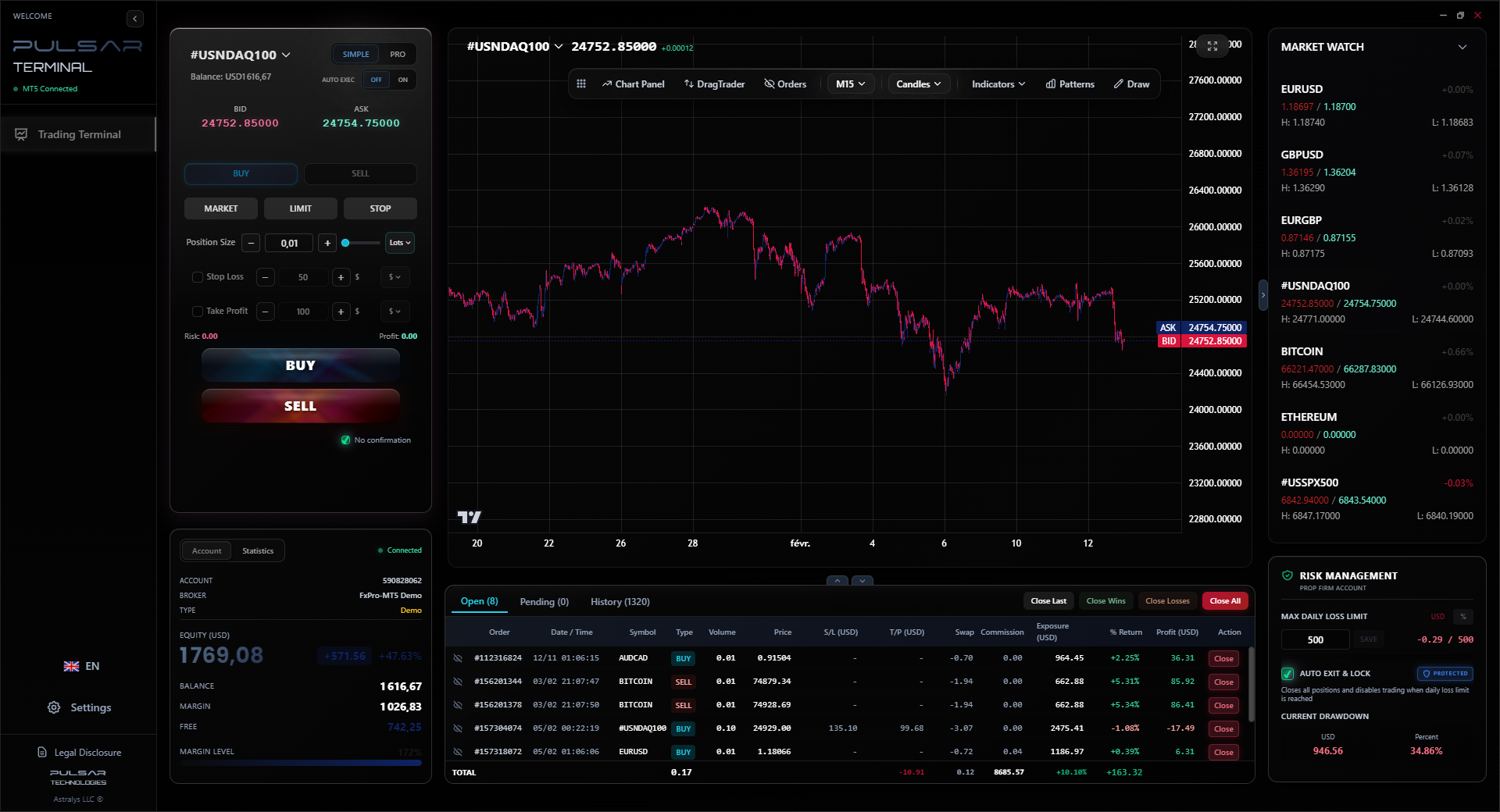
Managing partial profits and trailing stops on swing trades is critical, and Pulsar Terminal automates this directly on your MT5 platform, helping you lock in gains without emotional interference.
Pulsar Terminal
MT5一站式工具:拖拽下单、多重止盈/止损、追踪止损、网格交易、成交量分布图和自营交易保护。每日1000+交易者使用。
“The temptation to move your stop loss further away 'just this once' is the siren song of the swing trader.”
Consistency beats brilliance every time. Here’s the weekly routine that works for me.
Sunday Evening (Preparation): I review the weekly charts of my 5-6 favorite pairs (majors like EUR/USD and XAU/USD). No analysis, just observation. Where did they close? What’s the broader trend? I scan the economic calendar for the week ahead, flagging high-impact events (CPI, NFP, Central Bank speeches).
Daily (20-30 minutes, US evening): I check the daily candles on my watchlist. Has any key level been broken? Has a clear pin bar or engulfing candle formed? I’m not looking for a trade every day. Most days, I do nothing. If I see a potential setup, I plan it: Entry, Stop, Target, Position Size. I then set an entry order with my broker and walk away.
Trade Management: If I get filled, I log the trade. I check it once a day, same time, to see if it’s hitting my target or if the daily close has broken a level that suggests I should exit early. I do not watch it intraday. That’s the point.
The Journal: This is mandatory. Every trade gets logged: screenshot of the setup, reason for entry, outcome, emotional state. Reviewing my journal every month is how I improve. I learned I was terrible at trading swings during major Fed announcements, so now I just avoid them.
This routine turns swing trading from a stressful guessing game into a calm, business-like process. It’s the difference between reacting and responding.
💡 Winston 小贴士
Your trading journal should have a special section for 'Trades I Didn't Take.' Review why you passed on them. Often, your best decisions are the trades you avoid.
“Patience is a position. Sometimes the best trade is no trade for a week.”
I’ve stepped in every one of these. Learn from my scars.
Overtrading: The market is quiet, no setups. So you take a mediocre one just to be ‘in the game.’ This is the #1 account killer. Patience is a position. Sometimes the best trade is no trade for a week.
Ignoring the Trend on the Higher Timeframe: Trying to swing short in a strong daily uptrend is like swimming against a tidal wave. You might get a few pips, but you’ll get crushed eventually. Always know the daily trend. My rule: I only take swing trades in the direction of the daily EMA alignment, or at major counter-trend levels with overwhelming evidence.
Misunderstanding ‘Swing Lows/Highs’: A swing low isn’t just any dip. It’s a clear trough with a lower low before it and a higher low after it. Marking every little wiggle as a key level creates a messy, useless chart. Be selective.
Getting Greedy with Targets: You have a 100-pip profit, your target is 120 pips. Price gets to 115 and reverses. You don’t take profit, hoping for those last 5 pips. It reverses all the way back to your entry and you exit with nothing. I’ve done it. Take the profit at your plan. If you want to trail, have a mechanical rule for it.
Swing trading is a marathon. It rewards consistency, discipline, and the ability to be wrong and still preserve capital. It’s the style that finally gave me sustainable results, but only after I stopped fighting the US rules and my own bad habits.
FAQ
Q1What's the minimum account size for swing trading in the US?
Technically, some brokers like OANDA have $0 minimums. Realistically, due to the 1:50 use cap and sensible risk management, I wouldn't start with less than $2,000. To properly risk 1% ($20) on a trade with a 60-pip stop, you need enough capital to open a meaningful position. Starting too small forces you to risk a higher percentage per trade, which is dangerous.
Q2How many pips can I expect from a swing trade?
Aim for moves of 100-300 pips on major pairs. Don't get fixated on the count. Focus on the percentage gain relative to your risk. A 100-pip win where you only risked 40 pips is a fantastic 2.5:1 reward-to-risk trade. A 150-pip win where you risked 140 pips is nearly pointless.
Q3Can I swing trade with a full-time job?
Absolutely. That's one of its biggest advantages. My routine requires about 30 minutes in the evening for analysis and order placement. You don't need to watch the markets during the day. In fact, it's better if you don't.
Q4Does the FIFO rule make swing trading impossible?
No, it just makes it different. It removes the ability to average down on a losing position or easily scale in. This forces you to be more precise with your single entry. It's a constraint that, in my opinion, leads to better initial trade decisions.
Q5What's the best time frame for swing trading?
Use the daily chart (D1) to define the trend and key levels. Use the 4-hour chart (H4) to fine-tune your entry and spot the initial momentum shift. Never use a timeframe lower than H4 for your primary swing analysis.
Q6How do I handle weekend gaps with swing trades?
You accept them as part of the cost of doing business. You can't predict them. The best defense is a conservative position size (the 1% rule) so that even a bad gap against you isn't catastrophic. Avoid holding overly large positions into major news events or elections if you're nervous.
Q7Are prop firms good for swing trading?
They can be, but be careful. Most prop firm challenges have strict daily loss limits that are better suited for day trading. If you have a swing trade that goes 2% against you before coming back to profit, you might fail the challenge on that daily loss rule. You need to find a firm with rules compatible with your swing strategy's natural volatility.
Winston 教授的课程
要点总结:
- ✓Use the daily chart for direction, the 4-hour for entry.
- ✓Never risk more than 1% of your capital on a single swing.
- ✓Place stops beyond key levels, not based on a arbitrary pip amount.
- ✓Check swap rates before entering any multi-day trade.
- ✓A good swing setup appears 2-3 times a month, not daily.
这篇文章对您有用吗?
点击星星评分
每周交易洞察
免费每周分析与策略。无垃圾邮件。
关于作者
James Mitchell
高级交易分析师
常驻纽约,拥有超过9年的交易经验。专注于主要美元货币对、自营交易公司挑战和美国监管环境。
评论
风险提示
金融工具交易存在重大风险,可能不适合所有投资者。过往业绩不代表未来表现。本内容仅供教育目的,不构成投资建议。在交易前请务必自行研究。
您可能还喜欢

Cara Trading Forex Sukses: 7 Prinsip dari Trader Profesional
Cara trading forex sukses dengan 7 prinsip trader pro: manajemen modal, disiplin, journal trading, backtest. Data nyata, bukan janji profit palsu.
Jam Trading Forex Terbaik untuk Trader Indonesia: Panduan Lengkap dengan Tabel Waktu
Panduan jam trading forex untuk trader Indonesia. Tabel 4 sesi dunia, jam emas 20:00-00:00, sesi mana yang harus dihindari. Data akurat + tips dari trader berpengalaman.
Top 5 Sàn Forex Uy Tín Nhất 2026: Review Jujur dari Trader Indonesia
Top 5 sàn forex uy tín 2026 untuk trader Indonesia. Review jujur: spread, deposit, withdraw, dukungan lokal. Exness, XM, IC Markets & lebih.
