


It was October 2014, and the EUR/USD was sitting at 1.2500.

James Mitchell
高级交易分析师
☕ 12 分钟阅读
您将学到:
- 1What Are Swing Trading Signals, Really? (Hint: It's Not a Text Alert)
- 2How to Build Your Own Reliable Signals (The 3-Pillar Framework)
- 3The Only Technical Indicators You Need (And How to Use Them)
- 4The Signal is 20%. Risk Management is 80%.
- 5Red Flags: How to Spot a Useless or Fraudulent Signal Service
- 6Your Weekly Swing Trading Signal Routine
- 7Why Your Signals Fail (The 4 Classic Mistakes)

It was October 2014, and the EUR/USD was sitting at 1.2500. My 'signal service' pinged: "Strong sell, target 1.2200." I loaded up, confident. Two weeks later, the pair was at 1.2800 and I was staring at a $2,800 loss. The signal wasn't wrong because of bad analysis. It was wrong because it was just a snapshot, a guess dressed up as conviction, with zero risk management attached. That loss taught me more about real forex swing trading signals than any winning trade ever could. Most traders blow up chasing these ghosts. Let's talk about how to find the real ones.
When you hear 'forex swing trading signals,' you probably picture a Telegram message with an entry, stop loss, and take profit. That's the product. The reality is different. A real signal is the confluence of evidence that tells you a multi-day price move is probable. It's not a tip. It's a structured setup you identify yourself.
Think of it like this: a weather forecast says '80% chance of rain.' That's the signal. Deciding to bring an umbrella, wear a raincoat, or just risk it - that's your trade execution and risk management. The forecast alone doesn't keep you dry.
Most paid services sell you the 'rain forecast' without telling you the confidence level or what to do when the sun comes out instead. They can't. Because the moment price moves, their one-size-fits-all signal is obsolete. Your job isn't to follow alerts. Your job is to learn to read the weather maps yourself - the charts, the economic data, the market structure. That's the only signal that matters.

Warning: Any signal service that doesn't openly show a verifiable, long-term track record with drawdown included is selling hope, not an edge. If they only show the winners, run.
I learned this the hard way with that EUR/USD trade. The service had a great-looking chart with trendlines and Fibonacci levels. What it didn't have was a plan for when the ECB started hinting at more stimulus, which completely shifted the market's focus. The technical signal was valid in a vacuum, but the fundamental landscape changed. A real signal accounts for that shift.

💡 Winston 小贴士
A signal without a predefined exit is just a wish. Know your stop loss and profit target before you click 'buy' or 'sell.'
“A real signal is the confluence of evidence, not a text alert.”
Forget buying signals. You need to construct them. A strong swing trading signal rests on three pillars: Market Structure, Momentum Confirmation, and a Catalytic Trigger. Miss one, and your odds drop like a rock.
Pillar 1: Market Structure
This is the foundation. Is price making higher highs and higher lows (uptrend)? Is it stuck in a range? You need to identify key support and resistance levels on a higher timeframe - like the daily chart. A 'buy' signal near the bottom of a weekly range, in an overall uptrend, has a stronger wind at its back than a buy signal at a brand new all-time high after a massive run-up. I use simple horizontal lines and swing points. No fancy indicators needed here.
Pillar 2: Momentum Confirmation
This asks, 'Is there any fuel left for this move?' Structure tells you where, momentum hints at when. I use two tools here. First, a basic RSI indicator to check for divergences or overbought/oversold conditions within the trend. Second, I watch for a break of a minor trendline on the 4-hour chart. For example, in a downtrend, if price can't even break a minor 4-hour resistance, the bearish momentum is still intact.
Pillar 3: The Catalytic Trigger
This is your entry permission. The first two pillars set the stage, but the trigger starts the play. This is usually a specific candlestick pattern (like a bullish engulfing bar at support), a precise break of a consolidation, or a MACD indicator crossover on the 1-hour chart that aligns with the higher-timeframe direction. Without a clear trigger, you're just guessing and will likely enter too early.

Example: My last successful GBP/USD swing trade in January.
- Structure: Daily chart showed a strong hold above 1.2600 support.
- Momentum: 4-hour RSI showed bullish divergence (price made a lower low, RSI made a higher low).
- Trigger: A clear bullish pin bar formed on the 4-hour chart right at that 1.2600 support. Entry: 1.2625. Stop: 1.2580 (45 pips). Target: 1.2750. Result: Hit target in 4 days for +125 pips. The signal wasn't an alert. It was the process.

“You can be wrong on 60% of your signals and still be profitable. How? Ruthless risk management.”
The internet is flooded with 10-indicator setups that look like a rainbow threw up on your chart. It's noise. For swing trading, simplicity wins. You need one or two tools for momentum and one for dynamic support/resistance. That's it.
Moving Averages (The Trend Filter): I use the 50-period and 200-period Exponential Moving Average (EMA) on the daily chart. Their relationship is your primary filter. Price above both? Only look for buy signals. Price below both? Only look for sell signals. Price between them? The market is likely ranging - avoid swing trades or be extra selective. This one rule would have saved me from dozens of bad trades trying to pick tops and bottoms in strong trends.
RSI for Divergence: I keep the RSI indicator on a 14-period setting on the 4-hour chart. I ignore overbought/oversold lines in strong trends. Instead, I look for divergence. If price makes a new low but RSI makes a higher low, it signals weakening selling momentum - a potential buy signal if it occurs at a key support level. This is powerful confirmation.
Average True Range (ATR) for Stops & Targets: This is your reality check. The ATR tells you the average daily price movement. If the ATR on the daily chart is 70 pips, setting a 20-pip stop loss is a joke. It will get hunted. I use ATR to set my stop at least 1.5x the daily ATR away from my entry. Similarly, my first profit target should be a minimum of 1x ATR. This grounds your trade in current market volatility, not wishful thinking.
Combine these. A buy signal (from your 3-pillar framework) that occurs when price is above the 200 EMA, with bullish RSI divergence, and a stop loss sized using ATR? That's a professional-grade setup.
“You can be wrong on 60% of your signals and still be profitable. How? Ruthless risk management.”
Here's the brutal truth I learned over 12 years: You can be wrong on 60% of your signals and still be profitable. How? Ruthless risk management. The signal gets you in the door. Your money management decides if you leave with the casino's money or your shirt.
The 1% Rule (It's Not What You Think): Everyone says 'risk 1% per trade.' That's a start, but it's incomplete. Your 1% risk must be based on your position size, not your wishful stop loss. You find your stop loss level first (using structure and ATR). Then, you use a position size calculator to determine how many lots or units you can trade so that if price hits that stop, you lose exactly 1% of your account. I've blown a small account early on by risking 1% of my balance but using a stop loss that was way too tight for the pair's volatility. I was stopped out before the trade had any room to breathe.
Profit-to-Risk Ratio: Never take a swing trade with a target less than 1.5 times your risk. Aim for 2:1 or 3:1. If your stop loss is 50 pips away, your first profit target should be at least 75-100 pips away. This means you only need to be right 40% of the time to break even. This single metric forces you to only trade high-quality setups with clear runway.
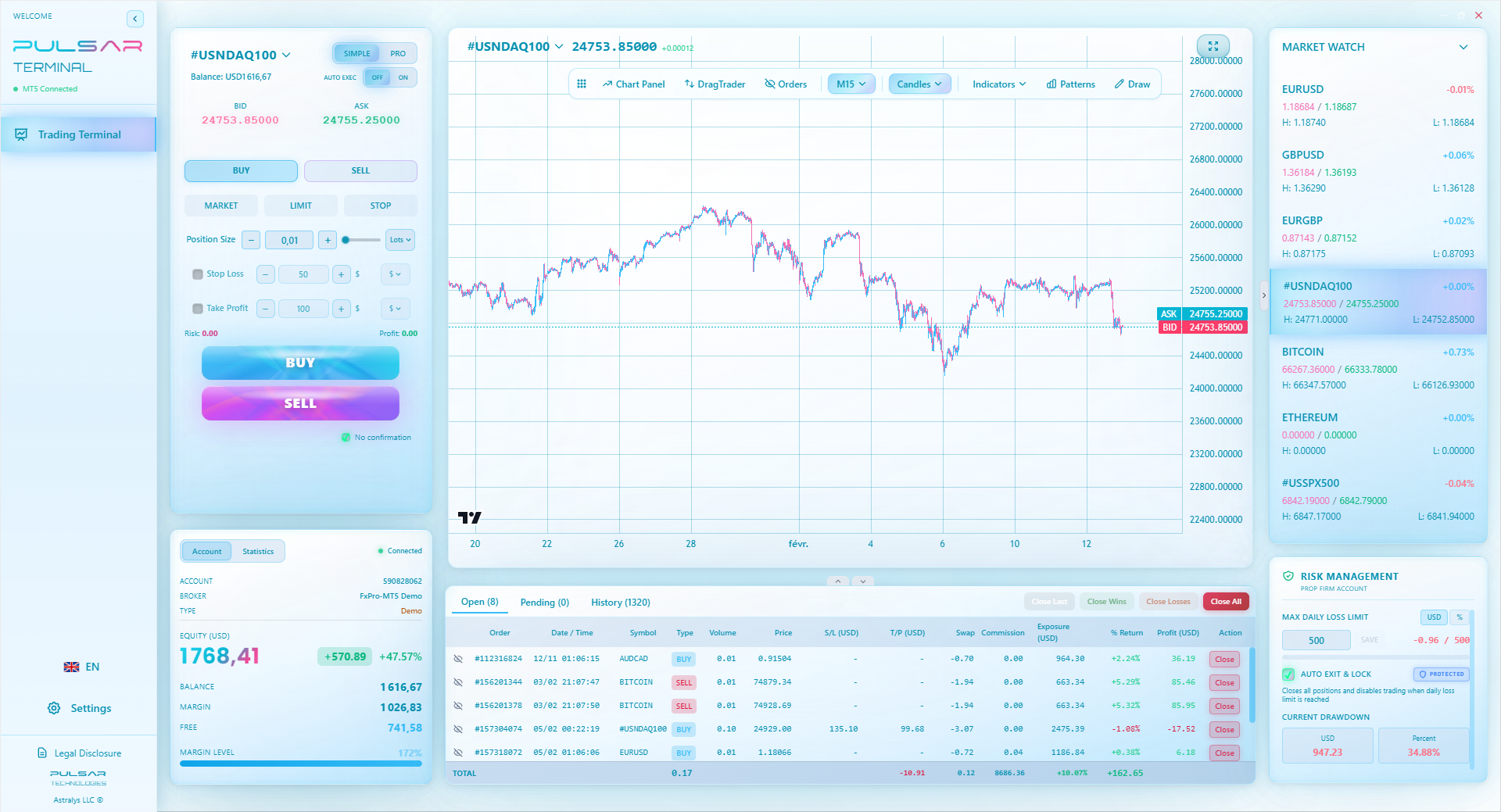
The Trailing Stop Mindset: For swing trades, I often use a manual trailing stop. Once price moves in my favor by 1x my initial risk (e.g., +50 pips), I move my stop loss to breakeven. Now the trade is risk-free. Then, I'll trail it behind recent swing lows (for longs) using the 4-hour chart. Automating this process is a game-saver, as emotion makes you hold on too long or exit too early. Tools that can automate trailing stops directly on your MT5 platform remove that psychological burden entirely.
💡 Winston 小贴士
The market's job is to make your signal look stupid. Your job is to have a plan for when it does. That plan is your stop loss.

Managing multiple swing trades with manual trailing stops is stressful; Pulsar Terminal automates trailing stops and breakeven triggers directly on your MT5 charts, enforcing your plan.
Pulsar Terminal
MT5一站式工具:拖拽下单、多重止盈/止损、追踪止损、网格交易、成交量分布图和自营交易保护。每日1000+交易者使用。
“The higher timeframe always wins. That 4-hour signal is just a bounce in a new downtrend.”
The market for signals is a minefield. Here’s how to separate the few legitimate educators from the countless scammers.
Red Flag 1: Guaranteed Wins or Absurd Win Rates. Anyone promising 90% win rates is lying. Full stop. A realistic, sustainable win rate for a swing trader is between 40% and 60%. What matters is the profit-to-loss ratio. If they don't talk about losses and drawdown, they're hiding them.
Red Flag 2: No Verified Track Record. A real service will have a publicly accessible, real-time track record (like a Myfxbook link) that shows every trade, including the losers, the drawdown periods, and the length of time it's been running. Screenshots of winning trades are worthless.
Red Flag 3: Vague or No Risk Management. If their signals just say "Buy GBP/USD" without a clear stop loss and take profit level, it's garbage. Even worse is a signal with a 500-pip target and a 20-pip stop. That's not a 'tight stop,' that's a guaranteed loss from normal market noise.
Red Flag 4: Pressure to Use a Specific Broker. This is a huge one. Many 'signal services' are actually introducing brokers (IBs) getting kickbacks from your losses. They make money when you lose. They'll push you to sign up under their link to a broker you've never heard of. Always choose your own regulated broker based on your needs, like IC Markets for raw spreads or Pepperstone for their platform suite.
Red Flag 5: They Sell the Sizzle, Not the Steak. If their marketing is all about Lamborghinis, private jets, and 'secret algorithms,' they're selling a dream to desperate people. Real trading is boring, disciplined, and focused on process, not profits. A good educator teaches you their framework, like a proper swing trading methodology, not just blasts out trade alerts.
“The higher timeframe always wins. That 4-hour signal is just a bounce in a new downtrend.”
Consistency beats brilliance every time. Here’s a simple weekly routine to find and execute your own signals.
Sunday Evening (Planning):
- Open your charts. Look at the weekly and daily charts for all major pairs (EUR/USD, GBP/USD, USD/JPY, etc.).
- Draw key horizontal support and resistance levels.
- Note where price is relative to the 50 and 200 EMA. Determine the primary trend.
- Check the economic calendar for the week. Flag high-impact news events (CPI, Central Bank decisions). You don't want to open a swing trade right before one of these.
- Identify 2-3 pairs that are approaching a key structural level (support in an uptrend, resistance in a downtrend). These are your watchlist pairs.
Monday-Thursday (Execution & Monitoring):
- On your watchlist pairs, drop down to the 4-hour chart.
- Look for your momentum confirmation (RSI divergence, MACD alignment) and wait for your specific entry trigger.
- When a trigger hits, calculate your position size using your position size calculator, set your stop and target, and enter the trade.
- Once entered, log the trade in your journal: reason for entry, risk amount, target. Then, forget about it. Check it once at the end of the day. Swing trading is not staring at screens.
- If stopped out, review why. Was the structure wrong? Was the trigger false? Learn and move on.
Friday (Review & No New Trades):
- I avoid opening new swing trades on Friday. Liquidity dries up, and weekend gaps are a real risk that can blow through your stop.
- Instead, review your week's trades. What worked? What didn't? Adjust your watchlist for the following week.
This routine removes emotion and turns trading into a process. The signals emerge from the process; you're not hunting for them.
💡 Winston 小贴士
If you feel a rush of excitement when you see a signal, that's your cue to double-check your analysis. Good trading feels boring.

“Consistency beats brilliance every time.”
I've made all these mistakes. You probably will too. Knowing them in advance might save you a chunk of money.
Mistake 1: Overleveraging on a 'Sure Thing.' You see a perfect signal. You think, 'This is it!' and you double or triple your normal position size. This ties your emotions directly to the trade. A normal 1% loss now feels like a catastrophe. You'll move your stop, panic exit, or turn a small, planned loss into an account-damaging event. Stick to your pre-calculated position size, every single time.
Mistake 2: Chasing the Trade. The perfect setup forms, but you're late. Price has already moved 30 pips in your direction. You FOMO in anyway, widening your stop loss to compensate. Now your risk-to-reward is terrible (e.g., risking 80 pips to make 50). These trades fail more often than not. If you miss the entry, let it go. There will be another signal.
Mistake 3: Ignoring Higher Timeframe Context. This is the big one. You get a beautiful buy signal on the 4-hour chart, but the daily chart shows price smashing through major support like it's tissue paper. The higher timeframe always wins. That 4-hour signal is just a bounce in a new downtrend. Always, always check the next timeframe up.
Mistake 4: Turning a Swing Trade into a Hopeful Investment. Your buy signal hits its target. You take partial profit, but then price keeps going up. Instead of trailing your stop or exiting, you get greedy and hold, thinking it will go forever. Then it reverses and takes all your profits. Have an exit plan before you enter. A common strategy is to take 50% off at your first target and trail a stop on the remainder. This books profit and lets winners run. Without a plan, you'll never know when to get out.

Pro Tip: Keep a 'mistake journal.' Next to your trade log, write down which of these classic errors you committed (if any) on each losing trade. You'll quickly see your personal pattern and can fix it.

FAQ
Q1Are paid forex swing trading signal services worth it?
Almost never. They create dependency, not skill. You learn nothing about why a trade works. Also,, you can't verify their real-time performance, and the time delay between their signal and your execution can kill the edge. The only potential value is if a service is actually teaching you their process and framework, with signals as examples. But you're better off investing that money in a few good books and a demo account.
Q2What's the best timeframe for finding swing trading signals?
Use multiple timeframes. Do your trend analysis on the daily and weekly charts. Look for your entry trigger and momentum confirmation on the 4-hour chart. The 1-hour chart can be used for fine-tuning your exact entry. Never look at just one timeframe; you'll miss the broader context.
Q3How many pips should I aim for in a swing trade?
Don't aim for a specific number of pips. Aim for a price move to a key structural level (like the next resistance zone). The pip distance will vary wildly by pair and volatility. Use the Average True Range (ATR) to understand what a 'normal' move is. A good swing trade should capture at least 1 to 2 times the daily ATR.
Q4Can I use swing trading signals for scalping?
No. They are completely different disciplines. Swing trading signals are based on multi-day market structure and momentum. Scalping strategy focuses on tiny, intraday price movements and order flow. The tools, mindset, and risk parameters are incompatible. Using a swing setup for a scalp will get you stopped out by noise. Using a scalp setup for a swing trade exposes you to enormous overnight risk.
Q5How do I handle news events with open swing trades?
It depends on your risk tolerance. The safest approach is to simply not hold swing trades over major, scheduled news events (like Non-Farm Payrolls or a central bank rate decision). Close the trade before the event or move your stop loss to breakeven. If you must hold, understand that price can gap through your stop, resulting in a larger loss than planned (a 'slippage'). Always check the economic calendar when you enter a trade planned to last several days.
Q6What's a good win rate for a swing trading strategy?
A very good, sustainable swing trading strategy might have a win rate between 45% and 55%. It's not about being right most of the time; it's about making significantly more on your winners than you lose on your losers. A strategy with a 40% win rate and a 3:1 average reward-to-risk ratio is far more profitable than one with a 70% win rate and a 0.5:1 ratio.
Winston 教授的课程
要点总结:
- ✓Build signals on 3 pillars: Structure, Momentum, Trigger.
- ✓Risk a maximum of 1% per trade, calculated properly.
- ✓Aim for a minimum 1.5:1 reward-to-risk ratio.
- ✓Never chase a trade. The next signal is already forming.
这篇文章对您有用吗?
点击星星评分
每周交易洞察
免费每周分析与策略。无垃圾邮件。
关于作者
James Mitchell
高级交易分析师
常驻纽约,拥有超过9年的交易经验。专注于主要美元货币对、自营交易公司挑战和美国监管环境。
评论
风险提示
金融工具交易存在重大风险,可能不适合所有投资者。过往业绩不代表未来表现。本内容仅供教育目的,不构成投资建议。在交易前请务必自行研究。
您可能还喜欢

Cara Trading Forex Sukses: 7 Prinsip dari Trader Profesional
Cara trading forex sukses dengan 7 prinsip trader pro: manajemen modal, disiplin, journal trading, backtest. Data nyata, bukan janji profit palsu.
Jam Trading Forex Terbaik untuk Trader Indonesia: Panduan Lengkap dengan Tabel Waktu
Panduan jam trading forex untuk trader Indonesia. Tabel 4 sesi dunia, jam emas 20:00-00:00, sesi mana yang harus dihindari. Data akurat + tips dari trader berpengalaman.
Top 5 Sàn Forex Uy Tín Nhất 2026: Review Jujur dari Trader Indonesia
Top 5 sàn forex uy tín 2026 untuk trader Indonesia. Review jujur: spread, deposit, withdraw, dukungan lokal. Exness, XM, IC Markets & lebih.
