


I stared at my screen in 2014, my account balance reading R4,200.

David van der Merwe
新兴市场交易员 ·  South Africa
☕ 13 分钟阅读
您将学到:
- 1The Salary Myth vs. South African Reality
- 2What Do Traders Actually Earn? Breaking Down the Numbers
- 3The Hidden Costs of Your 'Salary'
- 4How to Build a Realistic Income Plan
- 5Prop Firms: The Fast Track to a Bigger Salary?
- 6Common Mistakes That Destroy Income
- 7Tools to Manage and Protect Your Earnings
- 8Final Thoughts: Your Trading Business

I stared at my screen in 2014, my account balance reading R4,200. That was my 'salary' for three months of full-time trading. I'd quit my job, convinced I'd cracked the code. The reality was a brutal teacher. That R4,200 wasn't profit. It was what was left of my R50,000 starting capital. I'd 'paid' myself a salary of negative R45,800. That experience taught me more about a real forex trader salary than any glossy ad ever could. It's not about a magic number. It's about consistency, costs, and a mindset that separates income from fantasy.
Let's be brutally honest. You don't get a 'salary' as a retail forex trader. You don't have a boss depositing a fixed amount on the 25th of every month. What you have is performance-based income, and in South Africa, that comes with unique pressures.
I see the ads too: "Earn R50,000 a month from your laptop!" They're selling a dream, not a job description. A real forex trader salary is the net result of your trading profits, minus all your business expenses, taxes, and, most importantly, your drawdowns. It's wildly inconsistent, especially in the beginning.
Here’s the local context that changes everything. Our currency, the Rand, is volatile. Trading USD/ZAR or EUR/ZAR isn't like trading major pairs in stable economies. The spreads are wider, the moves can be explosive, and liquidity can dry up fast around local market closes or political events. This volatility is a double-edged sword: bigger potential profits, but much bigger potential losses that can wipe out a month's 'salary' in hours.

Warning: Treating trading like a salaried job is the fastest way to blow your account. A salary implies a guaranteed minimum. Trading guarantees nothing. You have to earn every cent, and the market can take it back just as quickly.
The first step to understanding your potential income is to kill the employee mindset. You are a business owner. Your trading account is your capital. Your 'salary' is your profit draw. And like any business, some months you make a killing, some months you scrape by, and some months you operate at a loss. I learned this the hard way during that R45,800 lesson. I was trying to force a consistent income from an inconsistent market.
Talking about averages is misleading because the gap between the top 10% and the rest is a chasm. But based on mentoring hundreds of local traders and my own circles, here’s a realistic spectrum. Remember, these figures are pre-tax and pre-expenses.
The Part-Time Trader (The Side Hustle)
This is where most South Africans start. You trade after work or on weekends with a smaller account (say, R10,000 to R50,000).
- Realistic Monthly Target: 5-10% return on capital.
- In Rand Terms: R500 – R5,000 per month.
- The Reality: This income is sporadic. A good month might net R3,000, followed by two break-even months. I used my scalping strategy for this initially, thinking quick wins were the answer. The transaction costs (spreads) ate me alive. I switched to a swing trading approach on the 4-hour charts, which suited my part-time schedule better and improved my consistency.
The Full-Time Retail Trader
This trader has a dedicated account, typically R100,000 to R500,000, and treats it as their primary job.
- Realistic Monthly Target: 3-8% return. (Yes, lower percentage than part-time. Why? Because with more capital, preservation becomes priority #1 over aggressive growth).
- In Rand Terms: R3,000 – R40,000 per month.
- The Reality: This is a grind. To hit the upper end, you need exceptional discipline and risk management. A 2% risk per trade on a R500k account is R10,000. One bad trade hurts. Your 'salary' is directly tied to your emotional control. I know a trader in Cape Town who averages R25k a month on a R400k account. He's been doing it for seven years. His secret? He never, ever risks more than 1.5%. Boring? Maybe. Effective? Absolutely.
The Prop Firm Trader
This changes the game. You trade a firm's capital for a split of the profits (often 70-90% to you). Your 'salary' isn't limited by your personal savings.
- Earning Potential: After passing the challenge, your income is based on the funded account size. A $100,000 (roughly R1.8 million) account with an 80% split is common.
- Realistic Target: 3-5% monthly on the firm's capital.
- In Rand Terms: On a $100k account, 5% is $5,000. Your 80% cut is $4,000, or about R72,000 per month.
- The Catch: You have to pass a brutal evaluation first, with strict drawdown rules. This is where most fail. Managing a margin call on your own capital is stressful. Managing one under a prop firm's daily loss limit is a career-ender for that challenge. The psychology is completely different.

Example: Let's say you're a full-time trader with a R200,000 account. You aim for 5% monthly (R10,000). After a good month, you withdraw R7,000 as 'salary'. You leave R3,000 in the account to compound your capital. This is a sustainable growth model most ignore.

💡 Winston 小贴士
Your first profitable year isn't for buying a car. It's for proving your system works over all market conditions. Reinvest the profits.
“Treating trading like a salaried job is the fastest way to blow your account.”
This is the part nobody talks about. Your gross trading profit is not your take-home pay. If you ignore these, you're lying to yourself about your real forex trader salary.
- Broker Spreads & Commissions: This is your biggest, silent business expense. On a volatile pair like USD/ZAR, the spread can be 50-100 pips during off-hours. If you're a scalper, this will destroy you. I learned this trading EUR/GBP with a 3-pip spread. I was right on direction 60% of the time, but the spread meant I needed a 5-pip move just to break even. My strategy was flawed from the start. Always factor in the cost of entry and exit. This is why I eventually switched to a broker like IC Markets for their raw spreads on major pairs.
- Data & Equipment: Reliable, fast internet isn't cheap. A backup power solution (load shedding, hello) is essential. You need a proper monitor, a comfortable chair. These are capital expenses.
- Education & Software: Charting packages, premium indicators, journaling tools. My subscription to a volume profiling tool costs me $99 a month. That's R1,800 out of my 'salary' before I even make a trade.
- Taxes (SARS): This is critical. In South Africa, trading income is generally considered revenue from a business (unless you're classified as an investor, which is rare). You pay tax on your net profit. You must keep careful records of every trade, every expense. My first tax bill was a nightmare because I hadn't kept proper records. I thought my broker statements were enough. They weren't. Get an accountant who understands trading.
- Psychological Costs: This is intangible but real. The stress, the sleepless nights after a big loss, the opportunity cost of not having a traditional job with benefits like medical aid and a pension fund. You have to fund your own retirement.
Forget about a salary. Build an income extraction plan. Here's how I structure mine now, after years of trial and error.
Step 1: Define Your Capital & Risk. This is non-negotiable. Use a position size calculator for every single trade. My rule: Never risk more than 1% of my core trading capital on any one trade. My 'salary' comes from consistent small wins, not lottery tickets.
Step 2: Set Profit Targets for Withdrawals. I don't withdraw money based on a calendar. I withdraw based on performance.
- My rule: Once my account grows by 10% from its baseline at the start of the quarter, I withdraw 50% of those profits.
- Example: Start Q1 with R100,000. I trade, and my account hits R110,000. I withdraw R5,000 (50% of the R10k profit). The other R5,000 stays to grow the account baseline. This ensures I'm always paying myself from genuine profits and my trading capital is slowly growing.
Step 3: Have a 'Salary Reserve' Fund. Because income is irregular, you need a cash buffer. I keep three months of living expenses in a separate, easy-access account. This means I never have to make a desperate trade to 'pay the rent' next week. This single habit changed my psychology more than any indicator.
Step 4: Specialize. You can't master everything. I focus primarily on EUR/USD and XAU/USD (gold). I know their rhythms, their typical ranges, how they react to news. Trying to trade the JSE, forex, and crypto all at once diluted my focus and my results. Pick one or two markets and know them inside out.

Pro Tip: Track your net profit per trade after costs. Open a simple spreadsheet. For each trade, note your profit/loss in pips, then convert it to Rands minus the estimated spread cost. This will show you the true effectiveness of your strategy. You might find you're a breakeven trader before costs, which means you're actually losing money.
💡 Winston 小贴士
Calculate your 'hourly wage' by dividing your monthly net profit by the hours spent analyzing and trading. You might be shocked at how low it is initially. This keeps you humble.
“use is a tool, not a magic wand. Use it like you'd use a power saw: with respect and clear safety measures.”
Prop trading firms are the closest you'll get to a 'trader salary' job. But it's not a job. It's a performance contract.
The Promise: Trade large capital (e.g., $200,000) with only the risk of your challenge fee (say, R2,500). If you pass, you get a share of the profits on that huge account.
The Brutal Truth: The challenges are designed to test discipline under extreme pressure. The rules - like maximum daily loss limits - force a level of risk management most retail traders ignore. I failed my first two challenges. Not because my analysis was wrong, but because I broke my own rules trying to recover from a small early loss, triggering the daily limit.
The key to passing? Treat the challenge like a real job with the strictest boss you've ever had. Your goal isn't to make maximum profit. Your goal is to not break a single rule. Use a tiny risk percentage (0.5% or less). The math works in your favor if you're consistent.
If you can pass and get funded, your potential forex trader salary scales dramatically. Instead of being capped by your R200k savings, you're capped by your skill. A 5% month on a $100k account is life-changing money in Rands. But you have to earn it every single day. One bad month can see your funded account pulled. The pressure is immense, but so is the reward.
This is where technology is a game-saver. Managing multiple take-profit levels and a trailing stop manually on a volatile gold trade is a recipe for a missed exit or a violated prop firm rule.

I've made most of these. Learn from my losses.
Mistake 1: Over-leveraging for a 'Quick Win'. This is the salary killer. You need R10,000 this month, your account is R50,000. So you take a huge position on a 'sure thing,' using excessive use. A 2% move against you wipes out 40% of your capital. There goes four months of potential salary. use is a tool, not a magic wand. Use it like you'd use a power saw: with respect and clear safety measures.
Mistake 2: Not Accounting for All Costs. As discussed, if you think your profit is your salary, you're wrong. That R5,000 profit is maybe R3,800 after spreads, data, and software. Plan for this.
**Mistake 3: Chasing Losses to 'Get Back to Even'.**nThis is an emotional response, not a business decision. A losing day is a cost of business. Trying to immediately win it back almost always leads to bigger losses, digging a deeper hole. If you're down for the day, week, or month, step away. Re-evaluate your plan. Don't just revenge trade.
**Mistake 4: Ignoring the Power of Compounding.**nEveryone wants the big, sexy win. But a consistent 3% per month compounds to over 42% per year. If you have R100,000 and you compound at 3% monthly, withdrawing only half your profits, you can build a significant income stream in a few years. Impatience destroys this mathematical certainty.
**Mistake 5: Trading Without an Edge.**nYou're gambling if you don't have a statistically proven edge. An edge is a strategy that, over many trades, yields a positive expectancy. Backtest. Use demo accounts. Prove your method works before risking real money that's supposed to be your salary. I spent six months demo-trading my current swing strategy before I put a single cent of my 'salary capital' on the line.
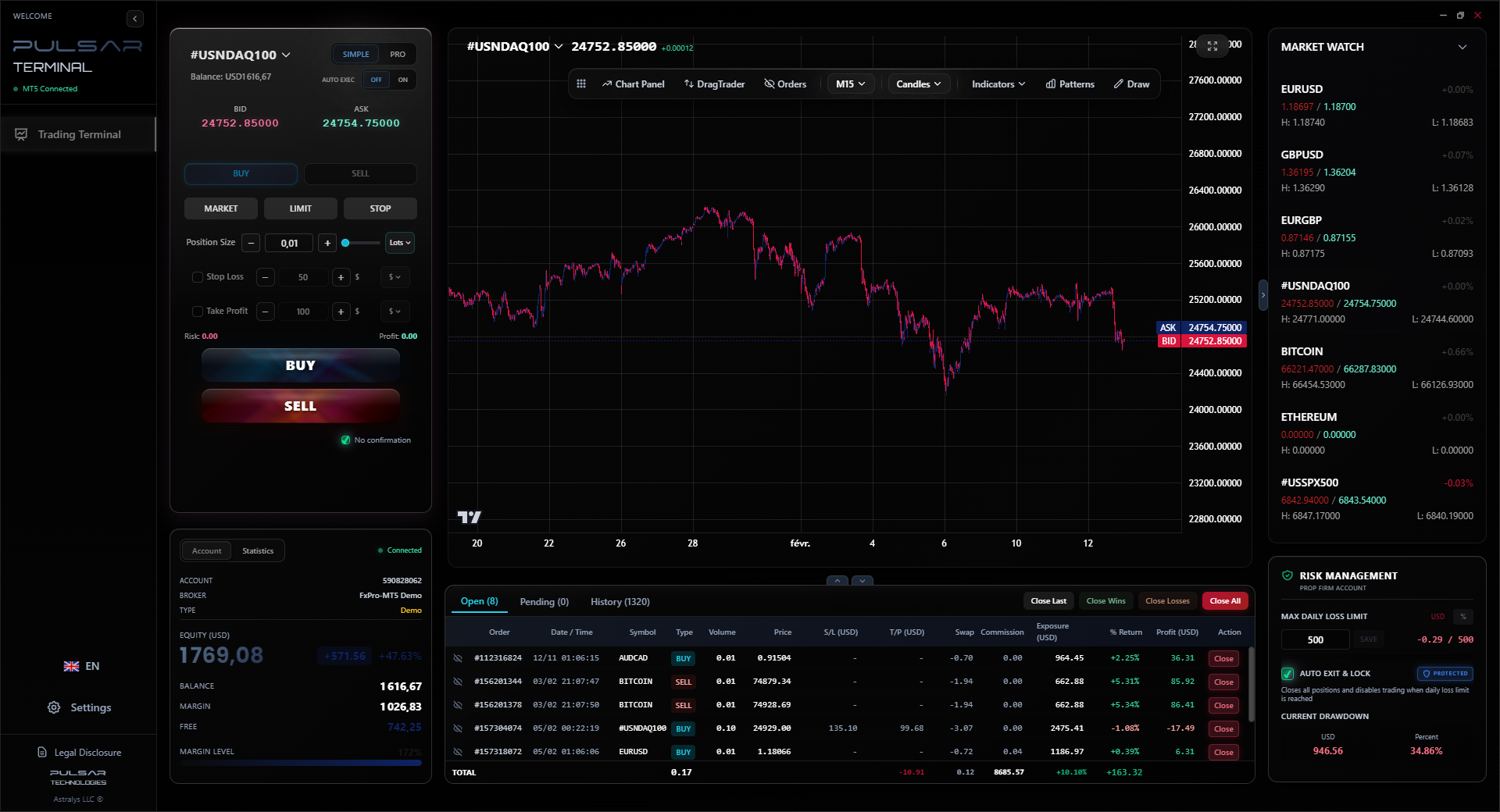
Managing the strict daily loss limits of a prop firm challenge is a huge psychological burden, but tools like Pulsar Terminal can automate this protection directly on your MT5 platform.
Pulsar Terminal
MT5一站式工具:拖拽下单、多重止盈/止损、追踪止损、网格交易、成交量分布图和自营交易保护。每日1000+交易者使用。
“Build your business first. The income will come.”
Your trading platform is your office. Don't work with broken tools.
A Reliable Broker: This is foundational. You need fast execution, tight spreads (check their USD/ZAR spread specifically), and good customer support. I've had good experiences with Pepperstone for their Razor account and local support. Do your own research. Read reviews like our Exness review or XM review to compare.
A Trading Journal: This is non-negotiable. It's not just a log of trades. It's where you diagnose your business performance. Why did that loss happen? Was it the spread? Bad timing? Emotional error? Your journal tells you what's working and what's costing you money.
Essential Indicators: Keep it simple. I rely heavily on the RSI indicator for momentum and the MACD indicator for trend confirmation. I don't use 10 indicators. I use 2 or 3, and I know them intimately. More tools just create more confusion and conflicting signals.
Risk Management Automation: This is the secret weapon for protecting your income. Manually moving stop-losses to breakeven or setting multiple take-profit levels in a fast market is how mistakes happen. How do you think prop firm traders manage their strict daily loss limits without staring at the screen 24/7? They use tools that automate these rules.
💡 Winston 小贴士
The market doesn't owe you a salary. You have to extract it through discipline. Every trade is a withdrawal attempt. Most get rejected.

Thinking about a forex trader salary is the wrong starting point. It puts the cart before the horse.
The right question is: "Can I build a profitable, sustainable trading business in South Africa?"
If the answer is yes, then the 'salary' will follow as a natural result. It won't be a fixed line on a payslip. It will be a variable income stream that reflects your skill, discipline, and the market's conditions.
Start small. Treat your first R10,000 not as money to get rich, but as tuition fees. Your goal in the first year isn't a salary. It's to not lose that tuition. Learn about spreads, about your own psychology, about risk. Use a demo account to test strategies. Then, when you have a proven edge, scale up slowly.
Remember my R45,800 lesson? It was the best money I ever spent. It bought me humility, respect for the market, and the burning desire to learn real risk management. That education formed the foundation of every rand I've earned since.
Build your business first. The income will come. And when it does, you'll know exactly what it cost to earn it, and you'll be able to manage it like the professional you've become.
FAQ
Q1What is the average monthly salary of a forex trader in South Africa?
There's no reliable 'average' because most traders lose money. For the minority who are consistently profitable, a realistic full-time income might range from R5,000 to R40,000+ per month, but this depends entirely on their trading capital, risk management, and strategy. It's far more useful to think in percentages (e.g., 3-8% monthly return on capital) than in fixed Rand amounts.
Q2Can I make R50,000 a month trading forex?
It's possible, but it's not typical for a retail trader starting with personal savings. To make R50k net per month, you'd likely need a very large trading capital (e.g., R1 million+ trading at 5% monthly) or be trading a significant prop firm account (e.g., a $100k+ funded account). Chasing this figure from a small account usually leads to excessive risk-taking and account blow-ups.
Q3Do I need a license to trade forex for a salary in South Africa?
If you're trading your own capital as an individual, you don't need a specific trading license. However, if you start managing other people's money for profit, you will need to be licensed as a Financial Service Provider (FSP) by the Financial Sector Conduct Authority (FSCA). Always ensure your broker is regulated by a reputable authority.
Q4How do forex traders pay tax in South Africa?
SARS generally views active trading as a business. You must declare your net profit (gross profit minus all allowable business expenses like software, data, broker fees) on your annual tax return (ITR12) under business income. It's crucial to keep detailed records of every trade and expense. Consult a tax professional familiar with trading.
Q5Is trading for a prop firm better than trading my own money?
It's different, not necessarily better. Trading your own money offers total freedom but limits your capital. Prop firms offer large capital but come with strict rules (daily loss limits, no overnights on certain pairs) and the pressure of an evaluation. Prop firms are excellent for disciplined traders who can follow rules rigidly and want to scale their earnings beyond their personal savings.
Q6What's the biggest mistake new traders make when thinking about salary?
Assuming consistent monthly income from day one. They create a budget based on a fantasy salary, then take huge risks to try and meet that self-imposed target when the market isn't cooperating. This 'making ends meet' pressure is the antithesis of good trading and destroys accounts.
Winston 教授的课程
要点总结:
- ✓A 'salary' is profit drawn after all costs, not gross trading gains.
- ✓Aim for 3-8% monthly return on capital, not a fixed Rand figure.
- ✓Prop firms can scale income but require iron discipline.
- ✓Track net profit per trade after spreads and commissions.
- ✓Keep a 3-month cash reserve separate from trading capital.
这篇文章对您有用吗?
点击星星评分
每周交易洞察
免费每周分析与策略。无垃圾邮件。
关于作者
David van der Merwe
新兴市场交易员
约翰内斯堡交易者,11年新兴市场货币经验。专注于ZAR货币对、FSCA监管交易和南非市场分析。
评论
风险提示
金融工具交易存在重大风险,可能不适合所有投资者。过往业绩不代表未来表现。本内容仅供教育目的,不构成投资建议。在交易前请务必自行研究。
您可能还喜欢

Cara Trading Forex Sukses: 7 Prinsip dari Trader Profesional
Cara trading forex sukses dengan 7 prinsip trader pro: manajemen modal, disiplin, journal trading, backtest. Data nyata, bukan janji profit palsu.
Jam Trading Forex Terbaik untuk Trader Indonesia: Panduan Lengkap dengan Tabel Waktu
Panduan jam trading forex untuk trader Indonesia. Tabel 4 sesi dunia, jam emas 20:00-00:00, sesi mana yang harus dihindari. Data akurat + tips dari trader berpengalaman.
Top 5 Sàn Forex Uy Tín Nhất 2026: Review Jujur dari Trader Indonesia
Top 5 sàn forex uy tín 2026 untuk trader Indonesia. Review jujur: spread, deposit, withdraw, dukungan lokal. Exness, XM, IC Markets & lebih.
