


If you think forex trading in India is just about buying Euros and selling Dollars from your bedroom, you're in for a rude awakening.

Rajesh Sharma
高级外汇分析师 ·  India
India
☕ 10 分钟阅读
您将学到:

If you think forex trading in India is just about buying Euros and selling Dollars from your bedroom, you're in for a rude awakening. I've seen too many Indian traders blow up their first account because they didn't understand the unique legal cage we trade in. This isn't a get-rich-quick manual. It's a survival guide, written from the trenches, to help you navigate the messy, regulated, and incredibly specific world of Indian forex trading. Let's set the record straight.
The first lesson, and the one that cost me my first ₹50,000, is understanding what you're actually allowed to trade. The Reserve Bank of India (RBI) and SEBI don't mess around. You cannot just open an account with any international broker and trade any pair you like. That's a fast track to getting your bank account flagged.
In India, you can only trade currency pairs that involve the Indian Rupee (INR) on the derivatives segment of exchanges like the NSE, BSE, or MCX-SX. Think USD/INR, EUR/INR, GBP/INR, JPY/INR. That's your primary playground. Trading major pairs like EUR/USD or exotic crosses directly is not permitted for resident Indians.

Warning: Many offshore brokers will happily accept Indian clients. While you can fund and trade with them, it operates in a regulatory grey area. Your funds have zero protection from Indian authorities if that broker goes under. I learned this the hard way when a "reputable" offshore broker froze withdrawals during a volatile period. It took months to get my capital back.
So, your practical choices are: 1) Trade INR pairs on Indian exchanges via a SEBI-registered broker, or 2) Use the international trading routes with a clear understanding of the risks. Most beginners should stick with option one. The liquidity in USD/INR futures, for example, is massive, and you're playing on a fully legal, transparent field.
This restriction isn't all bad. It forces you to become an expert on one currency - your own. You start to see how RBI policies, monsoon reports, and election results move the rupee. That focused knowledge is a huge advantage.

“The RBI's restrictions aren't a cage; they're guardrails that force you to become an expert on your own currency.”
You can't just download an app and start. You need a trilogy of accounts: a trading account with a broker, a DEMAT account to hold your electronic contracts, and a linked bank account. It sounds bureaucratic, and it is, but it's the system.
Choosing Your Broker
Look for brokers registered with SEBI and members of the NSE/BSE. Big names like Zerodha, Upstox, Angel One, and ICICI Direct offer this. Don't just look at brokerage fees. Look at the trading platform they provide. Is it stable during high volatility? Does it offer decent charts and tools? I started with a cheap broker whose platform crashed during a major RBI announcement. I was stuck in a losing position I couldn't exit. The few rupees I saved in fees cost me thousands in losses.
Understanding the Real Costs
It's not just the broker's commission. Here's what eats into your returns:
- Brokerage: Often a flat fee per trade or a tiny percentage.
- Exchange Transaction Charges: Paid to the NSE/BSE.
- SEBI Turnover Fees: A negligible statutory fee.
- STT (Securities Transaction Tax): This is the big one. It's a tax applied on the settlement price of your futures contract, whether you make a profit or not. It makes high-frequency scalping strategy very difficult to pull off profitably.
- GST: Applied on the brokerage and transaction charges.

Example: On a single USD/INR futures lot (where 1 lot = $1000), your total charges might be around ₹25-30 per side (entry and exit). That means you need the market to move by at least 3-4 pips just to break even. This makes tiny trades pointless.
Your first move should be to log into your broker's platform and use a position size calculator to factor in all these costs before you enter a single trade. If the math doesn't work, don't take the trade.

💡 Winston 小贴士
The market's job is to find the price where the maximum number of traders will be wrong. Your job is to not be one of them. Start by assuming you are wrong on every trade, and let your stop-loss prove you right.

“I learned more from my first ₹50,000 loss about margin than from ₹200,000 in paper trading profits.”
USD/INR is the main event. It's where the volume is, and it's what you'll likely trade first. Forget what you know about the calm, 24-hour Forex market. USD/INR trading has its own rhythm, dictated by Mumbai hours.
Liquidity is fantastic from 9 AM to 5 PM IST. But after that, it thins out dramatically. If you're holding a position overnight, you're exposed to gaps when the market opens, often based on what happened in the US markets or global news overnight.
The price is driven by a mix of local and global factors:
- Local: RBI intervention (they don't like wild volatility), inflation data (CPI), GDP growth numbers, foreign investment flows (FII data), and political stability.
- Global: US Dollar strength (watch the DXY index), crude oil prices (India is a major importer), and global risk sentiment.
I once shorted USD/INR (betting the rupee would strengthen) based on great local GDP data. I was right on the local story. But that same day, the US Fed made a hawkish comment, sending the Dollar soaring globally. My local win was crushed by the global move. The lesson? Never look at USD/INR in isolation. Always have the global Dollar trend on a separate chart.
A simple start is to watch for consolidation. USD/INR often moves in ranges for weeks, punctuated by sharp breaks when news hits. Trading the range (buying near support, selling near resistance) with tight stops can be a good beginner strategy, far better than trying to predict the big directional breaks.
“I learned more from my first ₹50,000 loss about margin than from ₹200,000 in paper trading profits.”
You don't need a complicated system with 10 indicators. You need discipline. Here’s a basic framework I wish I’d started with.
1. The Setup: Find the Floor or Ceiling. On a 4-hour or daily chart of USD/INR, identify clear areas where the price has reversed multiple times. Draw a horizontal line. That's your key level. Wait for the price to return to that level.
2. The Trigger: Patience is a Weapon. Don't buy or sell the moment it touches the line. Wait for a rejection candle - a pin bar, a bullish/bearish engulfing candle closing beyond the level. This shows other traders are defending that level.
3. The Entry & Stop Loss: Enter on the close of that rejection candle. Place your stop loss just on the other side of the key level. If you're buying at support, your stop goes below the lowest wick of the rejection candle. Your risk is now clearly defined.
4. The Take Profit: Scale Out. This is where most beginners fail. They get greedy or scared. Set two profit targets. Take half your position off at a 1:1.5 risk-to-reward ratio (if you risked 10 pips, take profit at 15). Move your stop loss on the remaining half to breakeven. Let the second half run towards the next obvious chart level.
I used this exact method on EUR/INR in October last year. Price rallied to 89.50, a level it had failed at twice before. A bearish pin bar formed. I shorted at 89.45, stop at 89.65 (20 pips risk). Took half off at 89.15 (30 pips profit). Moved stop to breakeven. The second half ran all the way to 88.80. One trade, two wins, zero stress.

Pro Tip: Combine this with the RSI indicator for extra confirmation. If price is at support and RSI is below 30 (oversold), it strengthens the buy signal. At resistance with RSI above 70, it strengthens the sell signal. Just don't use RSI alone.
💡 Winston 小贴士
In India, your edge isn't in a secret indicator. It's in understanding the 30-minute lag between a global news spike and its full effect on the USD/INR. Watch the DXY, then watch our market react.

“Your trading journal will reveal your real enemy: yourself.”
Our cultural context creates unique psychological traps. We're often raised to seek secure, salaried jobs. Trading, with its uncertainty, directly conflicts with that. The pressure to "make it" quickly to justify this "risky" path is immense. This leads to over-trading.
Then there's the "jugaad" mentality - finding a clever shortcut. In trading, there are none. Every shortcut I tried - following a Telegram tip, using a "guaranteed" robot - ended in losses. The market ruthlessly exploits the desire for an easy way out.
The biggest pitfall? Not respecting the margin call. Indian brokers can square off your positions automatically if your losses eat into your margin. It's not a request. I learned this during the 2013 "taper tantrum." I was over-leveraged in USD/INR shorts. The rupee crashed violently. My broker's system squared off my position at the absolute worst price, locking in a loss far bigger than I'd mentally prepared for. I had the capital to meet the margin call, but the automated system didn't wait. The lesson was brutal: never use more than 5-10% of your margin. Ever.
Build a routine. Review your trades weekly. Write down not just what the market did, but what you did. Were you impatient? Did you move your stop loss? Your trading journal will reveal your real enemy: yourself. This is the core of long-term swing trading success.

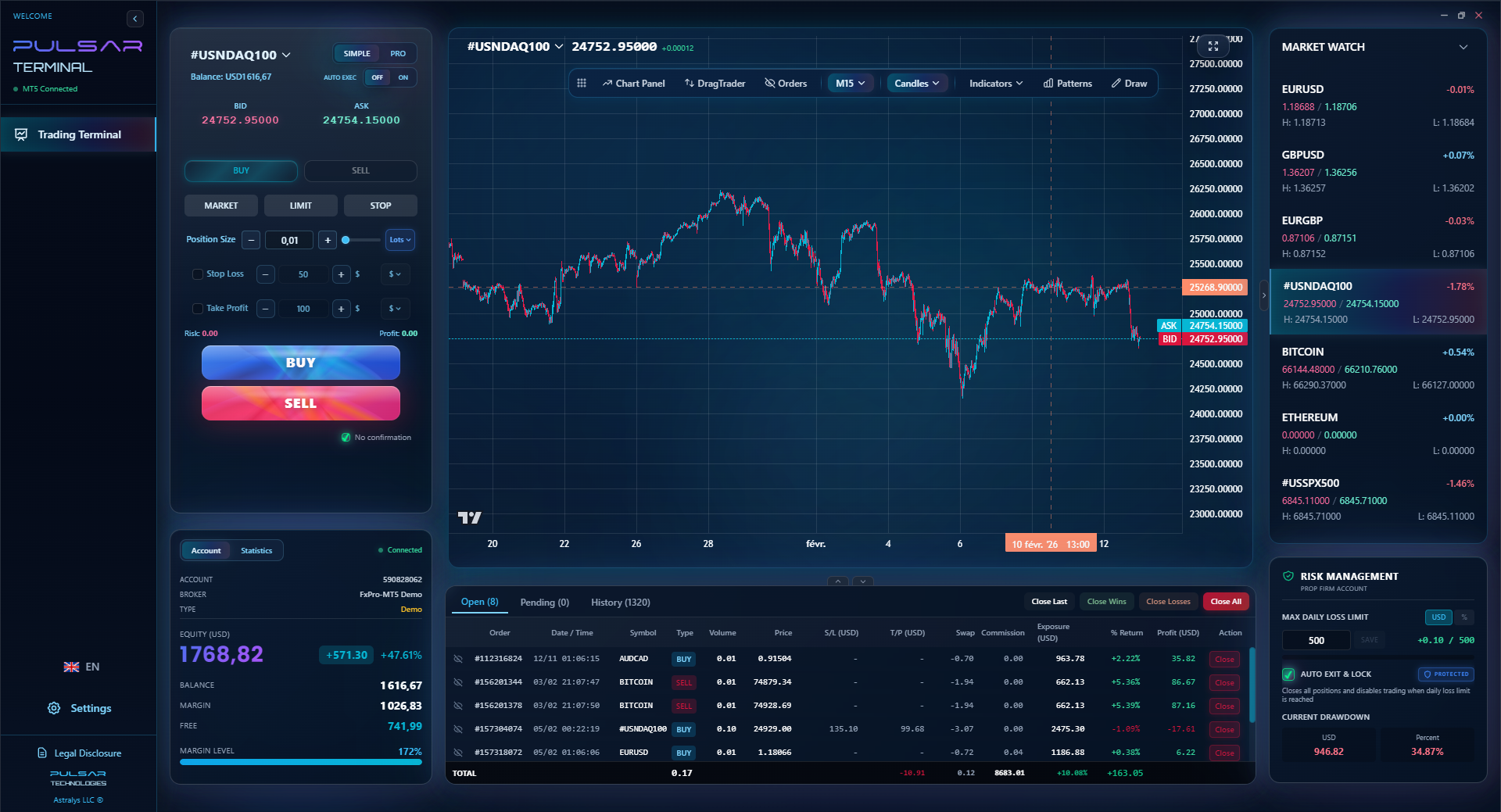
Managing the psychology of risk is hard enough without fumbling with your platform; a tool like Pulsar Terminal lets you set multi-level take-profits and trailing stops with one click, so your plan executes automatically.
Pulsar Terminal
MT5一站式工具:拖拽下单、多重止盈/止损、追踪止损、网格交易、成交量分布图和自营交易保护。每日1000+交易者使用。
“Your trading journal will reveal your real enemy: yourself.”
Making money is one thing. Keeping it is another. In India, the tax treatment depends entirely on how you trade.
If you trade futures & options (F&O) on exchanges: Your profits are treated as Business Income or Speculative Business Income. This is crucial. You can show it under "Business Income" and claim related expenses (internet, platform fees, home office). But you must maintain proper books of account. The tax rate is as per your income slab.
The 15% Rule for Intraday Equity (Not Forex): A common point of confusion. The 15% short-term capital gains tax with no expense deductions is for intraday equity trades. This does not apply to currency derivatives (forex futures). Your forex trading profits are not capital gains.
Tax Loss Harvesting: This is a critical strategy. Losses from F&O trading can be carried forward for 8 years to set off against future F&O profits. They cannot be set off against your salary income. So, if you have a bad year, file your returns correctly to carry those losses forward. I didn't do this in my second year, and I lost the ability to offset ₹2.8 lakh in losses against my profitable third year. A costly paperwork mistake.
Advance Tax: If your estimated tax liability for the year exceeds ₹10,000, you must pay advance tax in installments. Fail to do this, and you'll pay interest under Section 234B and 234C. The taxman always gets his share. Consult a CA who understands trading. It's worth every rupee.
💡 Winston 小贴士
Your first profitable year should bore you to tears. You're not here for excitement. You're here to execute a dull, repeatable process. Excitement is just expensive adrenaline.
“Making money is one thing. Keeping it in India, with its specific tax rules, is a whole other game.”
Don't jump in. Walk in slowly.
Weeks 1-2: Paper Trade. Open a demo account with your chosen broker. Not to make fake money, but to learn their platform. Place 20-30 trades using the simple strategy above. Get used to placing orders, setting stops, and calculating costs. See how the USD/INR moves during the day.
Weeks 3-4: Build Your Watchlist & Routine. Your daily routine should be:
- Check the global Dollar index (DXY) and US market close.
- Check crude oil prices.
- Scan the economic calendar for RBI meetings, US Fed speeches, Indian CPI data.
- Look at your USD/INR, EUR/INR charts. Mark key levels.
Month 2: Go Live, Tiny. Fund your account with an amount you can afford to lose completely - maybe ₹20,000. Your goal is not profit. Your goal is to execute 10 trades perfectly according to your plan, with correct position size calculator use. If you end up with ₹19,500 but followed your rules, that's a win. You're building discipline, not a bankroll.
Resources That Help:
- NSE Website: For official contract specifications and circulars.
- RBI Monetary Policy Statements: Read them. The language matters.
- TradingView: For better charts than most broker platforms offer.
- Focus on one instrument. Master USD/INR before you even glance at EUR/INR or XAU/USD guide (gold, which is also popular here).
Remember, this is a marathon. Your first year is about survival, not luxury cars. Learn the rules, manage your risk, and protect your capital. Everything else follows from that.

FAQ
Q1Is forex trading legal in India?
Yes, but with strict restrictions. It is legal to trade currency derivatives (like USD/INR, EUR/INR futures) on recognized Indian stock exchanges (NSE, BSE, MCX-SX) through a SEBI-registered broker. Trading international forex pairs (like EUR/USD) directly with offshore brokers operates in a regulatory grey area and is not permitted by the RBI for resident individuals.
Q2What is the minimum amount needed to start forex trading in India?
You can start with a relatively small amount. The margin required for one lot of USD/INR futures (which represents $1000) can be as low as ₹8,000-₹12,000, depending on your broker. However, I strongly recommend starting with at least ₹20,000-₹25,000 as your total capital. This allows for proper position sizing and surviving a few losing trades without an immediate margin call.
Q3Which is the best broker for forex trading in India?
There's no single "best" broker. You should choose a SEBI-registered broker that is a member of the NSE/BSE. Look for reliability, a stable trading platform (especially during market opens), transparent charges, and good customer support. Popular choices include Zerodha, Upstox, Angel One, and traditional bank brokers like ICICI Direct. Compare their fee structures and test their platforms first.
Q4How are forex trading profits taxed in India?
Profits from trading currency futures on Indian exchanges are treated as Speculative Business Income (not capital gains). You must file them under 'Profits and Gains from Business or Profession' in your ITR. You can deduct related expenses. The profit is added to your total income and taxed as per your applicable income tax slab. Losses can be carried forward for 8 years to set off against future speculative business income.
Q5Can I trade 24 hours in forex from India?
No, not for the legal INR pairs. Trading in USD/INR futures on Indian exchanges follows exchange timings (typically 9:00 AM to 5:00 PM IST). Some brokers may offer after-market orders, but execution happens at the next open, exposing you to gap risk. The global 24-hour forex market is only accessible via offshore brokers for non-INR pairs, which comes with significant regulatory and safety risks for Indian residents.
Q6What is the most important thing for a beginner to learn?
Risk management. Before you learn how to make money, learn how not to lose it. This means: using a position size calculator for every trade, always using a stop-loss, never risking more than 1-2% of your capital on a single trade, and understanding all the costs (brokerage, STT, GST) that eat into your profits. A disciplined loser survives to become a profitable winner.
Winston 教授的课程
要点总结:
- ✓Trade only SEBI-approved INR pairs (USD/INR) to stay legal and safe.
- ✓Factor in STT & all charges; you need a 3-4 pip move just to break even.
- ✓Global Dollar trend (DXY) often overrules local Indian news on USD/INR.
- ✓Profits are taxed as business income, not capital gains. Plan for it.
- ✓Never use more than 10% of your available margin. Ever.
这篇文章对您有用吗?
点击星星评分
每周交易洞察
免费每周分析与策略。无垃圾邮件。
关于作者
Rajesh Sharma
高级外汇分析师
在印度和南亚市场拥有超过10年的交易经验。从NSE货币衍生品起步,后转入国际外汇市场。专注于USD/INR和新兴市场货币对。
评论
风险提示
金融工具交易存在重大风险,可能不适合所有投资者。过往业绩不代表未来表现。本内容仅供教育目的,不构成投资建议。在交易前请务必自行研究。
您可能还喜欢

Cara Trading Forex Sukses: 7 Prinsip dari Trader Profesional
Cara trading forex sukses dengan 7 prinsip trader pro: manajemen modal, disiplin, journal trading, backtest. Data nyata, bukan janji profit palsu.
Jam Trading Forex Terbaik untuk Trader Indonesia: Panduan Lengkap dengan Tabel Waktu
Panduan jam trading forex untuk trader Indonesia. Tabel 4 sesi dunia, jam emas 20:00-00:00, sesi mana yang harus dihindari. Data akurat + tips dari trader berpengalaman.
Top 5 Sàn Forex Uy Tín Nhất 2026: Review Jujur dari Trader Indonesia
Top 5 sàn forex uy tín 2026 untuk trader Indonesia. Review jujur: spread, deposit, withdraw, dukungan lokal. Exness, XM, IC Markets & lebih.
