


You're an Indian trader, you've seen the ads for Dubai-based brokers with 1:1000 use, and you're wondering: can I legally trade forex with them? Let's cut through the marketing.

Rajesh Sharma
高级外汇分析师 ·  India
India
☕ 12 分钟阅读
您将学到:
You're an Indian trader, you've seen the ads for Dubai-based brokers with 1:1000 use, and you're wondering: can I legally trade forex with them? Let's cut through the marketing. The short answer is no, not in the way you think. I learned this the hard way, facing a nasty tax notice that wiped out two years of profits. This isn't about theory; it's about the real, messy intersection of Indian law and global brokerage promises. We'll look at what's actually permitted, the severe risks of going offshore, and how to trade currencies legally from India.
Most Indian traders start by asking about brokers. That's the wrong question. You need to start with the law. The Reserve Bank of India (RBI) and the Securities and Exchange Board of India (SEBI) have drawn a very clear, very restrictive line in the sand.
The cornerstone is the Foreign Exchange Management Act (FEMA) of 1999. This isn't some vague guideline; it's the rulebook. FEMA, enforced by the RBI, strictly controls how Indian money moves across borders. Crucially, it does not permit remittances for the purpose of margin trading or speculation on overseas platforms. That fancy Dubai broker's website might accept your sign-up, but getting your money to them violates FEMA from the moment you initiate the transfer.
SEBI governs what you can trade within India. Here's the only legal path for resident individuals: you can trade currency derivatives (futures and options) on Indian exchanges like the NSE. The key? The trade must involve the Indian Rupee. Pairs like USD/INR, EUR/INR, GBP/INR, and JPY/INR are fair game. Want to trade EUR/USD or GBP/JPY? That's a hard no. Those are called "cross-currency pairs" and trading them from India is prohibited.

Warning: The Liberalized Remittance Scheme (LRS) is a major trap. Yes, you can send up to $250,000 abroad per year for things like education, travel, or investing in foreign stocks. But the RBI's list of permitted purposes explicitly excludes forex trading and margin speculation. Using LRS for this is a direct violation.
The penalties aren't a slap on the wrist. Under FEMA, penalties can be up to three times the amount involved in the unauthorized transaction. I've seen cases where a trader's bank account was frozen pending an investigation. It's a nightmare that makes a losing trade look trivial.
So, when you see a broker ad promising "forex trading in Dubai legal for Indians," you now know the first layer of truth. Their service may be legal in Dubai, but your use of it from India likely isn't.

💡 Winston 小贴士
A rule that's kept me out of jail: If a trade feels like a secret you have to hide from your bank or accountant, it's not a trade. It's a liability. Legality is your first and most important stop loss.
“Their service may be legal in Dubai, but your use of it from India likely isn't.”
This is where the fantasy meets a brick wall. Dubai and other offshore financial centers (like Mauritius, the Bahamas, or Cyprus) host brokers who market aggressively to Indians. They offer what SEBI-regulated platforms can't: high use on major forex pairs.
Let's talk numbers. On Indian exchanges, use for currency derivatives is capped by SEBI, typically around 1:10 or 1:15 on the margin. It's sensible. Now, open an account with an offshore broker, and you'll see offers of 1:500, 1:1000, even 1:3000. It's intoxicating. With a $500 deposit, you can control $150,000? It feels like a shortcut.
I fell for this in 2021. I funded an account with a Cyprus-regulated broker (not Dubai, but the same principle) offering 1:500. My first few scalping strategy trades on EUR/USD were winners. The platform was slick, the spreads were tight. I felt like a global citizen. Then, a volatile news spike hit GBP/JPY. With that insane use, my $1,000 account was wiped out in 90 seconds. I got a margin call notification after my balance was already zero. The use wasn't a tool; it was a detonator.
The Regulatory Shell Game
These brokers are often legitimately regulated... elsewhere. You'll see licenses from the DFSA (Dubai), CySEC (Cyprus), or FSC (Mauritius). That regulation protects you in their jurisdiction. It means they have to keep client funds segregated and follow certain rules. It does not, and cannot, override Indian law. The RBI's "Alert List" is full of such "internationally regulated" entities that are unauthorized for Indian residents.

Pro Tip: If a broker's main selling point to you is "high use," run. It's a sign they're targeting inexperienced traders who equate use with opportunity, not risk. Real opportunity comes from strategy and risk management, not borrowed size.
The painful lesson? That use is a trap for the undisciplined. The legal risk is one thing, but the financial risk is magnified a hundredfold. A 2% move against you with 1:50 use is a 100% loss. With 1:500, it's a 1000% loss - you're wiped out and owe money. Tools like a position size calculator are meaningless when the use is designed to blow you up.
These brokers also offer minimal deposits - $1, $5, $100. It's a psychological trick. It makes signing up feel consequence-free. But funding that account is where you potentially break the law, and trading on it is where you face extreme financial danger.
“The use wasn't a tool; it was a detonator.”
Okay, so the offshore path is fraught with peril. What can you actually do? Plenty. The on-exchange currency derivatives market in India is deep, liquid, and completely above board.
Your Legal Toolkit: USD/INR, EUR/INR, GBP/INR, JPY/INR
This is your playground. You trade futures and options contracts on these pairs. The contract sizes are standardized (e.g., $1000 for USD/INR futures). The brokerage is low - often around 0.02% for futures or a flat ₹5 per lot for options. You'll use a standard Indian trading account with a SEBI-registered broker like Zerodha, Upstox, or ICICI Direct. Your money never leaves the Indian banking system.
I switched to this after my offshore disaster. It felt limiting at first. No XAU/USD guide mattered, no EUR/USD guide was relevant. I had to learn a new asset: the INR itself.
A Real Trade Example
In October 2023, I was watching USD/INR. The pair had been in a tight range. I used the MACD indicator on the hourly chart and saw a bearish crossover forming near resistance at 83.30. I sold 2 lots of USD/INR futures at 83.28. My total margin was about ₹1.2 lakhs for a position worth roughly ₹16.6 lakhs (that's the built-in, safe use). I set a stop loss at 83.45 and a target at 82.90.
The trade took three days to play out. It went against me initially, touching 83.35, but then reversed. I closed one lot at 82.95 for a profit of 33 paisa (or 330 points, since 1 paisa = 10 points in INR pairs). I let the second lot run with a trailing stop and was taken out at 82.80. Total profit: about ₹8,500 after all charges. It wasn't a glamorous 100% return, but it was clean, legal, and the risk was precisely defined from the start.
This market moves on RBI policy, oil prices (India's big import), and dollar flows. It's a different kind of analysis, more macro. You're not just trading forex; you're trading the Indian economy's relationship with the world. It's challenging and genuinely interesting.
For those with a longer-term view, swing trading these INR pairs based on fundamental shifts can be very effective. The key is to stop seeing the restriction as a barrier and start seeing the USD/INR as your primary instrument. It has all the volatility and opportunity you need.
💡 Winston 小贴士
use is a multiplier for losses first, profits second. The insane 1:1000 offered offshore isn't a feature; it's a guarantee of ruin for 99% of traders. SEBI's caps aren't restrictions, they're armor.
“Legal jeopardy is an unmanageable risk.”
Let's say you ignore everything and make money trading EUR/USD with a Dubai broker. Congratulations. Now you have a bigger problem: getting your profits back to India and explaining them to the taxman.
Income from illegal activities is still taxable. The Income Tax Department doesn't care if your trading violated FEMA; they care that you have income to declare. You'll need to show the source. How do you explain regular inbound remittances from a Dubai-based forex broker? You'd have to declare it as "Income from Other Sources" or possibly as business income, but the paper trail itself is evidence of a potential FEMA violation.
I learned this through a friend's horror story. He was profitable for two years with an offshore broker. He withdrew $25,000 in total profits over time. His bank's compliance department flagged the transactions. They asked for documentation on the source of funds. He provided broker statements. The bank then asked for proof that this activity was permitted under FEMA/LRS. He had none. The bank froze his account for 45 days while they "investigated." The funds were eventually released, but he received a notice from the tax department the following year, questioning the income and slapping on penalties for inaccurate filing. His net profit after taxes and penalties was negative.

Example: You profit $10,000 offshore. You bring it in. You pay 30% tax = $3,000. You then get a FEMA penalty of up to 3x the transaction amount. If they penalize the total remitted (not just profit), that's $30,000. You're now $23,000 in the hole.
Your bank is your first line of enforcement. RBI mandates banks to monitor transactions for FEMA compliance. Large, repeated, or suspicious inward remittances from known brokerage firms will raise red flags. It's not worth the constant anxiety.
With legal, on-exchange trading, taxes are straightforward. Profits from currency futures are treated as speculative business income. You can offset losses against other speculative income, and the accounting is clean through your Indian broker's consolidated statement. You sleep better.
“Legal jeopardy is an unmanageable risk.”
Before you even think about signing up, run any broker - foreign or domestic - through this list. It'll save you grief.
- SEBI Registration Number: For any broker offering you USD/INR trading, ask for their SEBI registration number. Check it on the SEBI website. No number? Stop.
- The "Dubai" Question: If it's a Dubai-based firm, ask them directly: "Can you provide a legal opinion or RBI circular that confirms Indian residents can legally remit funds to you for margin forex trading under FEMA?" Legitimate firms will be hesitant; shady ones will give you a vague "yes."
- Check the RBI Alert List: Go to the RBI website and search their "Alert List" of unauthorized entities. It's updated regularly. If the name is there, it's a definitive no-go.
- Examine the LRS Disclaimer: Reputable international brokers (like IG or FOREX.com) who are aware of Indian laws often have specific disclaimers for Indian residents. They might state that they accept clients but that the client is responsible for ensuring compliance with local laws. This is a red flag wrapped in a disclaimer.
- Payment Methods: If a broker asks you to fund your account via international wire transfer to a corporate account in another country, the FEMA risk is direct. If they offer "local payment methods" through obscure third-party payment processors, that's often a way to obscure the trail and is equally risky.
Let's compare two paths:
| Aspect | Legal Path (SEBI Broker) | Offshore Path (Dubai/etc.) |
|---|---|---|
| Legal Status | Fully compliant with FEMA/SEBI | Likely violates FEMA remittance rules |
| use | Capped (e.g., 1:10) | Extremely high (1:500+) |
| Instruments | INR pairs only (USD/INR, etc.) | All majors, minors, exotics |
| Tax Clarity | Clear, broker provides P&L | Opaque, high audit risk |
| Funds Safety | Segregated, in India | Segregated, but in foreign jurisdiction |
| Primary Risk | Market risk | Legal, tax, and extreme financial risk |
The choice seems obvious when laid out. Yet, the siren song of trading the "real" forex market is strong. I get it. But your first job as a trader is to protect your capital. Legal jeopardy is an unmanageable risk.
💡 Winston 小贴士
Your edge doesn't come from accessing exotic pairs. It comes from mastering one thing. Become the expert in USD/INR. Know its rhythms better than anyone. That's a real, legal, and sustainable advantage.
“Build your skills and career on a rock-solid legal foundation.”
If the on-exchange currency market doesn't satisfy you, there are other legal avenues that scratch a similar itch without the legal baggage.
1. Trade INR Pairs with More Sophistication Don't dismiss USD/INR as boring. Use the advanced tools you'd use on any other pair. Study order flow, use Volume Profile (available on some advanced Indian platforms), and get good at reading RBI policy statements. The moves can be significant.
2. Consider International Stock Indices Many Indian brokers now offer futures and options on global indices like the US Dow Jones, S&P 500, and FTSE 100 through partnerships with international exchanges. This is often a permitted activity under LRS for "investing in foreign stocks," though you must check with your specific broker and the product structure. It gives you exposure to global volatility.
3. Prop Firm Challenges This is a growing area. Some proprietary trading firms based outside India offer evaluation challenges. You trade their simulated capital, and if you pass, you get a funded account. The key? You never deposit your own money for live trading; you only pay a one-time challenge fee. Your profits are then shared. While the legal gray area exists, the FEMA risk is drastically lower since you're not remitting capital for margin trading. However, you must still declare any prize or income from them in India. If you go this route, strict daily loss limits are everything. A tool that automates this protection would be useful.
My final, hard-won advice is this: build your skills and career on a rock-solid legal foundation. The Indian currency derivatives market is a $60 billion daily market. That's enough opportunity for anyone. Chasing the illusion of easy, high-use trading on offshore platforms is a shortcut to financial and legal ruin. I've sat there, staring at a zeroed account and a worried bank manager. It's not a place you want to be. Trade what's legal, trade it well, and let your growth be steady and secure. That's the only path to lasting success in this game.
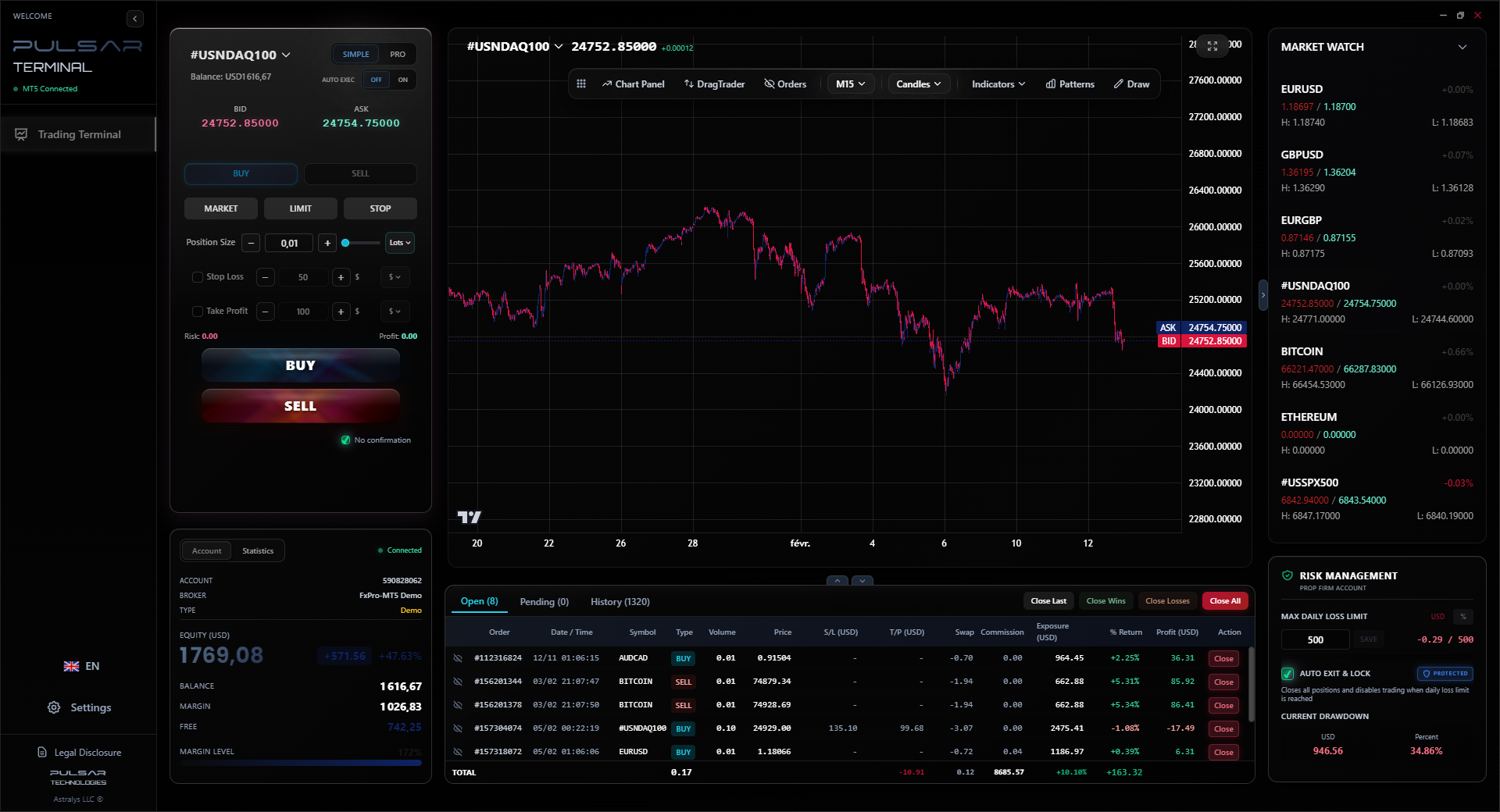
Managing risk in prop firm challenges requires iron discipline, and Pulsar Terminal automates daily loss limits and trailing stops directly on your MT5 platform.
Pulsar Terminal
MT5一站式工具:拖拽下单、多重止盈/止损、追踪止损、网格交易、成交量分布图和自营交易保护。每日1000+交易者使用。
FAQ
Q1Can I legally trade with a Dubai forex broker if I am an Indian resident?
No, not for margin forex trading. While the broker may be legal in Dubai, Indian law (FEMA) prohibits resident individuals from remitting money abroad for the purpose of margin trading or speculation on foreign exchange. Using the Liberalized Remittance Scheme (LRS) for this is explicitly not allowed. Your activity would likely violate Indian regulations.
Q2What happens if I get caught trading forex with an offshore broker?
You face penalties from two sides. The RBI can impose a FEMA penalty of up to three times the amount involved in the unauthorized transaction. Separately, the Income Tax Department will tax your profits and may levy penalties for inaccurate filing. Your bank may also freeze your accounts during an investigation. The financial and legal hassle can far exceed any profits.
Q3What forex pairs can I legally trade from India?
You can only trade currency futures and options involving the Indian Rupee on Indian exchanges like the NSE. The permitted pairs are USD/INR, EUR/INR, GBP/INR, and JPY/INR. Trading major pairs like EUR/USD, GBP/USD, or any other cross-currency pair is prohibited for resident individuals.
Q4Is the Liberalized Remittance Scheme (LRS) a loophole for forex trading?
Absolutely not. This is a common and dangerous misconception. The RBI's list of permitted purposes for the LRS (which allows up to $250,000 remittance per year) specifically excludes "margin trading" and "speculation." Using the LRS to fund an overseas trading account is a clear violation of its terms.
Q5Are brokers like XM, IC Markets, or Exness legal for Indians?
These brokers are legally incorporated and regulated in other countries and may accept Indian clients. However, their acceptance does not make your activity legal under Indian law. The act of sending them money for trading likely breaches FEMA. They are not regulated by SEBI for offering forex trading services to Indian residents. Always check the RBI Alert List first.
Q6How are profits from legal currency trading (USD/INR) taxed in India?
Profits from trading currency futures and options on Indian exchanges are treated as income from a speculative business. They are added to your total income and taxed according to your applicable income tax slab rate. You can offset these profits with losses from other speculative business activities. Your Indian broker will provide an annual statement for easy tax filing.
Q7What's a safer alternative if I want exposure to global markets?
Consider trading futures on global stock indices (like S&P 500) offered through some Indian brokers, as these may be structured as permitted investments. Another option is to practice through proprietary trading firm challenges, where you pay a fee to try out for a simulated funded account, eliminating the need to remit your own trading capital abroad. Always verify the legal structure first.
Winston 教授的课程
要点总结:
- ✓FEMA prohibits remitting funds for offshore margin trading. No loopholes.
- ✓Only trade INR pairs (USD/INR, EUR/INR) on Indian exchanges like NSE.
- ✓LRS excludes forex speculation. Using it for trading is a violation.
- ✓Penalties can be 3x the transaction amount plus tax headaches.
- ✓High offshore use (1:500+) is a fast track to a blown account.
这篇文章对您有用吗?
点击星星评分
每周交易洞察
免费每周分析与策略。无垃圾邮件。
关于作者
Rajesh Sharma
高级外汇分析师
在印度和南亚市场拥有超过10年的交易经验。从NSE货币衍生品起步,后转入国际外汇市场。专注于USD/INR和新兴市场货币对。
评论
风险提示
金融工具交易存在重大风险,可能不适合所有投资者。过往业绩不代表未来表现。本内容仅供教育目的,不构成投资建议。在交易前请务必自行研究。
您可能还喜欢

Cara Trading Forex Sukses: 7 Prinsip dari Trader Profesional
Cara trading forex sukses dengan 7 prinsip trader pro: manajemen modal, disiplin, journal trading, backtest. Data nyata, bukan janji profit palsu.
Jam Trading Forex Terbaik untuk Trader Indonesia: Panduan Lengkap dengan Tabel Waktu
Panduan jam trading forex untuk trader Indonesia. Tabel 4 sesi dunia, jam emas 20:00-00:00, sesi mana yang harus dihindari. Data akurat + tips dari trader berpengalaman.
Top 5 Sàn Forex Uy Tín Nhất 2026: Review Jujur dari Trader Indonesia
Top 5 sàn forex uy tín 2026 untuk trader Indonesia. Review jujur: spread, deposit, withdraw, dukungan lokal. Exness, XM, IC Markets & lebih.
