


Let's clear something up right away.

Olumide Adeyemi
西非交易先驱 ·  Nigeria
☕ 10 分钟阅读
您将学到:
Let's clear something up right away. Many Nigerian traders think opening a 'swap-free' account automatically makes their trading halal. That's a dangerous myth. I've seen too many students get the account type right but their entire approach wrong, piling on risk and gambling with use, thinking they're in the clear. The truth is, forex trading in Islam isn't just about avoiding interest; it's about your entire mindset and methodology. This guide will set the record straight on what's permissible, what's not, and how you can approach the markets in a way that aligns with your faith while protecting your capital.
You can't talk about forex trading in Islam without understanding the three big no-nos. These aren't just guidelines; they're the foundation. Get these wrong, and your trading is fundamentally flawed from a Sharia perspective.
Riba (Interest/Usury): This is the big one everyone knows. Any form of guaranteed, pre-determined interest is forbidden. In conventional forex trading, this shows up as swap or rollover fees - interest you pay or receive for holding a position overnight. A swap-free account removes this, but that's just the first step. It doesn't make a reckless trade halal.
Gharar (Excessive Uncertainty/Speculation): This is where many traders, even with Islamic accounts, fall down. Gharar means entering into a contract with major unknown factors. Pure gambling is the extreme example. In trading, it translates to taking positions with no real analysis, based on rumors, or with risk you don't understand. If you're throwing money at the chart hoping it goes up, that's gharar. A structured approach using a solid scalping strategy or swing trading plan with defined risk is the antidote.
Maisir (Gambling): Closely linked to gharar. Trading isn't supposed to be a casino. The intention matters. Are you investing in a currency's value based on economic factors, or are you just betting on price movements? Using excessive use (like 500:1) to make a quick fortune often crosses into maisir territory. The activity might look the same, but the intention and method separate speculation from gambling.

Warning: Don't think a swap-free account is a 'get out of jail free' card. I once took a massive, poorly-researched position on GBP/JPY in an Islamic account. No swap was charged, but the 8% loss I took from sheer guesswork? That was pure gharar. The account type didn't make the foolishness halal.

💡 Winston 小贴士
A swap-free account removes interest, not idiocy. If your trade is based on a 'feeling,' it's not halal, it's gambling. Backtest a strategy instead.
“The truth is, forex trading in Islam isn't just about avoiding interest; it's about your entire mindset and methodology.”
So, what exactly are you signing up for? Brokers market them as 'Islamic', 'Swap-Free', or 'Sharia-Compliant' accounts. The core mechanic is simple: they remove the interest-based swap charges for overnight positions. But there's always a catch - brokers aren't charities.
Instead of swaps, they typically charge a fixed administrative fee. This fee is often structured to cover their costs and isn't tied to an interest rate. Here’s the kicker: these fees can be higher than you think, and they often triple on certain days to account for the weekend.
How the Fees Actually Work
Let's use real numbers from a broker like Fusion Markets. On a standard account, holding a 1-lot (100,000 units) EUR/USD position overnight might incur a small swap credit or debit. On their swap-free account, you pay $0 for the first few days (a grace period), then a daily admin fee kicks in. For forex, that fee might triple on a Wednesday. For indices, it triples on a Friday. I’ve seen these fees range from a seemingly trivial $1 to a shocking $370 for larger positions on commodities.
The Fine Print You Must Read
- Dormancy Fees: Leave your account inactive for too long (often 3-12 months), and you'll get hit with a monthly fee. It's not riba, but it's a cost.
- Wider Spreads: Some brokers might offer the swap-free feature but have slightly wider spreads to compensate. Always compare the all-in cost.
- Not All Instruments: Your Islamic status might only apply to forex majors. Check if it covers indices, commodities, or cryptocurrencies if you trade those.
The key is transparency. The fee should be disclosed upfront, not an ambiguous interest calculation. That's what makes it structurally different from riba.

Example: You buy 1 lot of EUR/USD on a Tuesday in an Islamic account. You might pay $0 Tuesday night, $0 Wednesday night, but a $15 admin fee on Thursday (covering Wednesday's triple charge). If you hold over the weekend, you'll likely get charged for Friday, Saturday, and Sunday on Monday. Plan your holds accordingly.
“Don't think a swap-free account is a 'get out of jail free' card.”
Here's the Nigerian reality: we have almost no reputable local forex brokers. The SEC doesn't regulate the retail spot market. Your protection comes from choosing an international broker with a strong global regulator and a proven Islamic account offering.
You need a broker that accepts Nigerian clients, supports funding methods that work here (more on that next), and has a clear, reliable swap-free policy. Don't just trust a checkbox on their website. I always email their support and ask for their specific Sharia-compliance certificate or a detailed breakdown of their admin fee schedule. If they can't provide it clearly, walk away.
Based on my experience and community feedback, here are a few that consistently serve the Nigerian market well with Islamic options:
| Broker | Key Feature for Islamic Trading | Note for Nigerian Traders |
|---|---|---|
| XM | Award-winning swap-free account structure. | Reliable execution, good educational resources. Check our full XM review. |
| Octa | Islamic accounts with competitive average spreads (e.g., 0.6 pips on EUR/USD). | Offers very high use, which requires extreme discipline. |
| Fusion Markets | Clear, published admin fee schedule for swap-free accounts. | True ECN pricing, but ensure their funding methods work for you. |
| IC Markets | Raw spread accounts with swap-free option available. | A favorite for serious scalpers due to tight spreads. See our IC Markets review. |
Remember, the broker is just the tool. Their Islamic account makes the mechanics compliant, but your trading decisions make the activity halal or haram.
💡 Winston 小贴士
That 'tiny' admin fee on your Islamic account? Triple it for Wednesday holds. Do the math before you decide to swing trade over the week. A $5 fee becomes $15 fast.
“Your Islamic account makes the mechanics compliant, but your trading decisions make the activity halal or haram.”
Alright, you've got the principles down and picked a broker. Now, how do you actually get your money in and trade smartly? This is where local knowledge is everything.
Funding Your Account: Forget using your regular Naira debit card for large or frequent international transfers. The CBN restrictions will block you and cause headaches. The smart workarounds I and every serious trader I know use are:
- Domiciliary Account: Fund your trading account directly in USD from your Nigerian domiciliary account. This is the cleanest method.
- E-Wallets: Use Skrill or Neteller. You fund the e-wallet (often via bank transfer or card), then transfer to your broker. It adds a step but bypasses many direct card issues.
Trading with a Halal Mindset: This is the most important part. Your technical approach must minimize gharar.
- Use a Position Size Calculator: Every time. Never guess. This defines your risk upfront, removing uncertainty.
- Set Stop-Losses Religiously: Entering a trade without a stop-loss is the ultimate gharar. You're admitting you have no idea where you're wrong. I learned this the hard way early on, watching a USD/CHF trade go 200 pips against me because I was 'sure' it would reverse.
- Avoid Overtrading: Chasing every small move is speculative and exhausting. Have a plan, wait for your setup. Quality over quantity.
- Understand the Instrument: Stick to what you know. Trading an exotic pair you don't understand because you heard a tip introduces massive gharar. Start with majors like EUR/USD.
Your platform choice matters too. MT4 and MT5 are ubiquitous. Whichever you use, organize it. Cluttered charts with 20 indicators create confusion (gharar!). Use clean price action or one or two key tools like the RSI indicator or MACD indicator for confirmation.
“Your Islamic account makes the mechanics compliant, but your trading decisions make the activity halal or haram.”
I have to be blunt here: there is no universal fatwa that says 'forex trading is halal.' Some respected bodies, like the Islamic Fiqh Council, have issued opinions that forex trading is generally not permissible due to the prevalence of riba, speculation, and potential harm. Others are more permissive, provided strict conditions (like spot settlement and no interest) are met.
As a trader, this puts the responsibility squarely on you. You can't outsource your deen to a broker's marketing department. Here’s my advice:
- Seek Knowledge, Not Just Permission: Don't just look for a scholar who will say 'yes.' Understand the reasoning behind different opinions. What are the specific conditions for permissibility?
- Examine Your Own Activity: Be brutally honest. Is your trading a form of disciplined investment based on analysis, or is it emotional gambling? Are you using excessive use that creates unsustainable risk? That’s a sign of maisir.
- Prioritize Spot Trading: The consensus is strongest for immediate (spot) exchange. Avoid complex derivatives and futures where the element of speculation and deferred settlement is higher.
- Intention (Niyyah) Matters: Are you trading to provide for your family through a skilled profession, or to get rich quick? Your intention frames the entire activity.
My journey involved speaking with two different scholars and reconciling their views. One emphasized the permissibility of trade (bay') in currencies. The other focused on the danger of the gambling mindset. My takeaway? The structure (swap-free account, spot trading) provides the vessel, but my discipline, risk management, and intention have to fill it with halal content.

Pro Tip: Keep a trading journal. Note your reason for every entry and exit. If you can't write a clear, logical reason for a trade, it was probably speculation (gharar). This practice alone will filter out most of your impulsive, non-compliant trades.
💡 Winston 小贴士
Your first step towards halal trading isn't opening an account. It's defining your risk per trade as a percentage and never, ever breaking that rule. Discipline is worship here.
“As a trader, this puts the responsibility squarely on you. You can't outsource your deen to a broker's marketing department.”
Let's wrap this up with action. A Sharia-compliant trading plan isn't a different plan; it's a better, more disciplined one. It forces you to eliminate the weaknesses that lose money anyway.
1. The Setup Rule: Define exactly what conditions must be on the chart for you to enter. Is it a specific support bounce? A moving average crossover? Write it down. No deviations. This kills impulsive gambling.
2. The Risk Rule: Before every trade, use your calculator. Your risk per trade must be a fixed percentage of your capital (e.g., 1-2%). Set your stop-loss immediately. This defines your uncertainty (gharar) and contains it.
3. The use Rule: Just because your broker offers 500:1 doesn't mean you use it. High use amplifies both gains and losses, but it primarily amplifies greed and fear - the drivers of haram behavior. I recommend beginners use no more than 10:1. It forces you to be more selective.
4. The Profit & Loss Rule: Have take-profit levels. Don't let greed turn a winning trade into a loser. Also, have a daily or weekly loss limit. If you hit it, you stop. This prevents 'revenge trading,' which is pure emotional gambling.
5. The Review Rule: Weekly, review your journal. How many trades followed your plan? How many were impulsive? Your goal is to make your plan your master, not your emotions.
This plan does more than seek compliance; it builds the discipline of a professional. When I finally adopted a plan like this, my consistency improved not because I was luckier, but because I had removed the chaos from my process. The peace of mind that comes with that is worth more than any single winning trade.
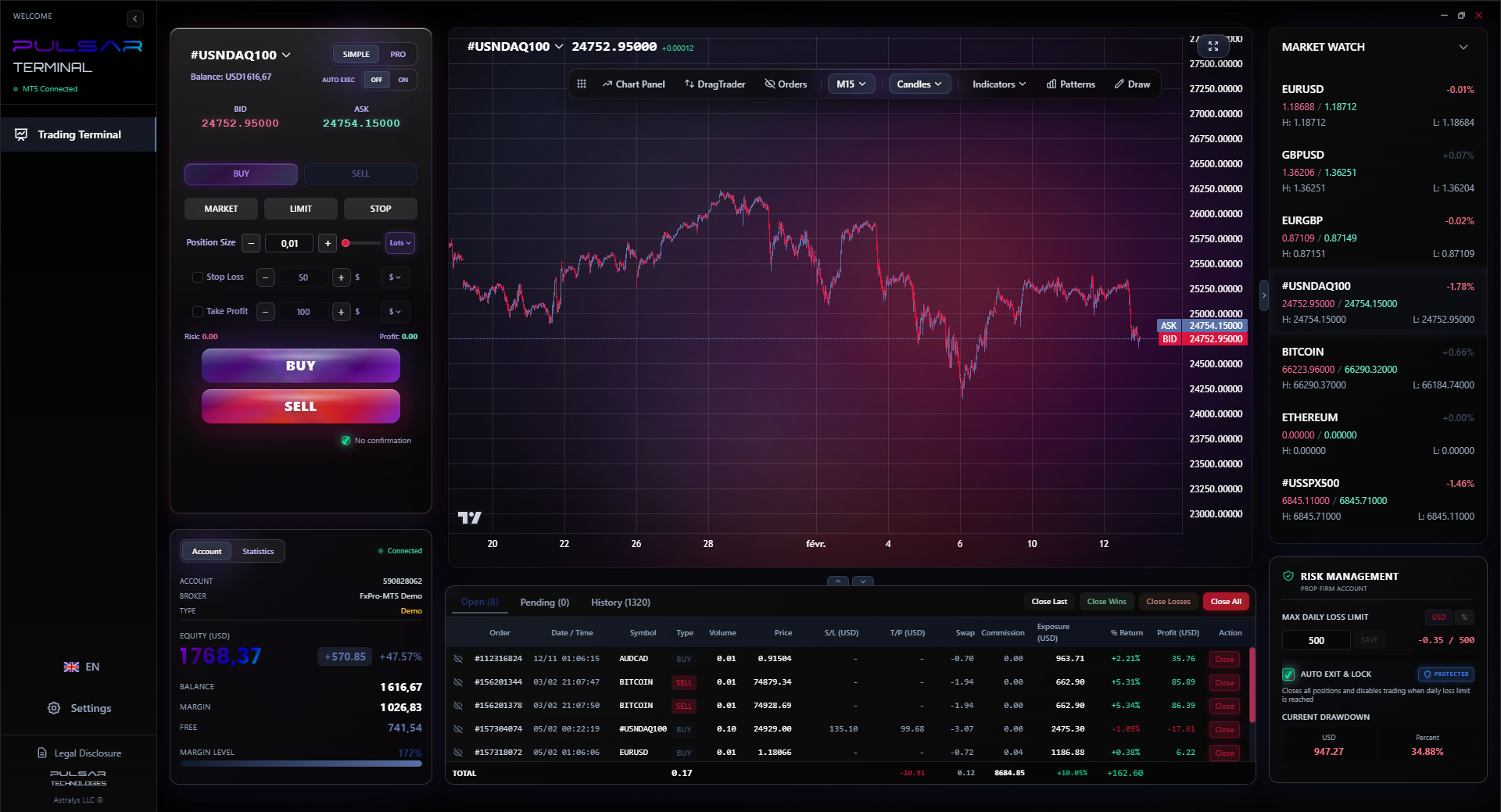
Executing a disciplined, low-gharar trading plan requires precise tools, and Pulsar Terminal's drag-and-drop orders and multi-TP/SL management on MT5 help remove emotional uncertainty from your entries and exits.
Pulsar Terminal
MT5一站式工具:拖拽下单、多重止盈/止损、追踪止损、网格交易、成交量分布图和自营交易保护。每日1000+交易者使用。
FAQ
Q1Is forex trading haram or halal in Islam?
There is scholarly disagreement. Many scholars say it can be permissible under strict conditions: it must be spot trading (immediate exchange), involve no interest (riba), avoid excessive uncertainty (gharar), and not resemble gambling (maisir). Using a swap-free account is necessary but not sufficient; your entire trading approach must be disciplined and analytical, not speculative.
Q2What is a swap-free or Islamic forex account?
It's a brokerage account that does not charge or pay overnight interest (swap fees) on held positions. Instead, the broker may charge a fixed administrative fee. This removes the element of riba (interest) from the transaction mechanics.
Q3Do Islamic accounts have any fees?
Yes. While they have no swap fees, brokers typically charge administrative fees after a short grace period (often 1-3 days). These fees can be significant and often triple on Wednesdays (for forex) or Fridays (for indices) to cover weekend costs. Always check the broker's fee schedule.
Q4Can I use high use with an Islamic account?
Technically, yes, as use itself isn't riba. However, using extremely high use (like 500:1) often leads to speculative, high-risk behavior that can cross into gharar (excessive uncertainty) and maisir (gambling). From both a Sharia and risk-management perspective, using low use is strongly advised.
Q5How do Nigerian traders fund international Islamic accounts?
Due to CBN restrictions on Naira cards, the most reliable methods are using a domiciliary account (to send USD directly) or an e-wallet like Skrill or Neteller. Avoid direct card deposits for larger amounts.
Q6What is the biggest mistake Muslims make in forex trading?
Thinking that using a swap-free account automatically makes all their trading halal. The bigger issues are gharar and maisir - trading without a plan, using excessive use, chasing losses, and gambling on price movements. The account type fixes the riba issue; the trader must fix the mindset issue.
Q7Are there any halal alternatives to forex trading?
Yes. Within Islamic finance, consider Mudarabah (profit-sharing investment) or Murabaha (cost-plus financing) based investments. Some platforms offer Sharia-compliant stocks or ETFs. The key is that returns must come from shared profit or trade, not from guaranteed interest.
Winston 教授的课程
要点总结:
- ✓Swap-free accounts fix riba, not gharar or maisir.
- ✓Admin fees can triple on Wednesdays and Fridays.
- ✓Use a position size calculator for every single trade.
- ✓use above 10:1 often invites speculative behavior.
- ✓Fund via domiciliary accounts or e-wallets, not Naira cards.
这篇文章对您有用吗?
点击星星评分
每周交易洞察
免费每周分析与策略。无垃圾邮件。
关于作者
Olumide Adeyemi
西非交易先驱
尼日利亚最活跃的外汇交易教育者之一。从拉各斯出发有8年交易经验。专注于低资金策略和面向非洲交易者的自营公司挑战。
评论
风险提示
金融工具交易存在重大风险,可能不适合所有投资者。过往业绩不代表未来表现。本内容仅供教育目的,不构成投资建议。在交易前请务必自行研究。
您可能还喜欢

Cara Trading Forex Sukses: 7 Prinsip dari Trader Profesional
Cara trading forex sukses dengan 7 prinsip trader pro: manajemen modal, disiplin, journal trading, backtest. Data nyata, bukan janji profit palsu.
Jam Trading Forex Terbaik untuk Trader Indonesia: Panduan Lengkap dengan Tabel Waktu
Panduan jam trading forex untuk trader Indonesia. Tabel 4 sesi dunia, jam emas 20:00-00:00, sesi mana yang harus dihindari. Data akurat + tips dari trader berpengalaman.
Top 5 Sàn Forex Uy Tín Nhất 2026: Review Jujur dari Trader Indonesia
Top 5 sàn forex uy tín 2026 untuk trader Indonesia. Review jujur: spread, deposit, withdraw, dukungan lokal. Exness, XM, IC Markets & lebih.
