


I blew my first R5,000 deposit in under a week.

David van der Merwe
新兴市场交易员 ·  South Africa
☕ 11 分钟阅读
您将学到:
I blew my first R5,000 deposit in under a week. I’d read all the articles, knew what a 'pip' was, and was confidently 'leveraged'. My mistake? I didn't understand the keyword 'margin call'. I was trading a USD/ZAR position with 50:1 use on a platform that wasn't even FSCA-regulated. When the Rand spiked, I got a notification I didn't understand, and my position was liquidated before I could react. The loss wasn't from a bad trade idea; it was from not knowing the language of the game. Here’s the vocabulary you need to survive, specifically for the South African context.
If you ignore this section, you're playing with fire. In South Africa, trading isn't a free-for-all. The rules exist, and knowing the keywords keeps you on the right side of them and protects your capital.
The Financial Sector Conduct Authority (FSCA) is your first line of defence. This isn't just a fancy name. A broker holding an FSCA license means they are legally required to keep your money in segregated accounts. It means they have capital adequacy rules. It means if they go bust (it happens), your funds are somewhat protected. Always verify an FSP number on the FSCA's public register. It takes two minutes.
use Limit: 30:1. This is a big one. Since 2021, the FSCA capped retail use at 30:1. If you see a broker offering 500:1 or 'unlimited' use to South African residents, ask a hard question: are they circumventing local law by registering you offshore? That often means you lose FSCA protection. That 30:1 isn't a suggestion; it's a risk-management rule born from watching too many people get wiped out.
SARS isn't just for your PAYE. Profits from trading are taxable income. The keyword here is 'record-keeping'. You need a detailed log of all trades, deposits, and withdrawals. I learned this the hard way after a good year; reconstructing 12 months of trades from broker statements was a nightmare. The tax man doesn't care about your clever scalping strategy, he cares about the net number.

Warning: Trading with an unregulated or offshore broker might offer higher use, but you have zero recourse if they decide to freeze your account or manipulate prices. Your contract is with a company in Vanuatu. Good luck with that lawsuit.
FAIS Act and FSRA. You don't need to memorise these, but you should know they're the laws that help the FSCA. They set the standards for how financial service providers must behave. When a broker is 'FAIS compliant', it's not marketing fluff, it's a legal requirement.

💡 Winston 小贴士
The FSCA's 30:1 use limit isn't a cage, it's a seatbelt. The traders complaining about it are the ones who would have crashed without it.
This is the language of the battlefield itself. Misunderstand a term here, and you'll misplace an order.
Currency Pair & Quote Convention: Every trade involves two currencies. For us, USD/ZAR and EUR/ZAR are the locals. The first currency (USD, EUR) is the 'base'. The second (ZAR) is the 'quote' or 'counter' currency. If you buy USD/ZAR at 16.50, you are buying US Dollars and selling South African Rand. You profit if that number goes up (the Dollar strengthens against the Rand).
Major, Minor, Exotic. Majors all involve the USD (e.g., EUR/USD). Minors are major currencies against each other without the USD (e.g., EUR/GBP). Exotics are a major currency against a smaller economy's currency. USD/ZAR is technically an exotic pair. Why does this matter? Exotics have wider spreads and can be less liquid. Your trading costs are inherently higher.
CFD (Contract for Difference). This is crucial. When you 'trade forex' in South Africa with an online broker, you are almost always trading CFDs. You don't own the physical currency. You have a contract with your broker to exchange the difference in price from when you open to when you close. This is why you can go short easily, and why use is available. It also means your broker is your counterparty, which is why their regulation is so important.
Spot Forex vs. Futures. You're trading spot. The settlement is 'on the spot' (technically T+2). Futures are contracts for a set date in the future. Stick with spot for now.
Liquidity & Sessions
London Session, New York Session, Asian Session. The market is open 24/5, but it's not equally active. The London session (9 AM - 5 PM SAST) overlaps with the end of Asia and start of New York. This is often the most volatile and liquid period, especially for pairs like GBP/USD and EUR/USD. Trading the ZAR pairs during London hours can see good movement as international flows hit our market.
“The FSCA's 30:1 use limit feels restrictive, but it's there for a reason. I promise you, 30:1 is more than enough to destroy an account if you're reckless.”
This is where theory meets practice. A 'buy' button isn't just a buy button.
Market Order: You buy or sell at the current best available price. It's instant, but you pay the spread. In fast markets, the price can 'slip' between clicking and execution.
Pending Order: You set an order to be executed in the future if the price reaches a certain level. Limit (buy below market, sell above market) and Stop (buy above market, sell below market) are the two main types. I once tried to short EUR/USD by placing a sell limit above the market. It never triggered while the pair tanked. I confused limit and stop. A R2,000 lesson in semantics.
Stop-Loss (SL) & Take-Profit (TP). Non-negotiable keywords. Your SL is a pre-set order that closes your trade at a loss to prevent a disaster. Your TP does the same for a profit. Never, ever trade without them. Your psychology will betray you. Use a position size calculator to determine where to place them based on your risk.
Slippage: The difference between your requested price and your actual fill price. Common during news events (like SARB interest rate announcements) or in illiquid markets. It can work for or against you.
Spread: The difference between the bid (sell) and ask (buy) price. This is your primary transaction cost. A 'tight' spread on EUR/USD might be 0.6 pips. On USD/ZAR, 50 pips isn't unusual. You are down that amount the moment you enter the trade. Always check the live spread before clicking buy.

Example: You buy USD/ZAR at an ask price of 16.4000. The bid price is 16.3950. The spread is 50 pips (16.4000 - 16.3950). The price needs to move up 50 pips just for you to break even on a standard lot.
This is the most important list. Master these, or you will blow up. It's not a question of if, but when.
Margin & Margin Call: This is the one that got me. Margin is the collateral you put up to open a leveraged position. If you have R10,000 and use 10:1 use, you can control a R100,000 position. Your R10,000 is your margin. Margin Call is a warning from your broker that your losses are eating into your required margin. If you don't add funds, the next step is...
Liquidation (or Stop-Out): This is the broker automatically closing your positions to prevent you from going into negative balance. Each broker has a stop-out level (e.g., 50%). If your equity falls to 50% of your used margin, they start closing. It's brutal and automatic. Understanding your broker's specific margin call and stop-out policy is critical.
use (Gearing): Expressed as a ratio (30:1). It amplifies both gains and losses. With 30:1, a 1% move against you is a 30% loss on your margin. The FSCA's 30:1 limit feels restrictive, but it's there for a reason. I promise you, 30:1 is more than enough to destroy an account if you're reckless.
Position Sizing: The art of determining how many lots or units to trade based on your account size and risk tolerance. The core keyword here is 'Risk per Trade'. I never risk more than 1% of my account on any single trade. This means if I have a R20,000 account, my maximum loss on a trade is R200. This dictates my stop-loss distance and lot size.
Drawdown: The peak-to-trough decline in your account. A 20% drawdown means you're down 20% from your highest balance. It's a measure of pain. Professional swing trading systems plan for 20-30% drawdowns. If you can't handle a 10% drawdown emotionally, you're in the wrong game.
Hedging: Opening a position to offset the risk of another. Some brokers allow you to have both a buy and sell position open on the same pair (which is confusing). In South Africa, it's often simpler to just close the position you're worried about.
💡 Winston 小贴士
Your first R10,000 is tuition, not capital. Expect to pay it to the market while learning these keywords. The goal is to lose it slowly, with lessons.
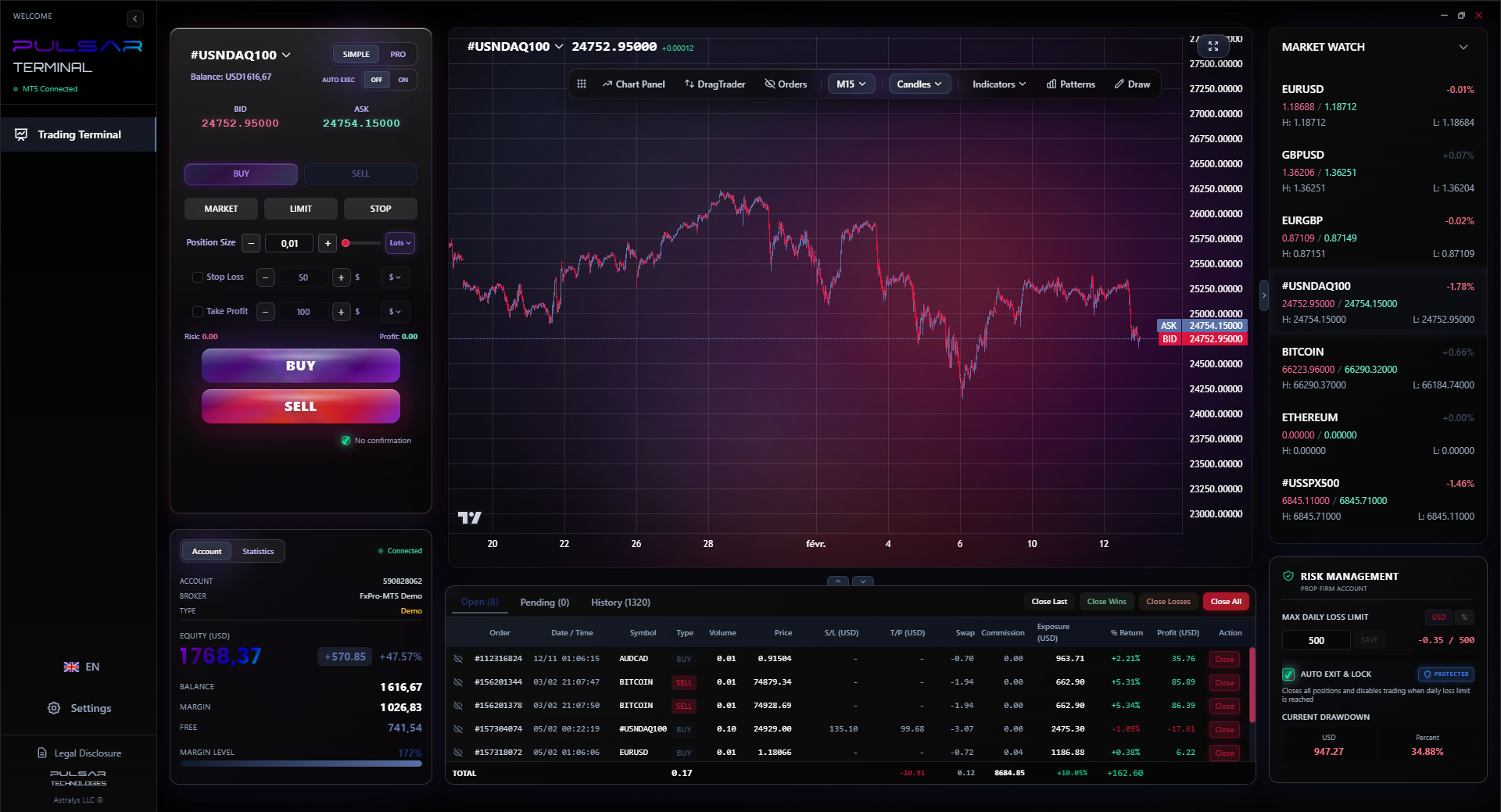
Managing multiple take-profit levels and stop-losses manually is stressful and error-prone; Pulsar Terminal lets you set them all with a single drag-and-drop directly on your MT5 chart.
Pulsar Terminal
MT5一站式工具:拖拽下单、多重止盈/止损、追踪止损、网格交易、成交量分布图和自营交易保护。每日1000+交易者使用。
“Your first R10,000 is tuition, not capital. Expect to pay it to the market while learning.”
The language of your edge. Do you know what you're actually looking at?
Technical Analysis (TA): The study of price action and chart patterns. Key tool keywords:
- Support & Resistance: Price levels where buying or selling has historically emerged. Think of them as floors and ceilings.
- Moving Average (MA): A smoothed line showing the average price over time. The '200-period MA' is a major benchmark.
- RSI (Relative Strength Index): An oscillator from 0-100 showing overbought (>70) or oversold (<30) conditions. It can stay extreme for a long time in a strong trend.
- MACD (Moving Average Convergence Divergence): Shows the relationship between two MAs. Used for trend direction and momentum.
I spent years chasing perfect RSI divergences. The truth? On ZAR pairs driven by commodity flows and politics, pure TA often gets run over. It's a tool, not a crystal ball.
Fundamental Analysis (FA): The study of economic factors. For a South African trader, these are your keywords:
- SARB (South African Reserve Bank) Repo Rate: Our key interest rate. Announcements cause huge ZAR volatility. A hike typically strengthens the Rand (in theory).
- CPI (Consumer Price Index): Inflation data. High CPI pressures SARB to hike rates.
- US Non-Farm Payrolls (NFP): American job data. Moves the USD, which moves USD/ZAR.
- Commodity Prices (Platinum, Gold): Our exports. Strong XAU/USD (Gold) prices can support the ZAR.
- Political Risk: A unique, unquantifiable keyword for South Africa. News around Eskom, Transnet, or elections can trump all charts.
The most successful local traders I know blend both. They use TA for entry and exit timing on USD/ZAR, but their bias (long or short) is shaped by the fundamental picture from SARB and commodity markets.
Choosing your tools. This is about knowing what you're signing up for.
ECN vs. Market Maker: An ECN (Electronic Communication Network) broker aggregates prices from multiple liquidity providers and passes them to you. They make money on a commission. A Market Maker acts as the counterparty to your trade and may take the other side. They profit from the spread. ECNs often have tighter spreads but charge a commission. For active traders, ECN can be cheaper. For beginners, a reputable market maker with an FSCA license is fine.
MetaTrader 4/5 (MT4/MT5): The dominant trading platforms. MT5 is newer and offers more timeframes and hedging options. Most local brokers offer one or both. Knowing how to place orders on MT5 is a basic skill.
Demo Account: A practice account with virtual money. Use it to test the platform and your strategy. But know this: it trades on ideal, slippage-free prices. The psychology is completely different. Don't assume demo success translates to real success.
Deposit/Withdrawal Methods: EFT, Ozow, PayPal, Skrill. Know your broker's options and any fees. Some international brokers like Exness or IC Markets have local payment partners for fast ZAR EFTs. Others might require international SWIFT transfers, which are slow and expensive.
Rollover/Swap: The interest paid or earned for holding a position overnight. If you're long a currency with a higher interest rate than the one you're short, you typically earn a small daily credit. This matters for long-term swing trading positions. Your broker's platform will show the swap rate.
“Understanding your broker's specific margin call and stop-out policy isn't fine print; it's the difference between a loss and a catastrophe.”
The market is a mirror. These keywords describe what it reflects back at you.
FOMO (Fear Of Missing Out): Jumping into a trade because it's moving fast and you're scared of not making money. This is how you buy the very top. I've done it on Bitcoin rallies that were minutes from collapsing.
Revenge Trading: After a loss, immediately jumping back in to 'win it back'. This is emotional, not analytical. It leads to doubling down on losing positions and ignoring risk rules. The single fastest way to turn a R1,000 loss into a R5,000 loss.
Confirmation Bias: Only seeing information that confirms your existing belief. If you're long USD/ZAR, you'll cling to every positive US data point and ignore the strengthening commodity prices.
Discipline: The keyword that beats all the above. It means following your trading plan, including your stop-loss and 1% risk rule, even when every fibre of your being is screaming to break it. This isn't glamorous. It's boring. It's also the only thing that works long-term.
Edge: Your statistical advantage. It's not a guarantee on any single trade. It's the premise that over 100 trades, your system will be profitable. If you don't have a defined edge (and most beginners don't), you're just gambling. Your edge is built on your understanding of all the other keywords on this list.
💡 Winston 小贴士
If you can't explain your 'edge' using three of the keywords from this guide, you don't have one. You have a hope.
FAQ
Q1Is forex trading legal in South Africa?
Yes, absolutely. It's a regulated activity under the Financial Sector Conduct Authority (FSCA). The key is to use a broker that is properly licensed by the FSCA to ensure your funds are protected under South African law.
Q2What is the best use for a beginner in South Africa?
Forget 'best'. Start with the maximum allowed by our regulators: 30:1. In reality, I'd suggest starting with 10:1 or even 5:1 while you learn. High use is a shortcut to a margin call, not to riches. The FSCA limit is there for your protection.
Q3Do I pay tax on forex trading profits in South Africa?
Yes. The South African Revenue Service (SARS) views trading profits as income. You must declare it and pay income tax on your net profits. Keep careful records of all your trades from day one.
Q4What is a pip in USD/ZAR trading?
For most pairs, a pip is 0.0001. For USD/ZAR, which is quoted as 16.3378, a pip is typically 0.0001 of that quote, so a move from 16.3378 to 16.3379 is one pip. However, some brokers quote USD/ZAR to two decimal places (e.g., 16.34), where a move of 0.01 is a pip. Always check your broker's definition on their website.
Q5Can I trade with international brokers like Pepperstone or XM?
You can, and many like Pepperstone or XM have strong reputations. However, if they sign you up under their offshore entity (e.g., in the Bahamas or Seychelles), you will not be protected by the FSCA's rules, including the 30:1 use cap and client money segregation rules. You must weigh higher use against lower legal protection.
Q6What's more important for trading ZAR pairs, technical or fundamental analysis?
For short-term moves, technicals can provide structure. But for the medium-term direction, fundamentals are king. You cannot ignore SARB interest rate decisions, South African political news, and global commodity prices. The most successful traders use technicals for timing entries into trades biased by the fundamental picture.
Q7What is a realistic starting capital for forex trading in South Africa?
While you can start with $10, it's pointless for proper risk management. A more realistic minimum is R5,000 to R10,000. This allows you to trade sensible position sizes (e.g., micro lots) and absorb a few losses without being wiped out by a single bad trade. Starting too small often leads to taking excessive risk to make it 'worthwhile'.
Winston 教授的课程
要点总结:
- ✓Verify your broker's FSCA FSP number. Every time.
- ✓Never risk more than 1% of your capital on a single trade.
- ✓SARB interest rate decisions trump any chart pattern on ZAR pairs.
- ✓use above 30:1 usually means you've lost FSCA protection.
- ✓FOMO and revenge trading are account killers, not strategies.
这篇文章对您有用吗?
点击星星评分
每周交易洞察
免费每周分析与策略。无垃圾邮件。
关于作者
David van der Merwe
新兴市场交易员
约翰内斯堡交易者,11年新兴市场货币经验。专注于ZAR货币对、FSCA监管交易和南非市场分析。
评论
风险提示
金融工具交易存在重大风险,可能不适合所有投资者。过往业绩不代表未来表现。本内容仅供教育目的,不构成投资建议。在交易前请务必自行研究。
您可能还喜欢

Cara Trading Forex Sukses: 7 Prinsip dari Trader Profesional
Cara trading forex sukses dengan 7 prinsip trader pro: manajemen modal, disiplin, journal trading, backtest. Data nyata, bukan janji profit palsu.
Jam Trading Forex Terbaik untuk Trader Indonesia: Panduan Lengkap dengan Tabel Waktu
Panduan jam trading forex untuk trader Indonesia. Tabel 4 sesi dunia, jam emas 20:00-00:00, sesi mana yang harus dihindari. Data akurat + tips dari trader berpengalaman.
Top 5 Sàn Forex Uy Tín Nhất 2026: Review Jujur dari Trader Indonesia
Top 5 sàn forex uy tín 2026 untuk trader Indonesia. Review jujur: spread, deposit, withdraw, dukungan lokal. Exness, XM, IC Markets & lebih.
