


What are the best hours to trade forex from Singapore? If you're sitting at your desk in Tampines or Tanjong Pagar, staring at a quiet chart, you've asked this.

Daniel Harrington
内容总监
☕ 11 分钟阅读
您将学到:
What are the best hours to trade forex from Singapore? If you're sitting at your desk in Tampines or Tanjong Pagar, staring at a quiet chart, you've asked this. I've been there. I used to trade at all hours, burning midnight oil for tiny moves, until I learned that timing isn't just about being awake, it's about being in sync with the world's financial heartbeat. This guide breaks down the Singapore forex trading day, not with generic theory, but with the specific clock times, currency quirks, and hard lessons that actually matter for your P&L.
Forex runs 24 hours a day, five days a week. But not all hours are created equal. The market's pulse is dictated by the opening and closing of major financial centers: Sydney, Tokyo, London, and New York. From Singapore Standard Time (SGT), which is GMT+8, this creates a rolling wave of activity.
Here’s the raw schedule:
| Financial Center | Local Session Hours | Singapore Time (SGT) |
|---|---|---|
| Sydney Open | 7:00 AM - 4:00 PM (AEST) | 5:00 AM - 2:00 PM |
| Tokyo Open | 9:00 AM - 6:00 PM (JST) | 8:00 AM - 5:00 PM |
| London Open | 8:00 AM - 5:00 PM (GMT) | 4:00 PM - 1:00 AM (next day) |
| New York Open | 8:00 AM - 5:00 PM (EST) | 9:00 PM - 6:00 AM (next day) |
The quietest period? That's usually after the New York close (around 6:00 AM SGT) until Sydney gets properly warmed up. I made the mistake of trying to scalping strategy the AUD/JPY at 7:00 AM SGT once. The spreads were wide, the moves were choppy, and I bled money waiting for a trend that never came. It was a lesson in patience.

Warning: Trading during low-liquidity periods (like the early SGT morning) often means wider spreads. Your broker's quoted price has less competition, so the cost of entering and exiting trades goes up. Check your broker's typical spreads during these hours before you commit.
The magic happens when sessions overlap. This is when banks, funds, and traders from two major centers are all active at once. Volume spikes, price action becomes more decisive, and trends often establish themselves. For you in Singapore, two overlaps are critical.

💡 Winston 小贴士
The market pays you for patience, not presence. If your chosen pair is asleep, walk away. The right move at the wrong time is still a wrong move.
“Your edge isn't just in analysis, but in execution and timing tailored to the Singapore forex trading time reality.”
The London & New York Overlap (The Power Hours)
This is the main event. From 9:00 PM to 12:00 AM SGT (London afternoon/New York morning), you get the highest trading volume of the entire day. About 70% of all forex transactions happen during these overlapping hours. Why does this matter? Higher volume means tighter spreads, smoother price action, and a higher probability of your orders being filled at the price you want.
I learned this the hard way. Early in my career, I was a daytime trader. I'd finish my other work and trade from 10:00 AM to 4:00 PM SGT, focusing on Asian pairs. My results were okay, but inconsistent. Then I shifted my schedule to focus on the 9:00 PM - 12:00 AM window. The difference was night and day (literally). My EUR/USD guide trades suddenly had clearer direction. A 20-pip stop-loss felt more secure because the market wasn't as prone to random, thin-volume spikes.
Pairs to focus on: EUR/USD, GBP/USD, USD/JPY, and any major involving the USD, EUR, or GBP.
The Sydney & Tokyo Overlap (The Asian Session)
This runs from about 8:00 AM to 2:00 PM SGT. It's more subdued than the London/New York frenzy, but it has its own character. This is the domain of the Asian currencies: AUD, JPY, NZD, and, crucially for us, the SGD.
The price action here can be range-bound, but it often sets the tone for the day. Breakouts that happen here can get a massive second wind when London traders come in. I use this session for analysis and setting up watchlists for the evening.

Pro Tip: Don't ignore the 30-60 minutes before a major session opens. Price often makes a preemptive move as large players position themselves. Watching the MACD indicator and volume on the 15-minute chart at 3:30 PM SGT (just before London open) can give you a huge edge.
“I shifted my schedule to focus on the 9:00 PM - 12:00 AM window. The difference was night and day.”
This is our local market. The USD/SGD is the 10th most traded pair globally, and its behavior has unique rhythms tied to Singapore's market hours and MAS policy announcements.
The most active window for USD/SGD isn't when you might think. While it trades all day, liquidity and volatility often peak during the London session overlap and the early New York session. Specifically, the period from 1:00 AM to 2:00 AM SGT (5:00-6:00 PM GMT) is typically very busy. Why? That's when European banks are finalizing Asian currency books and US players are still active.
I got caught out on this. I assumed, logically, that USD/SGD would be most active during my workday. I took a long position at 11:00 AM SGT based on a nice-looking support level. The pair just... sat there. For hours. It finally moved at 1:30 AM SGT, but by then I was asleep and had a tight stop-loss that got taken out by a tiny spike before the price went in my intended direction. I woke up to a loss on a correct analysis.
Key Influences on USD/SGD:
- Monetary Authority of Singapore (MAS) Policy: They use the exchange rate, not interest rates, as their main policy tool. Watch for their semi-annual policy statements (typically April and October). A hawkish (strengthening) SGD stance can move the pair sharply.
- Regional Risk Sentiment: The SGD is considered a regional safe-haven. When risk is off (Asian markets down, geopolitical tension), money often flows into SGD, strengthening it against the USD.
- US Economic Data: As a USD pair, it's still heavily influenced by US inflation, jobs reports, and Fed talk. Time these releases to your SGT clock.
Managing a trade on your home currency requires extra discipline. It's easy to get emotional or have a strong bias. Always use a position size calculator to keep your risk in check, especially with the MAS's 5% minimum margin requirement for local brokers.
“I shifted my schedule to focus on the 9:00 PM - 12:00 AM window. The difference was night and day.”
Your schedule should match your strategy and your life. You can't trade 24 hours. Here are three realistic profiles for a Singapore-based trader.
The Part-Time Evening Trader (Most Common)
- Session Focus: London/New York Overlap.
- SGT Hours: 9:00 PM - 12:00 AM.
- Strategy: Perfect for swing trading setups. Do your analysis after the Asian close (~6:00 PM SGT). Enter trades during the early overlap volatility and set stops/targets to run overnight. You're catching the meat of the daily move.
- My Routine: I place my orders between 9:00 PM - 10:30 PM SGT. I use OCO (One-Cancels-the-Other) orders so I don't have to watch the screen all night. Tools that automate this, like setting a multi-level take-profit, are useful. A platform that allows drag-and-drop order management saves precious seconds during fast markets.
The Full-Time Day Trader
- Session Focus: Asian (Sydney/Tokyo) and early London.
- SGT Hours: 8:00 AM - 5:00 PM, with a break, then maybe 9:00 PM - 11:00 PM.
- Strategy: Scalping and intraday trends on AUD, JPY, and Asian indices. Shift focus to EUR and GBP as London opens at 4:00 PM SGT.
The Weekend Analyst & Night Owl
- Session Focus: New York Session / Late London.
- SGT Hours: 11:00 PM - 3:00 AM.
- Strategy: Trading US data releases (which often happen at 8:30 PM EST, which is 9:30 AM SGT the next day, or 10:30 PM SGT during Daylight Saving). This is high-intensity, news-driven trading. Not for the faint of heart. You need a broker with fast execution like IC Markets or Pepperstone to handle the slippage.

Example: Let's say the US Non-Farm Payrolls report is due. It's released at 8:30 AM EST. In SGT, that's 8:30 PM (if EST is on standard time) or 9:30 PM (if on daylight time). You must know which one it is! I once mixed this up and was an hour late to a massive move. Now I have a world clock permanently on my screen.
💡 Winston 小贴士
Map your strategy to the session. Scalp during overlaps, swing trade across sessions, and analyze during the quiet. Fit the tool to the job.
“A quiet market leads to forcing trades where none exist. Boredom is a trader's enemy.”
Your broker and tools need to support your Singapore trading schedule.
Platforms: MT4 and MT5 are the standards. Their strength is in automated trading and custom indicators. However, the native MT5 platform can be clunky for advanced order management. This is where companion tools shine. Being able to set a trailing stop, or close part of a position at one profit target while letting the rest run, directly from the chart is a game-saver during volatile overlaps.
Broker Considerations for Singapore:
- Regulation: Always check the MAS register. A CMS license is non-negotiable for security. It ensures your funds are segregated.
- Spreads & Commissions: Compare costs during your trading hours. A broker might have great spreads at 2:00 PM SGT but terrible ones at 10:00 PM SGT. Test with a demo account.
- Local Support & Deposits: Does the broker support PayNow or direct SGD bank transfers? XM and others offer local bank account options, which slash deposit/withdrawal times and fees.
- use: While MAS doesn't set a hard cap, reputable brokers will limit use for retail clients based on risk. Don't chase 500:1 offers from offshore entities. The MAS's 5% minimum margin rule (S$5,000 per standard lot on USD pairs) for locally domiciled brokers is a good risk guideline to follow yourself, even if your broker is overseas.
A reliable internet connection is your lifeline. I learned this during a massive thunderstorm in Bukit Timah. My power flickered right as I had an open XAU/USD guide trade. Now, I have a mobile broadband backup. Always have a way to access your broker's mobile app to manage risk if your main connection fails.
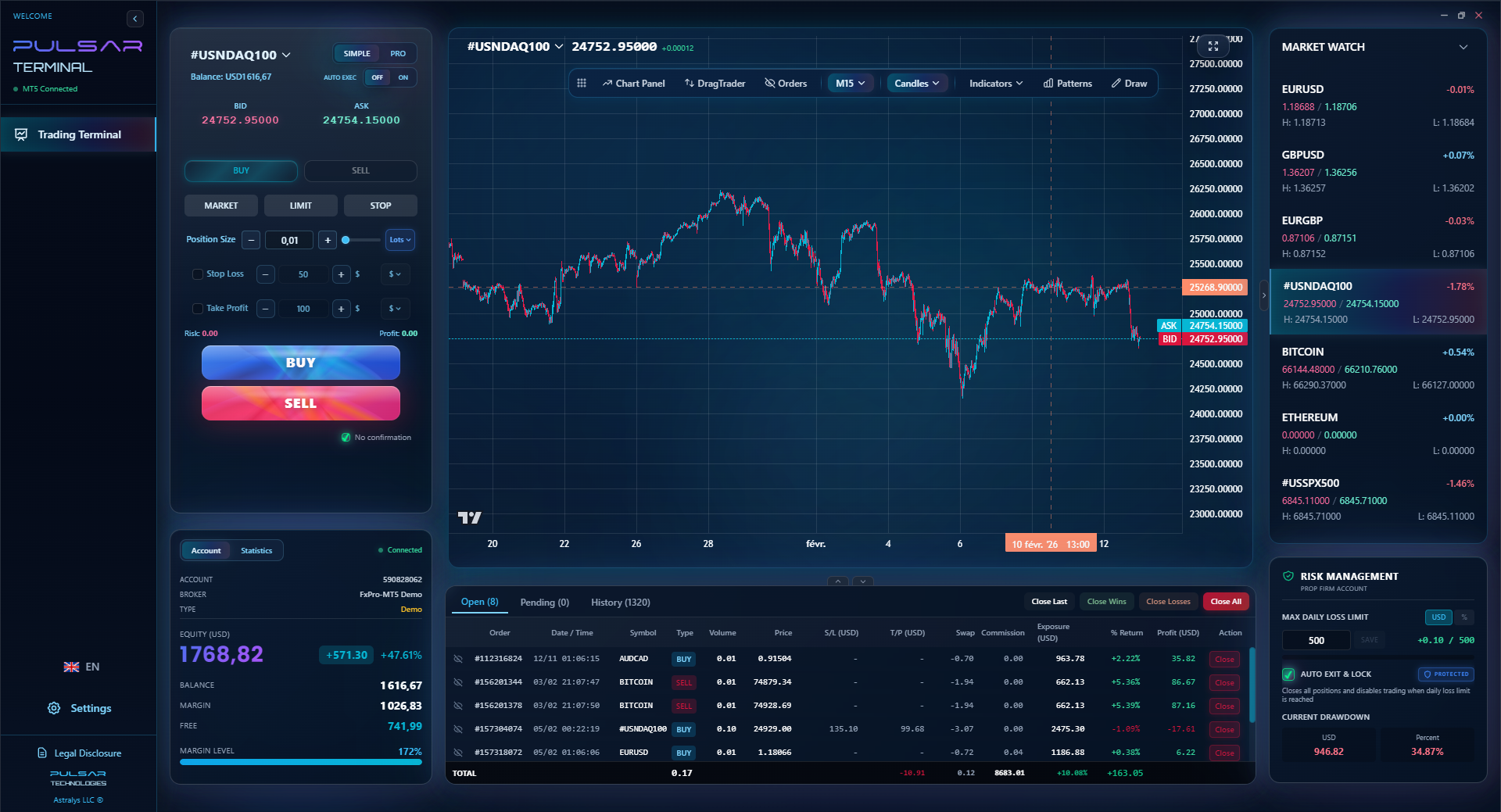
Managing complex orders during the volatile 9 PM SGT overlap is stressful; Pulsar Terminal lets you drag-and-drop multi-TP/SL orders and set trailing stops directly on your MT5 chart.
Pulsar Terminal
MT5一站式工具:拖拽下单、多重止盈/止损、追踪止损、网格交易、成交量分布图和自营交易保护。每日1000+交易者使用。
“A quiet market leads to forcing trades where none exist. Boredom is a trader's enemy.”
Let me save you some pain and lost capital.
Mistake 1: Trading Against the Session Flow. Trying to buy the EUR/USD during the dead Asian session (2:00 PM - 4:00 PM SGT) expecting a big rally is usually futile. The big players aren't in the market yet. Wait for the volume.
Mistake 2: Ignoring the Spread. At 5:00 AM SGT, the spread on EUR/USD might be 2.5 pips instead of 0.8. If you're scalping for 5 pips, you've just given half your potential profit to the broker before you even start. Know your costs.
Mistake 3: Overtrading the Quiet Hours. Boredom is a trader's enemy. A quiet market leads to forcing trades where none exist. If the RSI indicator is flatlining and bars are tiny, step away. Use that time for research or backtesting.
Mistake 4: Not Accounting for Daylight Saving Time (DST). The US and UK switch to DST on different dates. This shifts the London and New York open/close times by one hour relative to SGT (which does not observe DST). Twice a year, your 9:00 PM overlap becomes 8:00 PM or 10:00 PM. Mark the change dates in your calendar.
My Costly Lesson: I once held a GBP/USD swing trade over a weekend. A political event broke Sunday night, UK time. The market gapped down massively against me at the Monday open (4:00 PM SGT). I hadn't adjusted my position size for the weekend risk. The loss was far bigger than my usual 1% rule. Now, I either close before the weekend or use a much wider stop if I choose to hold. Understanding the global clock means understanding when you're most vulnerable.
💡 Winston 小贴士
Your home currency, the SGD, has its own personality. Trade it when it's awake (London/NY hours), not just when you are.
“Understanding the global clock means understanding when you're most vulnerable.”
Singapore isn't just a place you trade from, it's becoming a central node in the global forex network. Holding the title of the world's third-largest FX centre, with daily volumes hitting a staggering US$1.485 trillion, means the action is increasingly happening right here in our timezone.
The MAS's push to make Singapore Asia's premier FX liquidity hub means we'll likely see even more activity in Asian pairs and during Asian hours. The USD/SGD's strength and liquidity are direct results of this. As a trader here, you have a front-row seat.
This also means more competition and potentially smarter, faster markets. The old tricks might not work. It puts a premium on having strong tools, a clear schedule, and a disciplined strategy that respects the market's rhythms, not fights against them. Your edge isn't just in analysis, but in execution and timing tailored to the Singapore forex trading time reality.
FAQ
Q1What is the best time to trade forex in Singapore?
The single best time is the London-New York session overlap, from 9:00 PM to 12:00 AM Singapore Time (SGT). This period has the highest liquidity and volatility, providing the cleanest price action for major pairs like EUR/USD and GBP/USD.
Q2When is the USD/SGD pair most active?
USD/SGD sees peak activity during the London session and the early New York session. A particularly busy window is often between 1:00 AM and 2:00 AM SGT (5:00-6:00 PM GMT), when European and US liquidity overlaps for Asian currencies.
Q3Can I trade forex in Singapore at night?
Absolutely. The New York session runs from 9:00 PM to 6:00 AM SGT. Many Singapore-based traders actively trade the first half of this session (9:00 PM - 12:00 AM) to capture the London/New York overlap. Trading later into the night (e.g., for US data releases) is also possible but requires adjusting your sleep schedule.
Q4Do trading times change in Singapore?
Singapore Time (GMT+8) does not change for daylight saving. However, the opening times for London and New York do shift by one hour when those regions enter or exit Daylight Saving Time (DST). This means the key 9:00 PM overlap in SGT will start at 8:00 PM or 10:00 PM for part of the year. You must track UK and US DST dates.
Q5Is the Asian session good for trading?
The Asian session (roughly 5:00 AM - 5:00 PM SGT) is good for certain strategies. It's ideal for trading AUD, JPY, NZD, and SGD pairs. The action is often more range-bound than the London/NY overlap, making it suitable for range-trading strategies or setting up for breakouts later in the day.
Q6What should I avoid trading during Singapore lunch hours?
Avoid trying to trade major EUR or GBP pairs aggressively between about 12:00 PM and 4:00 PM SGT. This is the lull between the Asian close and the London open. Liquidity is low, spreads can widen, and price action is often choppy and directionless.
Q7How does MAS regulation affect my trading schedule?
MAS regulation itself doesn't change market hours. However, their strict rules (like client money segregation) ensure the brokers you trade with are secure, which is crucial if you're holding positions overnight or over weekends. Their 5% margin guideline for local brokers also encourages sensible position sizing, a key to surviving all market hours.
Winston 教授的课程
要点总结:
- ✓Trade the 9 PM - 12 AM SGT overlap for highest probability.
- ✓USD/SGD is most active during London/NY hours, not SGT daytime.
- ✓Always account for US/UK Daylight Saving time shifts.
- ✓Wider spreads in low-liquidity hours kill scalping profits.
- ✓Match your strategy (scalp, swing) to the appropriate session.
这篇文章对您有用吗?
点击星星评分
每周交易洞察
免费每周分析与策略。无垃圾邮件。
关于作者
Daniel Harrington
内容总监
The Trading Mentor内容主管。资深交易者,致力于让复杂的交易概念通俗易懂。涵盖全球话题、策略和平台指南。
评论
风险提示
金融工具交易存在重大风险,可能不适合所有投资者。过往业绩不代表未来表现。本内容仅供教育目的,不构成投资建议。在交易前请务必自行研究。
您可能还喜欢

Cara Trading Forex Sukses: 7 Prinsip dari Trader Profesional
Cara trading forex sukses dengan 7 prinsip trader pro: manajemen modal, disiplin, journal trading, backtest. Data nyata, bukan janji profit palsu.
Jam Trading Forex Terbaik untuk Trader Indonesia: Panduan Lengkap dengan Tabel Waktu
Panduan jam trading forex untuk trader Indonesia. Tabel 4 sesi dunia, jam emas 20:00-00:00, sesi mana yang harus dihindari. Data akurat + tips dari trader berpengalaman.
Top 5 Sàn Forex Uy Tín Nhất 2026: Review Jujur dari Trader Indonesia
Top 5 sàn forex uy tín 2026 untuk trader Indonesia. Review jujur: spread, deposit, withdraw, dukungan lokal. Exness, XM, IC Markets & lebih.
