


I was staring at my screen, my finger hovering over the sell button on EUR/USD.

David van der Merwe
新兴市场交易员 ·  South Africa
☕ 9 分钟阅读
您将学到:
- 1A Transaction Isn't Just a Trade
- 2The Hidden Costs for South African Traders
- 3How to Calculate Your Real Break-Even Point
- 4Broker Selection: It's All About Transaction Costs
- 5Strategies to Minimize Transaction Friction
- 6The Psychology of Paying the Toll
- 7Putting It All Together: Your SA Transaction Checklist
I was staring at my screen, my finger hovering over the sell button on EUR/USD. The price was 1.1050. My analysis was solid, my stop-loss was set. I clicked. The confirmation window flashed: 'Order Filled at 1.1048.' Just like that, R40 per standard lot was gone before the market even had a chance to move. That two-pip difference wasn't bad luck. It was the cost of doing business, the silent partner in every single trade you make. Most traders in SA fixate on finding the perfect entry. They're missing the point. Your first opponent isn't the market; it's the transaction itself.
When you think 'trade,' you picture buying low and selling high. A forex transaction is the mechanical, often brutal, process of making that happen. It's the bridge between your idea and the live market, and it's a toll road. Every component has a cost measured in South African Rand.
Think of it like buying a car. The sticker price is the mid-market rate. But you don't pay that. You pay the dealer's spread (their profit), a delivery fee (commission, if any), and you might even haggle and get a slightly worse price than advertised (slippage). In forex, you're the buyer, and your broker is the dealer. The spread is their primary cut. For major pairs like EUR/USD, a good raw spread might be 0.1 pips with a commission on top, while a standard account might have a 1.5 pip spread baked in. That's the first, and often biggest, chunk of your transaction cost.

Example: Let's make it real with ZAR. You buy 1 standard lot (100,000 units) of USD/ZAR at an offered price of 18.50. The bid price is 18.48. That's a 2 pip spread. 1 pip on USD/ZAR is roughly R10 (for a standard lot, with ZAR as the quote currency). Your trade is R200 in the red the moment it's filled. You need the market to move 2 pips just to break even on the transaction cost alone. That's your starting line.
“Your first opponent isn't the market; it's the transaction itself.”
The ZAR Conversion Double-Dip
This one stings. You fund your account with Rands. Your broker (even international ones) converts it to USD at their rate, which always includes a markup. When you withdraw profits? They convert USD back to ZAR, again with their markup. I've seen effective fees of 1-2% on these conversions. On a R10,000 deposit and a R15,000 withdrawal, that's R250-R500 vanishing without a single trade being placed. It's a silent tax on your capital.
Overnight Financing (Swap Rates)
Holding a position past 5pm New York time (midnight-ish SA time) triggers a swap charge or credit. It's the interest rate differential between the two currencies. For a ZAR-based pair, this can be massive. I learned this the hard way holding a short USD/ZAR position over a weekend. The swap was -R75 per lot per night. Over three nights, that was R225 gone, eating into my paper profits. It's not a hidden fee, but most new traders ignore it until it hits their statement. You can check our guide on XAU/USD to see how swaps work on non-forex assets too.
The Slippage Surprise
You set a market order during the London open on GBP/USD. You click at 1.2850. Your fill comes back at 1.2847. That's 3 pips of slippage. In fast markets or on exotic pairs, this gets ugly. I once had 15 pips of slippage on USD/TRY during a news event. My planned 1% risk trade instantly became a 1.5% loss. Slippage is the market's way of telling you your order isn't as important as the orders in front of it.

Warning: Many local 'bucket shop' brokers offer zero spreads. Sounds great, right? It's not. They make money by trading against you or by adding massive markups on the rollover swaps. You always pay. The question is how and when.

💡 Winston 小贴士
A trader once told me he had a 55% win rate but was losing money. I asked for his trade log. He wasn't logging the spread. His 'winners' were often just covering costs. His real win rate, after the transaction, was below 50%. Log the *fill price*, not the price you clicked.
“You always pay. The question is how and when.”
Most traders think: "I'm up 5 pips, I'm in profit." Wrong. You're in profit when you've covered the total cost of the forex transaction. Here's the formula you need to tattoo in your mind:
Real Break-Even (in pips) = Spread + Commission (in pip equivalent) + Slippage Buffer
Let's run the numbers for a common SA scenario using a broker like IC Markets on a Raw Spread account.
| Cost Component | EUR/USD Example | USD/ZAR Example |
|---|---|---|
| Spread | 0.1 pips | 2.5 pips |
| Commission | $7 per lot round turn = ~0.7 pips | $7 per lot = ~0.7 pips (but in ZAR terms) |
| Slippage Buffer | 0.5 pips (conservative) | 2.0 pips (volatile pair) |
| Total Transaction Cost | 1.3 pips | 5.2 pips |
See the difference? On USD/ZAR, you need over 5 pips of favorable movement just to cover costs. This is why scalping volatile exotic pairs is a nightmare for most. Your strategy's edge must be larger than this transaction cost hurdle. Use our position size calculator and input your real spread, not the advertised one, to see the true impact on your risk.
“You always pay. The question is how and when.”
Choosing a broker isn't about who has the flashiest platform. It's about who provides the most efficient forex transaction. For South Africans, you need to look at three things beyond regulation.
1. The Spread & Commission Structure: Are you a high-volume trader? A raw spread account with a commission (like Pepperstone's Razor account) is cheaper. Trade a few times a month? A standard spread account might be simpler. Always compare the all-in cost: spread + commission converted to pips.
2. Deposit/Withdrawal Fees in ZAR: This is critical. Does the broker offer free local ZAR deposits via EFT? How long do withdrawals take back to your FNB or Standard Bank account? Some international brokers partner with local payment processors to make this seamless. Others don't, and you'll pay international wire fees (R150+ each way).
3. Execution Quality: This is the slippery one. You want a broker that offers Straight Through Processing (STP) or true ECN execution. This means your order goes to the interbank market, not to the broker's dealing desk. The result? Tighter spreads, less requoting, and generally fairer slippage (it can go in your favor too!). I switched to an ECN broker years ago, and the reduction in 'mystery' slippage on news trades was immediate. Check reviews focusing on execution, like our Exness review, to see how they handle volatile periods.
💡 Winston 小贴士
The market's job is to create volatility. Your broker's job is to monetize your access to it. Your job is to ensure the former is greater than the latter. Most get this equation backwards.
“On USD/ZAR, you need over 5 pips of favorable movement just to cover costs.”
You can't eliminate costs, but you can outsmart them.
Trade in the Right Sessions: The spread on EUR/USD is often 0.2 pips during the London/New York overlap. At 3am SA time? It can widen to 2 pips. Trading during peak liquidity hours directly cuts your biggest cost.
Use Limit Orders, Not Market Orders: A buy limit order is placed below the current price. You're saying "I'll only buy if the market comes down to my price." This bypasses the spread. You pay the spread only when the order is filled, and if you're patient, you might get a better entry. This is a core tactic for swing trading approaches.
Avoid Exotics Until You're Serious: USD/ZAR, EUR/TRY, etc. The spreads are huge. Stick to majors (EUR/USD, GBP/USD, USD/JPY) and minors (EUR/GBP, AUD/USD) when building your first R50,000. The transaction costs are lower, giving your strategy room to breathe.
Factor Costs Into Your Backtesting: If your beautiful backtest on MACD indicator crossovers shows a 10-pip average win, but you didn't account for a 3-pip round-turn cost, your strategy is actually a 7-pip winner. That changes everything. Always deduct estimated transaction costs from your historical trade results.

Pro Tip: Before you hit buy, do this mental check: "What is the all-in cost of this forex transaction in Rands? Is my target at least 2.5 times that amount?" If not, your risk/reward is probably garbage, even if the chart looks perfect.
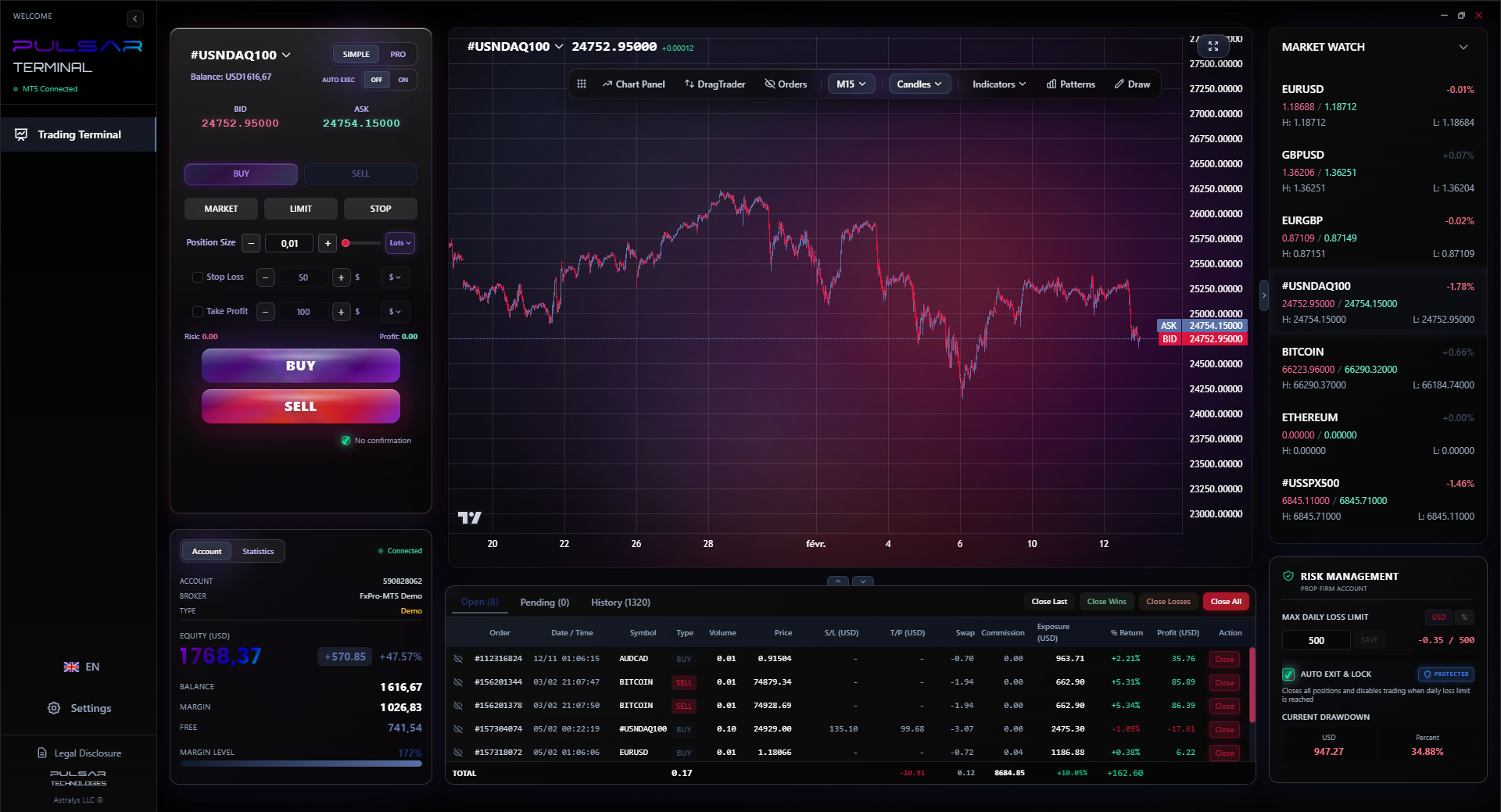
Manually calculating breakeven points for every trade is tedious; Pulsar Terminal can automate this and display your net P&L including costs directly on your MT5 chart.
Pulsar Terminal
MT5一站式工具:拖拽下单、多重止盈/止损、追踪止损、网格交易、成交量分布图和自营交易保护。每日1000+交易者使用。
“On USD/ZAR, you need over 5 pips of favorable movement just to cover costs.”
This is where accounts blow up. You take a trade, and it goes 4 pips into profit. "Great!" But your real break-even, after costs, is at 5 pips. It then reverses and hits your stop-loss. On your screen, it shows a 10 pip loss. In reality, with costs, it was an 11.3 pip loss. You think, "My stop was too tight," and you widen it next time.
That's the fatal error. You're adjusting your strategy to compensate for transaction costs you're not properly accounting for. You start taking smaller profits faster (to 'beat' the cost), which ruins your win rate. Or you let losers run, hoping to turn them around, because the initial cost makes the loss feel worse.
I had a brutal month where I was 'right' on direction 60% of the time but still lost money. I was scalping for 5-7 pip targets on EUR/USD with a 1.5 pip cost. My edge was too thin. The transaction friction burned it all away. I was a hamster on a wheel, working for the broker. Accepting that every trade starts with a deficit changes your entire approach. It forces quality over quantity. It makes you wait for the A+ setup, not jump on the B- one.
💡 Winston 小贴士
If you can't articulate the exact Rand cost of your next trade before you enter it, you are not trading. You are gambling with an undisclosed house edge.
“Accepting that every trade starts with a deficit changes your entire approach.”
Before your next trade, run down this list:
- Know Your All-In Pip Cost: (Spread + Commission in pips). For a scalping strategy, this number must be tiny (< 1 pip on majors).
- Check the Session: Is the market liquid, or are spreads wide because SA is the only one awake?
- Use the Right Order: Can a limit order get me in without crossing the spread?
- Calculate Real Targets: Minimum target = (Transaction Cost x 2.5). If your cost is 2 pips, don't take a trade for a 5 pip target.
- Mind the Swap: If holding >1 day, check the swap rate. A positive swap can be a small tailwind. A negative one is a headwind.
- Withdrawal Plan: Have you factored the ZAR conversion cost into your overall profit goal?
The forex transaction is the gatekeeper. It filters out the unprepared. The traders who survive in Johannesburg, Cape Town, or Durban aren't the ones with the magic indicator. They're the ones who treat every trade like a business deal, where the overhead is the first line on the spreadsheet. Master the cost, and you give yourself a fighting chance against the market itself. Ignore it, and you're just donating your Rands, one filled order at a time.
FAQ
Q1What is the biggest transaction cost for a typical South African forex trader?
For most, it's the spread, especially on ZAR pairs like USD/ZAR. A 2-5 pip spread on a volatile pair can mean you need hundreds of Rands of movement just to break even. The second biggest is often the hidden ZAR-USD conversion fees on deposits and withdrawals.
Q2Is a 'zero spread' account a good idea?
Almost never. Brokers aren't charities. They recover costs through other means, like massive slippage, wider spreads during volatility, or horrible swap rates. You're better off with a transparent, low raw spread plus a small commission from a reputable ECN broker.
Q3How do I calculate the commission in pips?
Divide the total round-turn commission (in USD) by the pip value (in USD). Example: $7 commission on EUR/USD. 1 pip on EUR/USD = $10. So, $7 / $10 = 0.7 pips. Add that to the raw spread to get your total cost.
Q4Can slippage ever be positive?
Yes, with good ECN execution. If you place a market buy order and liquidity is deep, you might get filled at a better price than you clicked (e.g., you click at 1.1050, get filled at 1.1049). This is rare but happens, effectively reducing your transaction cost.
Q5Why does my profit in USD look different when converted to ZAR in my bank account?
Two reasons: 1) Your broker uses their own conversion rate, which includes a markup. 2) The USD/ZAR exchange rate changes between when you profit and when you withdraw. A stronger ZAR when you cash out reduces your final profit in Rands.
Q6Should I avoid trading USD/ZAR because of the high spread?
Not necessarily, but you must adjust. Your trading edge (your strategy's expected profit) must be significantly larger than the 4-6 pip transaction cost. This makes scalping very difficult. Swing or position trading with wider stops and larger targets is more suitable for high-spread exotics.
Q7What's one quick way to reduce my transaction costs today?
Switch from market orders to limit orders where possible, and only trade major currency pairs during the London (3pm SAST) or New York (4pm SAST) market overlaps when spreads are at their tightest.
Winston 教授的课程
要点总结:
- ✓Every trade starts at a loss equal to the spread + commission.
- ✓ZAR conversion fees can silently take 1-2% of your capital.
- ✓Calculate your real break-even point before entering any trade.
- ✓Your strategy's edge must be larger than your transaction cost.
这篇文章对您有用吗?
点击星星评分
每周交易洞察
免费每周分析与策略。无垃圾邮件。
关于作者
David van der Merwe
新兴市场交易员
约翰内斯堡交易者,11年新兴市场货币经验。专注于ZAR货币对、FSCA监管交易和南非市场分析。
评论
风险提示
金融工具交易存在重大风险,可能不适合所有投资者。过往业绩不代表未来表现。本内容仅供教育目的,不构成投资建议。在交易前请务必自行研究。
您可能还喜欢

Cara Trading Forex Sukses: 7 Prinsip dari Trader Profesional
Cara trading forex sukses dengan 7 prinsip trader pro: manajemen modal, disiplin, journal trading, backtest. Data nyata, bukan janji profit palsu.
Jam Trading Forex Terbaik untuk Trader Indonesia: Panduan Lengkap dengan Tabel Waktu
Panduan jam trading forex untuk trader Indonesia. Tabel 4 sesi dunia, jam emas 20:00-00:00, sesi mana yang harus dihindari. Data akurat + tips dari trader berpengalaman.
Top 5 Sàn Forex Uy Tín Nhất 2026: Review Jujur dari Trader Indonesia
Top 5 sàn forex uy tín 2026 untuk trader Indonesia. Review jujur: spread, deposit, withdraw, dukungan lokal. Exness, XM, IC Markets & lebih.
