


Most forex tutorials for beginners are a straight-up lie.

David van der Merwe
新兴市场交易员 ·  South Africa
☕ 9 分钟阅读
您将学到:
- 1The Biggest Myth About Forex
- 2Your Only Real Edge: Risk Management
- 3Understanding Pips, Spreads, and the Real Cost of Trading
- 4Choosing a Broker in South Africa: The FSCA & Deposits
- 5Building Your First Trading Plan (The Simple Version)
- 6Potholes on the Road: Common Beginner Mistakes
- 7The Bridge: From Tutorials to Live Trading
Most forex tutorials for beginners are a straight-up lie. They sell you a dream of fast cars and beachside laptops, skipping the brutal reality that 90% of new traders lose their money. I know because I was part of that 90% for my first two years. This isn't another 'get rich quick' guide. It's a risk manager's breakdown of the three foundational truths every South African beginner must understand before placing a single trade. I'll show you the math, the mistakes, and the mindset that actually leads to survival.
The biggest lie in forex is that it's a shortcut to wealth. It's not. It's a high-stakes probability game where the house (the market) has no rules. Your edge isn't a secret indicator; it's disciplined risk management.
I learned this the hard way in 2012. I'd read all the tutorials, mastered the MACD indicator and RSI, and felt invincible. Then the SARB made an unexpected comment on the Rand. My USD/ZAR trade, which was way too big, moved 300 pips against me in minutes. I didn't have a stop loss because I was 'sure' it would come back. It didn't. I lost R8,000 in one afternoon - over 40% of my account. That was my tuition fee.
For you, starting in South Africa, the myth is doubly dangerous. We see USD/ZAR moving 1000 pips in a week and think, 'Imagine the profit!' What we don't see is the volatility that can wipe us out just as fast. A proper forex tutorial for beginners should start with loss, not profit.

Warning: If a tutorial promises consistent monthly returns or downplays risk, close it. They are selling a fantasy, not education. Real trading is a grind of small, managed bets over years.
Your analysis might be wrong half the time. Your risk management must be perfect 100% of the time. This is the core lesson missing from most forex tutorials for beginners.
The 1% Rule is Non-Negotiable
Never risk more than 1% of your trading capital on a single trade. If you have a R10,000 account, that's R100 max risk per trade. This isn't a suggestion; it's the rule that keeps you in the game after a string of losses. I break my own trades down using a simple position size calculator every single time.
Let's say you're trading GBP/ZAR. Your entry is R23.50, and your stop loss is at R23.35. That's a 15-pip stop. If each pip on a standard lot is roughly R130, your risk is huge. But with a micro lot (1,000 units), that pip value drops to about R1.30. Your total risk on that 15-pip stop would be R19.50 - well within your R100 limit. This is the boring math that saves you.
The Stop Loss is Your Best Friend
A stop loss isn't a sign of weakness. It's a pre-defined price where your thesis is proven wrong. Not placing one is like driving without a seatbelt. You might be fine for a while, but one accident is catastrophic. I've seen more accounts hit a margin call from one unstopped trade than from ten stopped-out ones.

Example:
- Account: R20,000
- 1% Risk: R200 per trade
- Trade: Buy EUR/USD at 1.0850
- Stop Loss: 1.0820 (30 pips risk)
- Pip Value Needed: R200 / 30 pips = R6.67 per pip
- Lot Size: You'd need to trade roughly 0.07 lots to achieve this risk. A broker like IC Markets or Pepperstone allows this precision.

💡 Winston 小贴士
The market doesn't owe you a profit for your clever analysis. It only pays you for being right and managing risk when you're wrong.
“Your analysis might be wrong half the time. Your risk management must be perfect 100% of the time.”
You don't make money on the entry price. You make money on the spread - the difference between the buy and sell price. For South Africans, this gets tricky with exotic pairs like USD/ZAR.
A pip in EUR/USD is 0.0001. In USD/ZAR, it's 0.0010. But the value is different. The spread on EUR/USD might be 1 pip. On USD/ZAR, it can be 80 pips or more during volatile sessions. That means your trade starts 80 pips in the red. You have to overcome that just to break even.
I made this mistake early on. I was scalping USD/ZAR, thinking small moves were easy money. I didn't factor in the 50-pip spread. I'd win 30 pips on a move, but after costs, I was actually down 20. The broker made money; I didn't. This is why I stick to majors like EUR/USD for short-term strategies. The lower spread gives my strategy a chance.
Here’s a quick comparison for a South African perspective:
| Pair | Typical Spread (pips) | What It Means for a R10,000 Account |
|---|---|---|
| EUR/USD | 0.8 - 1.5 | Low cost of entry. Good for beginners. |
| USD/ZAR | 50 - 150 | High cost. You need a much bigger price move to profit. |
| GBP/USD | 1.5 - 2.5 | Moderate cost. More volatile than EUR/USD. |
Choose your battles wisely. Starting with USD/ZAR because it's 'familiar' is a common, expensive error.
This is critical. You must use a broker regulated by the Financial Sector Conduct Authority (FSCA). It's your only real protection. An unregulated broker can disappear with your money, and you'll have zero recourse.
I've tested most of the major ones. For beginners, I look for three things: FSCA regulation, low minimum deposits (so you can start small and learn), and a reliable platform like MetaTrader 4 or 5.
- Exness: Offers ZAR accounts and local deposit options. Their spreads can be very tight, which is good. Just be aware of swap rates on held positions.
- XM: Well-regulated and has a strong educational section, which aligns with needing good forex tutorials for beginners. Their customer support is decent.
- IC Markets: My personal favourite for raw spreads and execution speed. More suited once you have a strategy you're confident in.

Pro Tip: Never deposit more than you can afford to lose completely. Start with a demo account, then move to a live account with the smallest possible deposit - maybe R2,000. Trade with 0.01 lots (micro lots) until your risk management is automatic. The goal is to learn, not to get rich on day one.
“Starting with USD/ZAR because it's 'familiar' is a common, expensive error.”
A trading plan isn't a complex 50-page document. It's a one-page checklist that removes emotion. Here’s what mine looked like when I started making real progress.
1. The Instrument: I will only trade EUR/USD and XAU/USD (gold). I will avoid USD/ZAR until I am consistently profitable for 6 months. 2. The Strategy: I will use a simple trend-following approach on the 4-hour chart. I will only enter if price is above the 200-period moving average for longs, below for shorts. I will use the RSI indicator to identify overbought/oversold conditions within the trend. 3. The Risk: I will never risk more than 1% of my account. I will calculate my position size before every trade. My stop loss will be placed at the recent swing low/high. 4. The Daily Loss Limit: If I lose 3% of my account in a day, I stop trading. I close the platform and walk away. 5. The Weekly Review: Every Saturday, I will review all my trades. Why did I enter? Did I follow my plan? What did the market teach me?
This plan forced discipline. It stopped me from jumping into every shiny opportunity. I remember one week where I hit my 3% daily loss limit on a Tuesday. It was frustrating, but stopping saved me from a 10% loss week. That's the power of a plan.
💡 Winston 小贴士
Your first profit target should always be to keep your job or main income source. Trading income is unstable; don't bet your rent on it.
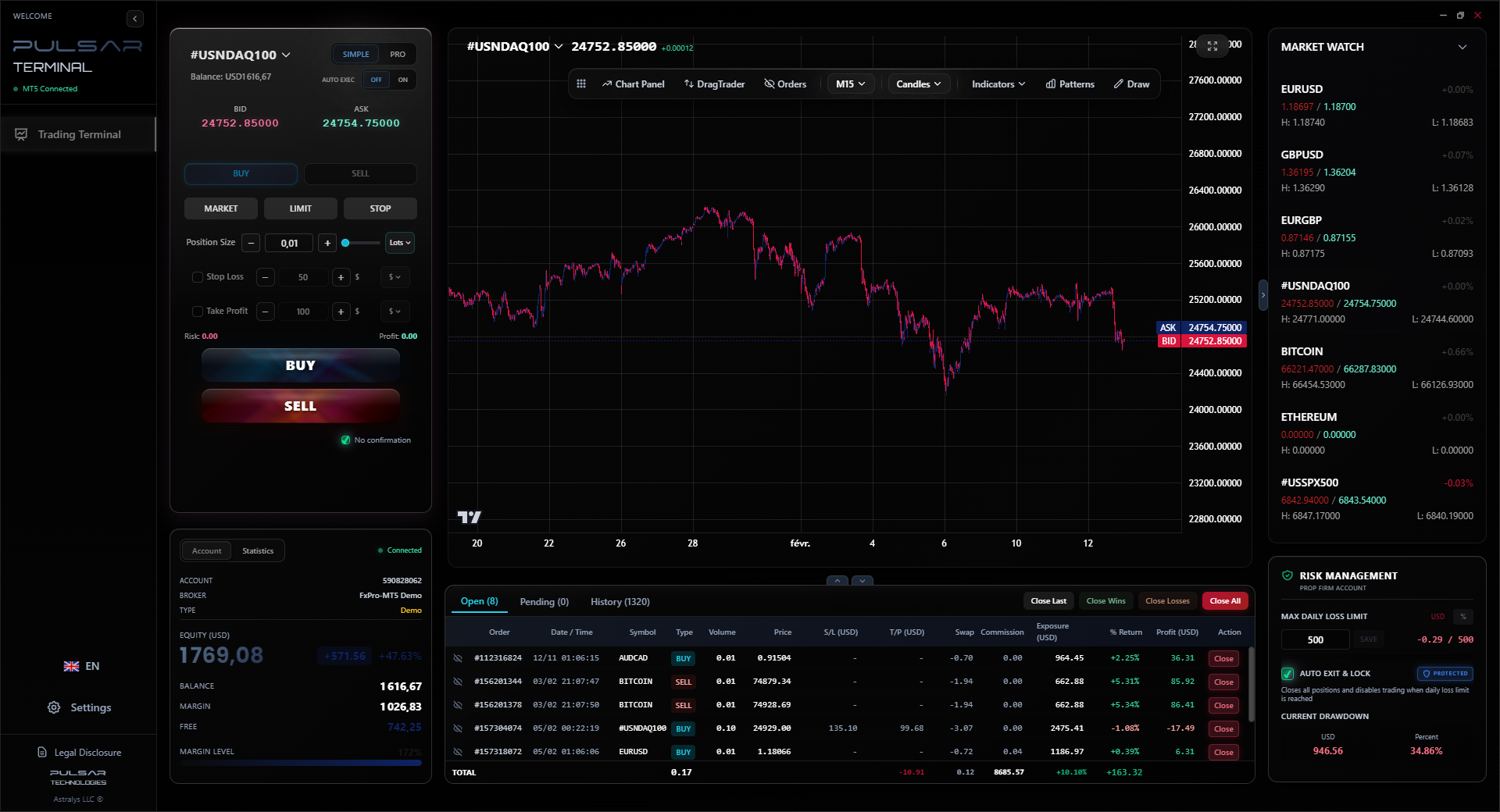
Sticking to a detailed trading plan is hard when emotions run high, but a tool like Pulsar Terminal can automate your risk rules and trade management directly on MT5.
Pulsar Terminal
MT5一站式工具:拖拽下单、多重止盈/止损、追踪止损、网格交易、成交量分布图和自营交易保护。每日1000+交易者使用。
Let's map out the specific potholes so you can steer around them.
Chasing Losses: You lose R100 on a trade. Your plan says stop. Your ego says, 'Double up on the next one to get it back.' This is how R100 losses become R1000 losses. I've been there. It feels awful.
Overtrading: This isn't a job where activity equals productivity. Sometimes the best trade is no trade. In my first year, I felt I had to be in the market constantly. Most of those trades were noise, not opportunity.
Ignoring Fundamentals: As a swing trader, you can't just look at charts. If you're in a USD/ZAR trade and the US Federal Reserve is speaking, you are gambling, not trading. Economic calendars are free. Use them.
Falling for 'Sure Thing' Signals: Anyone selling you guaranteed signals is a scammer. Full stop. If their system was so foolproof, they'd be using it to trade their own billion-dollar fund, not selling it to you for R500 a month.
The common thread in all these mistakes? Emotion overriding logic. Your trading plan is the logic. Stick to it.
“The traders who rush are the ones funding the accounts of the traders who didn't.”
Knowledge without application is useless. Here's your step-by-step bridge.
Weeks 1-4: Demo Account. Don't just mess around. Treat it like real money. Start with a virtual R50,000. Practice your plan. Execute 20-30 trades. Your goal isn't profit; it's consistency in following your rules. Use this time to get fluent with your broker's platform.
Weeks 5-8: Live Micro Account. Deposit the minimum, say R2,000 with a broker like Pepperstone. Trade 0.01 lots only. The money is real, so the psychology is real. The amounts are small, so mistakes are cheap lessons. Your goal here is to make the transition from demo to live without the panic.
Month 3 Onwards: Evaluation. Are you following your plan? Are you emotionally stable after a loss? If yes, you can consider slowly scaling your position sizes, but keep that 1% risk rule sacred.
This process seems slow. It is. But the traders who rush this phase are the ones funding the accounts of the traders who didn't. I funded a lot of accounts before I learned to slow down.
FAQ
Q1How much money do I need to start forex trading in South Africa?
Technically, you can start with as little as R500 with some brokers. Realistically, I'd recommend at least R2,000-R5,000. This allows you to trade micro lots (0.01) and properly implement the 1% risk rule without your position size being rounded down to zero. The key is that this should be money you can afford to lose completely.
Q2What is the best time to trade forex in South Africa?
The most liquid and volatile sessions overlap when both London and New York are open. That's from 3:00 PM to 6:00 PM South African time. This is when spreads are often tightest on major pairs like EUR/USD. Trading USD/ZAR is most active during local business hours (9 AM - 5 PM SAST).
Q3Can I really make a living from forex trading as a beginner?
Absolutely not. Anyone who tells you that is lying. Treat it as a skill you're learning over years. Start by aiming to preserve your capital, then aim for small, consistent gains. The vast majority of profitable traders have other sources of income, especially in the first 3-5 years. Thinking of it as a 'side hustle' is a much healthier mindset.
Q4What's more important, technical or fundamental analysis?
For beginners, focus on technical analysis - learning to read price action and charts. It's more rule-based. However, you must be aware of major fundamental events (like SARB interest rate decisions or US Non-Farm Payrolls) because they can override any technical setup. Never hold a trade through a major news event you don't understand.
Q5How do I handle the emotional stress of losing trades?
You pre-handle it with your trading plan. If you know you'll only ever lose R100 on a trade (1% of a R10k account), the stress is manageable. The panic comes from undefined, uncontrolled risk. Also, having a daily loss limit (like 3%) forces you to walk away before emotion takes over. It's a circuit breaker for your psychology.
Q6Is forex trading taxable in South Africa?
Yes. Profits from forex trading are considered capital gains or income by SARS, depending on your trading frequency and intent. If you're trading actively, it's likely to be seen as income. You must keep detailed records of all your trades, including entries, exits, and profits/losses. Consult a tax professional who understands trading.
Winston 教授的课程
要点总结:
- ✓Risk a maximum of 1% per trade. Always.
- ✓A stop loss is not optional. It's your lifeline.
- ✓Avoid exotic pairs like USD/ZAR as a beginner.
- ✓Choose only FSCA-regulated brokers.
- ✓A trading plan beats a trading guess every time.
这篇文章对您有用吗?
点击星星评分
每周交易洞察
免费每周分析与策略。无垃圾邮件。
关于作者
David van der Merwe
新兴市场交易员
约翰内斯堡交易者,11年新兴市场货币经验。专注于ZAR货币对、FSCA监管交易和南非市场分析。
评论
风险提示
金融工具交易存在重大风险,可能不适合所有投资者。过往业绩不代表未来表现。本内容仅供教育目的,不构成投资建议。在交易前请务必自行研究。
您可能还喜欢

Cara Trading Forex Sukses: 7 Prinsip dari Trader Profesional
Cara trading forex sukses dengan 7 prinsip trader pro: manajemen modal, disiplin, journal trading, backtest. Data nyata, bukan janji profit palsu.
Jam Trading Forex Terbaik untuk Trader Indonesia: Panduan Lengkap dengan Tabel Waktu
Panduan jam trading forex untuk trader Indonesia. Tabel 4 sesi dunia, jam emas 20:00-00:00, sesi mana yang harus dihindari. Data akurat + tips dari trader berpengalaman.
Top 5 Sàn Forex Uy Tín Nhất 2026: Review Jujur dari Trader Indonesia
Top 5 sàn forex uy tín 2026 untuk trader Indonesia. Review jujur: spread, deposit, withdraw, dukungan lokal. Exness, XM, IC Markets & lebih.
