


I was staring at my screen in late 2024, watching a free signal from a popular Telegram group scream 'BUY GBP/NGN NOW!' The chart was a mess, Naira volatility was insane, and my gut said run.

Olumide Adeyemi
西非交易先驱 ·  Nigeria
☕ 9 分钟阅读
您将学到:
- 1What Are Free Forex Signals, Really?
- 2The Hidden Costs Nobody Mentions
- 3How to Spot a Scam Signal (The Nigerian Edition)
- 4When Signals Can Actually Be Useful (A Little)
- 5Forget Following: Build Your Own Signal System
- 6The Nigerian Market Realities You Can't Ignore
- 7The Final Verdict from a 12-Year Veteran
I was staring at my screen in late 2024, watching a free signal from a popular Telegram group scream 'BUY GBP/NGN NOW!' The chart was a mess, Naira volatility was insane, and my gut said run. I ignored it, took the trade, and watched 80,000 Naira evaporate in 45 minutes. That loss, more than any win, taught me the brutal reality about free forex signals. Everyone promises the moon, especially here in Nigeria where the dream of dollar gains is so strong. Let's cut through the noise. I'll show you what these signals are really worth, how to spot the fakes, and when - if ever - they might actually help you.
A free forex signal is just a suggested trade someone else gives you. It usually says something like 'Buy EUR/USD at 1.0850, stop loss at 1.0820, take profit at 1.0900.' They're blasted out on WhatsApp, Telegram, Facebook, and fancy websites. The promise is simple: do the work for you.
Here's the thing nobody tells you upfront. 'Free' is the bait. The business model isn't about you winning. It's about building an audience to sell you a 'premium' service, a course, or a managed account. Or worse, it's a scam where the signal provider is on the other side of your trade.
In Nigeria, this is a huge industry. With the Naira's wild swings - going from around N460 to over N1,500 to the dollar in a few years - everyone's looking for an edge. Signal sellers prey on that desperation. They'll show you screenshots of winning trades (easily faked) and talk about 'insider flows.' Remember, if their strategy was so bulletproof, they'd be trading it with their own millions, not selling it for 5,000 Naira a month.

Warning: The most dangerous signals are for exotic pairs involving the Naira, like USD/NGN or GBP/NGN. Liquidity can be thin, spreads are massive, and the volatility is political, not technical. A 'free signal' here is often a guaranteed way to get stopped out instantly.

💡 Winston 小贴士
A signal without a stated risk-reward ratio is just noise. If they don't tell you where to get out, they're not managing your money, they're gambling with it.
Let's talk numbers, because that's where the 'free' myth falls apart. I learned this the hard way early on.
The Brokerage Fees You Still Pay
That free signal doesn't pay your spreads or commissions. If you're trading a standard account with a broker like Exness or AvaTrade, you might be looking at a 1-pip spread on EUR/USD. On a $10,000 (roughly 15 million Naira) position, that's a $10 cost before the trade even moves. Use a position size calculator to see this in real time. If the signal's profit target is only 15 pips, you've already given up a big chunk of it.
The Tax Man Cometh
This is critical for Nigerian traders. Any profit you make from following a signal is subject to a 10% Capital Gains Tax by the FIRS. It doesn't matter if the signal came from Mars. If you make 500,000 Naira, 50,000 Naira is owed. A 'free' signal just became a lot more expensive. You must factor this into your profit targets.
The Opportunity Cost
This is the big one. Time spent waiting for, analyzing, and blindly following signals is time you're not spending learning to read the charts yourself. I followed signals for my first 18 months. My account went sideways. The month I switched to studying price action and building my own swing trading plan was the month I turned a consistent profit. That lost year and a half? That was the real cost.
“'Free' is the bait. The business model isn't about you winning.”
Nigerian signal sellers have their own playbook. Here’s what to watch for.
The 'CBN Insider' Myth: Anyone claiming to have signals based on 'CBN insider information' or 'forex liquidity flows' is lying. That's illegal, and they're not sharing it on WhatsApp. The CBN's recent reforms, like the new FX Code in 2025, are public knowledge, not trade secrets.
The Guarantee: 'Make 50% return this month, guaranteed!' Run. Forex has no guarantees. The market can wipe out 50% of your capital in a day if you're over-leveraged. This is a classic sign of a margin call waiting to happen.
Vague Entry Points: 'Buy USD soon.' When? At what price? A real signal has exact entry, stop loss, and take profit levels. Vagueness lets them claim victory no matter what happens.
Pressure to Deposit More: 'Your 50,000 Naira account is too small to follow our gold signals. Deposit 500,000 Naira to access the real trades.' This is a wealth transfer - from you to them.
No Losses, Ever: Go through their history. If you never see a losing trade, it's fabricated. I have a 60% win rate, and I'm proud of it. A 40% loss rate is part of the game. Anyone showing 100% wins is cooking the books.

Example: A seller posted a 'live trade' screenshot showing a buy on XAU/USD (gold) for a 100-pip win. I checked the timestamp and the chart. In that exact 30-minute window, gold had actually spiked down 80 pips. The screenshot was edited. Always verify independently.
I'm not saying all signals are useless. Used correctly, they can be a tool, not a crutch. Here's how I've used them.
As a Second Opinion: I have my own trading plan for EUR/USD. Sometimes, I'll check a few reputable sources I trust (not random groups) to see if their analysis aligns with my bias. If I'm thinking buy, and two solid analysts I respect are also highlighting a buy zone, it adds conviction. It never overrules my own rules.
For Learning: Early on, I'd take a signal and then try to reverse-engineer it. Why did they pick that entry? Is it at a key support level? Does it align with the MACD indicator or RSI indicator being oversold? This helped me learn to read the charts.
Finding Reputable Sources: Look for analysts who:
- Share their live track record with verified results (like Myfxbook).
- Explain the reasoning behind the trade (e.g., 'Buying at this Fibonacci retracement level because of weekly support').
- Regularly post their losses, not just wins.
- Are transparent about their brokerage relationships. Some good international brokers like Pepperstone or IC Markets host credible educational analysts.
Remember, even a good signal is useless if your trade execution is poor. You need to understand spreads, pips, and how to manage the trade once it's live.
💡 Winston 小贴士
Backtest any signal provider's 'method' on three months of old data yourself. If you can't replicate their wins, they don't have a method.
“Time spent blindly following signals is time you're not learning to read the charts yourself.”
This is the only way to long-term success. You need to become the signal generator. It's work, but it's liberating.
Start with One Pair: Don't try to trade everything. Master EUR/USD or XAU/USD. Learn its personality, its average daily range, when it's most active.
Develop a Simple Checklist: My first profitable system was just three things:
- Price at a clear support or resistance level on the 4-hour chart.
- RSI indicator showing divergence (price makes a new low, but RSI makes a higher low).
- A candlestick pattern (like a pin bar) showing rejection at that level.
Only when all three boxes were ticked would I take a trade. This filtered out 90% of the noise.
Backtest and Journal: Before risking a kobo, test your checklist on old charts. Write down every hypothetical trade. Then, when you go live with small money, journal every real trade - your emotion, the setup, the outcome. I still have my journal from 2016 where I wrote 'Felt greedy, ignored stop loss, lost 2%.' That lesson was worth more than any signal.
Use Tech to Your Advantage: Instead of relying on someone else's Telegram message, use tools that help you execute your own plan better. Managing multiple take-profit levels and moving stops manually is stressful.

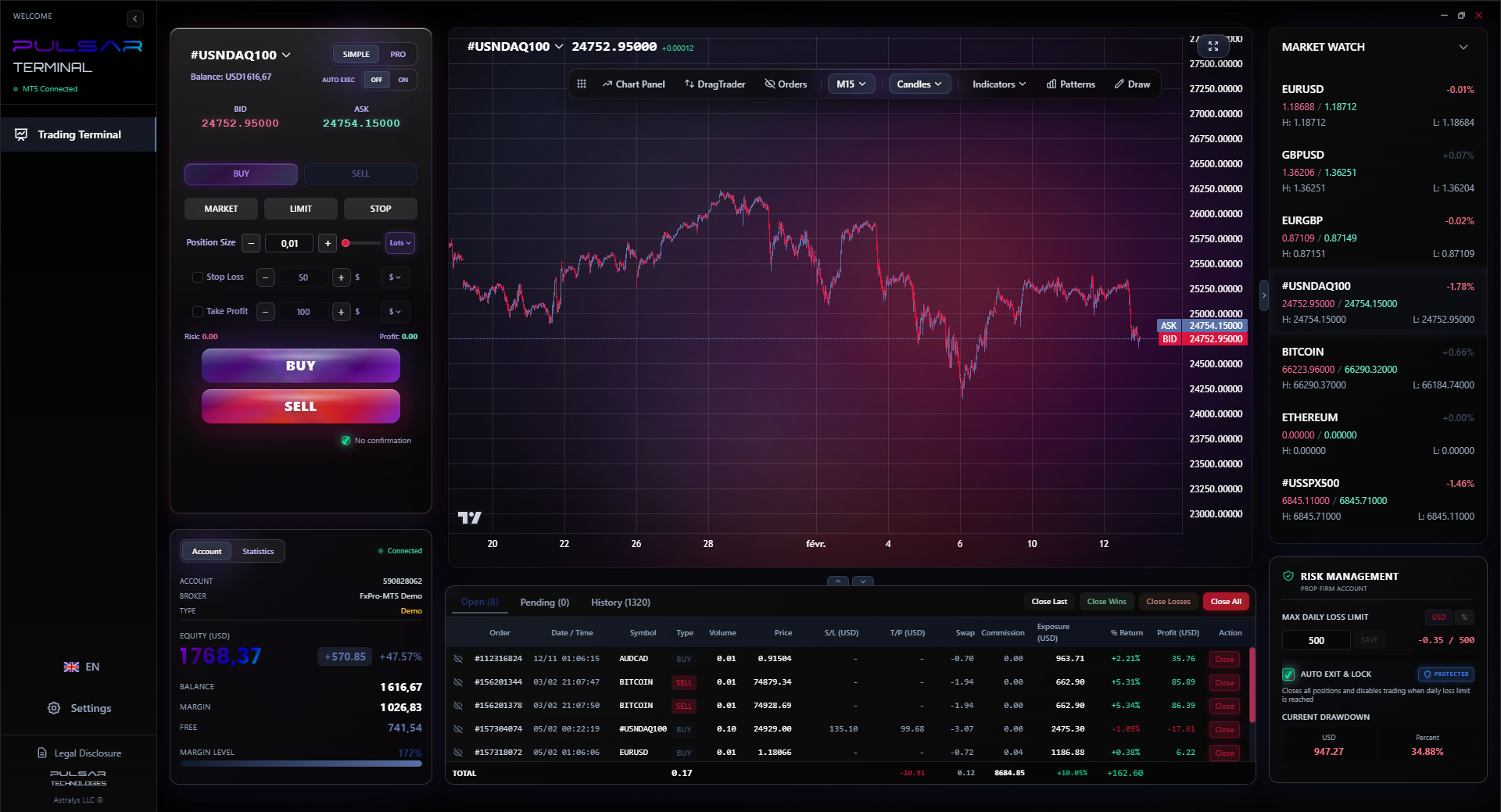
When you're testing your own trading system, managing multiple take-profit levels and moving stops manually on MT5 is a distraction that Pulsar Terminal automates, letting you focus on the analysis, not the clicks.
Pulsar Terminal
MT5一站式工具:拖拽下单、多重止盈/止损、追踪止损、网格交易、成交量分布图和自营交易保护。每日1000+交易者使用。
Trading from Nigeria isn't the same as trading from London. Our context changes everything.
Funding and Withdrawals: Funding your broker account is a hurdle. The CBN prohibits using official FX windows for trading. You'll use payment processors, cards, or crypto. Choose a broker with solid local options. I've had smooth experiences with brokers like Exness for this. Always factor transfer fees and rates into your capital calculations.
Naira Volatility is a Double-Edged Sword: Trading USD/NGN might seem tempting, but it's a specialist's game driven by CBN policy announcements, not just charts. The reforms in 2024-2026 (unifying rates, the new FX Code) created huge moves. A 'free signal' won't give you that political insight. It's often better to trade major pairs (EUR/USD, GBP/USD) where global liquidity is higher and the rules are clearer.
The Community is Everything (and Nothing): Nigerian trading forums and groups are full of both brilliant insight and toxic hype. Use them to discuss concepts and market news, not to get signals. If a group is just a signal-pumping factory, leave.
Your 'Why' Matters: Are you trading to escape a tough economic situation? That pressure will make you hold losing trades from a signal, hoping it turns around. Trade with capital you can afford to lose, so you can think clearly and stick to your plan - whether it's yours or a vetted signal you're testing.
💡 Winston 小贴士
The moment you feel the urge to move your stop loss further away because 'the signal provider knows something,' close the trade. You've already lost control.
“The market doesn't care who gave you the idea. It only cares about your position.”
Here's my blunt conclusion: chasing free forex signals as a Nigerian trader is a fantastic way to lose money slowly and learn nothing.
I've been there. I've paid for 'premium' signals after the free ones teased me. I've seen my friends blow accounts following 'gurus.' The common thread isn't bad signals (though many are), it's the surrender of your own judgment.
The market doesn't care who gave you the idea. It only cares about your position.
Invest the time you'd spend refreshing Telegram into building one simple, boring, testable strategy. Learn what a spread really costs you on a 1-lot trade. Practice with a position size calculator until it's second nature. Understand that a 10% tax applies to your profits, so a 7-pip win might only be a 6-pip win after costs.
Once you have that foundation, then you can look at a free signal from a place of strength. You can evaluate it, critique it, and maybe, just maybe, use it as one piece of a larger puzzle you control. But you will never need to rely on it. And that's the only freedom that matters in forex.
FAQ
Q1Are free forex signals illegal in Nigeria?
No, providing or using free forex signals is not illegal. However, the activity is largely unregulated. The risk is fraud. If a signal provider guarantees profits or pretends to be a licensed financial advisor, they are likely operating illegally. Always remember, any profits you make are subject to the 10% Capital Gains Tax.
Q2What is the success rate of free forex signals?
The published 'success rates' (often 80-90%) are almost always fake. A realistic, reputable trader might have a 55-65% win rate over time. The real metric isn't win rate, but risk/reward. A strategy with a 40% win rate can be highly profitable if winners are much larger than losers. Free signal providers rarely share this full picture.
Q3Can I make a living from following free forex signals?
It's extremely unlikely and highly risky. Signal delays, poor execution on your part, and the inherent inconsistency of any external system make it unreliable for consistent income. You are building a 'business' on a supplier (the signal giver) you don't control. To make a living, you need the skill and discipline that comes from developing your own edge.
Q4Which forex pairs are best for signal trading in Nigeria?
Avoid Naira pairs (USD/NGN) due to high volatility and potential manipulation. Stick to major pairs with high liquidity and tight spreads, like EUR/USD or GBP/USD. These are widely analyzed, so you can more easily verify if a signal's logic makes sense. Check our guide on EUR/USD to understand its dynamics.
Q5How do I verify if a forex signal provider is legitimate?
- Demand a verified, real-time track record (like Myfxbook). 2. See if they explain the analysis behind trades. 3. Check if they openly discuss losses. 4. Research their name + 'scam' online. 5. Start by paper-trading their signals for at least two months before risking real money. If they pressure you to skip this step, they are not legitimate.
Q6What's better: free signals or copy trading?
Copy trading (on platforms from brokers like AvaTrade or social networks) can be more transparent, as you automatically copy every trade of a chosen trader, seeing their full history. However, the same risks apply: you are relying on another person. It removes the manual entry error of signals but doesn't teach you anything. Both are inferior to dedicated learning.
Q7How much money do I need to start using forex signals?
This is a trap question. The signal seller will say 'Start with $50.' That's a terrible idea. With a small account, proper risk management (risking 1% per trade) means tiny position sizes where spreads and commissions eat your profits. You need enough capital so that a standard 0.01-lot trade is a small percentage of your account. Realistically, you shouldn't even consider it until you have at least $500-$1000 (roughly 750k-1.5M Naira) that you can afford to lose entirely.
Winston 教授的课程
要点总结:
- ✓Free signals are a marketing tool, not an education.
- ✓You still pay all trading costs and 10% tax on profits.
- ✓Verify every signal against the raw chart yourself.
- ✓Build your own 3-point checklist before trusting anyone else's.
- ✓Naira volatility makes exotic pair signals especially dangerous.
这篇文章对您有用吗?
点击星星评分
每周交易洞察
免费每周分析与策略。无垃圾邮件。
关于作者
Olumide Adeyemi
西非交易先驱
尼日利亚最活跃的外汇交易教育者之一。从拉各斯出发有8年交易经验。专注于低资金策略和面向非洲交易者的自营公司挑战。
评论
风险提示
金融工具交易存在重大风险,可能不适合所有投资者。过往业绩不代表未来表现。本内容仅供教育目的,不构成投资建议。在交易前请务必自行研究。
您可能还喜欢

Cara Trading Forex Sukses: 7 Prinsip dari Trader Profesional
Cara trading forex sukses dengan 7 prinsip trader pro: manajemen modal, disiplin, journal trading, backtest. Data nyata, bukan janji profit palsu.
Jam Trading Forex Terbaik untuk Trader Indonesia: Panduan Lengkap dengan Tabel Waktu
Panduan jam trading forex untuk trader Indonesia. Tabel 4 sesi dunia, jam emas 20:00-00:00, sesi mana yang harus dihindari. Data akurat + tips dari trader berpengalaman.
Top 5 Sàn Forex Uy Tín Nhất 2026: Review Jujur dari Trader Indonesia
Top 5 sàn forex uy tín 2026 untuk trader Indonesia. Review jujur: spread, deposit, withdraw, dukungan lokal. Exness, XM, IC Markets & lebih.
