


Let's be brutally honest: most free forex trading classes online are either useless or a direct path to losing your money.

David van der Merwe
新兴市场交易员 ·  South Africa
☕ 8 分钟阅读
您将学到:
- 1Why Most 'Free Classes' Are Marketing Trash
- 2Actually Legit Free Resources for South Africans
- 3The South African Rules You MUST Know (It's Not Just Trading)
- 4From Knowledge to Skill: The Free Practice That Matters
- 5Spotting the Red Flags: When 'Free' Becomes Dangerous
- 6Your Free, Self-Directed Curriculum
Let's be brutally honest: most free forex trading classes online are either useless or a direct path to losing your money. They're designed to get you excited, not educated. For the 200,000-plus traders in South Africa, the real challenge isn't finding free information, it's filtering out the dangerous nonsense. I'll show you the few free resources that actually teach you something, expose the common traps disguised as 'education,' and explain how to build real skill without paying a 'guru' a single rand.
You see the ads everywhere: 'Learn to make R10,000 a day from your couch!' They're usually a slick video of a guy next to a Lamborghini, talking about financial freedom. Here's the truth: these aren't classes. They're sales funnels. Their sole purpose is to get you emotionally hooked so you'll buy their R5,000 'advanced course' or sign up for their managed account service where they'll blow your capital.
The structure is always the same. The 'free' part gives you the absolute basics - what a candlestick is, the definition of a pip - information you could get from Wikipedia in 10 minutes. Then, they hit you with the 'secret' or the 'proprietary system' that requires payment. They create a problem (your ignorance) and sell you the solution (their product).
I fell for this early on. Spent R2,500 on a course that promised 'institutional order flow.' The 'secret' was just looking for large candles on the 5-minute chart. I lost that amount in two trades using their method. The real lesson was that valuable market knowledge is rarely given away for free in a packaged course. Real skill comes from study, screen time, and painful experience, not a three-hour webinar.

Warning: If a 'free class' spends more time showing you testimonials of luxury cars than explaining how to calculate your position size, run. It's a commercial, not an education.
Okay, enough cynicism. There are genuinely good, free resources out there. The key is they come from established institutions or regulated brokers, not random 'mentors' on Instagram.
Broker Education Hubs
Regulated brokers like IG, Pepperstone, and XM have extensive, free education sections. Why? Because an informed client is a better client (and less likely to blame them for losses). IG's academy is particularly thorough, covering everything from macroeconomics to trading psychology. These modules are dry, factual, and incredibly useful. They won't give you a 'magic bullet' strategy, but they'll give you the foundation to build your own.
The FSCA and JSE
Don't sleep on the regulators. The Financial Sector Conduct Authority (FSCA) website has investor education material. It's not about specific trading tactics, but about understanding risks, recognizing scams, and knowing your rights. The Johannesburg Stock Exchange (JSE) also offers free webinars and guides on market mechanics. This is the boring, essential stuff that keeps you safe.
University & MOOC Platforms
Sites like Coursera and edX offer free courses from real universities on finance, economics, and data analysis. Look for 'Financial Markets' from Yale or 'Introduction to Computational Finance.' This is the opposite of get-rich-quick content. It's academic, challenging, and will give you a massive edge over traders who only understand technical indicators. Building a strategy based on economic fundamentals, which you can learn here, is far more strong than chasing another scalping strategy you saw on YouTube.

💡 Winston 小贴士
The first R10,000 you should invest is in books, not a trading account. Read 'Trading in the Zone' by Mark Douglas and 'The Daily Trading Coach' by Brett Steenbarger. They cost less than a bad trade.
“The real secret to trading isn't in a paid course; it's in the boring, disciplined use of a free demo account.”
This is where most free classes fail you completely. They teach you about the MACD indicator but say nothing about SARS. Ignorance here can cost you more than a bad trade.
First, use. Since 2021, the FSCA caps use for retail traders at 30:1. If you see a 'class' teaching you how to use 500:1 use, it's either outdated or promoting an offshore, potentially unregulated broker. That high use is a one-way ticket to a margin call.
Second, and this is critical: Exchange Controls. You, as a South African resident, cannot legally speculate directly against the Rand (ZAR) with an offshore broker. You also can't just wire your Rands to a broker in Cyprus. All foreign currency transactions for investment must go through an Authorised Dealer (a bank) and fall within your allowances: R1 million single discretionary allowance and R10 million foreign investment allowance per year. Many 'free classes' gloss over this because it's complicated. They'll just say 'fund your account.' How you fund it legally is your problem.
Finally, tax. Your trading profits are taxable income. You must declare them to SARS. Keep careful records of every trade - entry, exit, profit/loss in Rands. I learned this the hard way after a good year; my accountant had to spend hours reconstructing my trades from broker statements. The 'free' education cost me R3,500 in extra accounting fees.
Knowing something and being able to execute it under pressure are worlds apart. This is where the truly valuable free tool comes in: the demo account.
Every reputable broker offers a free demo account with virtual money. This is your laboratory. It's not for 'practicing until you win.' It's for practicing the boring, disciplined processes that keep you in the game.
Here’s a specific drill I give all my students. Don't trade for profit. Trade for process.
- Journal Everything: For every demo trade, write down the reason (e.g., "RSI oversold on H4, support at 1.0850 on EUR/USD").
- Pre-Calculate Risk: Before clicking buy, use a position size calculator to determine your lot size so you're risking no more than 1% of your demo capital.
- Set & Forget: Place your stop-loss and take-profit orders immediately. Then close the platform for 4 hours.
The goal is to build the muscle memory of planning a trade and letting it run. 95% of beginners fail because they micromanage, move stops, and chase losses. A demo account used correctly breaks those habits for free. I spent six months on a demo account after my initial losses. It felt painfully slow, but it rebuilt my approach from the ground up. When I went live again, my first 10 trades were executed with the same cold discipline as my demo trades. That's the only 'secret' you need.

Pro Tip: Treat your demo capital as real. Start with R20,000 virtual money. If you blow it, you've learned a crucial lesson for free. Reset and start again, focusing on why you blew it - was it over-use, revenge trading, poor risk management?
💡 Winston 小贴士
If you can't explain your trade setup in one simple sentence (e.g., 'buying pullback to weekly support'), it's too complicated. Complexity is the enemy of execution.
“Ignoring South Africa's exchange controls can get you in more trouble than a string of losing trades ever could.”
Let's get specific about what to avoid. If you see these in a free forex trading class online, close the tab.
- Guaranteed Profits or High Win Rates: Anyone claiming a 90% win rate is lying. The market is probabilistic, not certain. If their strategy was that good, they'd be trading it with billions, not selling it for R500.
- Pressure to Deposit Quickly: 'Limited-time bonus' if you fund an account right after the webinar. This is a classic broker-affiliate tactic. The educator gets a commission when you deposit, regardless of whether you win or lose.
- Overcomplication: Selling you on 'harmonic patterns,' 'Elliott Wave theory,' or proprietary indicators with flashy names. These are often used to dazzle beginners into thinking the mentor has deep, secret knowledge. In reality, price action and volume are king. I wasted months trying to perfectly identify 'Gartley patterns.' The EUR/USD guide based on simple support/resistance and economic news would have been more profitable.
- No Discussion of Risk Management: If the entire class is about entry signals with zero talk about stop-loss placement, position sizing, or emotional control, it's criminal negligence. Period.
A real educator talks about losses more than wins. They show you their losing trades and explain what went wrong. They emphasize that survival - not spectacular gains - is the first goal of trading.
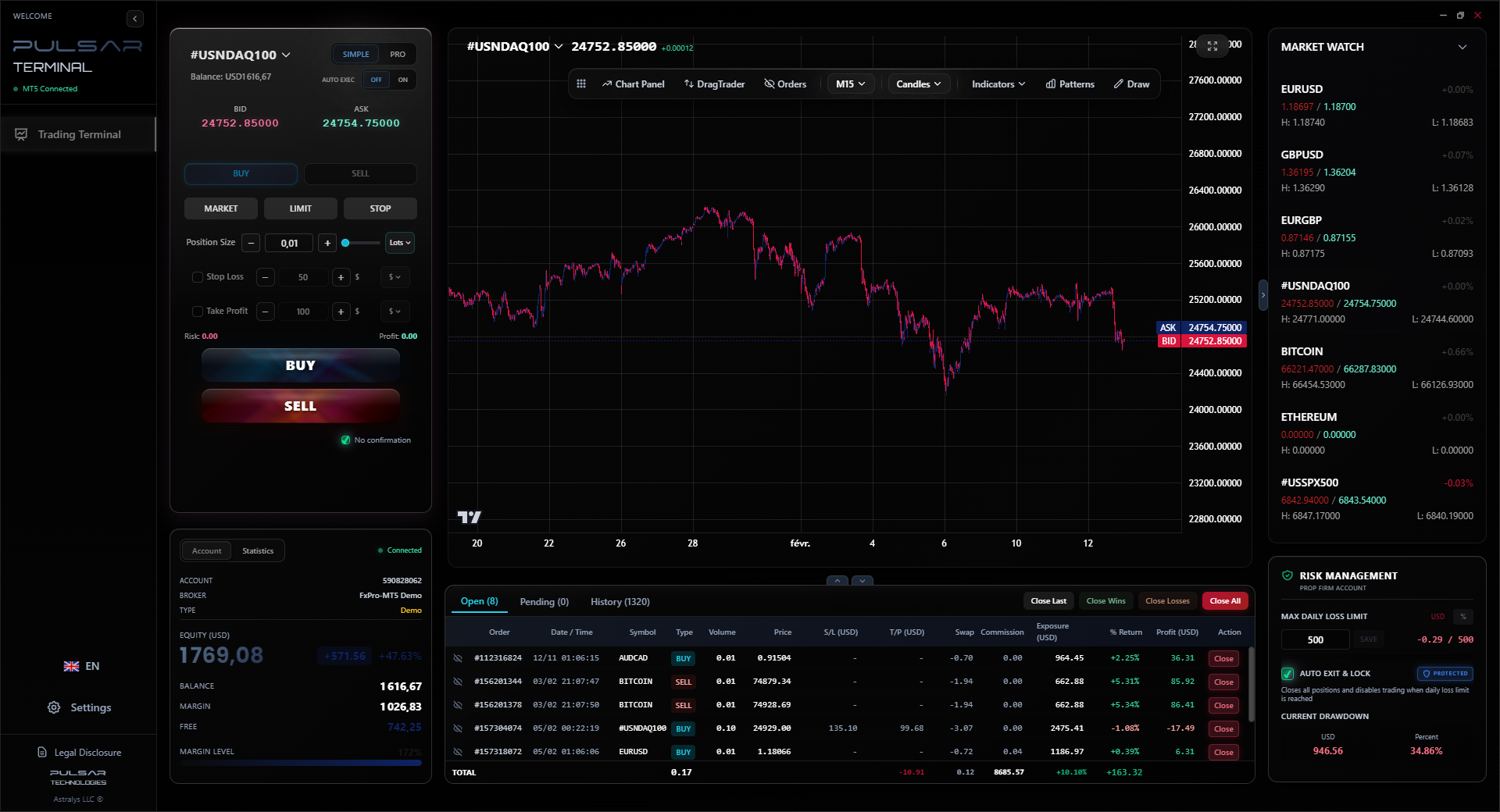
When you graduate from demo to live trading, managing multiple orders and risk becomes critical; Pulsar Terminal's drag-and-drop order system and automated multi-TP/SL tools on MT5 turn complex trade management into a simple, disciplined process.
Pulsar Terminal
MT5一站式工具:拖拽下单、多重止盈/止损、追踪止损、网格交易、成交量分布图和自营交易保护。每日1000+交易者使用。
Forget the packaged 'class.' Build your own education path. Here’s a 12-week plan using only free resources.
| Week | Focus | Free Resource To Use |
|---|---|---|
| 1-2 | Market Mechanics & Jargon | Broker Glossary (Learn: Pip, Lot, Spread, Margin) |
| 3-4 | Risk Management Foundation | FSCA guides, Position Size Calculator practice |
| 5-6 | Basic Technical Analysis | Broker videos on Support/Resistance, Trends |
| 7-8 | Fundamental Analysis | Central Bank websites (SARB, Fed, ECB), economic calendars |
| 9-10 | Trading Psychology | Academic papers on behavioral finance (Google Scholar) |
| 11-12 | Strategy & Demo Trading | Build & test a simple plan on demo account |
Start with the XM review or IC Markets review to find a broker with a solid education section. Then, open a demo account with them. Your first mission isn't to trade, but to understand every field on the order ticket and every tab in the platform.
Then, pick one major pair like EUR/USD or XAU/USD (Gold) and study it. Read the news that affects it. Watch how it reacts. Paper trade it based on economic releases. This focused, deep learning is 100x more valuable than skimming 20 different 'free strategy' videos.
The goal after 12 weeks isn't to be profitable. It's to be competent. You should understand how a trade works from start to finish, how to calculate your risk, and have a journal full of demo trades you can review. That's a real education, and it won't cost you a cent beyond your internet bill.
💡 Winston 小贴士
Keep a 'stupidity log.' Write down every time you break your own rules. Review it weekly. The pattern that emerges is your biggest weakness. Mine was moving stop-losses further away.
FAQ
Q1Are free forex trading classes from brokers biased?
Yes, but usefully biased. A broker's free education won't teach you to trade against their interests, but they have a strong incentive to make you a competent, risk-aware trader. A losing client who blames the broker is bad for business. Their material is generally factual and solid on basics, which is what you need first.
Q2What is the single most important thing to learn from a free class?
Risk management. Full stop. If the class doesn't spend significant time teaching you how to calculate position size, place stop-losses, and define your risk-per-trade (e.g., never more than 1-2% of capital), it's worthless. Everything else is secondary.
Q3Can I become a profitable trader using only free resources?
Absolutely. The information needed is publicly available. The barrier isn't paid knowledge; it's discipline, emotional control, and screen time. Free resources give you the map. You still have to walk the path, which involves making mistakes and learning from them in a demo or small live account.
Q4How do I handle the South African exchange control rules when funding?
You must use your bank as an Authorised Dealer. Inform them you are transferring funds within your discretionary allowance for the purpose of online trading/investment. They will guide you through the required forms (e.g., A01). Do not use informal or unapproved channels, as this breaches exchange controls and could lead to penalties.
Q5Is a demo account really enough to practice?
It's essential for learning mechanics and discipline, but it lacks real emotional pressure. The psychology changes with real money. The smart move is to master the demo, then transition to a very small live account (e.g., $100) where the losses are real but manageable. This bridges the gap between theory and reality.
Q6What's a realistic amount of time to spend learning before trading live?
A minimum of 3-6 months of consistent, daily study and demo trading. This isn't a hobby you pick up in a weekend. Treat it like a university module. If you can't commit that time, you're not ready, and the market will take your money as a tuition fee.
Winston 教授的课程
要点总结:
- ✓Free broker academies are your best starting point.
- ✓Master risk management before any entry strategy.
- ✓Demo trade for process, not for profit.
- ✓Always account for SARB rules and SARS.
这篇文章对您有用吗?
点击星星评分
每周交易洞察
免费每周分析与策略。无垃圾邮件。
关于作者
David van der Merwe
新兴市场交易员
约翰内斯堡交易者,11年新兴市场货币经验。专注于ZAR货币对、FSCA监管交易和南非市场分析。
评论
风险提示
金融工具交易存在重大风险,可能不适合所有投资者。过往业绩不代表未来表现。本内容仅供教育目的,不构成投资建议。在交易前请务必自行研究。
您可能还喜欢

Cara Trading Forex Sukses: 7 Prinsip dari Trader Profesional
Cara trading forex sukses dengan 7 prinsip trader pro: manajemen modal, disiplin, journal trading, backtest. Data nyata, bukan janji profit palsu.
Jam Trading Forex Terbaik untuk Trader Indonesia: Panduan Lengkap dengan Tabel Waktu
Panduan jam trading forex untuk trader Indonesia. Tabel 4 sesi dunia, jam emas 20:00-00:00, sesi mana yang harus dihindari. Data akurat + tips dari trader berpengalaman.
Top 5 Sàn Forex Uy Tín Nhất 2026: Review Jujur dari Trader Indonesia
Top 5 sàn forex uy tín 2026 untuk trader Indonesia. Review jujur: spread, deposit, withdraw, dukungan lokal. Exness, XM, IC Markets & lebih.
