


Here's a wild fact to start with: the modern forex market turns over about $7.5 trillion every single day.

Olumide Adeyemi
西非交易先驱 ·  Nigeria
☕ 10 分钟阅读
您将学到:
- 1From Barter to Bretton Woods: The Ancient Roots
- 2The Nixon Shock and the Birth of Floating Rates
- 3The Digital Revolution and the Rise of the Retail Trader
- 4The Smartphone and the Social Trading Wave
- 5The Nigerian Forex Crisis and the Modern Market
- 6What History Teaches Us: Key Lessons for Traders
- 7What's Next? The Future of Forex Trading
Here's a wild fact to start with: the modern forex market turns over about $7.5 trillion every single day. That's more than the entire Nigerian stock market trades in a year, every 24 hours. But it didn't start that way. The history of forex trading is a story of cowrie shells, gold smugglers, and a Nigerian banking crisis that accidentally created a generation of retail traders. If you think trading Naira pairs is stressful now, wait until you hear how they did it in the 80s.
Long before we had USD/NGN charts, people were already trading value. In West Africa, we had the cowrie shell. Seriously, those little shells were currency across the region for centuries. They were portable, durable, and hard to counterfeit (good luck forging a seashell).
Fast forward a bit, and you get to the gold standard. This was the first real 'global system.' A country's currency was directly linked to a specific amount of gold. It created stability, but it was rigid. If you didn't have the gold, you couldn't print the money. For colonies like Nigeria, our currency, the Nigerian Pound, was pegged to the British Pound Sterling, which itself was tied to gold. Our monetary policy was literally made in London.
Then came World War II, which blew up the global financial system. In 1944, the Allies met in Bretton Woods, USA, to build a new one. This is a cornerstone moment in the history of forex trading. They created a system of fixed exchange rates. All major currencies were pegged to the US Dollar, and the Dollar was pegged to gold at $35 an ounce. The International Monetary Fund (IMF) and World Bank were born here too.
For a newly independent Nigeria in the 1960s, this system provided a stable framework. Our Naira (introduced in 1973) had a fixed value against the Dollar. It was simple, but it didn't allow for the kind of speculative trading we know today. The market was for governments and big banks, not for you and me.

Example: Under Bretton Woods, if the official rate was 1 USD = 0.78 NGN (roughly the initial peg), that was it. No daily fluctuations. A Nigerian importer knew exactly how much his goods would cost in Naira for years.
“The Nixon Shock in 1971 didn't just break the gold standard; it created the volatile, opportunity-rich market we trade today.”
The Bretton Woods system had a fatal flaw: it relied on the US having enough gold to back all the Dollars in the world. By the early 1970s, it didn't. Too many Dollars had been printed to fund the Vietnam War and social programs.
In 1971, President Richard Nixon dropped the bomb. He suspended the convertibility of the Dollar into gold. Just like that, the anchor was gone. This 'Nixon Shock' is the single most important event in the modern history of forex trading. By 1973, the major currencies were floating. Their value was now set by supply and demand in the market.
Chaos? Absolutely. Opportunity? Even more so. For the first time, currencies could move significantly. This created the volatility that traders profit from. The forex market as a speculative arena was born.
In Nigeria, we felt this shift indirectly at first. Our economy was (and is) tied to oil, priced in Dollars. When the Dollar fluctuated wildly, our oil revenue in Naira terms swung with it. The stability of a fixed rate was gone, replaced by a new world of risk. This volatility would later become the very reason many of us got into trading.
I remember my first real grasp of this. I was analyzing an old USD/NGN chart, and you could see the jagged moves start in the late 70s and early 80s, a direct result of the world switching to floating rates. It made all the textbook stuff click.

💡 Winston 小贴士
The market's memory is short, but its patterns are long. A chart pattern from the 1980s can play out the same way today because human fear and greed haven't evolved.
“Nigeria's 2004 banking crisis accidentally created a wave of sophisticated retail traders looking for a new hustle.”
The 1980s and 90s saw the market remain a club for institutions. Trading happened over phone lines between bank dealers. The spread was huge, and you needed millions to play. Then came the internet.
The late 1990s and early 2000s changed everything. Online retail brokers emerged. They pooled client orders to get interbank rates, then offered small, leveraged accounts to regular people. Suddenly, you didn't need to be a bank in Lagos or London. You could trade from a cybercafe in Surulere with a few hundred dollars.
The Nigerian Banking Consolidation (2004)
Here's a local twist many don't connect. In 2004, the Central Bank of Nigeria raised the minimum capital base for banks from 2 billion to 25 billion Naira. This led to massive mergers and layoffs. Thousands of sharp, financially literate people were suddenly out of a job. Many of them found their way into the burgeoning online forex market. They had the brains for analysis and now needed a new income stream. This wave of ex-bankers significantly boosted the sophistication of the local retail trading scene.
The MetaTrader Era
Then came MetaTrader 4 (MT4) around 2005. This was our weapon. A free, powerful platform with charts, indicators, and automated trading. It democratized trading technology. I placed my first trade on MT4 in 2007. It was a EUR/USD buy order, and my hands were shaking. The platform made it look easy, but the psychology was (and is) the hard part.
Brokers like Exness review, XM review, and IC Markets review later became household names here by offering local deposits and support. The barrier to entry vanished.

Warning: This easy access was a double-edged sword. Many of us, myself included, blew up our first accounts. We confused a bull market for genius. use of 1:500 felt like free money until a single margin call wiped us out. The history of forex trading is also a history of humble pies served via platform notifications.
“Nigeria's 2004 banking crisis accidentally created a wave of sophisticated retail traders looking for a new hustle.”
If the internet opened the door, the smartphone blew the walls off. Around 2010 onwards, trading went from your desktop to your pocket. Broker apps and MT4/MT5 mobile versions meant you could check your USD/NGN position while in traffic on the Third Mainland Bridge (not recommended, by the way).
This created a 24/7 connection to the market. News, alerts, and execution were instant. It also shortened attention spans. The rise of scalping strategy and ultra-short-term trading exploded because the tools allowed it.
Then came the social layer. Platforms like eToro (less common here) and copy-trading features within broker apps. You could now see what other traders were doing and copy their trades. This created 'trading celebrities' and a whole new dynamic. Was it helpful? Sometimes. But it also led to herd mentality. I once copied a 'guru' on a GBP/JPY trade because of his flashy win rate. He hit a 50-pip profit target; I got in late and caught a 120-pip reversal. A painful, but cheap, lesson in independent thinking.
The local element here is our love for community and 'hustle.' WhatsApp and Telegram groups became the new trading floors. Signal channels, both legit and scammy, proliferated. This social aspect is a uniquely vibrant part of Nigeria's chapter in the history of forex trading.
💡 Winston 小贴士
Your greatest historical advantage is the stop-loss. Traders in the 1970s couldn't set one with a click. Use it. It's the single innovation that allows you to live and trade another day.
“Easy access to use is a recent privilege in the history of forex trading, not a right. Treat it with extreme caution.”
You can't talk about forex in Nigeria without talking about the chronic Naira volatility and central bank policies. For retail traders, this has been both a curse and a goldmine.
The multiple exchange rate windows (CBN, I&E, Black Market) created massive arbitrage opportunities. At one point in 2016, the spread between the official and parallel market rate was over 100 Naira per Dollar. That's a trader's dream, but a nation's nightmare. Trading USD/NGN became less about pure chart analysis and more about predicting CBN policy moves and liquidity injections.
This environment forced Nigerian traders to become experts in fundamental analysis and political risk. We learned to read CBN governor speeches like tea leaves. I made one of my best trades shorting the Naira (via a proxy pair) after a specific CBN circular hinted at a devaluation. The 300-pip move that followed paid for a new laptop. But I've also been stopped out overnight by an unexpected central bank intervention.
Today's market is a hybrid. We have the global electronic marketplace for majors like EUR/USD guide and XAU/USD guide, and a uniquely volatile local landscape for the Naira. Brokers like Pepperstone review offer deep liquidity on global pairs, while local platforms grapple with providing accurate Naira pricing. The modern Nigerian trader often runs two strategies: one for the stable, liquid global markets, and another for the high-risk, high-reward local currency plays.
The tools have also evolved. It's not just about MT4 anymore. Advanced traders use tools that manage risk in real-time, a necessity in our volatile climate.
“Easy access to use is a recent privilege in the history of forex trading, not a right. Treat it with extreme caution.”
So, after all that history, what should you actually take to your charts?
First, nothing is permanent. The gold standard fell. Bretton Woods collapsed. Fixed rates died. The only constant is change. Your trading strategy needs to be adaptable. The MACD indicator that worked perfectly in a trending 2014 market might fail in a choppy 2023 range. You have to adjust.
Second, use is a recent privilege, not a right. Our forebears traded with physical gold. We trade with 1:500 use on digital screens. This is an insane amount of power. History shows that unmanaged use is the fastest route to a zero account balance. Always use a position size calculator. My rule? Never risk more than 1% on a single idea. It's boring, but it keeps you in the game.
Third, access does not equal edge. Everyone has a smartphone and a broker account now. The edge comes from discipline, risk management, and a strong psychology. The WhatsApp signal group has the same charts you do. Your mindset is what separates you.
Finally, understand the 'why' behind the systems. Knowing why the Naira is volatile (oil dependence, FX demand, policy) makes you a better trader than just following a moving average crossover. Blend technicals with a deep understanding of fundamentals, especially in our market.

Pro Tip: Study past crises. Look at the USD/NGN chart during the 2016 devaluation or the 2020 oil crash. Don't just look for patterns; try to understand the sentiment. Where did panic set in? Where was the capitulation? This emotional map is more valuable than any indicator.
💡 Winston 小贴士
Don't just learn indicators like the [RSI indicator](/en/indicators/rsi). Learn the market conditions they were designed for. The RSI works until it doesn't - history shows the 'doesn't' periods are where accounts blow up.
Managing complex multi-take-profit strategies and enforcing strict daily loss limits—key for surviving volatile markets—is exactly what tools like Pulsar Terminal automate directly on your MT5 platform.
Pulsar Terminal
MT5一站式工具:拖拽下单、多重止盈/止损、追踪止损、网格交易、成交量分布图和自营交易保护。每日1000+交易者使用。
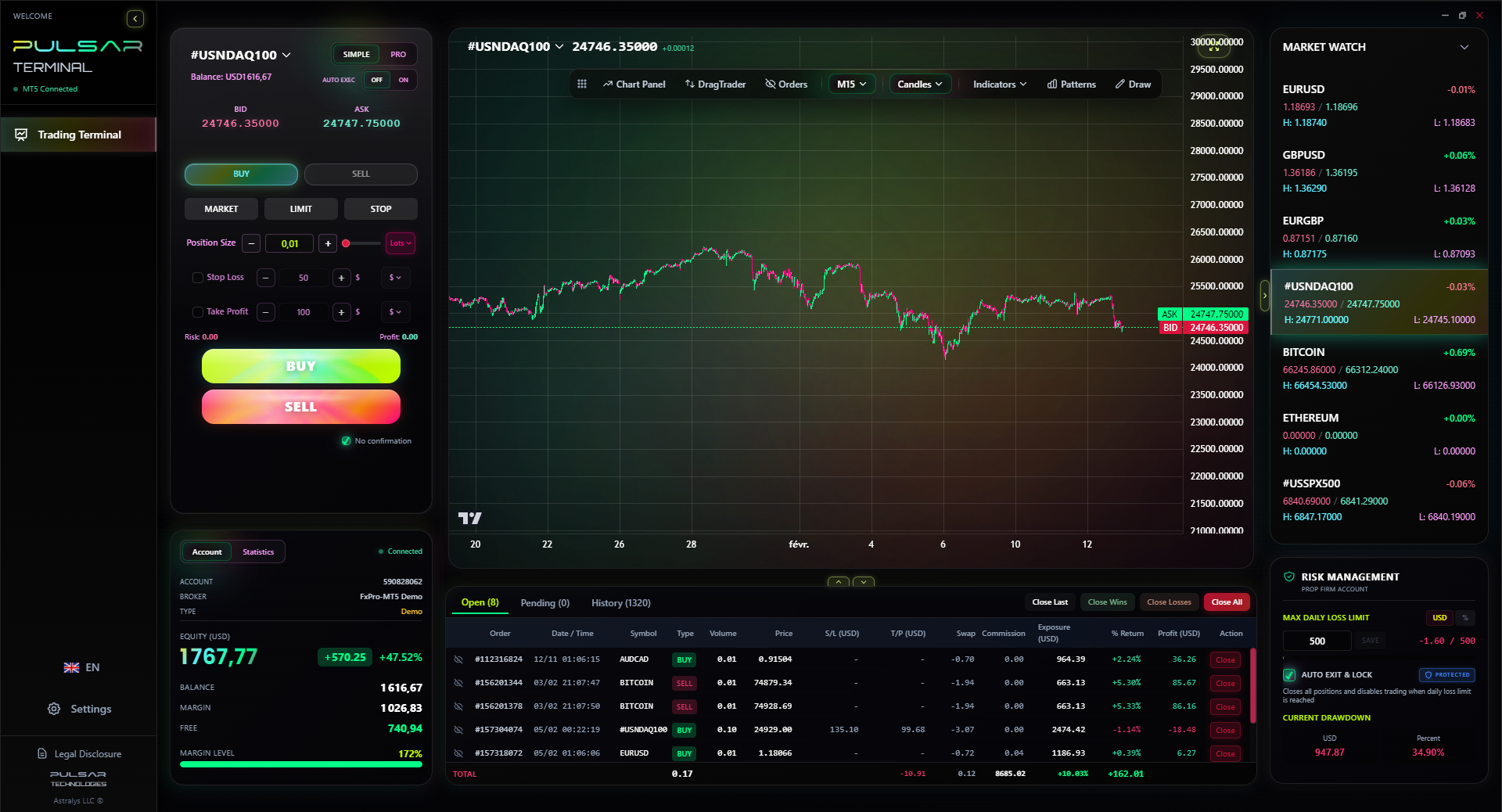
“The future of trading isn't just better charts, but tools that automate discipline - the one thing history proves we lack.”
Where is the history of forex trading leading us? A few trends are clear.
Algorithmic and AI-Driven Trading: This is already dominant at the institutional level and is trickling down. Retail tools that offer 'AI signals' are just the tip of the iceberg. The future is in algorithms that can adapt to regime changes - spotting when a ranging market is about to trend, for instance.
Regulation and Cryptocurrency Blur: The lines between forex and crypto are blurring. Many brokers now offer crypto CFDs. Regulation is scrambling to catch up. In Nigeria, with our complex relationship with crypto, this will be a space to watch closely.
Advanced Retail Tools: The next step isn't just placing orders, but managing complex strategies with ease. Think automated swing trading setups with multiple take-profit levels and trailing stops that don't require you to babysit the chart. Tools that help you pass prop firm challenges by automatically enforcing daily loss limits will become standard.
The core will remain the same: human psychology, greed, and fear. But the tools we use to navigate those emotions will get smarter. The trader who embraces these tools while mastering their own mind will have the edge. After all, the history of forex trading is a tech story, but it's a story about people trying to outsmart each other. That part never changes.
FAQ
Q1When did forex trading actually begin?
As a formal exchange of currencies, it began with ancient money changers. The modern, speculative market we know started after 1973 when the Bretton Woods system collapsed and major currencies began to 'float' against each other.
Q2How did Nigerians start trading forex?
Widespread retail trading took off in the mid-2000s with the spread of internet access and platforms like MetaTrader 4. A key local catalyst was the 2004 banking consolidation, which pushed many financially savvy ex-bankers into seeking new income through online markets.
Q3What was the 'Nixon Shock' and why does it matter?
In 1971, US President Nixon ended the direct convertibility of the US Dollar to gold. This broke the Bretton Woods system and led to floating exchange rates by 1973. It created the currency volatility that makes modern forex trading (and profit) possible.
Q4Is trading USD/NGN different from trading EUR/USD?
Completely. EUR/USD is a highly liquid global pair driven by economic data from two stable regions. USD/NGN is heavily influenced by local CBN policy, oil prices, and local dollar liquidity, making it far more volatile and prone to sudden gaps. The spread definition is also typically much wider on Naira pairs.
Q5What's the biggest lesson from forex history for a new trader?
That easy access and use are very new. They are tools, not skills. The traders who survived through different eras (like the 1992 ERM crisis or 2015 SNB shock) prioritized risk management above all else. Always know your pip definition value and risk per trade before thinking about profit.
Q6Will AI replace human forex traders?
At the retail level, not entirely. AI will handle more execution, analysis, and risk management (like setting automatic trailing stops). But the final decision-making, especially in unprecedented events or when interpreting 'soft' data, will likely remain with humans who understand market psychology.
Winston 教授的课程
要点总结:
- ✓Floating rates (post-1973) created the volatility traders need.
- ✓The 2004 Nigerian bank layoffs fueled local retail trading.
- ✓use is a modern tool, not a substitute for skill.
- ✓Always risk less than 2% per trade to survive history's shocks.
这篇文章对您有用吗?
点击星星评分
每周交易洞察
免费每周分析与策略。无垃圾邮件。
关于作者
Olumide Adeyemi
西非交易先驱
尼日利亚最活跃的外汇交易教育者之一。从拉各斯出发有8年交易经验。专注于低资金策略和面向非洲交易者的自营公司挑战。
评论
风险提示
金融工具交易存在重大风险,可能不适合所有投资者。过往业绩不代表未来表现。本内容仅供教育目的,不构成投资建议。在交易前请务必自行研究。
您可能还喜欢

Cara Trading Forex Sukses: 7 Prinsip dari Trader Profesional
Cara trading forex sukses dengan 7 prinsip trader pro: manajemen modal, disiplin, journal trading, backtest. Data nyata, bukan janji profit palsu.
Jam Trading Forex Terbaik untuk Trader Indonesia: Panduan Lengkap dengan Tabel Waktu
Panduan jam trading forex untuk trader Indonesia. Tabel 4 sesi dunia, jam emas 20:00-00:00, sesi mana yang harus dihindari. Data akurat + tips dari trader berpengalaman.
Top 5 Sàn Forex Uy Tín Nhất 2026: Review Jujur dari Trader Indonesia
Top 5 sàn forex uy tín 2026 untuk trader Indonesia. Review jujur: spread, deposit, withdraw, dukungan lokal. Exness, XM, IC Markets & lebih.
