


I remember staring at my screen in 2015, watching a GBP/USD trade bleed.

Olumide Adeyemi
西非交易先驱 ·  Nigeria
☕ 10 分钟阅读
您将学到:
I remember staring at my screen in 2015, watching a GBP/USD trade bleed. I was down $450 on a single position, convinced it would 'surely bounce back.' It didn't. That loss, nearly a month's salary back then, wasn't about a bad prediction. It was about not having a real answer to the core question: how do you make money on forex? It's not guessing. It's a business with rules, costs, and a mindset most get wrong. Here's what I've learned trading from Lagos for over a decade.
Let's strip away the complexity. How do you make money on forex? You profit from the change in value between two currencies. If you think the Nigerian Naira (NGN) will weaken against the US Dollar (USD), you sell the NGN/USD pair (or more commonly, a USD/NGN CFD if offered). If you're right, you make money.
The core mechanic is the spread, the difference between the buy (ask) and sell (bid) price. It's your immediate cost of doing business. A tight spread on a major pair like EUR/USD might be 0.9 pips, while an exotic pair could be 20 pips or more. You're in the red from the moment you enter the trade by that amount.

Warning: Many new traders in Nigeria focus only on the potential profit. They ignore the spread, swap fees (overnight financing costs), and potential commission. On a short-term trade, the spread can eat a significant chunk of your profit. Always calculate your break-even point first.
Your profit or loss is measured in pips. For most pairs, a pip is a 0.0001 move. If you buy EUR/USD at 1.0850 and sell at 1.0860, you've made 10 pips. The monetary value of a pip depends on your trade size (lot size). A standard lot (100,000 units) means each pip is worth about $10. A mini lot (10,000 units) is about $1 per pip. This is why understanding position size is non-negotiable. I blew an account early on by trading standard lots with a $500 balance. One bad move wiped me out.
Forget the 'get rich quick' ads. Let's talk real Naira and Kobo. Your trading business has startup and running costs.
Startup Costs:
- Education: You can spend ₦0 teaching yourself (my path, which took years of mistakes). Or, you can invest in a course. Quality online courses range from $50 to $500 (₦75k to ₦750k at parallel rates). In-person training in Lagos or Abuja can hit $3,000. I paid $300 for a mentorship in 2017. Was it worth it? Partly. It saved me time but didn't replace screen time.
- Initial Capital: This is critical. Brokers like XM or Exness might let you start with $10. But with that, you're just paying for expensive lessons. A serious beginner should consider at least $200-$500 as risk capital they can afford to lose. Your first goal isn't Lamborghini money, it's to survive and learn.
Operational Costs:
- Internet: You need rock-solid connectivity. A heavy-data monthly plan from a good ISP will run you ₦15,000 to ₦20,000. A trade failing to execute during a NEPA outage cost me 80 pips on Gold once.
- Hardware: A reliable laptop and a backup power solution (inverter/solar) are part of your toolkit.
- Broker Fees: These are embedded in the spread or charged as commissions. Check the real costs. A broker advertising 'zero spread' will charge a commission per lot. Do the math.
The Hidden Tax: The Federal Inland Revenue Service (FIRS) wants its share. Profits from forex trading are subject to a 10% Capital Gains Tax. You must file a return within 90 days of the year ending December 31. I learned this the hard way in 2019 and had to scramble to calculate my annual P&L. Keep careful records.

Example: Let's say you make a net profit of ₦1,000,000 from trading in a year. Your capital gains tax liability would be ₦100,000 (10%). Factor this into your profit targets.

💡 Winston 小贴士
Your first profit target should be to survive for six months without blowing your account. Profit comes after survival.
“The chart is truth. Your opinion is irrelevant until the chart agrees.”
Your strategy must fit your personality, schedule, and the unique liquidity windows of the market. Copying a London session scalper when you're in Lagos with a day job is a recipe for stress.
Swing Trading: The Lagos 9-to-5er's Friend
This was my gateway. You hold trades for days or weeks, capitalizing on broader market trends. You don't need to be glued to the screen. You analyze, set your entry, stop-loss, and take-profit levels, and check in a few times a day. It suits the Nigerian market where volatility often comes with news (CBN announcements, oil price swings). I once held a USD/ZAR trade for 11 days based on a broader risk-off theme, banking a 220-pip gain. It required patience I didn't have when I started. Learn more about the core principles of swing trading.
Day Trading & Scalping: For the Disciplined and Connected
This is intense. You're in and out within the day (day trading) or within minutes (scalping). It requires a fast internet connection, intense focus, and a strategy with a very high win rate because the profits per trade are small. You're fighting the spread constantly. I tried scalping EUR/USD during the London open. My record? Two weeks of small gains wiped out by one emotional, revenge trade after a loss. It taught me I'm not a scalper.
The News Trader
This is playing major economic releases: US Non-Farm Payrolls, CPI data, or CBN Monetary Policy Committee announcements. The volatility is huge. The key is having orders placed in advance (buy stops/sell stops) and rock-solid risk management. A good platform like IC Markets or Pepperstone with fast execution is vital. I made a quick 50 pips on GBP/USD after a Brexit vote headline, but I've also been 'whipsawed' and stopped out on both sides of a trade during high news chaos.
You need a reason to enter a trade. That reason comes from analysis.
Technical Analysis: This is reading the price chart. You're looking for patterns, trends, and levels where other traders might buy or sell. Tools like the RSI indicator can show if a market is overbought or oversold. The MACD indicator can help identify trend changes. My most consistent setup uses a simple concept: support and resistance. I mark clear highs and lows on the chart and look for price to react at those levels. For example, if EUR/USD bounces three times from 1.0700, that's a strong support zone. My failed trade in 2015? I entered with no clear support level in sight.
Fundamental Analysis: This is the 'why' behind the move. Why is the Naira strengthening? Maybe the CBN just hiked interest rates to combat inflation (which fell from over 32% in late 2024 to around 15% by early 2026). Why is the US Dollar weak? Maybe the Fed signaled a pause. You combine this with your technical view. Trading USD/NGN without watching CBN policy and Nigeria's external reserves (which climbed to $43.4 billion by late 2025) is like driving blindfolded.
The Hybrid Approach: This is what I use now. I use fundamentals to decide the overall direction (e.g., I'm bullish on USD because of high US yields). Then, I use technicals to find the precise entry point (e.g., waiting for a pullback to a key moving average on the EUR/USD guide chart).
💡 Winston 小贴士
If you can't explain your trade setup in one simple sentence, you don't have a strategy. You have a hope.
“You don't need a 500-pip trade every month. Consistency with strict risk management will grow your account steadily.”
This is the master key. How do you make money on forex? First, you learn how not to lose it all. I can't stress this enough.
The 1% Rule: Never risk more than 1% of your trading capital on a single trade. If you have a $1,000 account, your maximum loss per trade should be $10. This protects you from a string of losses ending your career. Use a position size calculator every single time.
Stop-Loss Orders (SL): This is an automatic order to close a losing trade at a predetermined level. It's your lifeline. You must use it. Every. Single. Time. My $450 loss happened because I didn't set one, thinking 'I'll watch it.' I got distracted, and it ran away.
Take-Profit Orders (TP): Have a profit target. Greed makes you hold winners too long until they turn into losers. Define your reward-to-risk ratio before entering. Aim for at least 1.5:1. If you risk $10 (10 pips), aim for a $15 (15 pip) profit.
use: A Double-Edged Sword: Nigerian traders often get offered insane use like 1:2000 by brokers like HFM or Exness. This means with $100, you can control a $200,000 position. It magnifies both gains AND losses. With high use, a 5-pip move against you can wipe out your deposit. I treat use above 1:30 as dangerous for my style. It's not a tool for making more money, it's a tool for efficiently using capital. Misuse it, and you'll get a margin call faster than you can say 'Naira.'
Managing multiple trades and setting precise stop-losses is complex, but tools like Pulsar Terminal automate these risk management tasks directly on your MT5 platform.
Pulsar Terminal
MT5一站式工具:拖拽下单、多重止盈/止损、追踪止损、网格交易、成交量分布图和自营交易保护。每日1000+交易者使用。
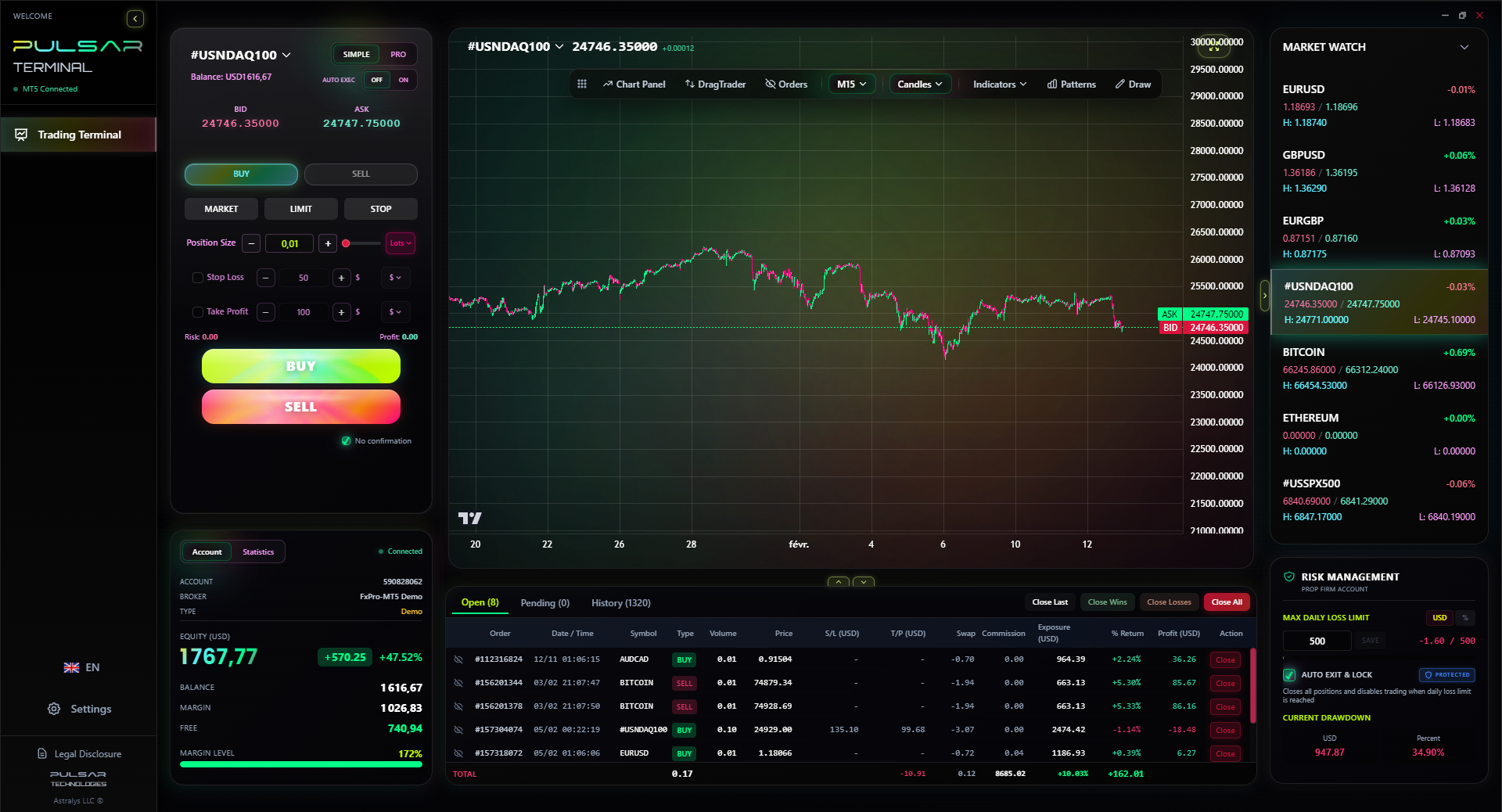
You can't trade without a broker. Your choice is dictated by regulation, costs, and practicality for Nigeria.
Regulation is Safety: While local CBN authorization exists for some OTC products, many Nigerian traders use internationally regulated brokers for access to global markets. Look for brokers licensed by the UK's FCA, Cyprus's CySEC, or Australia's ASIC. This offers some fund protection. I've used both XM (CySEC) and IC Markets (ASIC) for years. Their regulation provides peace of mind.
Key Practical Considerations:
- Deposit/Withdrawal: How do you fund your account? Brokers that accept local bank transfers (in Naira) or popular e-wallets make life easier. Check processing times and fees.
- Spreads & Commissions: Compare the all-in cost for the pairs you trade. See the table below.
- Platform: MT4/MT5 is the standard. Ensure it runs smoothly on your connection.
Here’s a quick comparison based on recent data:
| Broker | Min. Deposit (Approx.) | Avg. EUR/USD Spread | Key Feature for NG Traders |
|---|---|---|---|
| Exness | $10 | ~1.0 pip | High use offered, popular locally. Read our full Exness review. |
| IC Markets | $200 | 0.0 pips + commission | Raw spreads, excellent for scalping/day trading. |
| XM | $5 | Starts ~1.0 pip | Low minimum deposit, good for beginners. |
| Pepperstone | $0 | 0.0 pips + commission | Top-tier execution, great for active traders. |
Avoid unregulated 'bucket shops' that promise guaranteed profits. They are often scams targeting new traders.
💡 Winston 小贴士
The difference between a pro and an amateur isn't the winning trades. It's how they handle the losses. The pro's loss is always small and planned.
“High use isn't a tool for making more money, it's a tool for efficiently using capital. Misuse it, and you'll get a margin call.”
Let me save you some time and money.
Lesson 1: The Market Doesn't Care About Your Opinion. I was bullish on Gold (XAU/USD guide) for weeks in 2020. The chart kept going down. I kept buying, averaging down my losses, convinced I was right. I lost $1,200 before I finally listened to what the price was telling me. The chart is truth. Your opinion is irrelevant until the chart agrees.
Lesson 2: Psychology is 80% of the Game. After a loss, the urge to 'make it back now' is overwhelming. That's revenge trading. It leads to bigger losses. After a win, you feel invincible and take oversized risks. You must manage your emotions like you manage your money. I now have a rule: two consecutive losses, and I shut down the platform for the day.
Lesson 3: Consistency Over Home Runs. You don't need a 500-pip trade every month. A consistent strategy that nets you 30-50 pips a week with strict risk management will grow your account steadily. Compounding is a trader's best friend.
Lesson 4: Keep a Trading Journal. Write down every trade: entry, exit, reason, emotion. Review it weekly. My journal showed me that 70% of my losing trades were impulsive entries outside my strategy. Seeing it in writing forced me to change.
The path to understanding how do you make money on forex is a marathon of self-education and discipline. It's legal in Nigeria, but it's not easy. Start small, risk tiny, learn relentlessly, and maybe - just maybe - you can build a real income from it.
FAQ
Q1Is forex trading legal in Nigeria?
Yes, it is legal for individuals. There are no laws stopping Nigerians from trading with international brokers. However, brokers operating locally in OTC forex must have CBN authorization. Always prioritize brokers regulated by reputable international bodies like the FCA or ASIC for added security.
Q2How much money do I need to start forex trading in Nigeria?
Technically, you can start with as little as $5-$10 with some brokers. Practically, I recommend a minimum of $200-$500 as risk capital you can afford to lose entirely. This allows for proper position sizing and lets you survive the learning phase without blowing your account on a few bad trades.
Q3Do I pay tax on forex trading profits in Nigeria?
Yes. The Federal Inland Revenue Service (FIRS) treats forex trading profits as capital gains, subject to a 10% tax. You are required to file a tax return and pay this on your net annual profit. Keep detailed records of all your trades for the fiscal year (January 1 to December 31).
Q4What is the best time to trade forex in Nigeria?
The most liquid and volatile sessions overlap with the European and US markets. This is from about 1:00 PM to 10:00 PM Nigerian time (12:00 PM - 9:00 PM in winter). The London session open (1:00 PM) and the US session open (2:30 PM) often see the highest volume and best opportunities for active strategies like scalping.
Q5Which forex broker is best for Nigerians?
There's no single 'best' broker. It depends on your needs. For raw spreads and active trading, IC Markets is excellent. For beginners with a small budget, XM offers a low barrier to entry. For a balance of features and regulation, check Pepperstone. Always verify their deposit/withdrawal methods for Nigeria.
Q6Can I make a living from forex trading in Nigeria?
It's possible, but extremely difficult and should not be the initial goal. Treat it as a serious side business for at least 2-3 years. You need a strong strategy, proven consistency over hundreds of trades, and a significant capital base (I'd suggest at least $10,000) to generate meaningful, sustainable income while adhering to strict risk management.
Winston 教授的课程
要点总结:
- ✓Never risk more than 1% of capital per trade.
- ✓A stop-loss order is non-negotiable. Always.
- ✓Aim for a minimum 1.5:1 reward-to-risk ratio.
- ✓Fundamentals give direction, technicals give the entry.
这篇文章对您有用吗?
点击星星评分
每周交易洞察
免费每周分析与策略。无垃圾邮件。
关于作者
Olumide Adeyemi
西非交易先驱
尼日利亚最活跃的外汇交易教育者之一。从拉各斯出发有8年交易经验。专注于低资金策略和面向非洲交易者的自营公司挑战。
评论
风险提示
金融工具交易存在重大风险,可能不适合所有投资者。过往业绩不代表未来表现。本内容仅供教育目的,不构成投资建议。在交易前请务必自行研究。
您可能还喜欢

Cara Trading Forex Sukses: 7 Prinsip dari Trader Profesional
Cara trading forex sukses dengan 7 prinsip trader pro: manajemen modal, disiplin, journal trading, backtest. Data nyata, bukan janji profit palsu.
Jam Trading Forex Terbaik untuk Trader Indonesia: Panduan Lengkap dengan Tabel Waktu
Panduan jam trading forex untuk trader Indonesia. Tabel 4 sesi dunia, jam emas 20:00-00:00, sesi mana yang harus dihindari. Data akurat + tips dari trader berpengalaman.
Top 5 Sàn Forex Uy Tín Nhất 2026: Review Jujur dari Trader Indonesia
Top 5 sàn forex uy tín 2026 untuk trader Indonesia. Review jujur: spread, deposit, withdraw, dukungan lokal. Exness, XM, IC Markets & lebih.
