


I once lost R1,200 on a USD/ZAR trade because I miscalculated the pip value.

David van der Merwe
新兴市场交易员 ·  South Africa
☕ 14 分钟阅读
您将学到:
- 1What Exactly Is a Pip (or Point)?
- 2The Pip Value Formula: Your Key to Risk Management
- 3South African Market Specifics: ZAR, Costs & FSCA Rules
- 4Step-by-Step: Calculating Profit & Loss with Real Numbers
- 5Common Mistakes (And How to Avoid Them)
- 6Tools & Platforms for South African Traders
- 7Putting It All Together: Your Pre-Trade Checklist
I once lost R1,200 on a USD/ZAR trade because I miscalculated the pip value. The chart looked perfect, my entry was solid, but when I closed for a 50-pip 'profit,' my account was bleeding. I'd confused the decimal places on an exotic pair and completely botched my position size. That painful lesson taught me that knowing how to calculate points in forex isn't just theory - it's the difference between a profitable trade and an expensive mistake. For us trading in South Africa, with our unique ZAR pairs and FSCA rules, getting this right is non-negotiable.
Let's clear up the jargon first. In forex, a 'pip' and a 'point' are the same thing. Pip stands for 'Percentage in Point,' and it's the smallest standard price move a currency pair can make. It's how we measure our wins and losses.
For most pairs you'll trade, like EUR/USD or GBP/USD, one pip is a move at the fourth decimal place. If EUR/USD goes from 1.0850 to 1.0851, that's a 1-pip move. Simple, right?
Now, here's where it gets tricky for us South Africans. Pairs with the Japanese Yen (JPY) are the classic exception - they're quoted to two decimal places. So if USD/JPY moves from 151.50 to 151.51, that's also 1 pip.
And then there are 'pipettes.' Some brokers, especially on MT5 platforms, quote to a fifth decimal place for major pairs. That fifth digit is a pipette, which is one-tenth of a pip. It gives you more precision, but when you're calculating profit, you still work in whole pips for the main math.

Example:
- EUR/USD moves from 1.08500 to 1.08505. That's a 0.5 pip move, or 5 pipettes.
- Your broker's platform might show it as 1.08505, but your trade calculator should use 1.0851 for a full pip calculation.
Why does this matter? Because your broker's profit/loss display works in pips, your risk management should be in pips, and every strategy you read about uses pips as the measuring stick. Getting this foundation wrong is like trying to build a house on sand.

💡 Winston 小贴士
A pip is just a measurement. The money is in the pip *value*. Master that conversion to your local currency first, before you even think about a trade signal.
This is the most important math you'll do as a trader. The pip value tells you how much real money (in your account currency) you gain or lose for each pip movement. Forget this, and you're gambling.
The Universal Formula
For any pair where your account is in ZAR, the formula is: Pip Value (in ZAR) = (0.0001 / Current Exchange Rate) × Trade Size (in units) × ZAR/XXX Rate
That looks messy, I know. Let's break it down with a South African perspective.
For USD as the Quote Currency (Easiest Case)
If you're trading a pair where USD is the second currency (like EUR/USD, GBP/USD, AUD/USD), and your account is in USD, it's straightforward:
- 1 Standard Lot (100,000 units): 1 pip = $10
- 1 Mini Lot (10,000 units): 1 pip = $1
- 1 Micro Lot (1,000 units): 1 pip = $0.10
But most of us have ZAR accounts. So if your account is with an FSCA-regulated broker like Khwezi Trade or IG and is denominated in Rands, you need that extra conversion step.
Real Trade Example: EUR/USD with a ZAR Account
Let's say you buy 1 mini lot (10,000 units) of EUR/USD at 1.0850. Your account is in ZAR, and the USD/ZAR rate is 18.50.
- First, find the standard pip value in USD: For a mini lot, that's $1 per pip.
- Convert that to ZAR: $1 × 18.50 = R18.50 per pip.
So if EUR/USD moves 20 pips in your favor, you make 20 × R18.50 = R370. That's before spreads or commissions. This is why using a position size calculator is a lifesaver - it does all this cross-rate math instantly.
The ZAR Pair Quirk
Now for pairs like USD/ZAR or EUR/ZAR, it's different. Remember the JPY exception? ZAR pairs are similar - they're quoted to two decimal places for the Rand. So a move from USD/ZAR 18.500 to 18.501 is 0.01 ZAR, which is 1 pip.
The formula adjusts: Pip Value (ZAR) = (0.01 / Current Rate) × Trade Size. For 1 standard lot (100,000) of USD/ZAR at 18.50: (0.01 / 18.50) × 100,000 = R54.05 per pip. That's huge compared to EUR/USD! This is why trading ZAR exotics can wipe out your account fast if you don't size correctly.
I learned this the hard way. I once put the same 'R20 per pip' risk on USD/ZAR that I used on EUR/USD, not realizing the pip value was nearly triple. A small 30-pip stop-loss cost me over R600 instead of R200. My risk was 3% of my account, not the 1% I'd planned. That's a quick way to blow up.
“If you don't know the exact Rand value of your next pip, you're not trading, you're guessing.”
Trading from South Africa isn't the same as trading from London or New York. We have our own currency, regulations, and cost structures that directly impact how you calculate points in forex.
The ZAR Factor
First, the South African Rand is an emerging market currency. This means ZAR pairs (USD/ZAR, EUR/ZAR, GBP/ZAR) have unique characteristics:
- Wider Spreads: Expect 5-15 pips on USD/ZAR, and 12-25 pips on EUR/ZAR during active hours. At a quiet time on a Sunday night? They can blow out to 50+ pips. That's not a typo. If your strategy relies on 10-pip scalps, you're already at a massive disadvantage before the market moves.
- Higher Volatility: Political announcements, SARB interest rate decisions, or load-shedding news can send ZAR pairs swinging hundreds of pips in minutes. Your stop-loss needs breathing room.
- Liquidity Gaps: During off-hours (Asian session), ZAR pairs can get thin. Slippage on entry or exit is more common.
FSCA Regulations & use
Our regulator, the Financial Sector Conduct Authority (FSCA), sets the rules. Since 2021, retail use is capped at 30:1 for major pairs. This is a good thing - it protects you from yourself. But it changes your position size math.
With 30:1 use on a R30,000 account, you control roughly R900,000 worth of currency. That sounds like a lot, but remember the pip values we calculated? One standard lot of USD/ZAR at R54 per pip means a 100-pip move against you costs R5,400. That's 18% of your account gone on one bad trade.

Warning: Some international brokers not regulated by the FSCA might offer you 500:1 use. It's tempting, but it's a trap. The FSCA limit exists because higher use dramatically increases your risk of a margin call. Stick with FSCA-regulated brokers like AvaTrade or XM for proper protection.
Real Broker Costs in Rands
Let's talk about the real cost of trading here. That 'spread' is how you pay the broker, and it's measured in pips.
- Major Pairs (EUR/USD): On a standard account, you might pay 0.8 pips. On a raw ECN account from a broker like IC Markets, you could pay 0.0 pips plus a $7 commission per lot round-turn.
- ZAR Pairs (USD/ZAR): You're looking at 5 pips minimum, often more. If you're scalping and need 10 pips profit, half of that is just covering the spread. It forces you into longer-term swing trading styles on these pairs.
I made an account with a broker offering 'tight spreads' on ZAR pairs, only to find their 'from 5 pips' was only during London hours. At 10pm SA time, the spread was 12 pips. My short-term strategy was dead in the water.
Enough theory. Let's walk through two real trades a South African trader might make, from opening the position to calculating the final P&L in Rands.
Example 1: Trading a Major Pair (GBP/USD)
Your Setup:
- Account Balance: R50,000 (ZAR)
- Account with: Pepperstone (FSCA regulated)
- Risk per Trade: 1% (R500)
- Trade: Buy GBP/USD
- Entry Price: 1.2650
- Stop-Loss: 1.2620 (30 pips away)
- Take-Profit: 1.2710 (60 pips away)
- Current USD/ZAR Rate: 18.40
Step 1: Find your position size. You're willing to lose R500. First, find the pip value in ZAR.
- Standard GBP/USD pip value for 1 lot: $10 per pip.
- Convert to ZAR: $10 × 18.40 = R184 per pip per standard lot.
- Your stop is 30 pips away. Risk per lot = 30 pips × R184 = R5,520. That's way over your R500 risk.
- Calculate lot size: R500 / (30 pips × R184) = 0.09 lots. So you'd buy 9,000 units (a mini lot is close enough).
Step 2: Calculate potential profit. Your take-profit is 60 pips away.
- Pip value for your 0.09 lot size: (R184 per standard lot) × 0.09 = R16.56 per pip.
- Potential Profit: 60 pips × R16.56 = R993.60.
- Potential Loss: 30 pips × R16.56 = R496.80 (within your 1% risk).
Example 2: Trading a ZAR Pair (EUR/ZAR)
This is where new traders get slaughtered. Let's be careful. Your Setup:
- Account: R50,000
- Trade: Sell EUR/ZAR
- Entry Price: 20.1500
- Stop-Loss: 20.1800 (300 pips away – you need wide stops on exotics!)
- Take-Profit: 20.0500 (1000 pips away)
- Risk: Still 1% (R500)
Step 1: Pip value for EUR/ZAR. Remember, for ZAR pairs, a pip is the second decimal (0.01). Formula: (0.01 / Entry Price) × Trade Size. For 1 standard lot (100,000 units) at 20.1500: (0.01 / 20.1500) × 100,000 = R49.63 per pip.
Step 2: Find your position size. Your stop is 300 pips away. Risk per lot = 300 × R49.63 = R14,889! Lot size = R500 / R14,889 = 0.0336 lots. So you'd sell 3,360 units.
Step 3: Calculate P&L for your size.
- Your pip value: R49.63 × 0.0336 = R1.67 per pip.
- Potential Profit (1000 pips): R1,670.
- Potential Loss (300 pips): R500.
See the difference? On the ZAR pair, you're trading a tiny position (0.03 lots) because the pip value and volatility are so high. If you'd mistakenly used a 0.09 lot size like the GBP/USD trade, your risk would have been R1,350, blowing past your limit. This precise calculation is everything.
💡 Winston 小贴士
Your biggest risk isn't a losing trade. It's a winning trade sized incorrectly. A 100-pip win on a position that's too small teaches you nothing. A 10-pip loss on a position that's too large ends your game.
“The FSCA's 30:1 use limit isn't a restriction; it's a guardrail that keeps you on the road.”
I've made most of these errors. Let me save you the money and frustration.
Mistake 1: Ignoring the Account Currency Conversion. You calculate a pip value as $1 for your mini lot, see a 50-pip win, and think 'Great, $50!' But your broker shows a R920 profit. Huh? You forgot to convert using the USD/ZAR rate. Always know if your account is in USD, ZAR, or EUR. Most local brokers default to ZAR accounts, which is convenient but adds that conversion step. Double-check your account statement settings.
Mistake 2: Treating All Pairs the Same. This was my R1,200 lesson. You develop a strategy on EUR/USD where you risk 20 pips. You then apply the same 20-pip stop to USD/ZAR. It's a disaster. ZAR pairs need wider stops - 100 to 300 pips - because their normal daily noise is higher. Their pip value is also different. You must adjust your position size down accordingly. A tool that helps visualize this volatility is key.
Mistake 3: Forgetting About Spreads in Your Calculations. You buy USD/ZAR at 18.5000 (ask). The bid is 18.4995. You're down 5 pips immediately. If your profit target is only 15 pips away, the spread has eaten a third of your potential profit before you start. When you calculate points in forex for your target, always measure from the price you actually got (including spread), not the chart price. Better yet, only take trades where your target is at least 2-3 times the spread.
Mistake 4: Miscalculating on JPY or ZAR Pairs. You plug '0.0001' into your formula for USD/ZAR. Wrong. For pairs quoted to two decimals (JPY, ZAR, etc.), you use '0.01'. It seems small, but it makes the pip value ten times larger in the calculation. This one error can make your position size ten times too big. I keep a sticky note on my monitor: 'ZAR & JPY: Use 0.01'.
Mistake 5: Not Using a Calculator or Tool. Doing this math in your head while the market is moving is a recipe for error. Use your broker's built-in calculator on MT4/MT5, or a standalone position size calculator. Before you click 'buy,' know your exact risk in Rands, your exact position size, and your exact reward. No guessing.
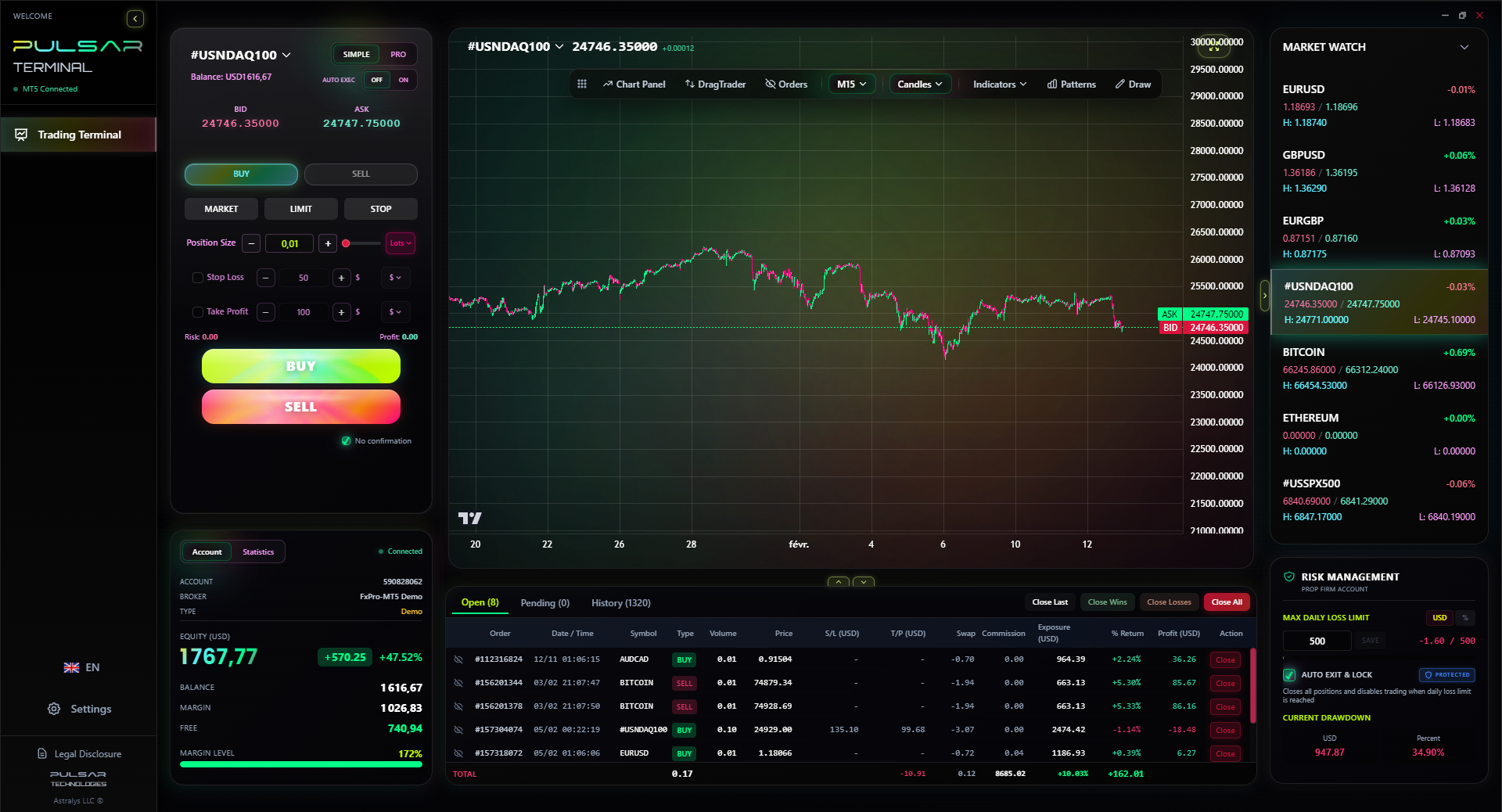
Manually calculating position size for every trade is tedious; Pulsar Terminal's trade panel can display real-time risk in your account currency and automate lot sizing based on your stop-loss distance.
Pulsar Terminal
MT5一站式工具:拖拽下单、多重止盈/止损、追踪止损、网格交易、成交量分布图和自营交易保护。每日1000+交易者使用。
You don't have to be a math whiz. The right tools do the heavy lifting.
Trading Platforms
MetaTrader 4 & 5 (MT4/MT5): The undisputed kings in South Africa. Nearly every FSCA-regulated broker offers them. The great thing is the built-in 'Terminal' window. When you open a new order, it shows you the estimated pip value, margin, and potential profit/loss based on your entry and stop-loss before you place the trade. Use it!
cTrader: Offered by some brokers like FxPro. It's slick and has even better built-in risk calculation visuals. The downside is less community support and fewer custom indicators compared to MT4.
Essential Calculators
Never trade without these:
- Position Size Calculator: Input your account size (in ZAR), risk percentage, stop-loss in pips, and pair. It spits out the exact lot size to trade. My favorite free online ones let you set the account currency to ZAR and include major and exotic pairs.
- Pip Value Calculator: Quick check for any pair. Tell it the pair, your trade size, your account currency (ZAR), and it gives you the Rand value per pip.
- Currency Converter: A simple, real-time USD/ZAR, EUR/ZAR converter. You need the current rate for accurate pip value conversions.
Broker Tools
Most decent brokers have these tools on their website or platform. For example, when I use Exness, their client area has a detailed calculator that includes all their specific account type spreads and commissions. It's more accurate than a generic one.

Pro Tip: Build a simple Excel or Google Sheets spreadsheet. Have columns for Pair, Account Currency (ZAR), Account Balance, Risk %, Stop (pips), USD/ZAR rate, and let it calculate your lot size. Update the USD/ZAR rate once a day. This gives you a consistent, personalized system. I've used mine for 8 years.
The goal is to automate the calculation so you can focus on the trade idea itself. When you're deciding to pull the trigger, you should already know your numbers cold. This discipline is what separates consistent traders from the crowd that blows up accounts.
“Trading USD/ZAR with the same lot size as EUR/USD is like driving a F1 car in first gear - you'll blow the engine.”
Here’s my exact checklist before every single trade. It takes 60 seconds and has saved me thousands.
- Identify the Trade: Chart looks good on EUR/USD. Potential long at 1.0750.
- Define Levels: Entry: 1.0750. Stop-Loss: 1.0725 (25 pips away). Take-Profit: 1.0800 (50 pips away).
- Check the Spread: At this moment, is it 0.8 pips or 2 pips? If it's wide, I might wait or adjust my entry slightly.
- Calculate Risk in Pips: Stop distance = 25 pips.
- Determine My Risk in Rands: My rule is 0.5% of my R100,000 account = R500 risk.
- Find Pip Value in ZAR: For EUR/USD, 1 pip for a mini lot = $1. Current USD/ZAR = 18.30. So 1 pip = R18.30.
- Calculate Position Size:
- Max loss per mini lot = 25 pips × R18.30 = R457.50.
- My risk is R500, so I can trade slightly over 1 mini lot.
- Exact size: R500 / (25 × R18.30) = 1.09 mini lots (10,900 units).
- Calculate Potential Reward: 50 pips × R18.30 per pip × 1.09 lot size = R997.35.
- Check Risk-Reward Ratio: R997 / R500 = almost 2:1. Acceptable.
- Check Margin/use: For 10,900 units of EUR/USD at 1.0750, margin required at 30:1 use is roughly (10,900 × 1.0750) / 30 = ~$390, or about R7,137. My equity is R100,000, so this is fine. No risk of margin call.
- Place the Trade: Enter as a limit order with stop-loss and take-profit attached.
This process turns an emotional decision into a mechanical one. The calculation for how to calculate points in forex is embedded in steps 4 through 8. After a while, it becomes second nature, but you should never skip it. Not even when you're 'sure' it's a winner.
Final thought: The market doesn't care if you miscalculated. It will take your money just as fast. But with these calculations down pat, you're not just throwing darts. You're running a business where you know the costs, risks, and potential rewards of every deal. That's how you survive and thrive from Cape Town to Joburg.
FAQ
Q1Is a 'point' the same as a 'pip' in forex?
For all practical purposes in forex trading, yes. 'Pip' is the more common term. It stands for 'Percentage in Point.' Sometimes you might see 'pipettes' which are tenths of a pip, but when we talk about calculating profit, risk, and position size, we work in whole pips.
Q2How much is 1 pip worth in South African Rands (ZAR)?
It depends entirely on the currency pair and your trade size. For a standard lot (100,000 units) of EUR/USD with USD/ZAR at 18.50, 1 pip is worth about R185. For a standard lot of USD/ZAR at 18.50, 1 pip is worth about R54. You must use the pip value formula for each specific trade - never assume it's the same.
Q3Why is the pip value different for USD/ZAR compared to EUR/USD?
Two reasons: 1) Quote Convention: USD/ZAR is quoted to two decimal places (e.g., 18.50), so a 1-pip move is 0.01 ZAR. EUR/USD is quoted to four decimals, so a 1-pip move is 0.0001 USD. 2) The Exchange Rate: The pip value formula divides by the current price. A higher price (like EUR/ZAR at 20.00) actually results in a slightly lower ZAR pip value per lot, all else being equal.
Q4What use can I use in South Africa?
The FSCA limits retail traders to a maximum of 30:1 use. This applies to brokers regulated by the FSCA. Some international brokers might offer more, but using them means forfeiting the local regulatory protections. The 30:1 limit forces sensible position sizing, which is a good thing for long-term survival.
Q5How do I calculate profit if my take-profit is hit?
Profit in ZAR = (Number of Pips Gained) × (Pip Value in ZAR for your specific trade size). First, calculate your pip value for the lot size you traded. Then multiply by the number of pips between your entry and your closing price. Remember to account for the spread - your profit is based on the bid price when you sell to close a long trade.
Q6Are there any good free calculators for South African traders?
Yes, many trading websites offer free pip value and position size calculators. The key is to find one that allows you to set your 'account currency' to South African Rand (ZAR) and includes exotic pairs like USD/ZAR. Your broker's MT4/MT5 platform also has a built-in calculator when you place an order.
Q7Do I pay tax on profits measured in pips?
SARS doesn't tax pips; they tax profits in Rands. You must convert all your trading profits and losses into ZAR at the exchange rate on the day each trade is closed. This is another crucial reason to know how to convert pip values into your local currency accurately. Keep detailed records of every closed trade's P&L in Rands.
Winston 教授的课程
要点总结:
- ✓A pip for ZAR pairs is 0.01, not 0.0001.
- ✓Always convert pip value to ZAR using the current USD/ZAR rate.
- ✓With 30:1 use, a R50k account controls ~R1.5m.
- ✓A standard lot of USD/ZAR can risk R50+ per pip.
这篇文章对您有用吗?
点击星星评分
每周交易洞察
免费每周分析与策略。无垃圾邮件。
关于作者
David van der Merwe
新兴市场交易员
约翰内斯堡交易者,11年新兴市场货币经验。专注于ZAR货币对、FSCA监管交易和南非市场分析。
评论
风险提示
金融工具交易存在重大风险,可能不适合所有投资者。过往业绩不代表未来表现。本内容仅供教育目的,不构成投资建议。在交易前请务必自行研究。
您可能还喜欢

Cara Trading Forex Sukses: 7 Prinsip dari Trader Profesional
Cara trading forex sukses dengan 7 prinsip trader pro: manajemen modal, disiplin, journal trading, backtest. Data nyata, bukan janji profit palsu.
Jam Trading Forex Terbaik untuk Trader Indonesia: Panduan Lengkap dengan Tabel Waktu
Panduan jam trading forex untuk trader Indonesia. Tabel 4 sesi dunia, jam emas 20:00-00:00, sesi mana yang harus dihindari. Data akurat + tips dari trader berpengalaman.
Top 5 Sàn Forex Uy Tín Nhất 2026: Review Jujur dari Trader Indonesia
Top 5 sàn forex uy tín 2026 untuk trader Indonesia. Review jujur: spread, deposit, withdraw, dukungan lokal. Exness, XM, IC Markets & lebih.
