


Most Nigerian traders think drawing a trend line is as simple as connecting two dots.

Olumide Adeyemi
西非交易先驱 ·  Nigeria
☕ 8 分钟阅读
您将学到:
Most Nigerian traders think drawing a trend line is as simple as connecting two dots. They slap a line on a chart, see a bounce, and go all in. That's how you lose your capital before you can say 'Lagos traffic.' The truth is, using trend lines effectively is less about art and more about a strict, evidence-based process. I've watched too many traders, myself included in the early days, get chopped up because we treated these lines like magic. Let's set the record straight on how to use trend lines in forex the right way.
A trend line is a visual representation of market sentiment. It's not a prediction, a force field, or a guarantee. It's a dynamic level where buyers and sellers have previously shown up in force. In an uptrend, you connect higher lows. In a downtrend, you connect lower highs. That's it. The biggest mistake I see is forcing a line to fit a preconceived bias. If you have to ignore three price spikes to make your line look good, you're wrong, not the market.
Think of it like this: a valid trend line is a level the market respects. It's a story of repeated rejection. When price approaches that line for a third or fourth time, you're looking at a potential battleground. But here's the kicker for us trading from Nigeria: liquidity and news events can make the Naira pairs (like USD/NGN on the black market or correlated majors like GBP/USD) behave erratically. A trend line on EUR/USD during London session might be clean, but trying to draw one on a thin exotic pair during off-hours is asking for trouble. Start with the major pairs where the spread is tight and the moves are cleaner.
“A trend line is a visual representation of market sentiment, not a force field.”
This debate is older than the queue at a filling station. Should you connect the wicks (the high/low shadows of the candles) or the closing prices (the bodies)? The answer determines your success rate.
I used to connect wicks exclusively. It seemed logical - connect the absolute extremes. Then I lost ₦120,000 on a GBP/USD trade because price spiked through my wick-based trend line by 2 pips, triggered my stop-loss, and reversed. The closing prices never actually closed beyond the trend. I was technically right, but my account was wrong.
My rule now: Connect closing prices for higher-probability setups. The closing price represents where the market settled after the period's battle. A wick is often just a liquidity grab or stop-hunt, especially in the fast-moving markets we access through brokers like Exness or IC Markets. A close beyond the trend line is a stronger statement of intent.

Warning: Be brutally consistent. Don't connect a wick on one point and a body on another. Pick a method and stick to it across all your charts. Inconsistency here is a silent account killer.
The Three-Touch Rule is a Minimum
Two points make a line, but only two. It's a hypothesis. The third touch confirms it's a valid level. The fourth and fifth touches make it a strong, tradable zone. I won't even consider a trend line for a live trade until I've seen that third respectful touch. This patience alone will filter out 50% of the bad trades you're tempted to take.

💡 Winston 小贴士
A trend line touched six times is six times more important than one touched twice. The market's memory is built on repetition.
“If you have to ignore three price spikes to make your line look good, you're wrong, not the market.”
This is the classic trend-following method. Price approaches an established uptrend line, you look for a bullish reversal candle pattern (like a pin bar or engulfing), and you buy, placing your stop-loss just below the line. Sounds easy, right? Here’s where it gets real.
You need confluence. A trend line alone is weak sauce. You need it to align with another technical factor. This could be:
- A previous horizontal support/resistance level.
- A key Fibonacci retracement level (like the 61.8%).
- A moving average (like the 50 or 200 EMA).
Real Trade Example: In early 2025, I was watching XAU/USD (gold). It was in a steady uptrend on the 4-hour chart. Price pulled back right to a trend line connecting three prior higher lows. This pullback also coincided almost perfectly with the 50-period EMA. That was my confluence. I entered a buy at $2021.50. My stop was at $2015.90 (below the trend line and the EMA). I didn't use a fancy target; I just trailed my stop manually as price climbed, eventually getting stopped out at $2058. That was a 36.5 pip gain, which on my 0.5 lot position was a $182 profit (about ₦230,000 at the time). The trend line gave me the level, but the EMA confluence gave me the confidence to size appropriately using my position size calculator.

Pro Tip: Wait for the candle to CLOSE beyond the trend line for your entry signal. Don't jump in mid-candle. That's reacting to noise, not price action. This one habit saved me from countless false starts.
“Trading breakouts is sexier but far more dangerous. Everyone wants to catch the big reversal. Most get fakeouts.”
Trading breakouts is sexier but far more dangerous. Everyone wants to catch the big reversal. Most get fakeouts. A true trend line break isn't just a spike. It's a sustained move with momentum.
My process for a break:
- Wait for the Close: Price must close decisively beyond the trend line on your chosen timeframe. A 4-hour close is stronger than a 5-minute close.
- Wait for the Retest: This is the critical step most Nigerians skip because of FOMO. After the break, price often retraces to retest the broken trend line from the other side. That former support now becomes resistance. You enter on the rejection from this retest.
- Confirm with Volume/Momentum: Use an indicator like the MACD to see if momentum is genuinely shifting with the break.
I learned this the hard way with EUR/USD. Price broke a key daily downtrend line. I sold immediately, thinking the downtrend was accelerating. It was a fakeout. Price snapped back above the line and rallied 90 pips against me. I lost 2% of my account. Now, I only enter on the retest. It means I sometimes miss the very first move, but my win rate on break trades improved dramatically. This patience is crucial for swing trading setups.
💡 Winston 小贴士
If you find yourself redrawing the same trend line three times in a session, walk away. You're not analyzing; you're arguing with price.
“Trading breakouts is sexier but far more dangerous. Everyone wants to catch the big reversal. Most get fakeouts.”
Let's get local. Here are the specific errors I see in our trading communities every day.
1. Over-leveraging on Thin Lines: You see a bounce on a 15-minute chart, load up with 1:500 use from a broker like HFM, and get liquidated by a 10-pip whipsaw. A trend line on a lower timeframe is fragile. Higher use needs higher timeframe confirmation. If you're trading off a 1-hour or 4-hour trend line, that's a different story.
2. Ignoring Broader Market Context: Drawing a neat uptrend line on GBP/JPY while the FTSE is crashing is pointless. Correlations matter. Also, know when the CBN or MPC is making announcements. No trend line in the world will hold against unexpected regulatory news. Trade around these events.
3. Not Adjusting Lines: Trends accelerate or decelerate. Sometimes you need to redraw your line to match the new angle of attack. Being dogmatic about your first line is a mistake. If price is consistently finding support above your original line, draw a new, steeper one. The market is the boss.
4. Forgetting About Fees: That beautiful 8-pip bounce play? If your broker's spread on that pair is 3 pips, you need an 11-pip move just to break even. Factor in costs before you enter, especially with strategies that target small moves like scalping.
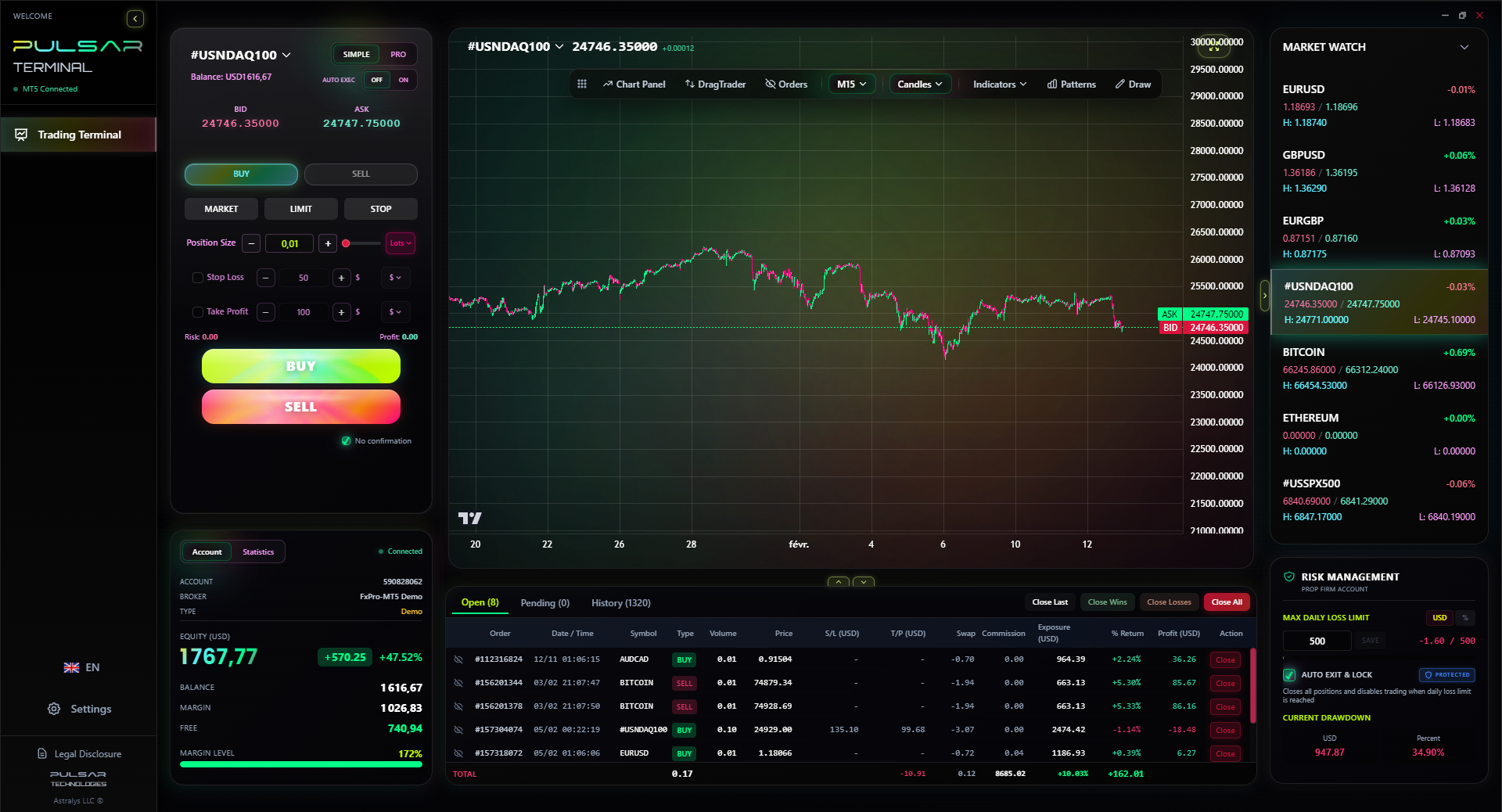
Manually trailing your stop to lock in profits as a trend runs is time-consuming and emotional; Pulsar Terminal automates advanced trailing stop and breakeven functions directly on your MT5 charts.
Pulsar Terminal
MT5一站式工具:拖拽下单、多重止盈/止损、追踪止损、网格交易、成交量分布图和自营交易保护。每日1000+交易者使用。
“Humility is your greatest tool.”
This isn't theory. This is your Monday morning checklist.
Step 1: Find the Macro Trend. Go to the daily chart. Draw the obvious major trend lines. Is USD/NGN in a structural uptrend? Then be cautious trying to buy GBP/USD if it's correlated. This defines your bias.
Step 2: Zoom In for the Setup. Drop to the 4-hour or 1-hour chart. Look for a trend line that has at least three touches. Is it approaching that line now?
Step 3: Seek Confluence. What else is there? Check the RSI for divergence. Is there a 200 EMA nearby? A round number? No confluence? Skip the trade. Go watch a movie.
Step 4: Define Your Risk. Where is your invalidation point? It's just beyond the trend line. Calculate your position size so that loss is 1% of your account. Not 5%, not 10%. 1%. Use a calculator.
Step 5: Execute and Manage. Place your entry order, your stop-loss, and your take-profit. Consider using a trailing stop to ride strong trends. And for God's sake, don't move your stop-loss further away because you're scared of being wrong. That's how a 1% loss becomes a margin call.
A Final, Personal Note: I have a screenshot of a chart from 2019. I drew a perfect-looking downtrend line on AUD/USD. I shorted it. I lost. Why? Because I was so in love with my line I ignored the fact that price had already formed a massive higher low on the weekly chart - the trend had already reversed. I was fighting the market. The line was correct, but my interpretation was dead wrong. Humility is your greatest tool.
💡 Winston 小贴士
The most profitable trend line is the one you draw but don't trade. It teaches you patience, the trader's rarest skill.
FAQ
Q1What's the best timeframe for drawing trend lines?
Start with the higher timeframes for the main trend (Daily, 4-Hour). These lines are stronger. Use lower timeframes (1-Hour, 15-min) for finer entry points, but never trade against the higher timeframe trend line direction. A 15-minute uptrend line means nothing if the daily chart is breaking below a major downtrend line.
Q2How do I know if a trend line break is real or a fakeout?
Look for a strong closing candle (a full-bodied candle that closes well beyond the line) and increased volume if you have a volume indicator. The most reliable signal is a subsequent retest and rejection of the broken line. If price slices through and never looks back, it's real. If it immediately snaps back, it was likely a fakeout.
Q3Can I use trend lines for trading USD/NGN?
Be extremely careful. The official and parallel market rates can differ wildly, and liquidity for direct USD/NGN pairs with international brokers can be poor. You're often better off analyzing trends in major USD pairs (like EUR/USD or GBP/USD) that strongly influence the Naira's perceived value, rather than trying to draw precise lines on a volatile, often-managed currency.
Q4How many pips should I set my stop-loss beyond the trend line?
There's no fixed number. Your stop should be placed beyond the recent swing low/high near the trend line, or a few pips beyond the line itself to account for normal market volatility (wicks). On a 1-hour chart, 15-25 pips might be sufficient. On a daily chart, you might need 50-80 pips. Always use a stop; guessing is a path to ruin.
Q5Do trend lines work with crypto trading?
The principles are the same, but crypto markets are far more volatile. Trend lines get broken more violently and frequently. Use wider stops, seek stronger confluence (like major support/resistance zones), and be prepared for more false breaks. The basic rules of how to use trend lines in forex apply, but the market's personality is much wilder.
Q6Is it better to use a straight line or a curved (moving average) line?
They serve different purposes. A straight trend line shows static support/resistance from specific swing points. A moving average (like the 20 or 50 EMA) is a dynamic trend line that reacts to average price. I use both. A straight trend line can show a long-term channel, while a moving average can show the current momentum within that channel. They are complementary tools.
Winston 教授的课程
要点总结:
- ✓Connect closing prices, not wicks, for higher-probability setups.
- ✓Never trade a trend line without a third confirming touch.
- ✓Always seek a second source of confluence before entering.
- ✓Place your stop-loss beyond the line, never move it away.
- ✓A break isn't valid until a retest confirms it.
这篇文章对您有用吗?
点击星星评分
每周交易洞察
免费每周分析与策略。无垃圾邮件。
关于作者
Olumide Adeyemi
西非交易先驱
尼日利亚最活跃的外汇交易教育者之一。从拉各斯出发有8年交易经验。专注于低资金策略和面向非洲交易者的自营公司挑战。
评论
风险提示
金融工具交易存在重大风险,可能不适合所有投资者。过往业绩不代表未来表现。本内容仅供教育目的,不构成投资建议。在交易前请务必自行研究。
您可能还喜欢

Cara Trading Forex Sukses: 7 Prinsip dari Trader Profesional
Cara trading forex sukses dengan 7 prinsip trader pro: manajemen modal, disiplin, journal trading, backtest. Data nyata, bukan janji profit palsu.
Jam Trading Forex Terbaik untuk Trader Indonesia: Panduan Lengkap dengan Tabel Waktu
Panduan jam trading forex untuk trader Indonesia. Tabel 4 sesi dunia, jam emas 20:00-00:00, sesi mana yang harus dihindari. Data akurat + tips dari trader berpengalaman.
Top 5 Sàn Forex Uy Tín Nhất 2026: Review Jujur dari Trader Indonesia
Top 5 sàn forex uy tín 2026 untuk trader Indonesia. Review jujur: spread, deposit, withdraw, dukungan lokal. Exness, XM, IC Markets & lebih.
