


Here's a stat that might surprise you: the South African forex market is projected to grow from USD 3.86 billion in 2024 to nearly USD 6.85 billion by 2033.

David van der Merwe
新兴市场交易员 ·  South Africa
☕ 10 分钟阅读
您将学到:
Here's a stat that might surprise you: the South African forex market is projected to grow from USD 3.86 billion in 2024 to nearly USD 6.85 billion by 2033. That's a lot of rand moving around. Yet, for many traders, the hardest part isn't making the money, it's getting it out of the trading platform and into your bank account without losing a chunk to fees or hitting a regulatory wall. Knowing how to withdraw money in forex properly is a skill as important as any trading strategy, especially with our unique SARB rules. Let's break it down.
Before you even think about clicking 'withdraw', you need to know the lay of the land. In South Africa, two big players watch over your forex profits: the Financial Sector Conduct Authority (FSCA) and the South African Reserve Bank (SARB).
The FSCA regulates the brokers. If you're using a local broker, they must be a licensed Financial Service Provider (FSP). This is non-negotiable for your safety. I always check the FSP number on the FSCA's website - it takes two minutes and can save you a world of pain. You can trade with international brokers too, but just know the FSCA's protective arm doesn't reach that far.
The real key for withdrawals is SARB's exchange controls. They're not there to stop you, but to manage capital flow. You have two main allowances:
- Single Discretionary Allowance (SDA): This is your 'easy' money. As a resident over 18, you can move up to ZAR 1 million per calendar year out of the country for things like travel, gifts, or investments. No tax clearance needed. This is usually enough for most retail traders.
- Foreign Investment Allowance (FIA): The big one. This allows you to move up to ZAR 10 million per year. The catch? You need a Tax Clearance Certificate from SARS for this. If you have a monster year trading XAU/USD and need to bring back serious profits, this is your route.

Warning: It's illegal to use informal channels (like the guy at the corner shop) to exchange currency. Always use a licensed bank or dealer. Also, if you travel and come back with foreign cash, you have 30 days to convert it back to rand. They're serious about this.
One more thing: yes, your trading profits are taxable income. SARS sees it as part of your normal income. Keep a clean record of your trades, deposits, and withdrawals. It makes life much easier come tax season.

💡 Winston 小贴士
Withdraw your initial stake first. Once your account balance is all profit, the psychological game changes completely. You're trading with the house's money.
“Knowing how to withdraw money in forex properly is a skill as important as any trading strategy.”
Okay, you've closed a winning scalping strategy run and you're ready to cash out. What now? The process is usually straightforward, but you've got to dot your i's.
Log In and Find the Cashier
First, log into your trading account's client portal or 'cashier' section. This is separate from your MT4/MT5 platform. Look for a button that says 'Withdraw', 'Withdraw Funds', or 'Payment Methods'.
Choose Your Withdrawal Method
This is critical. You generally need to withdraw back to the same method you used to deposit. This is an anti-money laundering rule. If you deposited with a Visa card from FNB, you'll likely withdraw back to that same FNB Visa card. Brokers like Exness and XM are strict on this. Some may allow a bank transfer to a different account in your name after verification, but don't count on it.
Enter the Amount and Details
Specify how much you want to withdraw. Be mindful of any minimum withdrawal amounts. Then, confirm the payment details. For a bank transfer, this means your South African bank account details (account holder name must match your trading account exactly), SWIFT/BIC code, and your bank's address.
Submit and Verify
Hit submit. You'll often get an email to confirm the request. Click that link. For larger amounts, the broker's compliance team might call you to verify. It's a hassle, but it's for security.
The Waiting Game
Now, you wait. Processing times vary wildly:
- E-wallets (Skrill, Neteller): 24 hours or less. Often instant.
- Credit/Debit Cards: 2-5 business days.
- Bank Wire Transfer: 3-7 business days, sometimes longer.
I once withdrew $2,000 via bank wire from an international broker. It left their end on a Tuesday, hit my Standard Bank account the following Wednesday. Seven full days. The market can move a lot in that time, so plan your withdrawals when you don't need that capital immediately.

Pro Tip: Always withdraw in the currency of your trading account (usually USD or EUR) if your bank allows you to hold a foreign currency account. Let your bank do the conversion to ZAR. You'll often get a better rate than the broker gives you, and you avoid double-dipping on fees.
“The real key for withdrawals is SARB's exchange controls. They're not there to stop you, but to manage capital flow.”
This is where profits can silently evaporate. When you're figuring out how to withdraw money in forex, you must account for every layer of cost. It's not just the broker's fee.
Broker Fees: Many brokers advertise 'free withdrawals'. This is often true for e-wallets. But for international bank wires, a fee of $10-$25 is common. Always check the fee schedule before you deposit.
Bank Fees: This is the silent killer. Your broker might send $1,000 for free, but two banks can take a cut along the way.
- Intermediary Bank Fee: If the money passes through a correspondent bank (common with international transfers), they might take $15-$30.
- Receiving Bank Fee: Your South African bank will charge to receive foreign currency. Let's look at real numbers from 2025:
| Bank | Fee for Incoming Int'l Payment (Digital) | Fee for Incoming Int'l Payment (Manual) |
|---|---|---|
| Nedbank | 0.63% (min R160, max R747) | 0.78% (min R270, max R1,046) |
| Standard Bank | Varies; often a flat fee + % | Varies; often a flat fee + % |
So, on a $1,000 (approx. R18,000) withdrawal, Nedbank could take about R160 just to receive it. If it's a manual processing, that jumps to R270.
Currency Conversion: If your trading account is in USD and your bank converts to ZAR, they add a margin to the exchange rate. Nedbank's international conversion fee is up to 2.75%. On R18,000, that's another R495 gone.
My Costly Lesson: Early on, I withdrew €500 to my Absa account. The broker charged €9. My bank took a €15 receiving fee and gave me a poor exchange rate with a 2.5% margin. I ended up with about R8,200 in my account instead of the R8,650 I was expecting. I lost over R450 (about 5.2%) just in fees. Now I use a broker like IC Markets that offers free withdrawals to a local South African bank via a payment processor, which sidesteps most of these international fees.
“This is where profits can silently evaporate. You must account for every layer of cost.”
So, with all these fees, what's the best way? It depends on speed, cost, and amount.
1. E-Wallets (Skrill, Neteller, PayPal):
- Speed: ★★★★★ (Often same-day)
- Cost: ★★★★☆ (Low broker fees, but check the e-wallet's own fees)
- Best for: Smaller, frequent withdrawals. Getting money out fast. You can then transfer from the e-wallet to your SA bank account, but that's another step with its own fees.
2. Credit/Debit Card:
- Speed: ★★★☆☆ (2-5 days)
- Cost: ★★★☆☆ (Usually low fees, but your bank's forex margin applies)
- Best for: Convenience if you deposited by card. The money goes straight back to your card account.
3. International Bank Wire:
- Speed: ★★☆☆☆ (3-7+ days)
- Cost: ★★☆☆☆ (High potential for layered fees)
- Best for: Large, one-off withdrawals where you're willing to pay for direct routing.
4. Local Bank Transfer (via Payment Processor):
- Speed: ★★★★☆ (1-3 days)
- Cost: ★★★★★ (Often zero broker fees, lower bank fees)
- Best for: South African traders. This is the winner. Brokers like Pepperstone and IC Markets offer this. They convert your funds to ZAR via a partner and do a local EFT into your SA account. You avoid international wire fees entirely. I use this exclusively now for any amount over R5,000.

Example: Withdrawing $1,000.
- Int'l Wire: Broker fee ($20) + Intermediary bank ($20) + SA bank fee (R160) + Conversion margin (2.75% = ~R495) = Total loss ~R1,100+
- Local EFT via Processor: Broker fee (R0) + Processing fee (R0) + SA bank fee (R0 for EFT) = Total loss R0. You just get the day's exchange rate, which is fair.
💡 Winston 小贴士
Treat withdrawal fees as a direct cost of your business. If your average trade profit is R500, but it costs R300 to get it out, your edge is gone. Factor it into your profit targets.
“This is where profits can silently evaporate. You must account for every layer of cost.”
Let's not kid ourselves. SARS is interested in your trading profits. Forex trading is not a tax-free hobby. Your net profit (after deducting legitimate expenses like data fees, platform fees, and internet costs) is considered ordinary revenue and is added to your other income (salary, etc.). You're taxed at your marginal income tax rate.
What you need to do:
- Keep Impeccable Records: This is non-negotiable. Use a spreadsheet or trading journal. Log every trade: date, instrument (like EUR/USD), entry/exit price, profit/loss in Rands. Also keep all deposit and withdrawal confirmations.
- Track Your Base Currency: If you trade in USD, you must convert each trade's P&L to ZAR using the spot rate on the day the trade was closed. This is a pain, but some broker statements or accounting software can do it.
- Report Annually: Declare your total net trading profit on your annual income tax return (ITR12).
I'm not a tax consultant, but here's what my accountant told me: The onus is on you to prove your numbers. A clear, auditable trail from your broker's platform to your tax return is your best defense. If you're making significant money, just pay the pros. The peace of mind is worth the fee.
“For South African traders, a local ZAR EFT via a broker's payment processor is often the winner.”
Even with the best planning, withdrawals can get stuck. Here are the usual suspects.
Problem 1: Withdrawal is 'Pending' for ages.
- Cause: Usually a compliance check. Large or unusual withdrawals trigger this.
- Fix: Be proactive. Contact support before withdrawing a large sum and ask if they need any extra documents. Have your ID, proof of address, and proof of payment method ready.
Problem 2: Bank rejected the transfer.
- Cause: Incorrect bank details (wrong SWIFT code, account number). Or your bank's name doesn't exactly match your trading account name (e.g., 'J. Smith' vs 'John Smith').
- Fix: Triple-check every digit and letter before submitting. Use the bank's official SWIFT code, not one from a Google search. The money will bounce back to the broker, but you'll lose the withdrawal fee and wait weeks.
Problem 3: You got less money than expected.
- Cause: The fee gauntlet we discussed. Or a worse-than-expected exchange rate.
- Fix: Calculate the net amount before you withdraw. Use a position size calculator in reverse: start with your desired net rand, work backwards to see what gross amount you need to request.
Problem 4: Withdrawal option is greyed out.
- Cause: You have open trades using the money you're trying to withdraw (margin in use), or you have a bonus with unmet trading volume requirements.
- Fix: Close some positions or wait. You can only withdraw your free margin. This is a key reason to manage your risk and avoid a margin call.
The bottom line? Patience and paperwork are part of the game. Don't let a delayed withdrawal make you take a reckless trade to 'make up for it.'
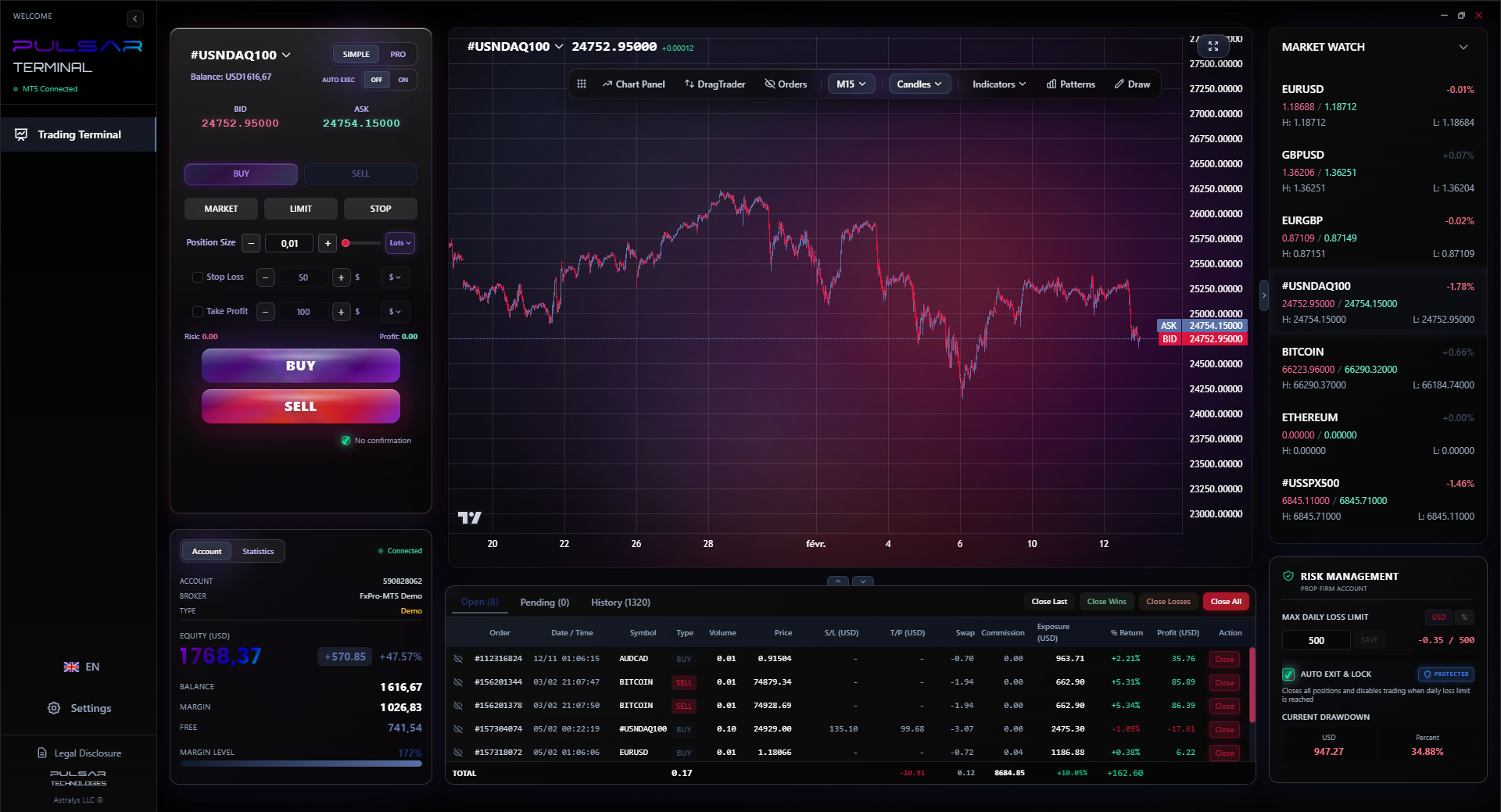
Managing your trades and risk effectively is the first step to a smooth withdrawal, and tools like Pulsar Terminal help you lock in profits and control losses directly on your MT5 charts.
Pulsar Terminal
MT5一站式工具:拖拽下单、多重止盈/止损、追踪止损、网格交易、成交量分布图和自营交易保护。每日1000+交易者使用。
FAQ
Q1How long does a forex withdrawal take to reach my South African bank account?
It depends on the method. E-wallets can be same-day. Card withdrawals take 2-5 business days. International bank wires take 3-7 business days, but can be longer. The fastest and cheapest method for SA traders is often a local ZAR EFT via a broker's payment processor, which typically lands in 1-3 business days.
Q2Can I withdraw my forex profits to a different bank account than I used to deposit?
Generally, no. Anti-money laundering (AML) rules require brokers to send funds back to the original source of deposit. Some brokers may make exceptions after rigorous verification, sending to a bank account in your exact name. Never assume this is possible - always check with your broker's policy first.
Q3What is the cheapest way to withdraw forex profits to South Africa?
For most, it's using a broker that offers a local ZAR EFT via a payment partner (like some international brokers do). This bypasses expensive international wire and intermediary bank fees. Alternatively, using an e-wallet like Skrill for the broker withdrawal (often free), then transferring from Skrill to your SA bank, can be cost-effective for smaller amounts.
Q4Do I need a tax clearance certificate from SARS to withdraw my money?
Not for the broker withdrawal itself. However, if you need to move more than ZAR 1 million out of South Africa in a year under the Foreign Investment Allowance (FIA), you will need a Tax Clearance Certificate from SARS to authorize that capital export with your bank. For withdrawals under ZAR 1 million, your Single Discretionary Allowance covers it.
Q5Why was my forex withdrawal rejected or delayed?
Common reasons include: 1) Incorrect or unverified account details, 2) Attempting to withdraw more than your 'free margin' (money not used to hold open trades), 3) Not meeting bonus wagering requirements, 4) The broker's compliance team conducting a routine check on large or first-time withdrawals.
Q6How are forex trading profits taxed in South Africa?
Forex trading profits are considered ordinary revenue by SARS. Your net profit (total gains minus losses and allowable trading expenses) is added to your other income (like your salary) and taxed at your marginal income tax rate. You must declare this on your annual tax return (ITR12).
Winston 教授的课程
要点总结:
- ✓Use your ZAR 1 million Single Discretionary Allowance first for withdrawals.
- ✓Local EFT beats international wire for cost and speed in SA.
- ✓Always withdraw to your original deposit method.
- ✓Keep a detailed trade log for SARS; it's not optional.
- ✓Factor all fees into your profit targets before you trade.
这篇文章对您有用吗?
点击星星评分
每周交易洞察
免费每周分析与策略。无垃圾邮件。
关于作者
David van der Merwe
新兴市场交易员
约翰内斯堡交易者,11年新兴市场货币经验。专注于ZAR货币对、FSCA监管交易和南非市场分析。
评论
风险提示
金融工具交易存在重大风险,可能不适合所有投资者。过往业绩不代表未来表现。本内容仅供教育目的,不构成投资建议。在交易前请务必自行研究。
您可能还喜欢

Cara Trading Forex Sukses: 7 Prinsip dari Trader Profesional
Cara trading forex sukses dengan 7 prinsip trader pro: manajemen modal, disiplin, journal trading, backtest. Data nyata, bukan janji profit palsu.
Jam Trading Forex Terbaik untuk Trader Indonesia: Panduan Lengkap dengan Tabel Waktu
Panduan jam trading forex untuk trader Indonesia. Tabel 4 sesi dunia, jam emas 20:00-00:00, sesi mana yang harus dihindari. Data akurat + tips dari trader berpengalaman.
Top 5 Sàn Forex Uy Tín Nhất 2026: Review Jujur dari Trader Indonesia
Top 5 sàn forex uy tín 2026 untuk trader Indonesia. Review jujur: spread, deposit, withdraw, dukungan lokal. Exness, XM, IC Markets & lebih.
