


Here's a number that should make you pause: 76%.
Rajesh Sharma
高级外汇分析师 ·  India
India
☕ 10 分钟阅读
您将学到:
Here's a number that should make you pause: 76%. That's the percentage of Indian traders under 30 who lost money intraday trading in FY23, according to SEBI. Net losses for individual traders widened by 41% year-on-year in FY2025. Everyone's searching for that magic 'intraday trading strategies pdf', but the real edge isn't in a secret document. It's in understanding the brutal math of Indian markets, the ever-tightening SEBI rules, and the psychological discipline most of us lack. I've been there, chasing setups and blowing accounts. Let me save you some pain.
Forget the YouTube gurus promising lakhs from a 10k account. Intraday trading in India is a game of survival, governed by strict rules most new traders ignore until it costs them. The biggest mistake I made starting out? Not factoring in the real cost of doing business.
SEBI's 5x use cap (20% margin) sounds generous, but it's a double-edged sword. It amplifies both gains and losses, and with the new peak margin reporting (four times a day), your broker will be watching your account like a hawk. The auto square-off by 3:20 PM is non-negotiable. I learned this the hard way in 2022, holding a losing Nifty futures position hoping for a reversal. The broker squared it off at 3:19 PM at the day's low, locking in a max loss. There was no heroic comeback.
Then there's the cost structure. It's a silent profit killer. Let's break down a ₹1,00,000 intraday trade on a stock, assuming you use a discount broker with ₹20 flat brokerage.
| Charge | Rate/Amount | Applied On | Your Cost (Approx.) |
|---|---|---|---|
| Brokerage | ₹20 per order | Buy & Sell | ₹40 |
| STT | 0.025% | Sell Value Only | ₹25 |
| SEBI Fee | 0.0002% | Turnover | ₹0.40 |
| Exchange Charge (NSE) | 0.00297% | Turnover | ₹5.94 |
| Stamp Duty | 0.003% | Buy Value Only | ₹3 |
| GST (18%) | 18% | On (Brokerage + Ex. Charge) | ₹8.27 |
| Total Cost | ₹82.61 |

Example: That ₹82.61 might not seem like much, but it means your trade needs to make over 0.08% just to break even. On a ₹50,000 position with 5x use (trading ₹2.5 lakhs), your costs scale proportionally. Do a few trades a day, and you're looking at hundreds, even thousands, in fees by month's end. This is why most lose. They trade too much, chasing tiny moves that get eaten by costs.
The landscape has gotten tougher. Since February 2025, buying options requires the full premium upfront. No use. And from October 2025, SEBI has placed hard intraday net position limits of ₹5,000 crore per entity in index options. The regulator is deliberately making it harder to speculate wildly. Your search for an 'intraday trading strategies pdf' needs to start with this rulebook.

💡 Winston 小贴士
The market's job is to find the price where you are most likely to make a mistake. Your job is to have a plan so clear that your emotions can't find a way in.
“Your search for an 'intraday trading strategies pdf' needs to start with SEBI's rulebook.”
You don't need a 100-page PDF. You need one or two strategies mastered. In India, liquidity and volatility are your best friends and worst enemies. I've found these frameworks adaptable to our market timings (9:15 AM - 3:30 PM).
Opening Range Breakout (ORB)
This is my bread and butter for the first hour. The concept is simple: identify the high and low of the first 15-30 minutes of trading. A sustained break above that high signals potential bullish momentum for the session; a break below suggests bearishness. The key is confirmation. Don't jump the gun.
I use a 5-minute chart for entries. On April 3rd, 2026, Bank Nifty's first 30-minute range was 48,200 - 48,450. Price consolidated, then a strong 5-minute candle closed above 48,480 with rising volume. I entered a long at 48,500. My stop was placed at 48,420 (just below the range high, now support). I took partial profits at 48,650 and let the rest run with a trailing stop, exiting finally at 48,800. The market gave the trend, and the ORB gave me a low-risk entry. Tools like a good Volume Profile can add conviction to these breakouts.
Momentum Scalping with Price Action
This is pure price reaction. I look for stocks or indices that are already in a clear intraday trend (using a 15-minute chart for direction) and then use a 2 or 3-minute chart to scalp in the trend's direction. I wait for pullbacks to minor support/resistance or a moving average (like the 20 EMA) and enter on the next candle that resumes the trend.
My risk is tight, usually 0.2-0.3%. The profit target is 0.5-0.8%. It's a grind. On a good day, I might take 4-5 such trades. On a bad day, two consecutive losses and I'm done. This is where a scalping strategy mindset is crucial: speed, discipline, and accepting that many trades will be breakeven after costs. You must be okay with that.
The Failed Auction (F&O Focus)
This is more advanced, suited for Nifty or Bank Nifty futures. I watch for sharp, high-volume moves that quickly reverse. The idea is that the initial move was an 'auction' that found no follow-through. If price rockets up but can't hold and falls back through the point of control, it shows weakness. I wait for this failure and then enter in the reversal direction.

Warning: This strategy is dangerous around expiry days. Remember, SEBI has removed calendar spread benefits on expiry day and penalties are active from Dec 2025. Liquidity dries up and moves can be erratic. I avoid this setup entirely on Thursday expiries now.
None of these require fancy indicators. A clean chart, volume, and an understanding of support and resistance are more valuable than any downloaded PDF.
“The 0.08% you need just to break even on a trade is the silent killer of Indian intraday accounts.”
Your broker is your battlefield partner. A slow platform or hidden charges will kill you. I've used most of the big names. Here's the real talk.
Zerodha Kite is the industry benchmark for a reason. Its charting (TradingView powered) is excellent for retail traders. The ₹20 per executed order (or 0.03%) for intraday is straightforward. But their margin policies are strict, and during extreme volatility, I've faced occasional latency. For most beginners, it's the best starting point.
Upstox and Angel One offer similar discount models with competitive platforms. Groww has gained massive popularity for its simplicity, but remember their auto square-off charge (₹50 + GST per position) if you forget to close.
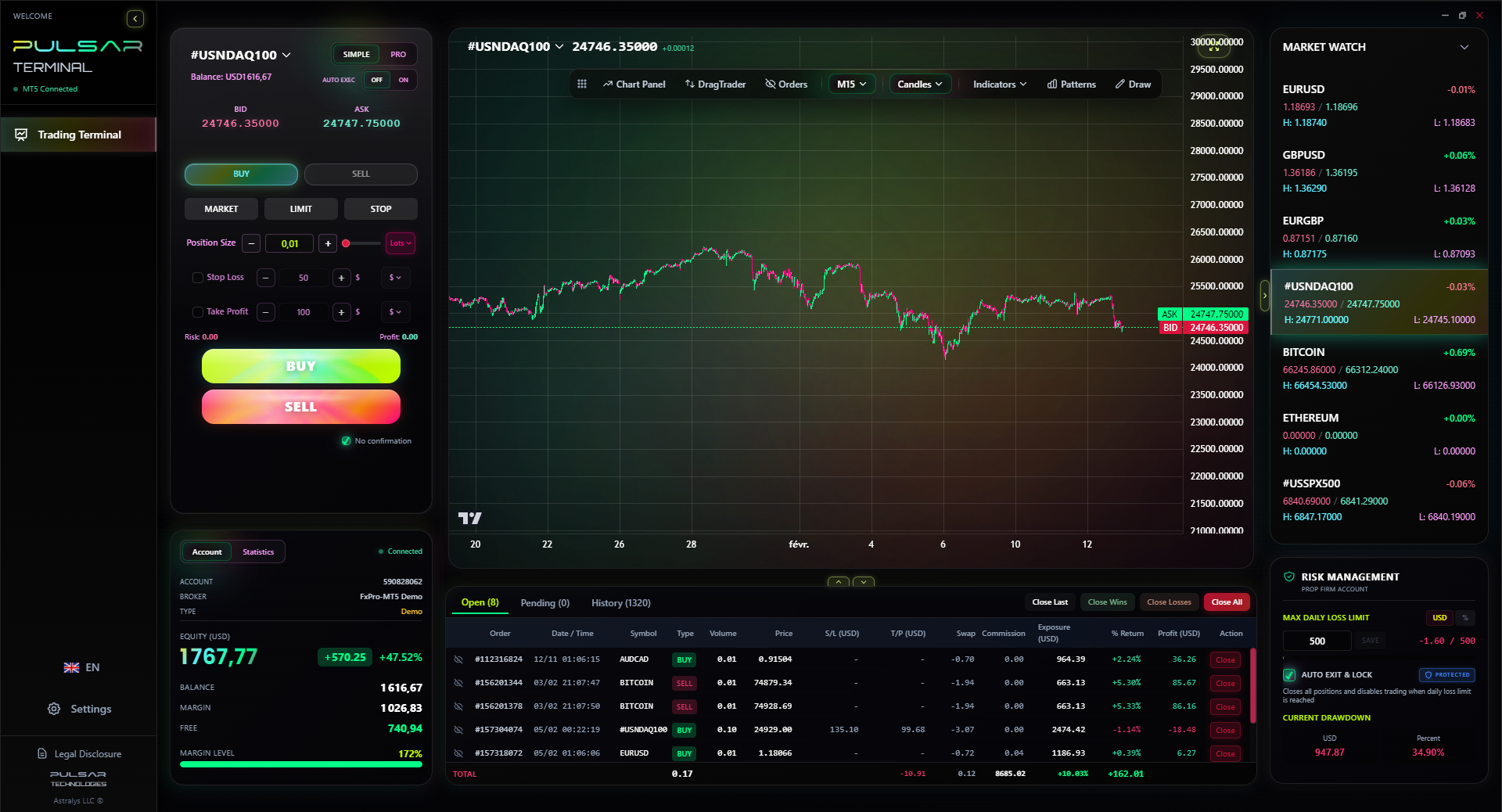
For the more serious intraday trader, especially in futures, a platform with advanced order types is non-negotiable. This is where a broker like IC Markets (if trading global instruments) or using a professional terminal like Pulsar Terminal alongside your MT5/MT4 becomes a game-changer. The ability to set multiple take-profits and stop-losses in one click, or use a trailing stop that automatically adjusts, is a massive psychological and operational advantage.

Pro Tip: Whatever platform you choose, practice on its demo first. Know how to place a bracket order (which sets your entry, target, and stop simultaneously) blindfolded. In a fast market, fumbling with the interface is a luxury you don't have.
Payment methods are seamless now. UPI is the king. Fund transfers from your bank to trading account are instant. But never, ever trade with money you can't afford to lose. That's not a cliché; it's the first rule of surviving the 76% statistic.
💡 Winston 小贴士
A losing trade where you followed your rules is a successful rehearsal. A winning trade where you broke your rules is a disaster in disguise.
“Your risk per trade is sacred. I now never risk more than 1% of my trading capital on any single intraday trade.”
This is where the real battle is fought. Between your ears. A PDF can't teach you this. I've blown up an account. It was 2019. I had a solid week of wins, got overconfident, increased my position size recklessly, and then took a massive loss on a single Bank Nifty trade. Instead of stopping, I 'averaged down,' trying to prove the market wrong. It was a classic margin call in the making. The broker squared off my position, and I was down 60% of my capital in a day.
The lesson was expensive but simple: Your risk per trade is sacred. I now never risk more than 1% of my trading capital on any single intraday trade. For most trades, it's 0.5%. This means if I have a ₹2 lakh account, my maximum loss on a trade is ₹2,000. This dictates my stop-loss distance and position size automatically.
You must have a daily loss limit. Mine is 3%. If I hit that, I shut down the terminal. No questions, no 'one more trade to recover.' Tomorrow is another day. The SEBI stats are filled with people who didn't have this rule.
FOMO (Fear Of Missing Out) is a killer. You'll see a stock rocket 5% and want to jump in. Nine times out of ten, you're buying the top. Have the discipline to watch. There are over 200 trading days a year. You only need to be active on the 20-30 that give you your clearest signals.
Finally, track everything. Not just P&L, but why you took each trade. Did you follow your plan? Was your stop too tight? This journal is more valuable than any 'intraday trading strategies pdf' you'll find. It's a map of your own mind.
“Your risk per trade is sacred. I now never risk more than 1% of my trading capital on any single intraday trade.”
Stop looking for the holy grail in a downloaded file. The goal is to synthesize rules, strategies, and psychology into a personalized trading plan. This is your actual 'PDF' – a living document you create.
Start with the Market Condition: Is it a trending day or a range-bound day? Use the first hour to gauge this. A trending day suits follow-through strategies like ORB. A range-bound day suits reversal plays at support/resistance.
Define your Entry Trigger with precision. Is it a close above a 15-minute high? A pullback to the 9 EMA on the 5-minute chart? A specific RSI indicator reading? It must be objective, not a feeling.
Your Exit Strategy is more important than your entry. Where is your stop-loss? Is it based on a recent swing low/high or a fixed pip amount? How will you take profits? All at one target? Scaling out? I prefer scaling out: 50% at my first target (1:1.5 risk-reward), move my stop to breakeven on the remainder, and let the rest run with a trailing stop. This locks in profit and removes the stress.
Backtest this on historical charts. Then forward-test it on a demo account for at least a month. Does it hold up? Only then should you risk real money. This process is boring. It's work. It's why most people would rather download a PDF and hope. But it's the only thing that separates the 24% from the 76%.
Automation tools can help enforce this system. Setting a trailing stop that mechanically follows price removes emotion. Using a terminal that lets you set a breakeven stop automatically once a certain profit is hit protects you from turning winners into losers.
💡 Winston 小贴士
Your P&L is a lagging indicator. Your adherence to your trading journal and risk parameters is the real-time measure of your success.
Building a robust system requires tools that enforce discipline, like Pulsar Terminal's automated multi-TP/SL and trailing stop features that work directly on your MT5 platform.
Pulsar Terminal
MT5一站式工具:拖拽下单、多重止盈/止损、追踪止损、网格交易、成交量分布图和自营交易保护。每日1000+交易者使用。
“The best 'intraday trading strategies pdf' you can have is the one you write yourself.”
The direction from SEBI is crystal clear: reduced systemic risk and less reckless speculation. The full premium rule for options, the T+1 margin collection, and the intraday position snapshots are all designed to cool overheated markets and protect retail traders from themselves.
For you, this means the game is changing. Overtrading and excessive use will be harder and more costly. The edge will go to the prepared, disciplined trader who treats this as a business, not a casino.
Technology will be your ally. Platforms that offer superior analytics, faster execution, and automated risk management will become standard. The trader using basic charts and gut feeling will be competing against traders using algorithmic assistants and deep market analytics.
Your focus should shift from 'how much can I make' to 'how consistently can I execute my plan while managing risk.' The strategies that will survive are the strong, rules-based ones that don't depend on infinite use or wild bets. It's about quality of execution over quantity of trades.
The best 'intraday trading strategies pdf' you can have in 2026 is the one you write yourself, informed by the hard rules of the Indian market, tested by your own experience, and bound by iron-clad risk management. That's the only edge that lasts.
FAQ
Q1Where can I find a free intraday trading strategies PDF for Indian markets?
Honestly, most free PDFs are generic, outdated, or sales funnels. The NSE and BSE websites offer excellent educational modules. Brokers like Zerodha's Varsity and Upstox's Academy provide high-quality, free content tailored to Indian regulations. Start there instead of searching for a magic PDF.
Q2What is the best intraday trading strategy for beginners in India?
Start simple. The Opening Range Breakout (ORB) is a great foundation. It teaches you to read early momentum, wait for confirmation, and manage a trade. Pair it with a strict 0.5% risk rule and a 1:2 risk-reward target. Master this one setup on a demo account for a month before adding anything else. Complexity is the enemy of execution.
Q3How much money do I need to start intraday trading in India?
You can technically start with ₹5,000-₹10,000. With 5x use, that gives you ₹25k-₹50k in buying power. But realistically, you need enough to withstand losses and costs without blowing up. I'd suggest a minimum of ₹50,000 in risk capital. This allows for sensible position sizing and lets you breathe through a string of losses, which will happen.
Q4Why do most intraday traders lose money in India?
The SEBI study points to three core reasons: 1) Ignoring transaction costs, which eat into small profits. 2) Overtrading and misusing use, leading to large, uncontrolled losses. 3) A lack of a structured plan and emotional discipline. They trade on hope and fear, not rules. It's a behavioral and mathematical failure, not a knowledge gap.
Q5Can I use trailing stops for intraday trading in India?
Absolutely, and you should. Most Indian broker platforms offer a trailing stop-loss order type. It's a crucial tool to lock in profits while letting winners run. For example, you can set a trailing stop of 0.5% below the market price. As price moves up, your stop follows, automatically protecting your profit. This removes the emotion of deciding when to exit.
Q6What are the new SEBI rules for intraday trading in 2026?
Key recent rules include: Full premium upfront for buying options (Feb 2025), intraday position snapshots by exchanges (April 2025), T+1 margin collection for most margins (April 2025), and intraday net position limits of ₹5,000 crore per entity in index options (Oct 2025). The trend is clearly towards tighter risk controls and reduced speculative use.
Q7Is scalping possible with Indian brokerage fees?
Yes, but it's a high-wire act. With a flat ₹20 brokerage per order, each round-trip trade costs at least ₹40 + other statutory charges. Your profit target must be significantly larger than this total cost to be worthwhile. This forces you to be highly selective, aiming for moves of 0.8-1% or more. High-frequency, tiny-profit scalping is likely a losing strategy after costs for most.
Winston 教授的课程
要点总结:
- ✓Intraday success is 30% strategy, 70% cost & risk management.
- ✓Never risk more than 1% of capital on a single trade.
- ✓The first hour often defines the day's trading range.
- ✓A daily loss limit of 3% is non-negotiable.
- ✓Your trading journal is more valuable than any downloaded system.
这篇文章对您有用吗?
点击星星评分
每周交易洞察
免费每周分析与策略。无垃圾邮件。
关于作者
Rajesh Sharma
高级外汇分析师
在印度和南亚市场拥有超过10年的交易经验。从NSE货币衍生品起步,后转入国际外汇市场。专注于USD/INR和新兴市场货币对。
评论
风险提示
金融工具交易存在重大风险,可能不适合所有投资者。过往业绩不代表未来表现。本内容仅供教育目的,不构成投资建议。在交易前请务必自行研究。
您可能还喜欢

Cara Trading Forex Sukses: 7 Prinsip dari Trader Profesional
Cara trading forex sukses dengan 7 prinsip trader pro: manajemen modal, disiplin, journal trading, backtest. Data nyata, bukan janji profit palsu.
Jam Trading Forex Terbaik untuk Trader Indonesia: Panduan Lengkap dengan Tabel Waktu
Panduan jam trading forex untuk trader Indonesia. Tabel 4 sesi dunia, jam emas 20:00-00:00, sesi mana yang harus dihindari. Data akurat + tips dari trader berpengalaman.
Top 5 Sàn Forex Uy Tín Nhất 2026: Review Jujur dari Trader Indonesia
Top 5 sàn forex uy tín 2026 untuk trader Indonesia. Review jujur: spread, deposit, withdraw, dukungan lokal. Exness, XM, IC Markets & lebih.
