


I lost $1,200 in under an hour trying to trade the USD/NGN pair at 2 AM WAT on a Saturday.

Olumide Adeyemi
西非交易先驱 ·  Nigeria
☕ 11 分钟阅读
您将学到:
- 1Forex Market Hours for Nigeria (WAT Time Zone)
- 2The Four Major Sessions & When Liquidity is Real
- 3Nigerian Regulations & What You're Actually Allowed to Trade
- 4Real Costs & use for the Nigerian Trader
- 5A Practical Trading Schedule for Someone with a Day Job
- 6Tools to Check Market Status & Economic Calendars
- 7Why Bank Holidays in the US or UK Matter to You
- 8Final Verdict: Your Best Trading Windows in Nigeria
I lost $1,200 in under an hour trying to trade the USD/NGN pair at 2 AM WAT on a Saturday. The chart was moving, my broker's platform was active, but I was trading in a ghost town. The spread was 15 pips wide, my order filled 8 pips away from my intended price, and a single news headline caused a 50-pip spike that wiped my stop loss. I learned the hard way that just because you can place a trade doesn't mean the market is truly 'open' for business. Knowing the answer to 'is forex market open now' isn't about a simple yes or no. It's about understanding liquidity, session overlaps, and the specific Nigerian context that can make or break your account.
The global forex market runs 24 hours a day, but not all hours are created equal. For us in Nigeria, trading kicks off on Sunday night and wraps up late Friday night, West Africa Time (WAT).
Here’s the weekly schedule in your local time:
- Opens: Sunday, 11:00 PM WAT
- Closes: Friday, 10:00 PM WAT
The market is closed from Friday 10:01 PM WAT until Sunday 10:59 PM WAT. If you try to trade during this weekend closure, your broker's platform might show static prices from the Friday close. Any orders you place will queue up and execute at the next available price when the market re-opens Sunday night, which is a fantastic way to get a nasty surprise - a phenomenon called 'slippage'.

Warning: Don't confuse your broker's platform being 'on' with the market being 'open'. Your broker's servers run 24/7, allowing account management and order placement. The real forex market, where banks and institutions trade, follows the schedule above. Trading outside these core hours means you're dealing with extremely thin liquidity, which leads to wider spreads and erratic price movements.
To answer the core question right now: as of this writing, the market is open. But the real question you should be asking is, 'Is the forex market liquid now?'
The 24-hour day is broken into four major trading sessions, each with its own personality. Liquidity - the ease of buying and selling at the price you see - changes dramatically between them. Trading during low liquidity is like trying to sell a mansion in a village market; you might not find a buyer, and the price will be all over the place.
The Session Breakdown (WAT Time)
| Session | Major Financial Center | WAT Time (Approx.) | Key Characteristics |
|---|---|---|---|
| Sydney | Australia | 12:00 AM - 9:00 AM | Often the quietest. Good for practicing, but major trends rarely start here. |
| Tokyo | Japan | 2:00 AM - 11:00 AM | Adds Asian liquidity. Focus on JPY pairs (USD/JPY). Can see breaks from Sydney's range. |
| London | UK, Europe | 9:00 AM - 6:00 PM | The big one. Highest volume (about 35% of all forex trades). Most reliable trends and tightest spreads. |
| New York | USA | 2:00 PM - 11:00 PM | High volume, especially at the open. Reacts to US economic data. Pairs with USD (EUR/USD, GBP/USD) are most active. |
The Golden Hours: Session Overlaps
This is where you want to be. When two major sessions are open simultaneously, trading volume spikes, spreads tighten, and price movements are more decisive.
- London & New York Overlap: 2:00 PM - 6:00 PM WAT. This is the most volatile and liquid 4-hour window of the entire day. This is prime time for scalping strategy or catching big moves.
- Tokyo & London Overlap: 9:00 AM - 11:00 AM WAT. A smaller but still significant window, often setting the tone for the European day.
My most consistent profits have come from focusing my active trading between 9:00 AM and 6:00 PM WAT. I learned this after blowing a $500 account trading the AUD/USD at 4 AM WAT. The spread was 3 pips on a broker that usually offered 0.8, and a single medium-sized order moved the price against me instantly. The market was 'open,' but there was no one else in it.

Pro Tip: For Nigerian traders, the London session (9 AM - 6 PM WAT) aligns perfectly with a normal workday. If you have a day job, consider swing trading where you analyze and place orders in the evening (New York session) and manage them the next afternoon (London session).

💡 Winston 小贴士
The market is open 24 hours, but your trading window should be no more than 4-6. Discipline is choosing when not to trade.
“Trading during low liquidity is like trying to sell a mansion in a village market.”
Here's where it gets specific to us. Retail forex trading with your own money is legal. However, the government isn't making it easy, and the rules have tightened up recently.
The Central Bank of Nigeria (CBN) wants to protect the Naira. They've made it illegal to use the official banking channels to get foreign exchange (USD, GBP, EUR) specifically for funding a speculative forex trading account. This is a big deal. It means you can't just walk into your bank, fill a form, and wire Naira to be converted into USD for your broker.
Because of this, most Nigerian traders use international brokers regulated abroad (like by the FCA or ASIC) and fund their accounts using alternative methods like crypto or payment processors. Brokers like Exness, IC Markets, and Pepperstone are popular here because they accept Nigerian clients and offer these deposit options.
Also, the new Investments and Securities Act (ISA) 2025 says any forex trading platform physically operating in Nigeria must register with the SEC. This targets local investment schemes and 'prop firms' with a Nigerian office. If you're just trading your own capital on an international platform, you're in a gray but generally accepted area. The key is you're responsible for your own profits and losses.
And yes, the taxman is watching. The FIRS expects a 10% Capital Gains Tax on your gross trading profits. Very few traders actually pay it, but it's on the books, and as the market grows, enforcement might too.
Let's talk numbers, because this is where dreams of Lamborghinis meet the reality of spreadsheets.
Spreads & Commissions: This is your direct cost of doing business. On the EUR/USD, a 'good' spread during the London session might be 0.7 to 1.0 pip on a standard account. On an ECN account, you might get a raw spread of 0.0 pips but pay a commission of around $6-$7 per standard lot (100,000 units).

Example: You buy 1 standard lot of EUR/USD on an ECN account. Spread is 0.1, commission is $7. Your trade starts $17 in the hole ($10 for the spread + $7 commission). You need the price to move over 1.7 pips in your favor just to break even. Use a position size calculator to factor this in before every trade.
use: This is the ultimate double-edged sword in Nigeria. Because we often use offshore brokers not bound by EU or UK use caps (1:30), we have access to crazy levels like 1:500, 1:1000, or even 1:2000.
I used 1:1000 use early on. I turned $50 into $1,500 in two days trading gold (XAU/USD). I felt like a genius. The next week, I lost it all plus another $200 on a single USD/JPY trade. A 10-pip move against me wiped out my account. use amplifies gains, but it annihilates accounts even faster. With high use, a margin call is always just a few pips away.
The Naira Pairs (USD/NGN, GBP/NGN): You'll see these on some platforms. Be extremely careful. The liquidity can be terrible outside of local banking hours, and the spreads are often massive (50+ pips). This isn't the EUR/USD guide you're used to. It's a great way to lose money to spread costs alone.
“The market's 24/5 nature is a trap for the undisciplined. It gives you the illusion of constant opportunity.”
Most of us aren't professional traders. We have jobs, families, and lives. Here’s a realistic schedule that works with the Nigerian rhythm and the forex market's liquid hours.
The Evening Analyst (8:00 PM - 10:00 PM WAT):
- The New York session is still active.
- Do your market analysis for the next day. Look at the daily and 4-hour charts.
- Set pending orders (buy stops, sell limits) for key levels you've identified, with stop losses and take profits attached. This lets you 'enter' the market while you sleep or work, catching the London open move.
- This is when I plan my swing trading setups, looking for holds of 2-5 days.
The Lunchtime Manager (1:00 PM - 2:00 PM WAT):
- The London session is in full swing, and New York is about to open.
- Check on your open positions. Manage your trades. Close partial profits if your target is being approached.
- You can look for quick intraday setups here, as volatility is rising.
The After-Work Review (6:00 PM - 7:00 PM WAT):
- The London/New York overlap is ending.
- Review all trades. Close any remaining day trades. Update your journal.
- Prepare your analysis for the evening again.
This schedule respects the market's liquidity and fits a normal Nigerian workday. It forces discipline and removes the temptation to stare at charts all night, which leads to overtrading.
Pro Tip: Use price alerts on your phone. Instead of watching the chart, set an alert at your key support/resistance level. When it pings, then you open your platform and assess. This saves your sanity and prevents reactive trading.
💡 Winston 小贴士
If the spread on EUR/USD is above 1.5 pips, the market is telling you to take a break. Go drink some zobo.
Don't just guess. Use tools.
- Forex Market Hours Clocks: Websites like 'WorldMarketHours' or '24MarketTime' have interactive clocks showing which sessions are currently open. Bookmark one.
- Economic Calendars: This is non-negotiable. The ForexFactory calendar is free and excellent. Filter for 'High Impact' events. Do not hold trades through major news events (like US Non-Farm Payrolls at 2:30 PM WAT) unless you are a seasoned news trader. The spreads widen violently, and stops can get hunted.
- Your Broker's Platform: The trading volume and spread on a major pair like EUR/USD tell you everything. If the spread on EUR/USD is consistently above 2 pips, liquidity is low (it's outside London/New York overlap or a major holiday).
I remember trading the MACD indicator crossover on GBP/USD right before a Bank of England announcement. The indicator was perfect. The news hit, the price gapped 80 pips through my stop loss, and my broker filled me at the worst possible price. I lost 3% of my account in a blink. The tool (MACD) didn't fail. I failed to check the calendar.
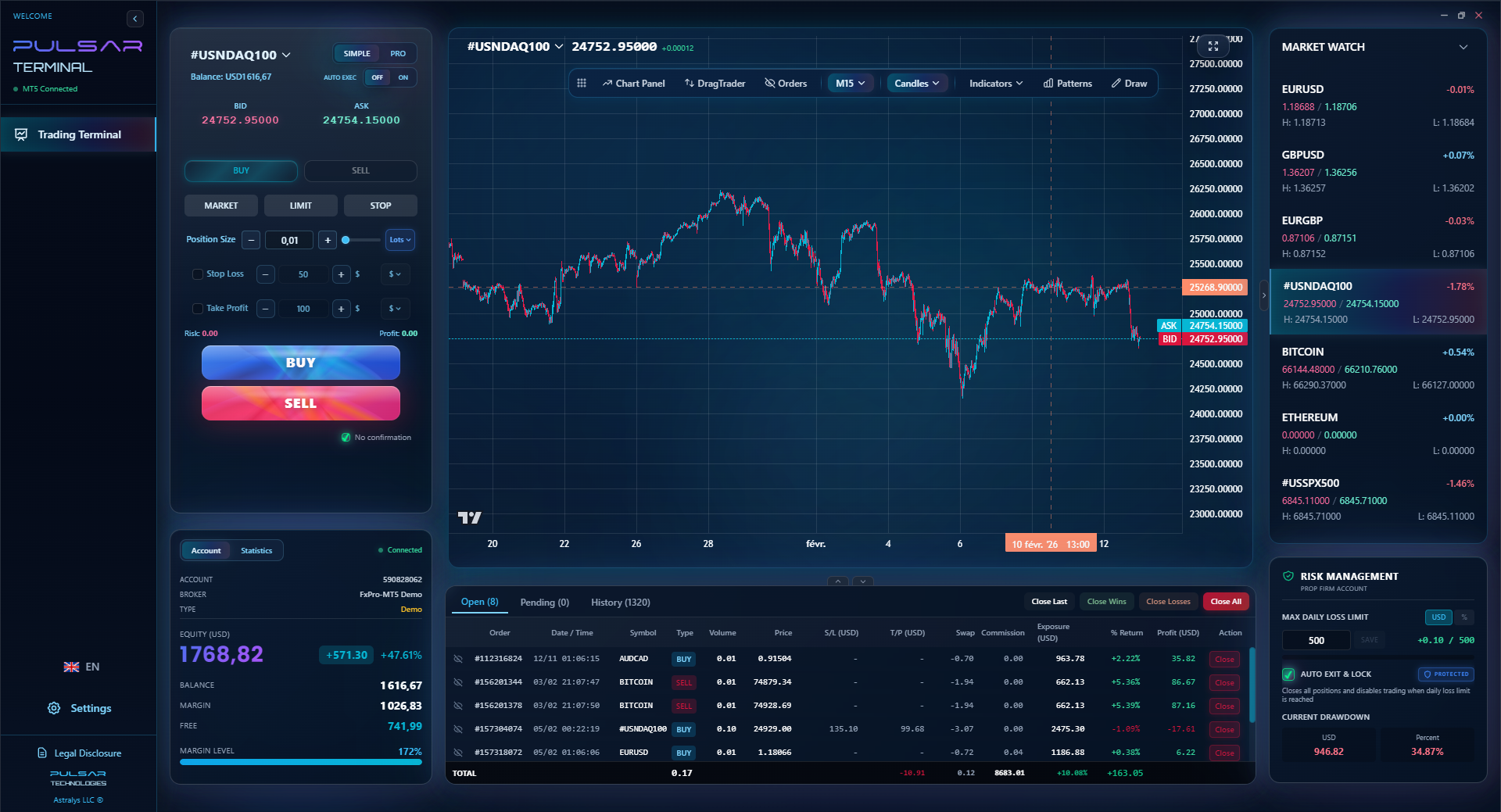
A tool like Pulsar Terminal, which integrates with MT5, can help manage this risk by allowing you to set multi-level take profits and stop losses ahead of time, so you're not scrambling when news drops.
Managing risk around news events is critical, and Pulsar Terminal lets you pre-set complex take-profit and stop-loss orders directly on your MT5 chart before volatility hits.
Pulsar Terminal
MT5一站式工具:拖拽下单、多重止盈/止损、追踪止损、网格交易、成交量分布图和自营交易保护。每日1000+交易者使用。
“use amplifies gains, but it annihilates accounts even faster.”
Just because it's a working day in Lagos doesn't mean the forex market is fully operational. If it's a public holiday in London (like Easter Monday) or New York (like Independence Day), the volume from that entire financial center dries up.
The market might technically be 'open,' but with London banks closed, the London session is a ghost town. Spreads on EUR/USD and GBP/USD will be wider, and price action will be choppy and unreliable. It's often better to take the day off.
Always check a global economic calendar for bank holidays in the UK, US, Japan, and Australia. The week between Christmas and New Year is also notoriously thin and unpredictable. Treat these days as practice or research time, not serious trading time.
💡 Winston 小贴士
Your most important tool isn't an indicator; it's the economic calendar. Know when the big players are active.
So, is the forex market open now? From Sunday 11 PM to Friday 10 PM WAT, yes.
But should you trade right now? That depends.
Prime Trading Windows (High Liquidity, Tight Spreads):
- Monday - Friday, 9:00 AM - 6:00 PM WAT (London Session). Your bread and butter.
- Monday - Friday, 2:00 PM - 6:00 PM WAT (London/New York Overlap). High-octane trading time.
Acceptable but Trickier Windows:
- Monday - Friday, 2:00 AM - 9:00 AM WAT (Tokyo/Sydney). Stick to JPY or AUD pairs. Expect slower moves.
- Monday - Friday, 6:00 PM - 11:00 PM WAT (New York Solo). Active but winding down. Good for reacting to US news.
Avoid Trading (If You Value Your Account):
- Sunday Open (11:00 PM - 2:00 AM WAT Monday). Gappy, unpredictable price action as the market finds its weekly footing.
- Friday Evening (After 6:00 PM WAT). Liquidity vanishes as banks close their weekly books. You can get stuck in a position over the weekend.
- Major UK/US Bank Holidays.
- During High-Impact News Events (first 5-15 minutes).
The market's 24/5 nature is a trap for the undisciplined. It gives you the illusion of constant opportunity. The successful Nigerian trader knows that real opportunity is concentrated. They treat trading like a business with optimal operating hours. They know when to be at the screen and, more importantly, when to walk away. Focus on the London and overlap sessions, manage your use, respect the news calendar, and you'll be trading in the real market, not just on an open platform.
FAQ
Q1Is forex trading legal in Nigeria?
Yes, retail forex trading with your own capital is legal for individuals. However, you cannot use official CBN channels to obtain forex for speculative trading. Most Nigerians use internationally regulated brokers and fund accounts via crypto or electronic payment processors. Platforms operating physically in Nigeria must now register with the SEC under the 2025 Act.
Q2What time does forex market open on Sunday in Nigeria?
The forex market opens on Sunday at 11:00 PM West Africa Time (WAT). The first few hours (until about 2:00 AM WAT Monday) are often volatile with low liquidity as the Asian sessions begin, so many experienced traders avoid placing new trades right at the open.
Q3What is the best time to trade forex in Nigeria?
The best time is during the London session (9:00 AM - 6:00 PM WAT) and especially the London-New York overlap (2:00 PM - 6:00 PM WAT). This period has the highest trading volume, tightest spreads, and most reliable price trends, making it ideal for most strategies.
Q4Can I trade forex 24 hours a day from Nigeria?
Technically, you can place trades 24 hours a day from Monday to Friday, but you shouldn't. The market is only truly liquid and efficient during specific sessions. Trading outside the London and New York hours means dealing with wide spreads, low volume, and erratic price moves, which significantly increases your risk.
Q5Do I pay tax on forex trading profits in Nigeria?
Yes, according to the law, you are liable to pay a 10% Capital Gains Tax on your gross forex trading profits to the Federal Inland Revenue Service (FIRS). While compliance has been low among retail traders, this is the official legal position.
Q6Why are the spreads so wide sometimes even when the market is open?
Spreads widen when liquidity is low. This happens outside of major session overlaps (e.g., late Friday WAT, during holidays in London or New York), around major news events, or during the illiquid Sydney session. A wide spread is the market's way of telling you it's a dangerous time to trade.
Q7What use can I get as a Nigerian trader?
Nigerian traders often have access to very high use (up to 1:500, 1:1000, or even 1:2000) through international brokers, as they are not subject to strict EU/UK caps. While this seems attractive, it dramatically increases risk. A small move against you can wipe out your entire account. Use extreme caution.
Winston 教授的课程
要点总结:
- ✓Trade the London session (9 AM - 6 PM WAT) for real liquidity.
- ✓Avoid use above 1:30, regardless of what's offered.
- ✓A 10% Capital Gains Tax applies to your profits.
- ✓Never trade through a High-Impact news event.
- ✓Wide spreads mean walk away.
这篇文章对您有用吗?
点击星星评分
每周交易洞察
免费每周分析与策略。无垃圾邮件。
关于作者
Olumide Adeyemi
西非交易先驱
尼日利亚最活跃的外汇交易教育者之一。从拉各斯出发有8年交易经验。专注于低资金策略和面向非洲交易者的自营公司挑战。
评论
风险提示
金融工具交易存在重大风险,可能不适合所有投资者。过往业绩不代表未来表现。本内容仅供教育目的,不构成投资建议。在交易前请务必自行研究。
您可能还喜欢

Cara Trading Forex Sukses: 7 Prinsip dari Trader Profesional
Cara trading forex sukses dengan 7 prinsip trader pro: manajemen modal, disiplin, journal trading, backtest. Data nyata, bukan janji profit palsu.
Jam Trading Forex Terbaik untuk Trader Indonesia: Panduan Lengkap dengan Tabel Waktu
Panduan jam trading forex untuk trader Indonesia. Tabel 4 sesi dunia, jam emas 20:00-00:00, sesi mana yang harus dihindari. Data akurat + tips dari trader berpengalaman.
Top 5 Sàn Forex Uy Tín Nhất 2026: Review Jujur dari Trader Indonesia
Top 5 sàn forex uy tín 2026 untuk trader Indonesia. Review jujur: spread, deposit, withdraw, dukungan lokal. Exness, XM, IC Markets & lebih.
