


I remember trying to exit a USD/NGN position during a public holiday announcement.

Olumide Adeyemi
西非交易先驱 ·  Nigeria
☕ 10 分钟阅读
您将学到:
- 1What is Liquidity? (In Simple Terms)
- 2Why Liquidity Matters for You
- 3The Liquidity Ladder: Major, Minor & Exotic Pairs
- 4When the Market Sleeps: Time of Day Matters Most
- 5How to Spot Liquidity on Your Charts
- 6Matching Your Strategy to the Liquidity
- 7The Hidden World: Liquidity Providers & Your Broker
- 8Common Liquidity Mistakes Nigerian Traders Make

I remember trying to exit a USD/NGN position during a public holiday announcement. The price was moving against me, fast. I clicked 'Close Order'... and nothing happened. The platform just spun. My 50-pip stop loss became a 180-pip nightmare because there was simply no one on the other side to take my trade. That sickening feeling, watching your money evaporate in a market that's frozen solid, is why you need to understand the liquidity meaning in forex. It's not some boring textbook term. It's the difference between a smooth trade and one that ruins your week.
Let's cut through the jargon. In forex, liquidity simply means how easily you can buy or sell something without causing a big change in its price.
Think of it like this: selling a popular iPhone in Computer Village is easy. You'll find a buyer quickly at a fair price. That's high liquidity. Selling a specialised, old phone part at 10 PM on a Sunday? You might wait forever or have to slash the price dramatically. That's low liquidity.
In our market, liquidity comes from the volume of trades happening. The more banks, hedge funds, corporations, and retail traders like us are actively buying and selling a currency pair, the more liquid it is. High liquidity usually means tight spreads (the difference between buy and sell price), fast order execution, and stable prices. Low liquidity means the opposite: wide spreads, slow execution, and prices that can jump around wildly.

Pro Tip: The easiest way to spot liquidity is by looking at the spread. A EUR/USD spread of 0.8 pips on your Exness review or IC Markets review platform screams high liquidity. A USD/TRY spread of 50 pips? That's the market telling you to tread carefully.

💡 Winston 小贴士
Liquidity is the water your trading ship floats on. In deep water (high liquidity), you sail smoothly. In shallow water (low liquidity), you run aground, no matter how good your ship is.
You might think, "I only trade 0.1 lots, the market won't notice me." True, but you'll definitely notice the market. Liquidity affects your bottom line in three direct ways.
First, it hits your profit before you even start. That spread is a transaction cost. On a major pair during the London session, you might pay $8 on a standard lot. On an exotic pair when Lagos is asleep, that cost could be $50. You're already in the red.
Second, it determines if your orders get filled at the price you see. In a liquid market, your market order to buy at 1.0850 gets filled at 1.0850. In a thin market, you might get 1.0857. That's 7 pips of 'slippage' gone before the trade even moves. I once had a 12-pip slippage on a GBP/AUD trade during a low-volume Asian session. It felt like a hidden tax.
Third, and most critically, it controls your risk. A wide, illiquid market can blow straight past your stop loss. Your broker executes the best price available, which could be miles away from where you set it. This is a major cause of a margin call. Understanding the liquidity meaning in forex is a core part of risk management, not just strategy.
“Understanding the liquidity meaning in forex is a core part of risk management, not just strategy.”
Not all currency pairs are created equal. They sit on a clear liquidity ladder.
The Majors (The Busy Expressway)
These are pairs that include the US Dollar (USD) and another major currency: EUR/USD, USD/JPY, GBP/USD, USD/CHF, AUD/USD, USD/CAD, NZD/USD. They account for over 80% of all forex volume. EUR/USD is the king, with daily turnover in the trillions of dollars. This is where you find the tightest spreads and fastest execution. It's the best place to learn, especially for techniques like scalping strategy.
The Minors (Crosses - The City Roads)
These are pairs without the USD, like EUR/GBP, EUR/AUD, or GBP/JPY. They're less liquid than majors. Their liquidity often depends on the overlap of their respective financial centers. GBP/JPY, for instance, gets a boost when London and Tokyo are both open. Spreads are wider, and moves can be more volatile.
The Exotics (The Village Paths)
This is where you find pairs like USD/NGN (Naira), USD/ZAR (South African Rand), or USD/TRY (Turkish Lira). These are currencies from smaller or emerging economies. Liquidity is low. Spreads are very wide - sometimes 50 pips or more. Why? Fewer big players trade them. The market is shallow. A single large corporate order can move the price significantly. Trading these requires patience and a much larger tolerance for volatility and cost.
| Pair Type | Example | Typical Spread (in pips) | Liquidity | Best For |
|---|---|---|---|---|
| Major | EUR/USD | 0.8 - 1.5 | Very High | All strategies, beginners |
| Minor (Cross) | EUR/GBP | 1.5 - 3.0 | Moderate | Swing trading |
| Exotic | USD/NGN | 40.0 - 100.0+ | Low | Long-term positioning, high risk tolerance |
This is the most practical lesson I can give you. Liquidity isn't constant. It ebbs and flows with the world's trading sessions. If you're trading from Lagos (GMT+1), you need to know this schedule by heart.
The Asian Session (Tokyo, Singapore, Hong Kong): 12 AM - 9 AM Lagos Time It's quiet when you're probably asleep. Liquidity is lower. Pairs like USD/JPY and AUD pairs get action, but EUR/USD can move in tight, slow ranges. Not the best time for big moves.
The London Session: 8 AM - 5 PM Lagos Time This is when the market wakes up for us. London is the world's forex capital. From 8 AM Lagos time, volume explodes. This is the most liquid period, especially when it overlaps with the end of Asia (8 AM - 9 AM) and the start of the US (1 PM - 5 PM Lagos). Over 30% of all daily volume happens here. Spreads are at their tightest. This is your prime trading time.
The New York Session: 1 PM - 10 PM Lagos Time The overlap with London (1 PM - 5 PM) is the most liquid window of the entire day. This is when major economic data (like US Non-Farm Payrolls) drops, causing huge, liquid moves. After 5 PM Lagos time, as Europe closes, liquidity starts to dry up rapidly.
The After-Hours (Pacific Session): 10 PM - 12 AM Lagos Time The quietest time. Only Sydney and Wellington are open. Spreads widen. Avoid entering new trades here unless you have a very specific reason. This is when I got caught in that bad USD/NGN trade I mentioned earlier.

Warning: Public holidays in major financial centers (UK, US, Japan) kill liquidity. Trading on Christmas Day or US Independence Day is a recipe for terrible fills and unexpected spikes. Just don't do it.
“The overlap between London and New York is the most liquid window of the entire day. That's your prime trading time.”
You don't need a special terminal to see liquidity. Your charts tell you the story if you know what to look for.
1. Volume Indicator: This is the most direct clue. High volume bars = high liquidity. Low volume bars = caution. A price breakout on high volume is more trustworthy than one on low volume. I use this to confirm moves all the time.
2. Price Action & Spread: Watch how price behaves. In liquid times, it moves in relatively smooth trends or ranges. In illiquid times, you see erratic spikes, long wicks, and prices that 'jump' between levels without trading in between. Constantly monitor the live spread in your platform's market watch window.
3. The Economic Calendar: Liquidity surges around major news events. But there's a trap: the 5-10 minutes BEFORE a high-impact news release (like US CPI data), liquidity often vanishes. Market makers pull their orders to avoid risk, causing spreads to blow out. I learned this the hard way trying to enter a trade 2 minutes before Fed news. The EUR/USD spread went from 1 pip to 25 pips instantly. My planned 2-pip risk turned into a 27-pip loss before the news even hit.
4. Order Book Depth (If Your Broker Provides It): Some brokers like Pepperstone review on their Razor account show depth of market. You can see the buy and sell orders stacked at different prices. A thick order book near the current price means high liquidity. A thin one means a small trade could move the price a lot.
💡 Winston 小贴士
The market's most dangerous hours are often the quietest. Low volume doesn't mean low risk; it means high unpredictability. A single large order in a thin market can act like a tsunami in a pond.
Your trading style must respect the liquidity environment. Trying to force a strategy into the wrong market is like trying to speed on a dirt road.
High Liquidity (London/NY Overlap): This is the playground for fast strategies. Scalping strategy works here because you can get in and out quickly with minimal cost. Day trading based on technical breaks is reliable because the moves are sustained and orders are filled cleanly. This is also the best time to use indicators like the RSI indicator or MACD indicator, as their signals are less likely to be whipsawed by random noise.
Moderate/Low Liquidity (Asian Session, Late NY): Slow down. This is the domain of the swing trading mindset. Look for larger chart patterns, support and resistance levels, and be prepared to hold for days or weeks. Execution patience is key. Use limit orders to specify your exact entry price instead of market orders. Expect wider stops. I adjust my position size calculator inputs to account for the wider spreads and potential slippage during these times, which effectively reduces my lot size.
A Personal Rule: I don't trade exotics like USD/NGN with the same tactics as EUR/USD. For the Naira pair, I might only look for a long-term fundamental trend (based on oil prices and CBN policy) and use a weekly chart. The daily noise from illiquidity is just too great.
Managing multiple trades and setting precise stops in volatile, liquid markets is easier with tools that automate risk, like Pulsar Terminal's multi-TP/SL and trailing stop features on MT5.
Pulsar Terminal
MT5一站式工具:拖拽下单、多重止盈/止损、追踪止损、网格交易、成交量分布图和自营交易保护。每日1000+交易者使用。
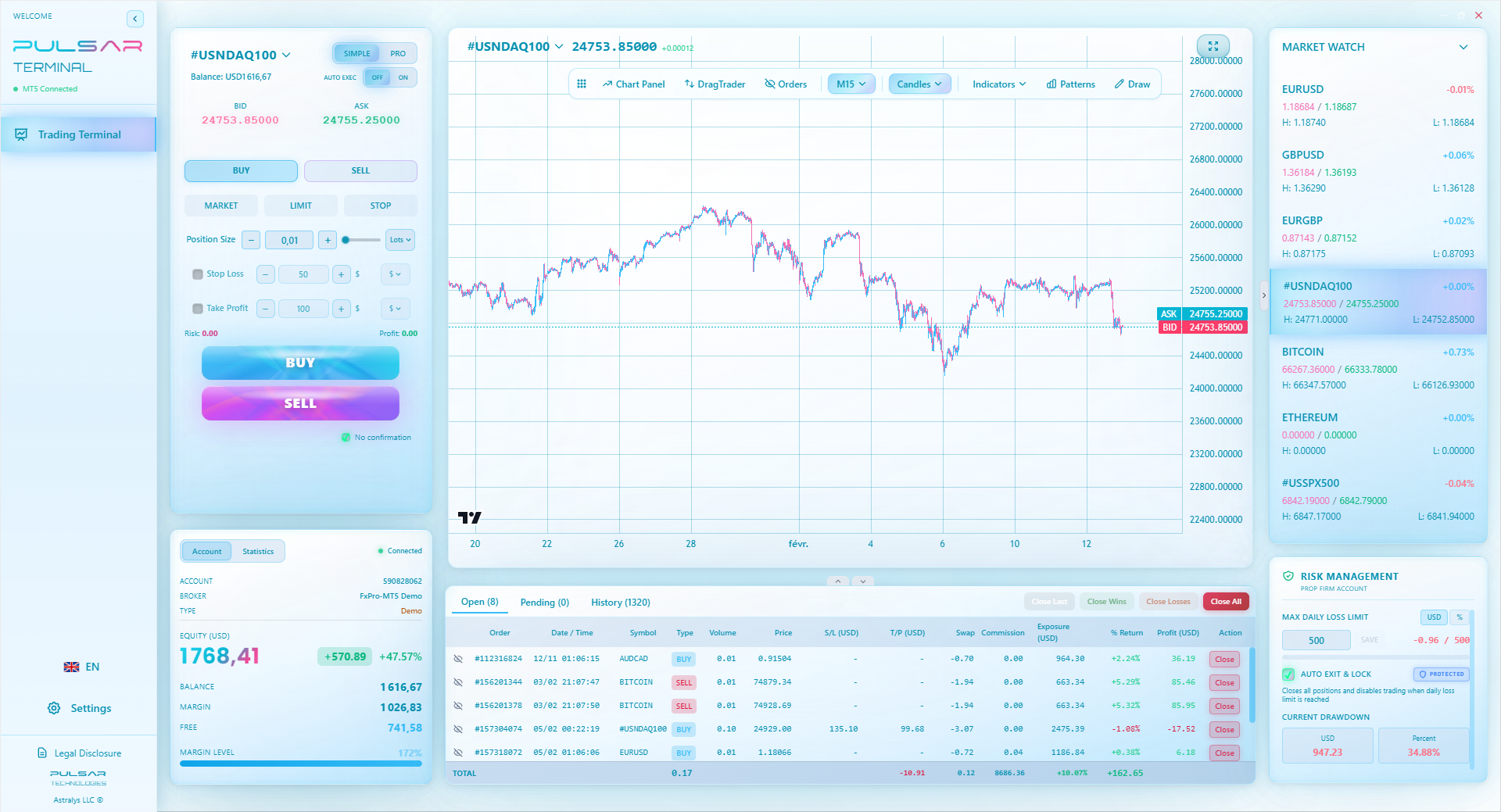
“Trying to scalp USD/NGN with a 10-pip target is a losing game. The spread alone might be 50 pips.”
Where does the liquidity actually come from? It's not a magic pool. When you click buy, your broker doesn't just create a price. They route your order.
Liquidity Providers (LPs) are the big banks (like Citi, JP Morgan, Deutsche Bank) and financial institutions that constantly quote buy and sell prices. Your broker aggregates prices from multiple LPs to give you the best available spread.
A good broker with strong LP connections (like those in our XM review or IC Markets reviews) gives you better, more consistent liquidity. A bad or 'bucket shop' broker might internalize your trade (take the other side themselves) or have poor LP links, leading to worse spreads and more frequent requotes, especially in volatile times.
This is crucial: during a flash crash or major news event, the LPs might temporarily withdraw. This is why your platform might freeze or show 'no liquidity' messages. Your broker isn't necessarily cheating you; the entire source of market prices has temporarily dried up. Knowing this helps you understand the system's limits and why risk management is non-negotiable.

Let's talk about the pitfalls I see all the time, so you can avoid them.
1. Trading Exotics Like Majors: Trying to scalp USD/NGN with a 10-pip target is a losing game. The spread alone might be 50 pips. You're fighting an impossible cost structure. Understand the pip definition and cost for each specific pair.
2. Trading Right Before Major News: As I mentioned, liquidity evaporates. Your stop loss becomes a suggestion, not a guarantee. If you must trade news, do it after the initial spike, when liquidity returns and the market finds a new equilibrium.
3. Ignoring Session Times: Trying to catch big moves at 11 PM Lagos time on a EUR/USD chart is mostly futile. The big players are asleep. You're trading in a ghost town, vulnerable to any small order that comes in.
4. Over-leveraging in Low Liquidity: This is the killer. Low liquidity + high use = account suicide. A tiny move against you in a thin market can cause disproportionate losses due to slippage. Always use a sensible position size calculator.
5. Chasing Illiquid Breakouts: A price breaks above resistance on the 15-minute chart at 2 AM Lagos time. You jump in. The breakout fails instantly because there was no real volume behind it - just a single small order that moved the price in an empty market. Wait for volume confirmation, especially on lower timeframes.
FAQ
Q1What is the simplest definition of liquidity meaning in forex?
It's how easily you can buy or sell a currency pair at a stable, predictable price. High liquidity means easy trading with tight costs. Low liquidity means it's hard to trade without moving the price and paying high costs.
Q2Which forex session has the highest liquidity for a trader in Nigeria?
The London session (8 AM - 5 PM Lagos time) and, specifically, the overlap with the New York session (1 PM - 5 PM Lagos time). This 4-hour window is the most liquid period of the entire trading day.
Q3Why is the spread on USD/NGN so much wider than on EUR/USD?
USD/NGN is an exotic pair with much lower trading volume. Fewer large banks and funds make a market in it, so there's less competition to tighten the bid/ask spread. The wider spread compensates market makers for the higher risk and lower liquidity of holding the Naira.
Q4Can low liquidity cause my stop loss to fail?
Yes, absolutely. A stop loss becomes a market order when triggered. In a low-liquidity environment, there might not be enough buyers/sellers at your stop price. Your order is then filled at the next best available price, which could be significantly worse. This is called slippage.
Q5Is it better to trade during high or low liquidity?
It depends on your strategy. For fast, precise trading (scalping, day trading), high liquidity is essential. For slower, position-based swing trading, you can operate in moderate liquidity, but you must adjust your order types and risk parameters. Beginners should stick to high-liquidity periods and major pairs.
Q6How can I check the liquidity of a currency pair before I trade?
- Look at the live spread - a wider spread indicates lower liquidity. 2) Check the volume indicator on your chart. 3) Be aware of the time of day and upcoming economic news. 4) Review your broker's market depth tool if they have one.
Q7Does my choice of broker affect the liquidity I get?
Yes, significantly. A reputable broker with strong connections to top-tier liquidity providers will offer you tighter spreads, faster execution, and more stable prices, especially during volatile markets. Always choose a well-regulated broker known for good trade execution.
Winston 教授的课程
要点总结:
- ✓Trade major pairs during London/NY overlap for lowest cost.
- ✓Avoid exotic pairs unless you understand their wide spreads.
- ✓Check the economic calendar: liquidity dries up pre-news.
- ✓Use limit orders, not market orders, in thin markets.
- ✓Adjust position size for wider spreads to manage real risk.
这篇文章对您有用吗?
点击星星评分
每周交易洞察
免费每周分析与策略。无垃圾邮件。
关于作者
Olumide Adeyemi
西非交易先驱
尼日利亚最活跃的外汇交易教育者之一。从拉各斯出发有8年交易经验。专注于低资金策略和面向非洲交易者的自营公司挑战。
评论
风险提示
金融工具交易存在重大风险,可能不适合所有投资者。过往业绩不代表未来表现。本内容仅供教育目的,不构成投资建议。在交易前请务必自行研究。
您可能还喜欢

Cara Trading Forex Sukses: 7 Prinsip dari Trader Profesional
Cara trading forex sukses dengan 7 prinsip trader pro: manajemen modal, disiplin, journal trading, backtest. Data nyata, bukan janji profit palsu.
Jam Trading Forex Terbaik untuk Trader Indonesia: Panduan Lengkap dengan Tabel Waktu
Panduan jam trading forex untuk trader Indonesia. Tabel 4 sesi dunia, jam emas 20:00-00:00, sesi mana yang harus dihindari. Data akurat + tips dari trader berpengalaman.
Top 5 Sàn Forex Uy Tín Nhất 2026: Review Jujur dari Trader Indonesia
Top 5 sàn forex uy tín 2026 untuk trader Indonesia. Review jujur: spread, deposit, withdraw, dukungan lokal. Exness, XM, IC Markets & lebih.
