


Most new traders in SA think market movers are just the big US news headlines.

David van der Merwe
新兴市场交易员 ·  South Africa
☕ 11 分钟阅读
您将学到:
Most new traders in SA think market movers are just the big US news headlines. They watch Non-Farm Payrolls like hawks, then wonder why their USD/ZAR trade got smoked by a local mining strike announcement they missed. The truth is, for us trading the Rand, the real juice often comes from our own backyard. I learned this the hard way, losing a chunk of change on a seemingly perfect EUR/USD setup that got obliterated by an unexpected SARB speech. Let's set the record straight on what actually moves the market for a South African forex trader.
In simple terms, a market mover is any event, data release, or piece of information that causes a significant shift in supply and demand for a currency. This creates volatility, which is where we find our opportunities (and our risks).
For a global trader, the classic movers are US interest rate decisions, employment data from major economies, and geopolitical shocks. But from a South African perspective, you need a dual lens. You must watch the global scene for pairs like EUR/USD, but you absolutely must have a laser focus on local catalysts for ZAR pairs like USD/ZAR or EUR/ZAR.
A common mistake is to treat all news with equal importance. The market doesn't. It prices in expectations. The real move happens when the actual data deviates from the forecast. I remember trading GBP/ZAR ahead of a UK inflation print. The forecast was 7.3%. The actual came in at 7.1%. It was a 'better than expected' number, but the pair barely budged down. Why? Because the whisper number among big desks was already around 7.0%. The actual news was already mostly priced in. The lesson? Understand the consensus, but also try to gauge the market's real sentiment.

Example: Trading USD/ZAR before a US Fed meeting. The consensus is for a 0.25% rate hike. If they hike 0.50%, the USD will likely surge (bullish for USD/ZAR). If they pause hikes at 0%, the USD will likely tank (bearish for USD/ZAR). A 0.25% hike that was perfectly expected might cause a 'sell the fact' move with little direction.

💡 Winston 小贴士
The market's reaction to news is more important than the news itself. A 'good' number that gets sold tells you everything about the underlying trend.
“For a South African trader, the real market movers are often local: a SARB speech, an Eskom announcement, or a budget detail the global market missed.”
This is where you can gain an edge. While everyone is glued to US news, you can be monitoring the local catalysts that move the Rand with often surprising force. The ZAR is a classic emerging market currency, which means it's highly sensitive to local political stability, commodity prices, and fiscal policy.
Key Local Economic Data Releases
These are your bread and butter. Mark them on your calendar.
- SARB Interest Rate Decision (MPC): The big one. The South African Reserve Bank's Monetary Policy Committee sets the repo rate. Higher rates can attract foreign capital, supporting the ZAR, but they also slow the economy. The statement tone is as important as the number.
- CPI (Inflation) Data: SARB's primary mandate is price stability. High inflation figures increase the odds of rate hikes, which can boost the ZAR in the short term.
- Budget Speech & Medium-Term Budget Policy Statement (MTBPS): This is huge. The market scrutinizes the government's debt trajectory, spending plans, and revenue projections. A credible, fiscally conservative budget can strengthen the ZAR. A budget seen as reckless can trigger a sell-off. I once caught a 300-pip move on USD/ZAR in the hour after a particularly dire MTBPS that showed debt spiraling.
- Current Account & Trade Balance Data: South Africa often runs a trade surplus due to commodity exports. A wider-than-expected surplus is ZAR-positive.
- Unemployment Data (QLFS): A sign of economic health, but often secondary to inflation and fiscal data for the ZAR.
Political & Commodity Drivers
- Eskom & Load-Shedding Stages: This isn't a joke. Announcements of escalating load-shedding stages directly impact business confidence and economic growth forecasts, weakening the ZAR. I've seen the Rand sell off within minutes of an Eskom press conference announcing Stage 6.
- Commodity Prices: The ZAR is a proxy trade for platinum, gold, and coal. Strong gold prices generally support the ZAR, as South Africa is a major producer. Keep a chart of gold (XAU/USD) open alongside your USD/ZAR chart. The correlation isn't perfect every day, but the long-term trend is clear.
- Political Stability & Ratings Agencies: Comments from Moody's, Fitch, or S&P regarding South Africa's credit rating are critical. Downgrades to junk status, or warnings thereof, cause massive capital outflows and ZAR weakness. Keep an eye on National Treasury's engagements with these agencies.

Warning: Trading ZAR pairs around local news requires a broker with stable execution during volatility. Slippage can be brutal. I've had stops filled 50 pips away from my order on a rogue SARB headline with a less-reputable broker. Always use a well-regulated broker like those under the FSCA, such as IC Markets or Exness, who have the liquidity to handle these spikes.
“Trading the news isn't about being right on every headline. It's about having a strong process that lets you capitalize when you are right.”
The Rand doesn't trade in a vacuum. It's a high-yield, risky currency. In the global 'risk-on, risk-off' game, the ZAR is often on the front line.
- US Federal Reserve Policy: This is the single biggest external driver. When the Fed is hawkish (raising rates), it sucks capital out of emerging markets like South Africa and into the US dollar. This is bearish for ZAR pairs (USD/ZAR goes up). In a Fed hiking cycle, trying to fight a long-term uptrend in USD/ZAR is a recipe for disaster. I learned this in 2022, trying to pick a top too early and watching my position get crushed over weeks.
- Global Risk Sentiment: Measured by indices like the VIX ("fear index"). When global markets panic (risk-off), investors flee to safe havens like the USD, JPY, and Swiss Franc. They sell out of risky assets, which includes the ZAR. In a market crash, USD/ZAR will almost certainly spike higher, regardless of local SA news.
- Chinese Economic Data: China is a massive consumer of South African commodities. Weak Chinese industrial production or GDP data can signal lower demand for our exports, hurting the ZAR.
- Major Geopolitical Events: Wars, trade wars, and sanctions disrupt global trade and commodity flows. The Rand, as a commodity currency, gets whipsawed by these events. During the initial phases of the Ukraine war, commodity prices spiked, which initially supported the ZAR, but was quickly overwhelmed by the global risk-off panic.
The trick is to layer these global drivers over your local analysis. If the SARB is hiking (ZAR positive) but the Fed is hiking faster (USD positive), the net effect on USD/ZAR might be a messy, volatile grind higher for the dollar. This interaction is the core of trading market movers forex for a cross like USD/ZAR.
💡 Winston 小贴士
For ZAR pairs, if you can only watch one thing besides price, make it the 10-year US Treasury yield. When it rises, the pressure on USD/ZAR is almost always upward.
“A stopped-out trade is not a failure. It's the cost of doing business.”
You know what the movers are. Now, how do you trade them without getting your head taken off? Blindly jumping in as the news hits is gambling. Here’s a more structured approach I’ve settled on after years of trial and error.
1. The Preparation (Before the Event):
- Know the Time: Use an economic calendar. The exact minute of the release matters.
- Know the Consensus: What are the economists forecasting? (e.g., CPI at 5.3%).
- Assess the Market Mood: Is the market nervous or complacent? Check the price action in the hours before the event.
- Identify Key Levels: Mark clear support and resistance on your chart. Where will price go if the news is bullish? Where if it's bearish?
- Plan Your Trade, Including Risk: Decide your entry, stop-loss, and take-profit before the news. Use a position size calculator to ensure your risk is a small percentage of your capital (I never risk more than 1% on a high-volatility news trade).
2. The Execution (The Release & Aftermath):
- Don't Trade the Initial Spike: The first 5-60 seconds are chaos. Spreads widen, liquidity drops, and prices can spike in both directions (a 'whipsaw'). Let the initial panic settle.
- Wait for a Retracement & Confirmation: After the spike, price often pulls back to a key level (like a previous support/resistance, or a Fibonacci level). Look for a candlestick pattern or a break of a small consolidation to confirm the new direction. This is where you enter.
- Manage the Trade Tightly: News-driven moves can reverse quickly if the initial interpretation was wrong. Use a trailing stop or be prepared to move your stop-loss to breakeven once you have a reasonable profit.
My Personal Example: Ahead of a SARB decision, consensus was for a 25bps hike. USD/ZAR was in a downtrend. I placed a buy limit order 50 pips below the current price, expecting a 'sell the fact' dip if they hiked 25bps. They hiked 50bps. The ZAR spiked stronger instantly. My order wasn't triggered, and I avoided a loss. Sometimes, the best trade is the one you don't take.

Pro Tip: For a less stressful approach, consider swing trading based on the trend established after a major news event, rather than scalping the news itself. The trend following a key SARB or Fed meeting can last for weeks.
“A stopped-out trade is not a failure. It's the cost of doing business.”
You can't do this with just a broker's platform. You need the right intel.
| Resource | What It's For | Why It's Good for SA Traders |
|---|---|---|
| Investing.com Economic Calendar | Tracking global & SA data releases. | You can filter for 'South Africa' and set alerts for high-impact events. |
| TradingView | Charting and analysis. | The social features let you see what other traders are marking on ZAR charts. Their built-in news feed is decent. |
| SARB Website | Official MPC statements, speeches, and data. | Go straight to the source. Read the actual MPC statement, not just the headline. |
| National Treasury Website | Budget speeches, MTBPS documents. | For fiscal news, this is your primary source. |
| Bloomberg/Reuters (via broker) | Real-time news headlines. | Crucial for catching unexpected political headlines or commodity news. |
| Your Broker's Economic Calendar | Often integrated with platform. | Allows you to see the event impact directly on the symbols you trade. |
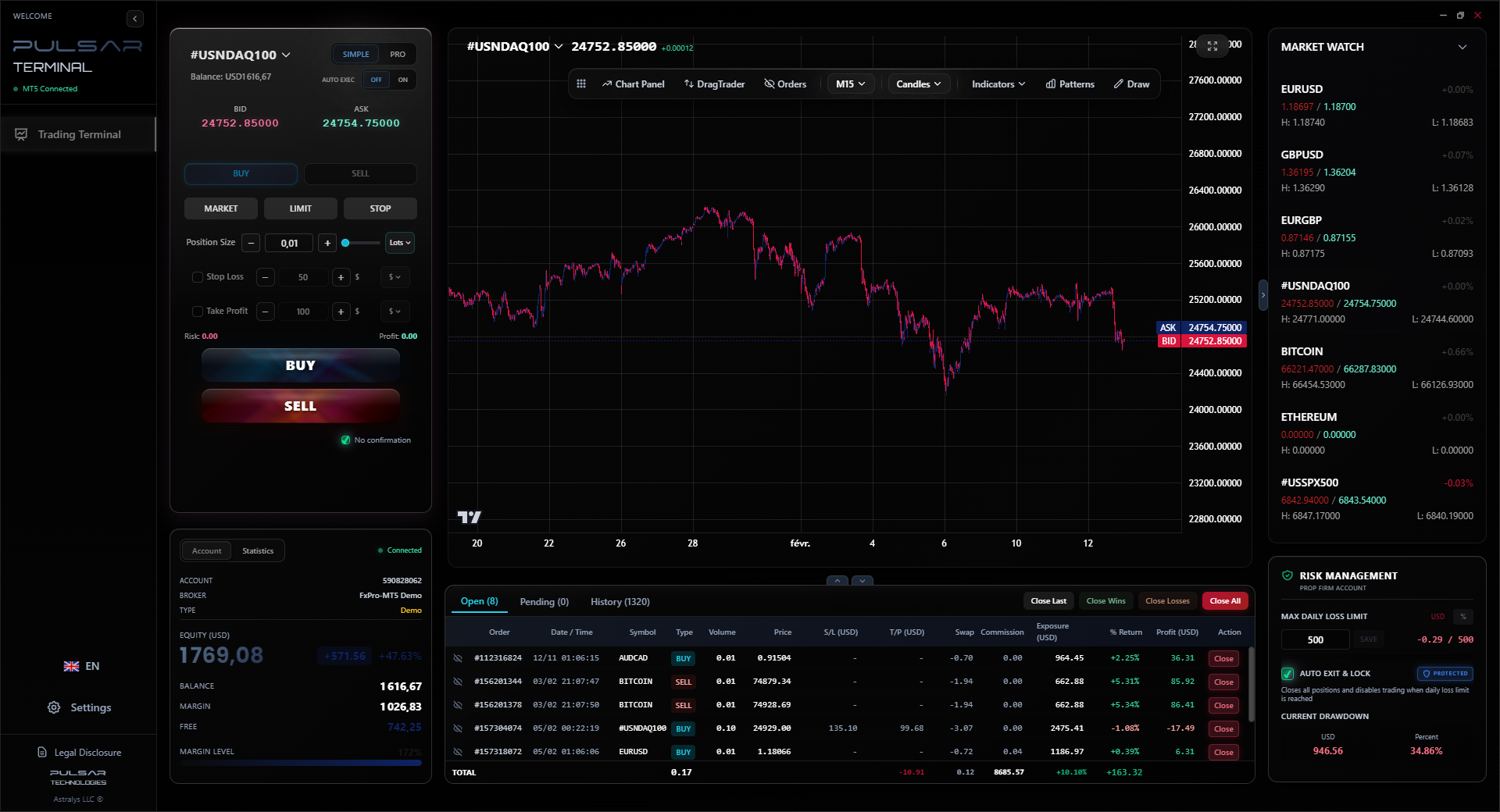
A tool like Pulsar Terminal, an MT5 companion, can be a game-saver for news trading. Its drag-and-drop order entry lets you place pending orders around key levels lightning-fast right before a release. More importantly, its advanced trade management features, like multiple take-profits and a trailing stop, let you lock in profits on a volatile news spike without having to babysit the chart every second. When the SARB announcement hits and USD/ZAR moves 200 pips in a minute, you'll be glad your profit-taking and risk management are partially automated.
When trading fast-moving news events on USD/ZAR, Pulsar Terminal's drag-and-drop orders and multi-take-profit levels let you execute your pre-news plan instantly on MT5 without fumbling.
Pulsar Terminal
MT5一站式工具:拖拽下单、多重止盈/止损、追踪止损、网格交易、成交量分布图和自营交易保护。每日1000+交易者使用。
“The ZAR is a proxy trade for platinum, gold, and coal. Keep a chart of gold open alongside your USD/ZAR chart.”
This is the most important section. You can have the best analysis and still blow up your account if your head isn't right.
The Psychological Traps of News Trading:
- FOMO (Fear Of Missing Out): You see a huge green candle on USD/ZAR after news. You chase the price, entering at the worst possible moment right before a reversal. I've done this more times than I care to admit.
- Revenge Trading: A news trade hits your stop-loss. You're convinced the market is 'wrong' and immediately jump back in with a bigger position to make the money back. This is how accounts die.
- Overconfidence: You nail two or three news trades in a row. You start thinking you've cracked the code. You increase your position size tenfold on the next one... and get wiped out by a whipsaw.
Your Non-Negotiable Risk Management Rules:
- The 1% Rule: Never, ever risk more than 1% of your trading capital on a single trade. For a volatile news trade, I often risk only 0.5%. This means if you have a R10,000 account, your maximum loss per trade is R100. Use a calculator.
- Always Use a Stop-Loss: Before you click buy or sell, know where your stop-loss is. It's not a suggestion; it's a life jacket. A news trade without a stop is suicidal.
- Understand use: The FSCA caps use at 30:1 for retail traders for a reason. On a news trade, even 30:1 is extremely powerful. A 50-pip move against you with high use can cause a margin call. Start lower.
- Accept the Loss: A stopped-out trade is not a failure. It's the cost of doing business. If you can't accept a R100 loss with discipline, you'll never be able to hold a trade for a R500 gain.
Remember, trading the news isn't about being right on every headline. It's about having a strong process that lets you capitalize when you are right, and survive with minimal damage when you're wrong. Focus on the process, not the profit of any single trade.
💡 Winston 小贴士
Your first loss is often your smallest loss. If a news trade goes against you immediately, don't average down. Your initial analysis was wrong. Exit and reassess.
FAQ
Q1What is the most important market mover for USD/ZAR?
For USD/ZAR, it's a tie between the US Federal Reserve's interest rate policy (the single biggest global driver) and the South African Reserve Bank's (SARB) Monetary Policy Committee decisions. The battle between US and SA interest rate expectations often dictates the long-term trend.
Q2Is forex trading legal in South Africa?
Yes, absolutely. It's regulated by the Financial Sector Conduct Authority (FSCA). Always verify your broker is FSCA-licensed. The FSCA also caps use for retail traders at 30:1 to protect them.
Q3Why does load-shedding affect the Rand?
Load-shedding directly cripples economic productivity, scares off foreign investment, and increases business costs. This worsens South Africa's growth prospects and fiscal health, making the country a less attractive place for foreign capital, which leads to selling of the ZAR.
Q4What's a good ZAR pair for beginners to practice news trading?
Start with USD/ZAR. It's the most liquid ZAR pair, has the tightest spreads among ZAR crosses, and reacts cleanly to both US and SA news. The high volatility also teaches you respect for risk management quickly.
Q5Should I trade the news as a beginner?
Honestly, no. Start by observing. Use a demo account to watch how prices react to different events for at least 3-6 months. The speed and volatility can overwhelm new traders and lead to quick losses. Master basic swing trading and chart analysis first.
Q6What time do most South African market movers get released?
Local data like CPI and unemployment are typically released around 10:00 or 11:00 SAST. The SARB usually announces interest rate decisions in the late afternoon (around 15:00 SAST). Always check the specific time on an economic calendar.
Q7How much money do I need to start trading forex in South Africa?
Winston 教授的课程
要点总结:
- ✓Layer global Fed policy over local SARB decisions for USD/ZAR.
- ✓Mark SARB MPC, CPI, and Budget Speech dates on your calendar.
- ✓Never risk more than 1% of capital on a single news trade.
- ✓Let the initial 60-second news spike settle before entering.
- ✓Use FSCA-regulated brokers for protection during volatility.
这篇文章对您有用吗?
点击星星评分
每周交易洞察
免费每周分析与策略。无垃圾邮件。
关于作者
David van der Merwe
新兴市场交易员
约翰内斯堡交易者,11年新兴市场货币经验。专注于ZAR货币对、FSCA监管交易和南非市场分析。
评论
风险提示
金融工具交易存在重大风险,可能不适合所有投资者。过往业绩不代表未来表现。本内容仅供教育目的,不构成投资建议。在交易前请务必自行研究。
您可能还喜欢

Cara Trading Forex Sukses: 7 Prinsip dari Trader Profesional
Cara trading forex sukses dengan 7 prinsip trader pro: manajemen modal, disiplin, journal trading, backtest. Data nyata, bukan janji profit palsu.
Jam Trading Forex Terbaik untuk Trader Indonesia: Panduan Lengkap dengan Tabel Waktu
Panduan jam trading forex untuk trader Indonesia. Tabel 4 sesi dunia, jam emas 20:00-00:00, sesi mana yang harus dihindari. Data akurat + tips dari trader berpengalaman.
Top 5 Sàn Forex Uy Tín Nhất 2026: Review Jujur dari Trader Indonesia
Top 5 sàn forex uy tín 2026 untuk trader Indonesia. Review jujur: spread, deposit, withdraw, dukungan lokal. Exness, XM, IC Markets & lebih.
