


I remember staring at my screen in 2018, watching my account bleed from R120,000 down to R78,000.

David van der Merwe
新兴市场交易员 ·  South Africa
☕ 9 分钟阅读
您将学到:
- 1So, What Exactly Is Drawdown?
- 2Why Drawdown Is Your Most Important Metric
- 3How to Calculate Your Own Drawdown (The Right Way)
- 4Practical Tactics to Manage Your Drawdown
- 5How Brokers and Prop Firms View Your Drawdown
- 6A Personal Story: My Worst Drawdown (And What I Learned)
- 7Your Action Plan: Building a Drawdown-Resistant Strategy

I remember staring at my screen in 2018, watching my account bleed from R120,000 down to R78,000. It wasn't one bad trade. It was a series of small, stubborn losses where I kept thinking the next one would turn it around. That 35% drawdown felt like a punch to the gut. It took me months to climb back, and it taught me a brutal lesson: if you don't understand and respect drawdown, the market will teach you the hard way. Let's talk about what it really is, why it matters more than your profits sometimes, and how to keep yours under control.
In the simplest terms, drawdown is the drop in your account value from its highest point (the peak) to its lowest point before a new peak is made. It's not just a loss on a single trade. It's the total decline during a losing streak or a period of bad performance.
Think of it like this: you start with R100,000. You trade well and grow it to R150,000. Then you hit a rough patch, and your balance falls to R130,000 before you start climbing again. Your drawdown is R20,000, or 13.3% from that R150,000 peak. That's the meaning of drawdown in forex – it's a measure of risk and pain, not just a number.
South African traders often get this wrong. They look at their starting capital versus current balance. But that's not the full picture. Drawdown measures the peak-to-trough decline, which shows you the real volatility and risk in your strategy. A strategy that makes 20% but has a 25% drawdown along the way is incredibly stressful and risky. I'd rather take a strategy that makes 15% with a max 8% drawdown any day.

Warning: A common mistake is confusing 'loss' with 'drawdown'. A loss is on a single trade. Drawdown is the cumulative effect of multiple losses (or a single large one) on your total account. You can have a winning trade and still be in a drawdown from your overall account peak.

“Drawdown isn't just a loss on a single trade. It's the total decline during a losing streak or a period of bad performance.”
For us trading with ZAR, where broker use can be tempting (and dangerous), drawdown is the gatekeeper to survival. Here’s why it’s non-negotiable.
The Psychological Wall
A deep drawdown messes with your head. When you're down 20-30%, the pressure to "make it back" leads to desperate, oversized trades. That's how a bad situation becomes a blown account. I've been there. After my big drawdown, I started doubling my position sizes, which just dug the hole deeper.
The Math of Recovery
This is the killer. The deeper your drawdown, the exponentially harder it is to recover. Losing 50% of your account means you need a 100% return just to get back to breakeven. It's a brutal mathematical reality.
| Drawdown % | Gain Required to Recover |
|---|---|
| 10% | 11.1% |
| 20% | 25% |
| 30% | 42.9% |
| 50% | 100% |
| 70% | 233% |
As you can see, keeping drawdowns small isn't just nice, it's essential for long-term viability. This is a core principle of professional swing trading and other disciplined approaches.
The Prop Firm Reality
If you're looking at funded trader programs, they live and die by drawdown rules. Most have a maximum daily or overall drawdown limit (often 5-10%). Blow past it, and you're out. Understanding this isn't just theory; it's the difference between passing a challenge and losing your fee. Managing drawdown is the #1 skill they test.

💡 Winston 小贴士
A 50% drawdown requires a 100% gain just to break even. Protect your capital like your trading life depends on it - because it does.

“The deeper your drawdown, the exponentially harder it is to recover. Losing 50% means you need a 100% return just to get back to breakeven.”
You don't need fancy software. You can track this in your trading journal or a simple spreadsheet. Here’s the step-by-step.
- Record Your Equity High: Note your account balance every time it hits a new high-water mark. This is your 'peak'.
- Track the Decline: As your balance falls from that peak, track the lowest point it reaches before starting to climb again.
- Do the Math:
- Absolute Drawdown: (Peak Balance) - (Lowest Trough Balance). Example: R150,000 - R130,000 = R20,000 drawdown.
- Percentage Drawdown: (Absolute Drawdown / Peak Balance) * 100. Example: (R20,000 / R150,000) * 100 = 13.33% drawdown.

Example: Let's say your account runs like this: R100k -> R140k (PEAK) -> R125k -> R110k (TROUGH) -> R135k. Your drawdown is measured from R140k to R110k. That's R30,000, or a 21.4% drawdown. Even though you're now at R135k (up from start), you experienced a 21.4% drawdown.
The key is to always measure from the last peak. This gives you your 'maximum drawdown' for that period. Most serious traders review their max drawdown monthly. I use a simple spreadsheet that updates automatically. Knowing your historical max drawdown helps you set realistic risk parameters. If your strategy has historically had a 12% max drawdown, you shouldn't risk 5% per trade – you'll blow past that 12% fast. A position size calculator is useless if you don't know what drawdown your strategy can handle.
“The deeper your drawdown, the exponentially harder it is to recover. Losing 50% means you need a 100% return just to get back to breakeven.”
Knowing the meaning of drawdown in forex is pointless if you don't act on it. Here are the tactics that saved me after my disaster.
1. The Golden Rule: Risk Per Trade
This is your primary control lever. Never, ever risk more than 1-2% of your account equity on a single trade. For a R100,000 account, that's R1,000-R2,000 max risk. I stick to 1%. It feels slow sometimes, but it's the reason I sleep at night. It automatically limits how deep a losing streak can cut. This is the first thing you should set up, even before you place a trade.
2. Use a Trailing Stop
For winning trades, a trailing stop locks in profits and prevents a winner from turning into a loser if the market reverses. It's a fantastic tool for smoothing equity curves. On a long trade, as price moves up, your stop loss moves up behind it. If you're not using this, you're leaving money on the table and exposing yourself to unnecessary volatility.
3. Correlation is a Killer
Don't open three trades all based on the USD/ZAR move. If the dollar strengthens against the rand, you'll get hit three times. Spread your risk across uncorrelated pairs or assets. Maybe one forex pair, one commodity like gold (XAU/USD guide), and an index. It won't eliminate drawdown, but it will definitely smooth it out.
4. Know When to Stop
Set a personal maximum drawdown limit for yourself (e.g., 15% from peak). If you hit it, you stop trading live. Go back to demo, review your journal, find the flaw. This is the hardest rule to follow, but the most important. My rule is 12%. Hitting it means I've lost control, and continuing is gambling.

Pro Tip: Your broker matters. A broker with reliable execution and tight spreads (like Pepperstone or IC Markets) can reduce 'slippage' during volatile news events. Slippage can unexpectedly deepen your drawdown by making your losses bigger than you planned.
💡 Winston 小贴士
Your maximum risk per trade should be less than half your acceptable maximum account drawdown. If you can't stomach a 20% drawdown, risk no more than 0.5-1% per trade.
“Knowing the meaning of drawdown is pointless if you don't act on it. Risk per trade is your primary control lever.”
You're not just managing drawdown for yourself. Your broker and any prop firm you work with are watching it too, especially with the new FSCA regulations bringing more scrutiny.
Margin Calls and Stop-Outs
When your drawdown eats into your required margin, you get a margin call. If it continues, your broker will start closing your positions (stop-out) to prevent you going into negative balance. This usually happens when your equity falls to 50% or less of your used margin. A deep drawdown often triggers this death spiral. It's why low use is your friend.
Prop Firm Drawdown Rules
This is a whole different game. Firms like FTMO or The5%ers have strict rules:
- Maximum Overall Drawdown: Usually 10-12% from your starting balance. Hit it, account closed.
- Maximum Daily Drawdown: Often around 5%. Even if you're up overall, if you lose 5% in a single day, you can fail.
These rules force insane discipline. You can't just "wait for a trade to come back." You have to cut losses immediately. Succeeding here means your personal drawdown management must be flawless. It's the ultimate test of a trader's risk framework.
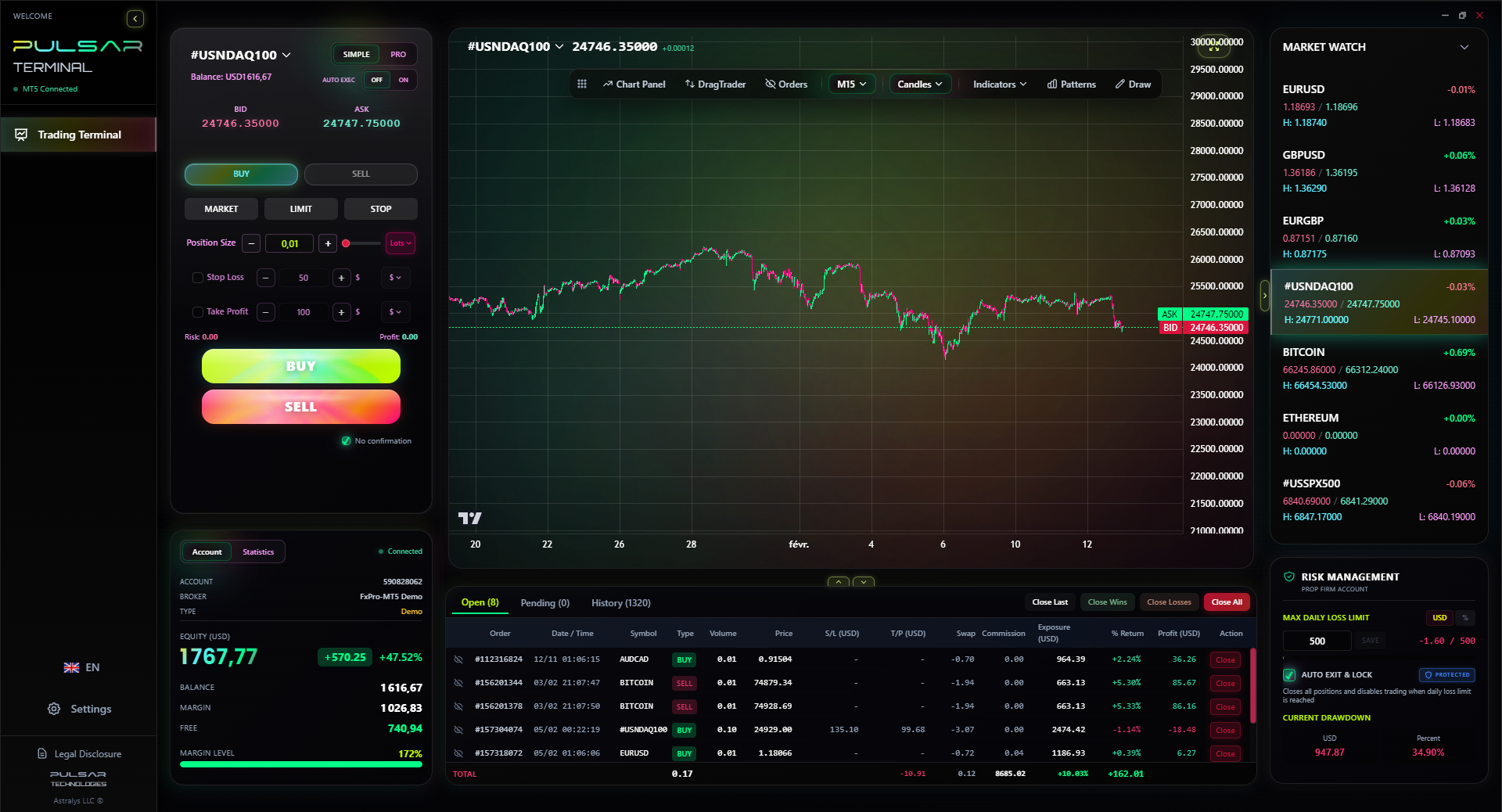
Managing strict prop firm daily loss limits is stressful, but tools like Pulsar Terminal can automate this monitoring and even close trades to protect your challenge account directly from your MT5 platform.
Pulsar Terminal
MT5一站式工具:拖拽下单、多重止盈/止损、追踪止损、网格交易、成交量分布图和自营交易保护。每日1000+交易者使用。
“Knowing the meaning of drawdown is pointless if you don't act on it. Risk per trade is your primary control lever.”
I mentioned my R120k to R78k drawdown earlier. Let me break down exactly how it happened, so you can avoid it.
I was trading EUR/USD (EUR/USD guide) and GBP/USD, thinking I was diversified. But they're highly correlated. I was using a scalping strategy but got greedy, increasing my lot size after a few wins. My risk per trade crept up to nearly 3%.
Then, a streak of five small losses hit. Instead of stopping, I was convinced my analysis was right. I moved my stop losses wider, violating my own rules, trying to "give the trade room." Loss number six was huge because of that widened stop. The MACD indicator and RSI indicator were screaming oversold, but I ignored them, driven by emotion.
The 35% drawdown wasn't from one event. It was death by a thousand cuts, compounded by broken rules. The lesson? Drawdown is a symptom. The disease is poor discipline and position sizing. I now have a hard rule: three consecutive losses, and I'm done for the day. No arguments. It's saved me from myself more times than I can count.
💡 Winston 小贴士
The market doesn't care about your breakeven point. Your stop-loss should be based on price action, not where you need the price to be to avoid a loss on paper.
“Drawdown is a symptom. The disease is poor discipline and position sizing.”
Let's wrap this up with what you can do today.
- Calculate Your Historical Max Drawdown: Go through your last 50-100 trades (on demo or live) and find your worst peak-to-trough percentage.
- Set Your Limits: Based on that number, set a hard maximum risk per trade (I recommend 1%). Set a maximum account drawdown limit where you will stop trading (I recommend 15% for beginners).
- Choose the Right Tools: Use a broker with solid risk management tools. Consider platforms that help visualize and control drawdown. For MT5 users, tools that automate trailing stops and monitor daily loss in real-time are useful for prop firm challenges.
- Journal with Purpose: In your journal, don't just record P&L. Record your account equity daily. Graph it. Watch for those peaks and troughs. The visual of a declining equity curve is a powerful wake-up call.
- Embrace the Boring: The goal isn't to get rich quick. It's to have a small, consistent edge and protect your capital. Low drawdown strategies might feel boring, but boring is profitable. Boring pays the bills in Rand and doesn't keep you up at night worrying about a margin call.
Understanding the meaning of drawdown in forex transforms you from a gambler hoping for wins to a manager focused on survival. It's the cornerstone of professional trading. Master this, and you master your biggest enemy in the markets: yourself.
FAQ
Q1What's a 'good' maximum drawdown for a forex trader?
For a retail trader, anything under 20% is manageable. Professional fund managers often aim for less than 10-15% max drawdown. For prop firm challenges, you typically need to keep it under 5-10%. Personally, if my strategy's historical max drawdown is above 15%, I go back to the drawing board.
Q2Is absolute drawdown or percentage drawdown more important?
Percentage drawdown is far more important. It's relative to your account size and standardizes performance. A R10,000 drawdown on a R50,000 account (20%) is catastrophic, while the same R10,000 on a R500,000 account (2%) is a minor blip. Always think in percentages.
Q3How does use affect my drawdown?
use magnifies drawdown dramatically. High use means small price moves against you can cause a large percentage loss. Using 100:1 use? A 1% price move against you can wipe out your margin. Lower use (like 10:1 or 20:1) is a key tool for controlling drawdown, especially for new traders.
Q4Can I have a winning trade but still be in a drawdown?
Absolutely, yes. Drawdown is measured from your overall account peak. If your account was at R150k, dropped to R130k, and you then have a winning trade that brings it to R135k, you are still in a R15k (10%) drawdown from your R150k peak. You're up from your trough, but not at a new high.
Q5What's the difference between daily drawdown and overall drawdown?
Daily drawdown is the maximum loss allowed from your balance at the start of the trading day. Overall (or maximum) drawdown is the maximum loss allowed from your initial starting balance or account peak. Prop firms use both: you can't lose more than X% today (daily), and you can never go below Y% of your starting balance (overall).
Q6How often should I review my drawdown?
Check it daily as part of your closing routine. Review your maximum historical drawdown formally at the end of each month. This regular check keeps you honest and alerts you early if your strategy's risk profile is changing.
Winston 教授的课程
要点总结:
- ✓Always measure drawdown as a percentage from your last equity peak.
- ✓Never risk more than 1-2% of your account on a single trade.
- ✓A 50% loss requires a 100% gain to recover.
- ✓Set a hard stop-trading limit (e.g., 15% drawdown) and walk away.
这篇文章对您有用吗?
点击星星评分
每周交易洞察
免费每周分析与策略。无垃圾邮件。
关于作者
David van der Merwe
新兴市场交易员
约翰内斯堡交易者,11年新兴市场货币经验。专注于ZAR货币对、FSCA监管交易和南非市场分析。
评论
风险提示
金融工具交易存在重大风险,可能不适合所有投资者。过往业绩不代表未来表现。本内容仅供教育目的,不构成投资建议。在交易前请务必自行研究。
您可能还喜欢

Cara Trading Forex Sukses: 7 Prinsip dari Trader Profesional
Cara trading forex sukses dengan 7 prinsip trader pro: manajemen modal, disiplin, journal trading, backtest. Data nyata, bukan janji profit palsu.
Jam Trading Forex Terbaik untuk Trader Indonesia: Panduan Lengkap dengan Tabel Waktu
Panduan jam trading forex untuk trader Indonesia. Tabel 4 sesi dunia, jam emas 20:00-00:00, sesi mana yang harus dihindari. Data akurat + tips dari trader berpengalaman.
Top 5 Sàn Forex Uy Tín Nhất 2026: Review Jujur dari Trader Indonesia
Top 5 sàn forex uy tín 2026 untuk trader Indonesia. Review jujur: spread, deposit, withdraw, dukungan lokal. Exness, XM, IC Markets & lebih.
