


You're looking for the most reliable forex strategy, aren't you? The holy grail.

David van der Merwe
新兴市场交易员 ·  South Africa
☕ 9 分钟阅读
您将学到:
- 1The Myth of a Single 'Most Reliable' Strategy
- 2The Actual Foundation: Unbreakable Risk Management
- 3Strategies That Work With the ZAR, Not Against It
- 4How Local Costs and Rules Secretly Eat Your Profits
- 5Building Your Own 'Reliable' System: A Step-by-Step Plan
- 6The Trader's Mindset: Your Real Battlefield
- 7The Final Verdict: What 'Most Reliable' Really Means
You're looking for the most reliable forex strategy, aren't you? The holy grail. The one system that prints money while you sleep. I've got bad news and good news. The bad news is that single, magic strategy doesn't exist. Anyone selling you that is lying. The good news? There is a reliable approach to trading. It's a framework built on brutal risk management, understanding our local market's quirks, and a mindset that survives the ZAR's wild swings. Let's strip away the nonsense and talk about what actually works here in South Africa.
Here's the first hard truth: searching for the one perfect strategy is a loser's game. I wasted two years and about R40,000 chasing that dream. I bought systems, followed gurus, and tried to automate the perfect scalping strategy. The market doesn't work like that. What's reliable isn't a specific set of indicators or chart patterns, it's your process. Think of it like this: a master carpenter isn't masterful because he owns one magical hammer. He's masterful because he knows which tool to use for which job, how to measure twice and cut once, and how not to saw his own fingers off. In trading, your primary tool isn't a strategy, it's risk management. Your most reliable edge is not blowing up your account when USD/ZAR decides to gap 300 pips overnight because of a political tweet. The FSCA's 30:1 use cap is a hint, not a limitation. It's the first lesson in reliability: you can't win if you're not around to play the next hand.

💡 Winston 小贴士
If you can't articulate your edge in one clear sentence, you don't have one. You're guessing.
This is the core of everything. Your trading plan should be 80% about managing risk and 20% about finding trades. If you get this backwards, you're just gambling.
The 2% Rule (And Why You Should Start with 1%)
You've heard it: never risk more than 2% of your account on a single trade. For a South African trader starting with, say, R20,000, that's R400. Sounds simple. But here's where it gets real. In early 2025, I got cocky. USD/ZAR was trending nicely, and I was up for the month. I broke my rule and risked 5% on a single "sure thing" trade. A surprise SARB comment sent it the other way. I lost R1,000 in minutes. That wasn't just money; it was my discipline. That loss hurt my confidence more than my account. Now, I use a position size calculator for every single trade, no exceptions.
Stop-Losses Are Not Suggestions
Your stop-loss is your lifeline. Placing it is not a debate. You decide where you're wrong before you enter the trade. With the ZAR's volatility, a stop that's too tight will get you whipped out constantly. Too wide, and a single loss can cripple you. It's a balance. For a pair like EUR/ZAR, your stop might need to be 50-80 pips wider than on EUR/USD. That means your position size must be smaller to keep the rand risk amount the same.

Warning: A common mistake is moving your stop-loss further away because the trade is going against you. This is called "hope management," not risk management. It's the fastest path to a margin call.
Risk-Reward: The Non-Negotiable Filter
Never enter a trade where the potential profit isn't at least double the potential loss. A 1:2 risk-reward ratio is the bare minimum. I aim for 1:3. This means if my stop-loss is 50 pips away, my take-profit target needs to be at least 100 pips away. Why? Because you can be wrong half the time and still be profitable. If you only look for 1:1 trades, you need to be right more than 60% of the time just to break even after spreads and commissions. That's a tough game.
“Your most reliable edge is not blowing up your account when USD/ZAR decides to gap 300 pips overnight.”
Once your risk framework is solid, you can layer on a strategy. The key is to pick one that suits the ZAR's personality and your own.
Trend Following: Let the Market Do the Work
This is my bread and butter for majors and the ZAR pairs. The ZAR loves long, emotional trends. Instead of predicting tops and bottoms, you wait for the trend to show itself, then jump on. I use a simple combination of a 50-period and 200-period moving average on the daily chart. When the 50 crosses above the 200 (a 'Golden Cross'), I only look for long opportunities on lower timeframes. It keeps me on the right side of the big moves. I caught a great swing trading move on USD/ZAR in late 2025 using this, riding it from 18.50 to just above 19.00.
Price Action at Key Levels
Forget the fancy indicators. Sometimes, just looking at the chart works. The ZAR pairs often respect big, round numbers and previous swing highs/lows. I watch how price behaves at these levels. Does it bounce? Does it pause? A clean bounce off a key support level with a strong bullish candle can be a high-probability entry. This pairs well with the 1:3 risk-reward rule.
Why Scalping the ZAR is a Tough Gig
Scalping requires tiny spreads and lightning execution. While brokers like Exness or IC Markets offer tight spreads on majors, remember that USD/ZAR's spread can be 50-100 pips or more during volatile times. You need to make 100 pips just to cover the cost of entering and exiting? That's a brutal hill to climb. Scalping EUR/USD is feasible; scalping ZAR pairs is often a fast track to giving your money to the broker in spreads.
You can have a great strategy and still lose money because you didn't account for the real cost of trading in South Africa.
Let's break down a typical trade on USD/ZAR with a R20,000 account:
| Cost Factor | Typical Example | Impact on Your Trade |
|---|---|---|
| Spread | 80 pips (that's R800 on a standard lot) | You start the trade R800 in the hole. Your first 80 pips of movement just gets you to breakeven. |
| Overnight Swap | Can be significant due to SA's interest rate | Holding a position for weeks? These fees add up. Sometimes you get paid, sometimes you pay. Check it. |
| Currency Conversion | Your account is in ZAR, profit is in USD. Broker takes a 1-2% cut. | You make $100 profit, but only get credited R1,850 instead of ~R1,880. |
| Bank Fees | Moving money to/from an international broker. | Could be a flat R100-200 fee per transfer, eating into smaller deposits/withdrawals. |
See the problem? Your strategy needs to account for this friction. This is why trading higher timeframes (daily, weekly) on ZAR pairs often works better than day trading. You give the trade room to overcome the wide spread and capture a larger move. It's also a strong argument for trading majors like EUR/USD or XAU/USD where spreads can be below 1 pip, then converting your profits back to ZAR.
💡 Winston 小贴士
Your trading journal is more important than your trading strategy. The strategy tells you what to do; the journal tells you what you actually did.
“Complexity is the enemy of execution. Your first system should be stupidly simple.”
Stop looking for a strategy. Start building a system. Here's how.
- Define Your Edge: What do you know or see that gives you a slight probability advantage? Is it reading SARB statements? Is it spotting trend continuations? Write it down in one sentence.
- Find Your Trigger: What specific event tells you to enter? "When price pulls back to the 50-period MA in a strong uptrend and forms a bullish pin bar." Not: "When it looks like it's going up."
- Set Your Hard Rules: This is your risk framework. My entry trigger is useless without my rules: Max risk 1.5% of capital. Stop-loss placed at the low of the trigger candle. Take-profit target set at a minimum 1:3 ratio. Position size calculated via my calculator.
- Backtest and Demo Trade: Don't guess. Test your system on at least 100 past trades. Then trade it on a demo account for a full month. Does it hold up? I once spent a month demo-trading a complex system only to find the profits were wiped out by commissions. Better to learn that with fake money.
- Journal Religiously: Every trade. Entry, exit, reason, emotion. After 50 trades, you'll see your real patterns. You'll find you break your rules more often after a loss, or that you're great at entries but terrible at exits.

Pro Tip: Your first system should be stupidly simple. One currency pair. One timeframe. One or two indicators max. Master that before you add anything. Complexity is the enemy of execution.
Your biggest enemy is in the mirror. I've seen more traders fail from poor psychology than poor analysis.
Fear of Missing Out (FOMO): USD/ZAR is rocketing and you jump in late, without a plan, way above your sensible entry. You're chasing. This is how you buy the top. I've done it. It feels awful.
Revenge Trading: You take a loss. Your pride is hurt. You immediately jump into another trade, twice the size, to "make it back." This is how you turn a R400 loss into a R2,000 disaster.
Overconfidence: You have three winning trades in a row. You start to feel invincible. You increase your risk to 5% because "you're on a roll." The market humbles you, fast.
The solution is boring: discipline. Your trading plan is your anchor. When emotions run high, you fall back on the rules you wrote when you were calm and logical. This is where tools that automate parts of your process are useful. They remove the emotional hesitation from executing your plan.
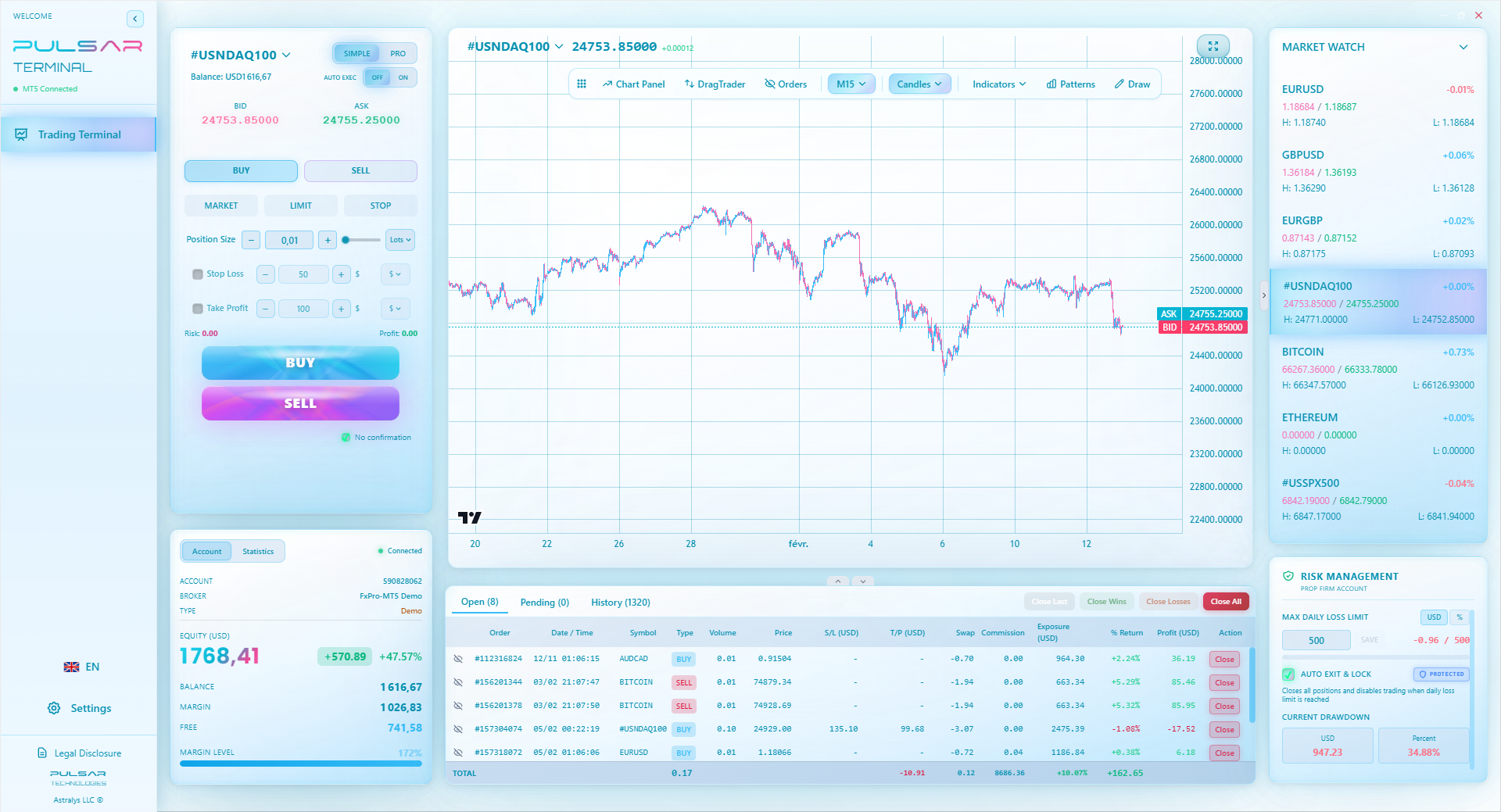
When your psychology is the biggest threat, a tool that automates your trade management—like setting multi-level take-profits or a trailing stop the second you enter—removes the emotion and locks in your plan.
Pulsar Terminal
MT5一站式工具:拖拽下单、多重止盈/止损、追踪止损、网格交易、成交量分布图和自营交易保护。每日1000+交易者使用。
“Aim for 2-5% consistent growth per month. That's realistic. Chasing 20% is a surefire way to blow up.”
So, after 12 years, what's the most reliable forex strategy for a South African trader?
It's the Risk-Managed Trend-Following System.
- It's Boringly Mechanical: It removes emotion. You follow the rules, not your gut.
- It Respects the ZAR: It works with the pair's tendency to trend, not against it.
- It Accounts for Costs: By aiming for larger moves (100-300 pips), it overcomes the wide spreads.
- It's Sustainable: The 1:3 risk-reward and strict 1-2% risk per trade means you can survive a string of losses and live to trade another day.
It won't make you rich overnight. But it might, just might, help you build consistent, compounding growth over years. And in this game, staying power is the only reliability that truly matters. Start with that foundation. Everything else is just decoration.
FAQ
Q1Is there a 100% winning forex strategy?
No. Absolutely not. Anyone claiming this is selling you a fantasy. The market is probabilistic, not deterministic. Even the best strategies have losing streaks. The goal isn't to win every trade; it's to be profitable over a large sample of trades through positive risk-reward.
Q2What's a realistic monthly return for a disciplined trader in South Africa?
Aim for 2-5% consistent growth per month. That's realistic and sustainable. If you compound 3% monthly, you'll double your account in about two years. Chasing 20% per month is a surefire way to blow up your account. Remember, the FSCA's 30:1 use cap should guide you towards more conservative, sustainable targets.
Q3Should I trade USD/ZAR or major pairs like EUR/USD?
Start with majors (EUR/USD, GBP/USD). The spreads are tiny (often under 1 pip), liquidity is massive, and it's easier to manage risk. USD/ZAR is volatile and has huge spreads (50-100 pips). It's a more advanced pair to trade. Get consistently profitable on majors first, then consider allocating a small portion of your capital to ZAR pairs.
Q4How much money do I need to start trading forex in South Africa?
You can open an account with as little as $10 (R180-ish) with some brokers. But realistically, to properly implement risk management (e.g., risking 1-2% per trade), you need enough capital so that your position size is meaningful. I'd suggest a minimum of R10,000 to start seriously. With less, the spreads and minimum trade sizes make proper risk management almost impossible.
Q5What's the single most important thing for a beginner to learn?
Risk management. Before you learn a single indicator or chart pattern, learn how to calculate your position size, where to place a stop-loss, and why a 1:3 risk-reward ratio is non-negotiable. Protecting your capital is Job #1. You can't learn to trade if you have no money left to trade with.
Q6Are international brokers like Pepperstone or XM safe for South Africans?
Many, like Pepperstone and XM, are regulated by top-tier authorities (ASIC, CySEC) and are popular here. They are generally safe. However, remember that the FSCA's protection (like the local ombud) only applies to brokers they license directly. Always verify a broker's regulatory status on the regulator's official website before depositing.
Winston 教授的课程
要点总结:
- ✓Risk management is 80% of trading. Strategy is the other 20%.
- ✓Never risk more than 2% of your capital on a single trade.
- ✓Always use a minimum 1:2 risk-reward ratio. Aim for 1:3.
- ✓Trade the trend on ZAR pairs; fight the spread on majors.
这篇文章对您有用吗?
点击星星评分
每周交易洞察
免费每周分析与策略。无垃圾邮件。
关于作者
David van der Merwe
新兴市场交易员
约翰内斯堡交易者,11年新兴市场货币经验。专注于ZAR货币对、FSCA监管交易和南非市场分析。
评论
风险提示
金融工具交易存在重大风险,可能不适合所有投资者。过往业绩不代表未来表现。本内容仅供教育目的,不构成投资建议。在交易前请务必自行研究。
您可能还喜欢

Cara Trading Forex Sukses: 7 Prinsip dari Trader Profesional
Cara trading forex sukses dengan 7 prinsip trader pro: manajemen modal, disiplin, journal trading, backtest. Data nyata, bukan janji profit palsu.
Jam Trading Forex Terbaik untuk Trader Indonesia: Panduan Lengkap dengan Tabel Waktu
Panduan jam trading forex untuk trader Indonesia. Tabel 4 sesi dunia, jam emas 20:00-00:00, sesi mana yang harus dihindari. Data akurat + tips dari trader berpengalaman.
Top 5 Sàn Forex Uy Tín Nhất 2026: Review Jujur dari Trader Indonesia
Top 5 sàn forex uy tín 2026 untuk trader Indonesia. Review jujur: spread, deposit, withdraw, dukungan lokal. Exness, XM, IC Markets & lebih.
