


I lost $4,200 in a single morning trading SPY options.

James Mitchell
高级交易分析师
☕ 12 分钟阅读
您将学到:
- 1What the Hell is an Option Trading Prop Firm, Really?
- 2The Murky Regulatory Swamp (U.S. Edition)
- 3The Real Math: Fees, Splits, and the 7% Payout Club
- 4Picking Your Poison: What to Look For in an Options Prop Firm
- 5How to Actually Pass the Challenge (Trading Options)
- 6Life After the Challenge: Don't Blow Your Funding
- 7Is a Prop Firm Even Right For You? The Alternatives.
I lost $4,200 in a single morning trading SPY options. It was 2021, the market was gyrating on Fed rumors, and my iron condor got steamrolled. My personal account was bleeding, but my funded prop firm account? Untouched. That's the first brutal lesson: an option trading prop firm isn't a magic money machine. It's a capital firewall. It separates your emotional, often stupid, trading decisions from the firm's cold, hard cash. Most traders get this backwards and blow up before their first payout.
Forget the slick marketing. At its core, an option trading prop firm gives you a funded account to trade with. You don't risk your own capital beyond an evaluation fee. If you're profitable, you take a big slice (usually 70-90%). If you lose, you lose their money, up to a point - then you're out.
It's not a broker. You're not a customer. You're a contractor, a revenue source. The firm's business model banks on the fact that most traders fail. Those evaluation fees? That's pure profit for them. The 5-10% who actually pass and become consistently profitable? That's the gravy.
There are two main types. The first are the heavily regulated broker-dealers, like T3 Trading Group. They're SEC-registered, FINRA members, and you're literally on their trading floor or using their direct market access. The second, and far more common for retail, are the 'challenge' or 'evaluation' firms. These operate in a regulatory gray area. They use simulated accounts for the test, then give you a live, but heavily restricted, account if you pass. Your job is to know which one you're getting into.

Warning: That 'funded' account isn't always what you think. Many firms use a 'simulated live' environment. Your trades are mirrored in the real market, but legally, you're trading against the firm's model until you hit a payout threshold. Always read the fine print on account structure.

💡 Winston 小贴士
When sizing an option trade for a prop challenge, calculate your max loss first. Then cut it in half. That's your real position size. Boredom is your ally.
“A prop firm's capital is a firewall between your emotions and the market.”
This is where most traders' eyes glaze over, and it's exactly why they get burned. U.S. regulation for prop firms is a patchwork quilt with giant holes.
SEC & FINRA vs. The Gray Zone
If a firm is a registered broker-dealer (like T3), you're covered by SEC rules and FINRA oversight. That means SIPC protection on cash and securities (up to $500k) in a worst-case scenario. It also means they're subject to the Pattern Day Trader (PDT) rule for equity options.
Most retail-focused prop firms you see advertised? They're not broker-dealers. They structure themselves as technology or education companies selling a 'challenge.' Your fee is for the evaluation software, not for trading capital. This cleverly sidesteps direct SEC/CFTC oversight. Your rights as a 'trader' are defined by a contract, not by securities law.
The PDT Rule & You
This is critical for stock option traders. The PDT rule says if you make more than 3 day trades in a 5-business-day period in a margin account, you must maintain $25,000 in equity. It applies to equity options (like AAPL or SPY options) and single-stock futures.
Here's the kicker: It generally does NOT apply to broad-based index options (like SPX, NDX) or futures options (like /ES). This is why many serious prop traders focus on SPX. No PDT rule, 1256 contract tax treatment (60% long-term/40% short-term capital gains). It's a cleaner vehicle.
Recent Shake-Ups
In late 2024, a court vacated an SEC rule that would have forced more prop firms to register as dealers. The SEC dropped its appeal in early 2025. For now, the gray zone remains. Also, FINRA is proposing to scrap the fixed $25k PDT rule for a risk-based model. If that passes (maybe 2026), it could change the game for small-account equity option traders. Don't trade based on rumors, but keep an ear to the ground.

Pro Tip: If you want to day trade equity options with less than $25k, a prop firm is one of your only legal paths. The firm's broker-dealer registration covers the account. But you must understand their specific daily loss limits and trade rules, which are often stricter than the PDT rule.
“Passing the challenge is a test of discipline, not genius. Most fail because they can't handle the boredom.”
Let's talk numbers, because this is where dreams get priced.
Evaluation Fees: You'll pay $100 to $600 for a shot. Some firms, like Bulenox, use a monthly subscription model ($115-$535/month). A few offer 'refundable' challenges where you get your fee back on your first payout. I view non-refundable fees as a sunk cost - a tuition payment for a very harsh lesson.
Profit Splits: They advertise 80%, 90%, even 100%. What they don't shout about is the scaling. You might start at 50/50 on an 'instant' account. Hit your first profit target, maybe you jump to 70/30. Consistent performance over months might get you to 90/10. I'm in an 85% split program. Last quarter, I generated $28,500 in gross profit. My take-home after the split was $24,225. The firm kept $4,275. Fair deal for their capital and platform.
The Brutal Statistics:
- Industry-wide, about 5-10% of traders pass the evaluation.
- Of those who get funded, only about 7% ever receive a payout.
- Earn2Trade reported a 10.42% pass rate in 2024. That's actually high.
Why? Because passing the challenge is a different skill set from trading profitably long-term. The challenge forces hyper-risk-averse behavior. Once funded, traders often get overconfident, size up, and blow the account in a week. My first funded account lasted 11 days. I broke every rule I used to pass the challenge. It was a $500 lesson in humility.
Capital Sizes: They'll dangle $250k, $500k, $1M accounts. Remember, these are notional values with tight drawdown limits. A $100k account with a 5% max daily loss means you can only lose $5,000 in a day. That's your real risk capital, not the $100k. Use a position size calculator religiously.
| Item | Typical Range | What It Really Means |
|---|---|---|
| Evaluation Fee | $100 - $600 | The cost of your audition. Often non-refundable. |
| Starting Profit Split | 70% - 90% | Can be lower for instant funding (50%). |
| Scaled Account Size | $25k - $4M | Notional value. Your effective capital is defined by loss limits. |
| Daily Loss Limit | 2% - 5% of account | Your true risk management leash. This will stop you out. |
| Success Rate to Payout | ~7% | The hard truth. Most funded traders don't get paid. |
“Passing the challenge is a test of discipline, not genius. Most fail because they can't handle the boredom.”
Not all firms are built for options traders. You need the right tools and rules.
1. Platform & Execution: This is non-negotiable. You need a professional platform. ThinkorSwim is the gold standard for retail option analytics. Sterling Trader Pro and Silexx (Cboe) offer incredible direct routing and complex order entry. If a firm only offers a stripped-down MT5 or a janky web platform, walk away. You can't efficiently trade multi-leg strategies without good tools. I once tried trading iron butterflies on a platform with 300ms order latency. The slippage ate my potential profit on 3 out of 4 legs. It was a nightmare.
2. Product Offering: Can you trade SPX? NDX? RUT? What about weeklys? ETFs? Futures options (/ES, /NQ)? If you're a broad-index trader and they only offer equity options, you're hamstrung by the PDT rule.
3. Rule Structure:
- Daily Loss: Is it based on your starting balance or trailing equity? Trailing equity (high-water mark) is tougher but more realistic.
- Profit Target: Is it realistic? A 10% profit target in a month on a $100k account is $10k. That's aggressive for a consistent option strategy.
- Minimum Trading Days: Some require you to trade a certain number of days to prevent lottery-style YOLO trades. This is good.
- Strategy Restrictions: Do they ban naked options? Do they require defined risk? My current firm requires all equity option positions to be defined risk (spreads, iron condors). It saved me during the meme-stock frenzy.
4. Payout Schedule & Threshold: Weekly? Bi-weekly? Monthly? Is there a minimum payout amount ($500, $1,000)? How long does the wire take? I favor firms with bi-weekly payouts and a low threshold. It creates a positive feedback loop.
5. Community & Support: Do they have experienced option traders you can talk to? Or are you just a number in a dashboard? This matters more than you think when you're in a drawdown.

Example: Firm A offers a $100k account, 80% split, $399 challenge. Firm B offers a $50k account, 90% split, $299 challenge. Firm A uses ThinkorSwim and allows SPX. Firm B uses a basic platform and only stocks. Firm A is the better deal for a serious option trader, every time.
💡 Winston 小贴士
The platform matters more than the profit split. A 70% split on ThinkorSwim is better than a 90% split on a platform that can't handle a 4-leg order.
“Your maximum loss on any single trade should be no more than 1% of your challenge account balance. Period.”
The goal isn't to get rich. The goal is to pass. This is a test of discipline, not genius.
1. Strategy Selection: Forget complex multi-leg strategies for the challenge. Volatility is your enemy here. You need consistency. I passed my last challenge using a simple, boring strategy: selling out-of-the-money put credit spreads on SPY, 30-45 days out, for a 1:3 risk/reward. I aimed for 1-2% account growth per week. No heroics. The MACD indicator on a daily chart gave me trend direction, and I only sold puts in a clear uptrend. That's it.
2. Position Sizing is King: This is 90% of the game. Your maximum loss on any single trade should be no more than 1% of your challenge account balance. For a $50k challenge, that's $500. If you're trading a spread with a $500 wide strike difference, you can only sell 1 contract. Not 2. One. Use the calculator.
3. Embrace the Daily Loss Limit: This is your circuit breaker. If you're down 2-3% on the day, STOP. Log off. The challenge gives you 30, 60, 90 days. One bad day won't fail you. Five bad days in a row because you 'revenge traded' will.
4. Document Everything: I kept a journal for my last challenge: 'Day 14: Sold 1 SPY 435-430 put spread, 38 DTE, credit $1.65. Max risk $335. Reason: Daily MACD bullish, holding above 20 EMA. No other trades.' This forces accountability.
5. The Mental Game: You will have losing trades. Your job is to keep them small. The profit target is usually far away. Don't look at it. Focus on the process of making 5 good, small, disciplined trades in a row. Then 10. The profit will come.
This grind is the opposite of the 'get rich quick' fantasy. It's why 90% fail. They can't handle the boredom of disciplined, small-ball swing trading. They'd rather blow up trying to hit a home run.
“Your maximum loss on any single trade should be no more than 1% of your challenge account balance. Period.”
You passed. Congrats. Now the real work begins, and the psychology gets harder.
The biggest trap is scaling up too fast. Your risk per trade was 1% during the challenge. On a $100k funded account, that's $1,000. Suddenly, a $1,000 loss feels trivial compared to the notional $100k. You get sloppy. You size up to 2% or 3%. One bad trade now costs $3,000 and might hit your daily loss limit. Game over.
Stick to your challenge rules for the first 3 payout cycles. No exceptions. Prove to yourself you can do it with real payouts on the line.
Manage your payouts like a business. That first payout is intoxicating. Don't blow it on a new watch. Reinvest some in your education, pay down debt, or put it in a savings account. This income is volatile. Build a buffer.
Communication is key. If you have a drawdown, communicate with your firm's risk team if needed. Some are flexible if you're transparent. If you're about to breach a rule, sometimes they can work with you. Don't ghost them.
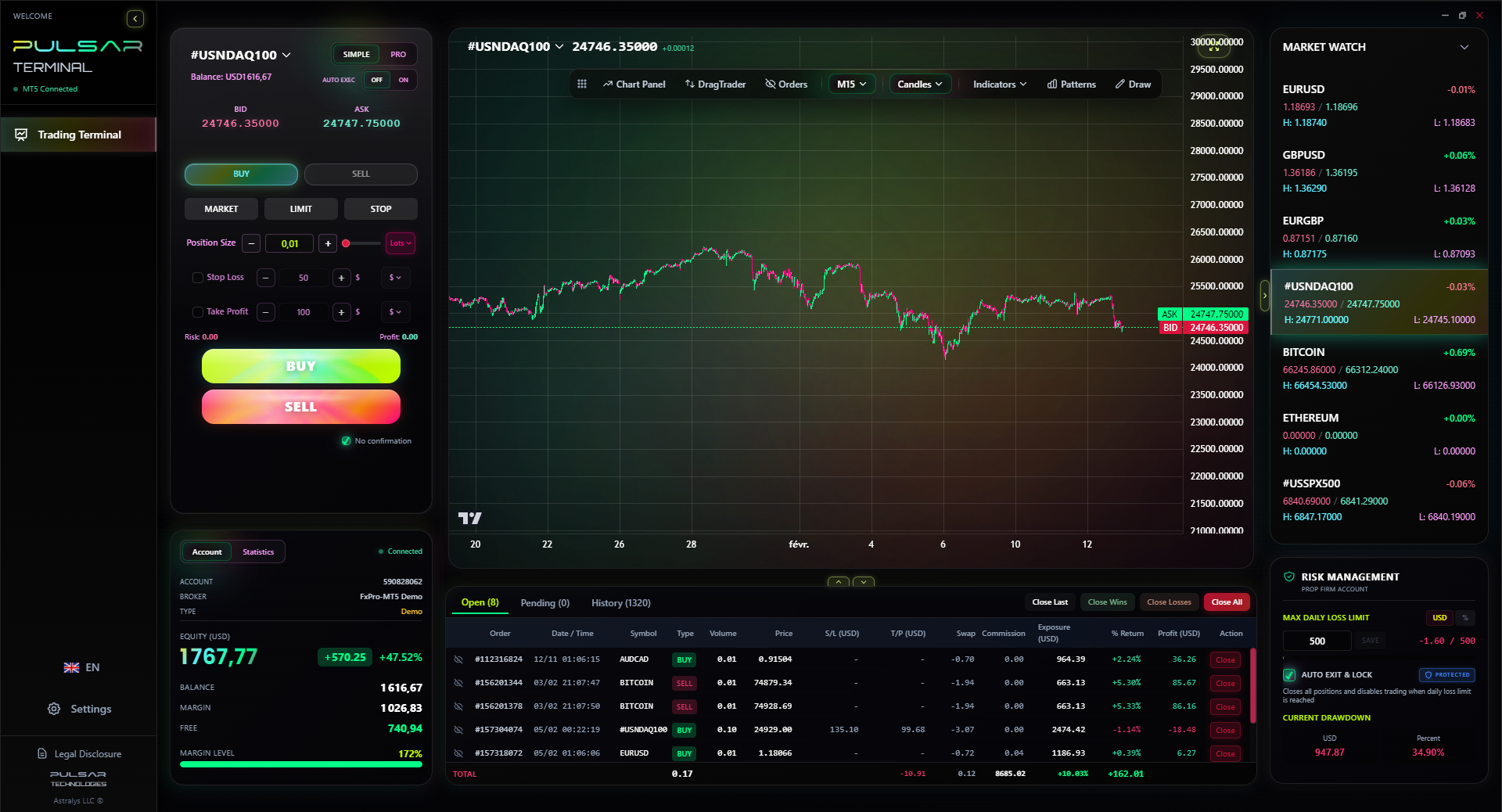
Platforms like Pulsar Terminal become useful here. When you're managing multiple leg options positions, having tools for drag-and-drop order management, automated trailing stops on your net position, and one-click breakeven can mean the difference between a scratch and a loss. It lets you manage the trade, not just stare at it hoping.
Finally, always have a plan for the firm shutting down. It happens. Don't keep all your trading capital in one firm's environment. Diversify across two firms if you can, or keep your personal account active. I learned this the hard way when a firm I was with suddenly changed its rules overnight, making my strategy impossible. I had to scramble.
💡 Winston 小贴士
Your first payout isn't income. It's proof of concept. Reinvest it in your trading infrastructure - better data, tools, or education - before you spend a dime.
Managing complex option positions under strict prop firm rules requires precision; Pulsar Terminal's drag-and-drop order management and automated breakeven/trailing stops on MT5 help you execute your plan without emotional hesitation.
Pulsar Terminal
MT5一站式工具:拖拽下单、多重止盈/止损、追踪止损、网格交易、成交量分布图和自营交易保护。每日1000+交易者使用。
“The 7% payout rate isn't a conspiracy; it's a monument to poor risk management.”
A prop firm isn't the only path. Let's be brutally honest about the alternatives.
Trading Your Own Capital:
- Pro: Ultimate freedom. No rules, no profit splits, no evaluations.
- Con: You're risking your own money. Emotional pressure is immense. The PDT rule cages you if under $25k. Most traders lose their personal accounts before they develop skill.
Joining a Registered Broker-Dealer (Like T3):
- Pro: Legitimate, regulated, often with direct mentorship and superior technology. You're an actual trader.
- Con: Much higher barriers to entry. Often requires a proven track record, a series of interviews, and sometimes you need to contribute some of your own capital.
The 'Retail Challenge' Prop Firm (The Topic of This Article):
- Pro: Access to larger capital with no personal financial risk beyond the fee. Structured path. Forces discipline.
- Con: Opaque regulation. Restrictive rules. High failure rate. You are the product.
My take: If you have less than $25k and want to trade equities/equity options seriously, a prop firm is a viable path around the PDT rule. If you have a solid track record and want a career, aim for a registered broker-dealer. If you're still learning and blowing up personal accounts, save your money. A prop firm challenge will just be an expensive lesson. Go back to a simulator, build a 6-month profitable track record on paper, then consider it.
For instruments like forex or gold, where PDT doesn't apply, the calculus changes. You might be better off with a large use broker like Pepperstone or IC Markets and trading your own scaled capital, especially if you're a scalping specialist.
FAQ
Q1Do option trading prop firms have to follow the PDT rule?
It depends on the firm's structure and what you trade. If the firm is a registered broker-dealer (like T3), then YES, their equity and equity option accounts are subject to the PDT rule. If the firm is not a broker-dealer and you are trading a simulated account, the PDT rule may not technically apply, but their internal rules will mimic or be stricter than PDT. Also,, if you trade index options like SPX or futures options, the PDT rule does not apply at all.
Q2What's the most common reason traders fail prop firm challenges?
Oversizing. Hands down. A trader gets a $50k account and immediately trades 10-lots of a spread, risking 5% of the account on one idea. One bad move hits their daily loss limit. They fail in a week. The second reason is revenge trading after a loss - breaking their rules to 'get it back fast.'
Q3Are prop firm payouts guaranteed?
No. They are contingent on you being profitable and following all their rules. Your payout is a share of the net profits you've generated, minus any fees. If you have a losing month, you get nothing. Also, read the contract: some firms have clauses where they can withhold payouts under certain conditions.
Q4Can I trade credit spreads or iron condors with a prop firm?
Most allow defined-risk strategies like credit spreads. Many actively encourage them. However, some firms restrict or ban naked option selling due to the unlimited risk. You must check the firm's specific allowed strategies list before paying for a challenge.
Q5What's better for options: a prop firm or a broker like Interactive Brokers?
If you have under $25k and want to day trade equity options, a prop firm is better (it bypasses PDT). If you have over $25k and strong discipline, a broker like IBKR gives you more freedom and keeps 100% of profits. If you trade index options (SPX) and have your own capital, a broker is usually the simpler choice.
Q6How do taxes work with prop firm payouts?
In the U.S., your profit share is typically reported on a 1099-MISC or 1099-NEC as miscellaneous income. It's taxed as ordinary income (your individual tax rate), not at the lower capital gains rate. This is a significant downside compared to trading your own account, where 1256 contracts (like SPX) get favorable tax treatment. Consult a tax professional.
Winston 教授的课程
要点总结:
- ✓Risk 1% or less per trade during the challenge.
- ✓PDT rule applies to equity options, not SPX/NDX.
- ✓Only 5-10% pass evaluations; 7% get paid.
- ✓Platform quality is non-negotiable for options.
- ✓Payouts are taxed as ordinary income.
这篇文章对您有用吗?
点击星星评分
每周交易洞察
免费每周分析与策略。无垃圾邮件。
关于作者
James Mitchell
高级交易分析师
常驻纽约,拥有超过9年的交易经验。专注于主要美元货币对、自营交易公司挑战和美国监管环境。
评论
风险提示
金融工具交易存在重大风险,可能不适合所有投资者。过往业绩不代表未来表现。本内容仅供教育目的,不构成投资建议。在交易前请务必自行研究。
您可能还喜欢

Cara Trading Forex Sukses: 7 Prinsip dari Trader Profesional
Cara trading forex sukses dengan 7 prinsip trader pro: manajemen modal, disiplin, journal trading, backtest. Data nyata, bukan janji profit palsu.
Jam Trading Forex Terbaik untuk Trader Indonesia: Panduan Lengkap dengan Tabel Waktu
Panduan jam trading forex untuk trader Indonesia. Tabel 4 sesi dunia, jam emas 20:00-00:00, sesi mana yang harus dihindari. Data akurat + tips dari trader berpengalaman.
Top 5 Sàn Forex Uy Tín Nhất 2026: Review Jujur dari Trader Indonesia
Top 5 sàn forex uy tín 2026 untuk trader Indonesia. Review jujur: spread, deposit, withdraw, dukungan lokal. Exness, XM, IC Markets & lebih.
