


Most people think position trading is just 'buy and forget.' They're wrong, and that's why they lose money.

Rajesh Sharma
高级外汇分析师 ·  India
India
☕ 12 分钟阅读
您将学到:
- 1What Position Trading Really Means for an Indian Trader
- 2The Rules & Costs You Absolutely Cannot Ignore
- 3How to Find Trades That Last for Months, Not Days
- 4My Framework: Entry, Management, and the All-Important Exit
- 5Brokers & Platforms for the Indian Position Trader
- 6The Pitfalls That Will Crush You (And How to Avoid Them)
- 7How to Place Your First Real Position Trade
Most people think position trading is just 'buy and forget.' They're wrong, and that's why they lose money. In India, with our unique taxes, SEBI rules, and market quirks, a proper position trading strategy is a disciplined, active process of holding for the big moves. It's not passive investing, and it's definitely not gambling on weekly options. I'll show you the real framework I've used for over a decade, including the exact trades where I sat through 30% drawdowns to catch 150% moves, and the one time that patience cost me ₹4.2 lakh.
Let's clear this up first. Position trading isn't about picking a stock and checking it once a year. It's about identifying a primary market trend - one that could last for several months or even a couple of years - and riding it for the majority of its move. You're not reacting to daily news or quarterly results. You're betting on a larger economic story, a sectoral shift, or a structural change in a company.
Think of it like this: if a scalping strategy is a series of quick jabs, and swing trading is a few well-placed hooks, position trading is waiting for the perfect opening to land a knockout punch. You'll take fewer trades, but each one has a much larger profit potential.
The Indian context adds specific layers. You're dealing with SEBI's position limits, the Securities Transaction Tax (STT) on every sale, and the crucial distinction between delivery and intraday holdings for tax purposes. A position trader here needs to be part economist, part chart reader, and part tax planner.

Warning: Don't confuse this with 'investing.' As a position trader, your primary tool is still the price chart. Fundamentals provide the story, but the chart tells you when the story is beginning and, more importantly, when it's ending. I've seen too many 'long-term investors' turn into 'bag holders' because they fell in love with a story and ignored the price action screaming that it was over.

💡 Winston 小贴士
The market pays you for patience, not for activity. The more you do, the less you keep after taxes and fees. Your goal is to be strategically lazy.
“Position trading in India is a disciplined, active process of holding for the big moves. It's not passive investing.”
This is where many aspiring position traders get a nasty shock. The Indian regulatory and cost structure directly impacts your strategy's profitability. You can't just copy a US-based strategy and expect it to work here.
The SEBI Rulebook
First, you need a Demat account. That's non-negotiable. SEBI's peak margin rules mean your broker will block funds upfront for any trade. For delivery-based position trades (which you'll mostly use), you need to have the full value of the shares available if you're buying without use.
Then there are position limits. While these are more relevant for [F&O traders, SEBI sets Market Wide Position Limits (MWPL) for stocks. If you're building a very large position in a single stock, you need to be aware of this. For most retail traders, it's not a hurdle, but it's good to know.
The Real Cost of Doing Business
Here’s the breakdown that hits your P&L. Let's say you buy ₹10,00,000 worth of Infosys shares for a long-term position trade.
| Charge | Applicability | Approx. Cost on ₹10L Buy | Notes |
|---|---|---|---|
| Brokerage (Delivery) | Buy & Sell | ₹0 (Discount Broker) | Most discount brokers like Zerodha charge zero. |
| Securities Transaction Tax (STT) | Sell only | ₹1,000 | 0.1% on sell value. A pure cost of exiting. |
| Exchange Transaction Charge | Buy & Sell | ~₹60 | NSE charges 0.00325% on delivery. |
| GST | On Brokerage + Charges | ~₹11 | 18% on the exchange charge (since brokerage is 0). |
| Stamp Duty | Buy only | ₹150 | 0.015% on buy value, depends on state. |
| DP Charges | Sell only | ₹15.34 per scrip | Charged when you sell shares from Demat. |
The Big One: Capital Gains Tax.
- Short-Term Capital Gains (STCG): Hold for less than 1 year? Your profit is added to your income and taxed at your slab rate. Could be 30%+.
- Long-Term Capital Gains (LTCG): Hold for over 1 year? First ₹1 lakh of profit per year is tax-free. Anything above that is taxed at 12.5% (plus surcharge & cess).

Example: You buy at ₹10,00,000 and sell at ₹15,00,000 after 18 months. Your gross profit is ₹5,00,000. The first ₹1,00,000 is tax-free. You pay 12.5% on ₹4,00,000 = ₹50,000 in tax. Your net profit is ₹4,50,000 minus the STT and other charges (~₹1,100).
This tax structure fundamentally shapes the position trading strategy. It incentivizes you to hold winners for at least a year. I've often held a position through a 6-month consolidation just to cross that 1-year mark and save a massive tax bill. It changes your entire psychology around taking profits.
“The tax structure incentivizes you to hold winners for at least a year. It changes your entire psychology around taking profits.”
This is the art and science of it. You're filtering out 99% of the market's noise to find the 1% of setups with truly explosive potential.
Start with the Macro: In India, what's the big story? Is it government capex driving infrastructure stocks? Is it a boom in private banking credit? Is it a global commodity cycle helping metals? Your first screen is thematic. In 2020-2021, the theme was 'digitalization.' That led me to not just IT services, but also to digital payment companies.
Use the Weekly Chart: This is your primary tool. Daily charts are for entry refinement; the weekly chart tells you the truth. I look for markets that have been stuck in a large range for years and are now breaking out. A classic example was Tata Motors in early 2021. The weekly chart showed it breaking above a 5-year consolidation base around ₹180. That was the signal, not any daily news.
The Role of Fundamentals: I do a basic check. Is the company's debt manageable? Is there sectoral tailwind? But I keep it simple. My worst loss as a position trader (that ₹4.2 lakh I mentioned) was on a supposedly 'great fundamental' story (a specialty chemical company) where I ignored a clear weekly chart breakdown. The chart knew the fundamentals were deteriorating before the quarterly results showed it.
Confirmation with Volume: A breakout on the weekly chart needs to be accompanied by a clear spike in volume. It shows conviction. Without it, the breakout is suspect.
I primarily use two indicators on the weekly chart to gauge trend strength and potential turning points: the MACD indicator for momentum shifts and the RSI indicator to identify overbought or oversold conditions within the larger trend. They work on a completely different timescale here compared to day trading.
“The tax structure incentivizes you to hold winners for at least a year. It changes your entire psychology around taking profits.”
Here's my exact process, refined over hundreds of trades.
Entry: I never buy the initial breakout. I wait for what I call the 'first pullback.' After a stock breaks out on the weekly chart, it almost always comes back to retest the breakout level. That's my entry zone. It's lower risk and confirms the level is now support. For Tata Motors, the breakout was at ₹180. I entered on the pullback to ₹185-190.
Position Sizing: This is critical. Because you're holding through volatility, you must size so that a 20-30% drawdown doesn't wipe you out or panic you into exiting. I use a simple position size calculator based on my account risk. I never risk more than 1-2% of my total capital on a single position trade idea.
Stop Loss Placement: Your stop is not below yesterday's low. It's below the structure that defines your trade. For a breakout trade, your initial stop goes below the consolidation range. On that Tata Motors trade, my stop was at ₹165, well below the ₹180 breakout. That's a wide stop, which is why your position size has to be small.
Trailing and Exits: This is where most fail. You don't just set a target and forget it. As the trend matures on the weekly chart, you start moving your stop loss up to lock in profits. I use the weekly swing lows as my guide. When the stock finally takes out a major weekly swing low, that's my signal to exit the entire position.
Let me give you a real example from 2023. I identified a trend in the defence sector. Entered Bharat Electronics (BEL) around ₹130 after its weekly breakout. My stop was at ₹110. The trade went sideways for 4 months. I held. It then ran to ₹220 over the next 8 months. I trailed my stop up under the weekly swings. I was finally stopped out at ₹195. That's a 50% return over a year, tax-efficient, for managing a trade about four times. That's the job.

Pro Tip: Your biggest enemy is boredom. You will watch other stocks fly while yours does nothing for months. You will be tempted to switch. Don't. The grass is rarely greener. The patience to sit is the position trader's secret weapon.
💡 Winston 小贴士
Always calculate your net return after STT and LTCG tax. A 25% gross return can become a 15% net return. If that doesn't meet your hurdle rate, don't take the trade.
“Your biggest enemy is boredom. The patience to sit is the position trader's secret weapon.”
Your broker is a key partner. You need reliability, low costs for delivery trades, and a platform that lets you analyze weekly charts effectively.
For most Indian position traders, a discount broker is the best fit. Their zero brokerage on delivery trades is a massive advantage. Here’s a quick comparison of the leaders:
| Broker | Key Strength for Position Trading | Watch Out For |
|---|---|---|
| Zerodha (Kite) | Industry standard. Excellent charting (with TradingView). Zero delivery brokerage. | Platform can feel overwhelming to beginners. Recent fee changes for F&O. |
| Upstox | Very clean, intuitive interface. Also zero delivery brokerage. | Charting tools slightly less strong than Kite, but more than sufficient. |
| Groww | Superb for beginners. Great for fundamental data alongside charts. | Geared more towards investors; active trading tools are lighter. |
| Angel One | Strong research and screening tools (SmartAPI). Good for finding thematic ideas. | Interface can be cluttered with promotional content. |
My Take: I use Zerodha Kite for execution and charting. It's powerful and the cost structure is perfect for this style. For advanced international markets or more complex order types, a global broker like Interactive Brokers (regulated by SEBI in India) is top-tier, but it's overkill if you're only trading Indian equities.
Your platform must allow you to easily view and draw on weekly charts. That's non-negotiable. All the brokers above allow this. Don't get sucked into the platform with the most flashing lights; get the one that lets you execute your plan with the least friction and cost.
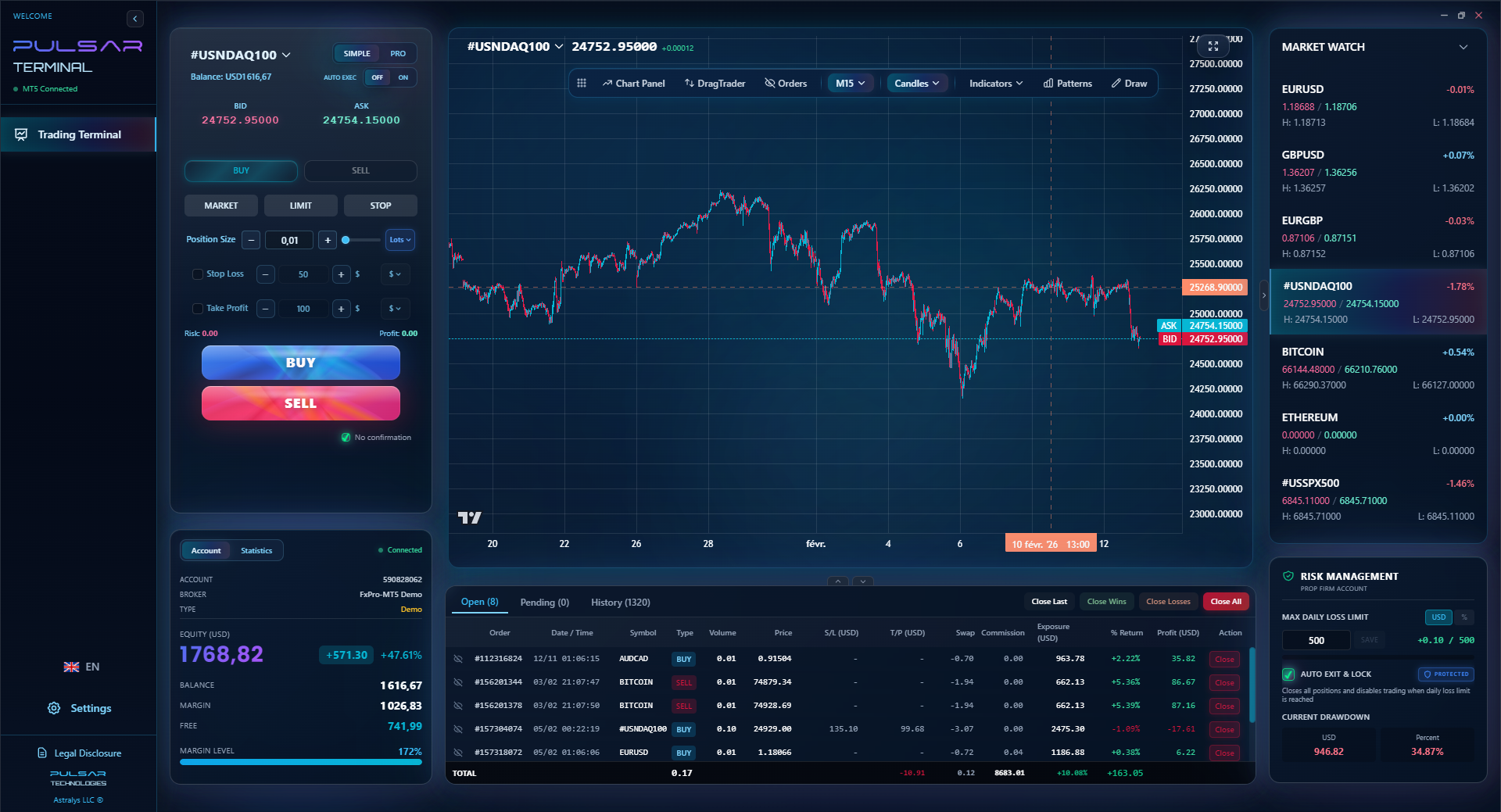
Managing multiple long-term positions and their trailing stops across different timeframes is complex, but tools like Pulsar Terminal automate this directly on your MT5 platform.
Pulsar Terminal
MT5一站式工具:拖拽下单、多重止盈/止损、追踪止损、网格交易、成交量分布图和自营交易保护。每日1000+交易者使用。
“Your biggest enemy is boredom. The patience to sit is the position trader's secret weapon.”
I've made these mistakes so you don't have to.
- Ignoring the Tax Clock: Exiting a position at 11 months and 29 days for a quick profit is often a terrible financial decision after accounting for STCG tax. Plan your entries with the one-year mark in mind.
- Over-leveraging in the F&O Segment: It's tempting to use futures for position trading to get more bang for your buck. The use is deadly. A 20% move against you can trigger a margin call and force you out of a trade that would have eventually worked. I only use futures for position trading if the margin required is similar to the cash needed for delivery, effectively using it for efficiency, not use.
- Adding to a Losing Position: 'Averaging down' is often just throwing good money after bad. In position trading, your initial thesis is based on a chart structure. If that structure breaks (your stop loss hits), your thesis is wrong. Adding more is gambling, not trading.
- Confusing a Trading Position with an Investment: You must have an exit plan. An investor can 'hold forever.' A trader, even a position trader, has a defined exit based on price. When the price says the trend is over, you leave. No attachment.
- Not Accounting for All Costs: That STT and LTCG tax bill is a real drag on returns. Your profit target needs to be high enough to clear these hurdles comfortably. A 15% return over a year might only be 10% after tax and costs. Was the risk worth it?
The mental game is the hardest part. You need the patience of an investor but the discipline of a sniper. It's a unique blend that takes years to cultivate.
💡 Winston 小贴士
Your trading journal for position trades should have quarterly check-ins, not daily ones. Note the weekly chart structure, your trailing stop level, and any change in the macro theme. That's it.
“An investor buys a company. A position trader buys a chart.”
Let's make this concrete. Here is a step-by-step walkthrough.
Step 1: Find a Theme. Don't start with a chart. Start with a story you understand. Maybe it's 'Power Infrastructure' or 'Domestic Tourism Recovery.' Read about it.
Step 2: Screen for Stocks. Use your broker's screener to find 5-10 stocks in that theme.
Step 3: Go to the Weekly Chart. For each stock, pull up the weekly chart for the last 5-7 years. You're looking for one that is either: a) In a strong, steady uptrend and recently pulled back to a key support level (like a moving average). b) Breaking out of a multi-year consolidation range (like Tata Motors did).
Step 4: Plan the Trade. Pick the cleanest chart.
- Entry: If it's breaking out, wait for a pullback to the breakout level. If it's in a trend, buy near the rising weekly support.
- Stop Loss: Place it below the recent significant weekly swing low that defines the structure.
- Position Size: Use your position size calculator. If your account is ₹5,00,000 and you risk 1.5%, that's ₹7,500 risk. If your entry is ₹1,000 and your stop is ₹900 (a ₹100 risk per share), you buy 75 shares (₹7,500 / ₹100).
- Exit Plan: You will hold for at least a year for tax benefits. You will trail your stop up using weekly swing lows. You will not set a profit target; you will let the market tell you when the trend is done.
Step 5: Execute and Manage. Place the trade. Log it in a journal. Check the weekly chart every weekend. Adjust your trailing stop only if the weekly chart gives you a new, clear level. Ignore the daily noise. Your job is to sit.
Start with one trade. One position. Learn the emotional rhythm of holding for months before you even think about adding a second.
FAQ
Q1Is position trading profitable in India?
Yes, but not in the way intraday or swing trading is. The profitability comes from a few large wins that more than cover several small losses. Your edge comes from tax efficiency (LTCG), lower transaction costs (zero delivery brokerage), and catching the bulk of major trends. It's a high-win-rate, high-reward-per-trade strategy if done correctly.
Q2What is the best time frame for position trading?
The weekly chart is your primary decision-making time frame. Daily charts can be used for refining entry points, but the trend must be clear on the weekly. You should be making only a handful of decisions per year based on this chart.
Q3How much money do I need to start position trading in India?
You can start with any amount, but practically, I'd recommend at least ₹2-3 lakhs. This allows for proper position sizing across 2-3 ideas while keeping risk per trade small (1-2%). Starting with too little often leads to over-leveraging or taking excessive risk on a single trade, which defeats the safety principles of the strategy.
Q4What's the difference between position trading and long-term investing?
An investor buys a company. A position trader buys a chart. An investor focuses on fundamentals and holds through market cycles. A position trader focuses on price trends and has a strict, price-based exit plan. An investor may average down. A position trader will always cut a loss at a predefined stop.
Q5How do I handle dividends and corporate actions in a position trade?
Treat them as a minor bonus, not a reason for the trade. Dividends are factored into the price on the ex-date. For splits or bonuses, your broker adjusts your holding and cost price automatically. It doesn't change your chart-based thesis or exit plan. Just note your adjusted cost basis for tax calculation later.
Q6Can I use this strategy with Forex or Gold in India?
The core principles are the same, but the instruments are different. You'd be trading derivatives (F&O) or through international brokers, which adds complexity and different costs. I'd master it with Indian equities first. If you're interested in commodities, study our XAU/USD guide for the global perspective, but remember the local execution will be via MCX futures with their own rules.
Winston 教授的课程
要点总结:
- ✓Use the weekly chart as your primary battlefield.
- ✓Size for a 30% drawdown without panic (1-2% account risk).
- ✓Always factor in STT (0.1%) and LTCG tax (12.5% above ₹1L) before calculating profit.
- ✓Your exit is a trailing stop on weekly swing lows, not a price target.
这篇文章对您有用吗?
点击星星评分
每周交易洞察
免费每周分析与策略。无垃圾邮件。
关于作者
Rajesh Sharma
高级外汇分析师
在印度和南亚市场拥有超过10年的交易经验。从NSE货币衍生品起步,后转入国际外汇市场。专注于USD/INR和新兴市场货币对。
评论
风险提示
金融工具交易存在重大风险,可能不适合所有投资者。过往业绩不代表未来表现。本内容仅供教育目的,不构成投资建议。在交易前请务必自行研究。
您可能还喜欢

Cara Trading Forex Sukses: 7 Prinsip dari Trader Profesional
Cara trading forex sukses dengan 7 prinsip trader pro: manajemen modal, disiplin, journal trading, backtest. Data nyata, bukan janji profit palsu.
Jam Trading Forex Terbaik untuk Trader Indonesia: Panduan Lengkap dengan Tabel Waktu
Panduan jam trading forex untuk trader Indonesia. Tabel 4 sesi dunia, jam emas 20:00-00:00, sesi mana yang harus dihindari. Data akurat + tips dari trader berpengalaman.
Top 5 Sàn Forex Uy Tín Nhất 2026: Review Jujur dari Trader Indonesia
Top 5 sàn forex uy tín 2026 untuk trader Indonesia. Review jujur: spread, deposit, withdraw, dukungan lokal. Exness, XM, IC Markets & lebih.
