


Here's a statistic that should make any prop firm owner sweat: global search interest in prop firms exploded by 607% from 2020 to 2024.

James Mitchell
高级交易分析师 ·  Canada
☕ 10 分钟阅读
您将学到:
- 1What Prop Firm PR Really Is (And Isn't)
- 2The Canadian Regulatory Landscape: Your PR Bedrock
- 3The Costs: What You Actually Pay For
- 4PR Tactics That Actually Work (And Ones That Don't)
- 5The Bootstrapper's Guide: Doing It Yourself
- 6Measuring ROI: When is PR a Success?
- 7Crisis Management: The Non-Negotiable
- 8Final Verdict: To Hire or Not to Hire?
Here's a statistic that should make any prop firm owner sweat: global search interest in prop firms exploded by 607% from 2020 to 2024. In Canada, it was a 377% surge. That's not just growth, it's a gold rush. And where there's a gold rush, there are people selling shovels. Enter the PR agency. Suddenly, every firm needs a slick narrative about 'democratizing finance' and 'trader empowerment.' But as someone who's traded through the hype cycles, I can tell you most of it is noise. Let's cut through the marketing fluff and look at what PR for a prop firm in Canada actually means, what it costs, and whether it's a smart investment or just burning cash on Instagram ads.
Forget the fancy brochures. In the Canadian context, PR for a prop firm isn't about getting featured in the Globe and Mail's finance section (though that's a nice bonus). It's a survival tool in a brutally crowded market. With over 2,000 firms globally now, standing out is the game.
At its core, it's crisis management dressed up as brand building. You're not selling a product; you're selling trust. Canadian traders are savvy, and they're rightly skeptical. They've seen firms pop up and vanish. Your PR needs to answer one screaming question: "Why won't you disappear with my evaluation fee?"
This means communicating three things relentlessly: regulatory compliance, transparent payout structures, and real risk management. It's less about 'vibes' and more about verifiable facts. A good PR strategy here focuses on educating the trader on the process - explaining the brutal 5-10% pass rate not as a barrier, but as a quality filter. It's about managing expectations before they blow up in your support team's face.

Warning: Any PR agency that leads with 'influencer collabs' and 'viral TikTok trends' without a foundational plan for regulatory messaging is setting you up for failure. A viral post about easy money attracts the worst kind of trader - the one who will blow an account in a day and then trash your brand all over Reddit.

💡 Winston 小贴士
The best PR is a funded trader hitting a 90% profit split. Focus on creating success stories, then amplify them. No ad copy beats a real payout screenshot.
This is where your PR narrative either gets solid or falls apart. In Canada, the regulator is the Canadian Investment Regulatory Organization (CIRO). They're the ones who merged IIROC and the MFDA. Crucially, prop firms operate in a grey-ish zone: they trade their own capital, so they don't need to register as securities dealers... provided they don't handle client funds for investment.
Your entire PR message must be built on this foundation. You're not a broker; you're a capital allocator running an evaluation service. Every piece of communication must reinforce that distinction. If a PR agency doesn't understand the nuance between a prop firm and a broker like IC Markets or Pepperstone, fire them immediately.
Why Compliance is Your Best Marketing
use limits are a perfect example. A CIRO-regulated broker caps forex use at 30:1 for majors. Many international prop firms offer 100:1 or more. If you're a Canadian firm partnering with a regulated entity, your PR should hammer this home: "We operate within Canadian regulatory frameworks for safety." It's a constraint that you can spin into a massive trust signal.
Transparency on fees is another legal must-have that doubles as PR gold. Being upfront about the $49 to $2,999 evaluation fee range, and the fact that most traders spend four figures before a payout, builds more credibility than any flashy promo. It filters for serious traders. I've seen firms try to hide their fee structure in fine print; their online reputations are usually in tatters within six months.
“Transparency on fees builds more credibility than any flashy promo video.”
Let's talk numbers, because this is where dreams meet reality. PR agencies don't publish prop firm rates, but based on the industry and what I've seen from the inside, here's the breakdown.
You're not hiring a freelancer. For a dedicated retainer with a specialized finance PR agency, you're looking at $5,000 to $15,000+ CAD per month. For that, you might get 1-2 dedicated account people, content creation, media outreach, and basic social management.
What does that buy? Maybe a few pieces of coverage in niche trading blogs, some LinkedIn content, and a crisis comms plan. A major feature in a top-tier publication? That's a project fee on top, easily another $5k-$10k.
Now, compare that to your core business metrics. If your average evaluation fee is $300 and you have a 7% pass rate, you need a lot of volume to justify a $10k/month PR spend. That spend needs to directly drive applications.

Example:
- Monthly PR Retainer: $10,000
- Your Average Evaluation Fee: $300
- Applications Needed to Break Even on PR Cost: ~34
- But... with a 7% pass rate, those 34 apps might yield only 2-3 funded traders. The real ROI has to be calculated on the lifetime value of those funded traders and the brand equity built.
It's a long game. Any agency promising immediate, massive application spikes is lying. Good PR builds a reputation that makes your firm the default choice over time. I once consulted for a firm that blew $20k on a single 'influencer' campaign. They got a spike of applications from completely unqualified traders, which destroyed their risk metrics for the quarter. A brutal, expensive lesson.
Based on what moves the needle, not what looks fancy in a report.
What Works:
- Educational Content: Deep-dive articles on risk management, explaining drawdown rules, or how a position size calculator is a trader's best friend. This positions you as an authority, not a salesman.
- Transparent Case Studies: Show real, anonymized trader journeys. Not just the 90% profit split winner, but the guy who failed two challenges before passing. It's authentic.
- Regulatory Commentary: Have your founder or compliance lead comment on CIRO updates. It screams legitimacy.
- Focus on Payouts: PR around fast, reliable payouts is king. When FundedNext promotes 5-hour payouts, that's a powerful PR message that addresses a core trader anxiety.
What Doesn't Work (Usually):
- Generic Finance Influencers: Paying a generic 'finfluencer' with no prop trading experience to hype your firm. Their audience doesn't convert.
- Promising Easy Money: This attracts blow-up artists and will get you flagged by regulators. It also alienates the serious swing trading or scalping pros you want.
- Ignoring Negative Reviews: A smart PR strategy includes professionally and calmly addressing concerns on forums like Reddit. Silence is seen as guilt.
A tactic I've seen work well is sponsoring real trading education - webinars on using the MACD indicator or RSI indicator effectively, without pushing your firm hard. It builds immense goodwill.
💡 Winston 小贴士
If you wouldn't say it to a regulator in a hearing, don't let your PR agency put it in a press release. Compliance isn't just legal, it's your messaging backbone.
“No amount of PR will save a prop firm with predatory rules or slow payouts.”
Not every firm has $10k a month. Here’s how to build credibility on a budget. I built my own trading brand this way, years ago.
First, become a publisher. Start a blog or a detailed FAQ. Write the definitive guide on passing a prop challenge in Canada. Explain every term - from pip to spread to margin call. This content ranks on Google and answers questions traders have before they even contact you.
Second, leage LinkedIn. It's where serious traders and fund managers live. Post clear, value-driven threads. Break down a recent market move on XAU/USD or EUR/USD. Share a mistake you made in risk management. Authenticity is free and cuts through the noise.
Third, build relationships, not just contacts. Instead of cold-emailing journalists, engage with finance reporters on Twitter/X. Comment intelligently on their stories. When you finally have news, they'll recognize your name.
Finally, systematize transparency. Make your rules, fees, and profit splits (like the common 60-90% range) impossible to miss. Film a monthly video update from the founder. This DIY approach is grueling, but it builds a brand that's unshakably real. It’s how I turned a $5k trading account into a sustainable business, by focusing on real value over hype.
If you can't measure it, don't spend on it. Vanity metrics like 'impressions' are useless. Here’s what to track:
- Direct Media-Driven Applications: Use unique promo codes or landing page URLs for each publication. How many apps came from that TradingView blog feature?
- Cost Per Qualified Application (CPQA): Total PR spend ÷ number of applications that meet your basic criteria. This is harsher than cost per click, but it's real.
- Search Volume for Your Brand Name: Use Google Trends. Is your brand search growing organically alongside the industry's 377% surge in Canada?
- Sentiment Shift in Forums: Are the conversations on Reddit or Discord shifting from "Are they legit?" to "What's their max drawdown?" That's a huge win.
- Reduction in Support Tickets About Basics: If your PR/education content is working, fewer people will ticket asking "What's a profit split?"
A real example: A firm I advised spent 6 months on an educational content push. Their direct website traffic from organic search doubled. Their application volume stayed similar, but the quality shot up. The percentage of applicants who passed the first challenge phase increased by 40%. That's ROI - they were spending less on evaluating doomed accounts.

Pro Tip: The single best ROI for early-stage prop firm PR is often a one-time investment in a professional, brutally honest audit of your website and terms. Fixing confusing language and hidden clauses prevents a torrent of bad reviews, which is cheaper than any crisis PR campaign.
“In the court of trader opinion, perception is everything. Your credibility bank is your best defense.”
This is the dark side of PR, and you need a plan before you need it. Prop firms are crisis magnets.
Scenario 1: A Payout is Delayed. Maybe it's a banking hiccup. On Reddit, it's "THEY'RE SCAMMERS!" Your PR plan must have a pre-drafted, transparent communication template ready to go within hours.
Scenario 2: A Well-Known Trader Fails a Challenge and Blames You. They have a big YouTube following. You need a calm, fact-based response showing the trade history and the broken rule (e.g., exceeded daily loss).
Scenario 3: Regulatory Scrutiny. CIRO or a provincial commission asks questions. Your PR response must be "We are fully cooperating and committed to compliance," full stop. No speculation, no fighting.
Your number one asset in a crisis is the credibility bank you've built with months of transparent PR. If you've been silent or salesy, you have no trust to draw on. I've watched firms try to lawyer their way out of a PR crisis; they usually lose the public battle, even if they're technically right. In the court of trader opinion, perception is everything. Having a tool that enforces rules, like a daily loss protector, isn't just good risk management - it's a PR asset. It turns a subjective "you stopped me out!" argument into an objective "the automated rule was triggered."
💡 Winston 小贴士
Track your 'Cost Per Qualified Application' from PR spend. If it's higher than your average evaluation fee, you're buying attention, not business.
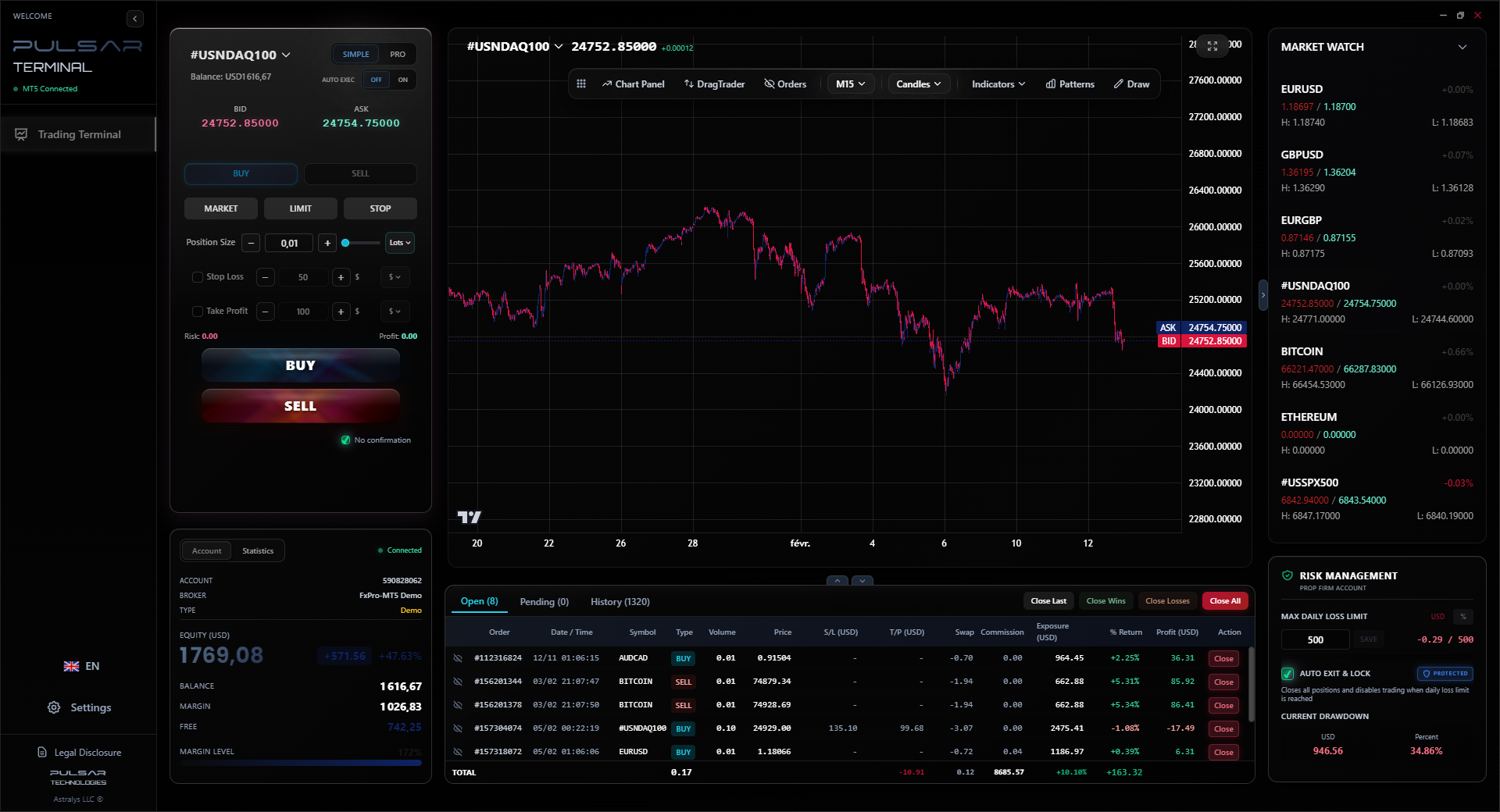
When a trader disputes a stop-out, having automated, unemotional rule enforcement—like Pulsar Terminal's prop firm daily loss protection—turns a PR nightmare into a simple statement of fact.
Pulsar Terminal
MT5一站式工具:拖拽下单、多重止盈/止损、追踪止损、网格交易、成交量分布图和自营交易保护。每日1000+交易者使用。
So, should a Canadian prop firm hire a PR service?
Hire a professional agency if: You have scale. You're consistently getting 100+ applications a month, you have funded traders earning serious money, and you need to build institutional trust to partner with larger brokers or attract elite talent. Your budget is solid, and you view PR as a core operational cost, like compliance. You need a seasoned team to handle the inevitable storms.
Bootstrapp it if: You're a new firm, or sub-100 apps/month. Your focus should be 100% on product and trader success. Spend that $10k/month on improving your platform, speeding up payouts, or hiring one more brilliant risk manager. Do the foundational PR yourself - be transparent, educational, and relentlessly focused on your traders' success.
The brutal truth is that no amount of PR will save a bad prop firm. If your rules are predatory, your payouts are slow, or your platform is glitchy, PR just amplifies the eventual backlash. But for a firm with a solid, fair product, smart PR isn't about hype. It's about clear communication in a noisy, skeptical market. It's about turning your compliance and risk management from a cost center into your most powerful marketing message. In Canada's evolving landscape, that's not just smart marketing. It's survival.
FAQ
Q1How much do PR services for prop firms typically cost in Canada?
Expect retainers with specialized finance PR agencies to range from $5,000 to $15,000+ CAD per month. This typically covers strategy, content creation, and basic media outreach. Major one-off projects like a national media feature can cost an additional $5,000-$10,000. It's a significant investment that only makes sense for firms with substantial, consistent application volume.
Q2What is the most important thing for a prop firm's PR to communicate in Canada?
Regulatory compliance and operational transparency. Canadian traders are acutely aware of the CIRO framework. Your PR must clearly explain how you operate within (or in relation to) that environment, differentiate yourself from client-fund brokers, and be brutally transparent about fees, rules, and realistic success rates (the 5-10% pass rate). Trust built on facts beats hype every time.
Q3Can I handle PR for my prop firm myself?
Absolutely, especially when starting. The most effective DIY PR is becoming a publisher of educational content (guides on risk, trading psychology, tool usage) and engaging authentically on professional platforms like LinkedIn. Focus on systematizing transparency on your website. This builds a foundation of real credibility that's often more effective than early-stage agency work.
Q4How do I measure the ROI of PR for my prop trading firm?
Avoid vanity metrics. Track direct media-driven applications via unique links/codes, calculate your Cost Per Qualified Application (CPQA), monitor organic search growth for your brand name, and observe sentiment shifts in trader forums. The best ROI often manifests as higher-quality applicants and fewer basic support tickets, not just raw application spikes.
Q5What is the biggest PR mistake a prop firm can make?
Promising easy money or obscuring the challenge. Marketing that attracts get-rich-quick traders leads to mass account blow-ups, a torrent of bad reviews, and regulatory scrutiny. The second biggest mistake is having no crisis plan. When a payout delay or a failed challenge from a popular trader hits social media, silence or a defensive legal response will destroy trust.
Q6Do prop firms in Canada need to worry about CIRO regulations for PR?
Yes, fundamentally. Your entire PR narrative must be built around your compliance posture. Since prop firms trade their own capital and don't handle client investment funds, they avoid direct dealer registration. Your PR must consistently and clearly communicate this distinction, and avoid any language that could be construed as offering investment advice or guaranteed returns.
Q7Are influencer partnerships good PR for prop firms?
Rarely, unless the influencer is a respected, proven trader who genuinely uses and understands prop firms. Generic finance influencers often bring an audience that doesn't convert to serious applicants and can damage brand credibility. A better partnership is sponsoring genuine trading education from a known educator.
Winston 教授的课程
要点总结:
- ✓PR must be built on regulatory compliance, not hype.
- ✓Measure ROI by application quality, not just volume.
- ✓A $10k/month retainer needs 34+ apps just to break even.
- ✓DIY PR through education builds lasting credibility.
- ✓Always have a crisis comms plan before you need it.
这篇文章对您有用吗?
点击星星评分
每周交易洞察
免费每周分析与策略。无垃圾邮件。
关于作者
James Mitchell
高级交易分析师
常驻纽约,拥有超过9年的交易经验。专注于主要美元货币对、自营交易公司挑战和美国监管环境。
评论
风险提示
金融工具交易存在重大风险,可能不适合所有投资者。过往业绩不代表未来表现。本内容仅供教育目的,不构成投资建议。在交易前请务必自行研究。
您可能还喜欢

Cara Trading Forex Sukses: 7 Prinsip dari Trader Profesional
Cara trading forex sukses dengan 7 prinsip trader pro: manajemen modal, disiplin, journal trading, backtest. Data nyata, bukan janji profit palsu.
Jam Trading Forex Terbaik untuk Trader Indonesia: Panduan Lengkap dengan Tabel Waktu
Panduan jam trading forex untuk trader Indonesia. Tabel 4 sesi dunia, jam emas 20:00-00:00, sesi mana yang harus dihindari. Data akurat + tips dari trader berpengalaman.
Top 5 Sàn Forex Uy Tín Nhất 2026: Review Jujur dari Trader Indonesia
Top 5 sàn forex uy tín 2026 untuk trader Indonesia. Review jujur: spread, deposit, withdraw, dukungan lokal. Exness, XM, IC Markets & lebih.
