


Let's get this out of the way: the prop firm competition model is built for you to fail.

James Mitchell
高级交易分析师
☕ 9 分钟阅读
您将学到:
Let's get this out of the way: the prop firm competition model is built for you to fail. They're not looking for the next trading genius; they're running a subscription business where your evaluation fee is the product. I've paid for that lesson personally, more than once. But here's the controversial part - it's still one of the best opportunities for a US trader with skill and no capital. This article will show you the brutal math, the ticking regulatory clock, and the exact adjustments you must make to not just compete, but actually win.
You see a $100,000 account for a $250 fee. I see a casino where the house edge is baked into the rules. The numbers don't lie. With a 90%+ failure rate on challenges, these firms are making their money upfront. Let's say a firm sells 1,000 challenges at $250 each. That's $250,000 in revenue before a single trade is placed. If only 10% pass, that's 100 funded traders. Now, if those 100 traders collectively blow their accounts (a high probability), the firm's total risk was just the initial payouts to the few who made a profit first. The rest is pure margin.
I learned this the hard way in 2022. I passed a two-phase challenge for a $50k account. I paid $350 in fees. I made my 8% profit target, got funded, and then hit a 5% max drawdown in three bad days during a Fed announcement. Account gone. My take? A $350 lesson in reading the fine print on trailing drawdowns. The firm's take? My $350, plus the subscription fees from thousands of others who never even got funded.

Warning: Don't think of the fee as buying capital. Think of it as buying a lottery ticket where the odds are terrible, but you can actually improve them with skill. Your goal isn't just to pass. Your goal is to pass and then keep the account long enough for multiple payouts.
The profit-sharing, usually 80/20 or 90/10 in your favor, is the carrot. But you only get a bite if you navigate a minefield first. This is why your strategy for the evaluation must be different from your strategy for the funded account. One is about survival under artificial constraints; the other is about sustainable growth. Most traders use the same approach for both and get wiped out.
Prop firms aren't evil, but they are rational. Their rules protect their capital. Your job is to understand these rules better than they understand your psychology.
The Daily Loss Trap
That 3-5% daily loss limit is a killer. It sounds generous, but it forces panic. Lose 2.5% by noon on a volatile day? You're done. You can't trade your way out, so you either break the rule by overtrading or sit on your hands. I've done both. The smart move? Use a ridiculously conservative position size calculator. On a $100k account with a 5% daily loss limit ($5,000), I now risk no more than 0.5% ($500) per day. It feels tiny, but it keeps me in the game.
The Drawdown Mirage
Maximum drawdown is often trailing. If your starting balance is $100,000 and your profit target is $110,000, your max drawdown might be 10% ($10,000). But with a trailing drawdown, your highest balance becomes the new benchmark. Hit $105,000? Your new max loss level might trail up to $95,000. A pullback to $104,000 is fine, but a drop to $94,999 fails you. This catches more traders than any other rule.
Minimum Trading Days
This rule exists to stop you from hitting a lucky 10% profit in one insane scalping session. You might need to trade 4-10 separate days. It's annoying, but it's fair. It forces consistency, which is what they actually want. Don't fight this one; just plan for it. Space out your trades.

💡 Winston 小贴士
Your first funded account isn't for buying a car. It's for getting a second, larger funded account. Reinvest your first few payouts into more evaluations to diversify your 'funding' risk.
“Your goal isn't just to pass. Your goal is to pass and then keep the account long enough for multiple payouts.”
Here's an open secret: your evaluation account, and often your initial funded account, is a simulated environment. The firm isn't routing your $250-challenge trades to the live market. They're using their own capital to hedge their overall risk based on the collective positions of all their traders. This matters for one reason: slippage and liquidity can be different. I've seen orders fill a bit too perfectly in evaluations compared to my personal IC Markets review account.
The standard platform is MetaTrader 5. It's clunky, but it's universal. Your edge won't come from a fancy platform during the eval; it'll come from discipline. However, once funded, some firms offer better infrastructure. This is where knowing your tools pays off. If you're used to TradingView, the switch to MT5 can cost you precious seconds.

Pro Tip: Practice your entire strategy on a demo MT5 account before starting your paid challenge. Get muscle memory for placing stops, limits, and calculating lot sizes. Wasting time fumbling with the platform is a luxury you don't have when real drawdown is ticking.
This is the biggest shift nobody is talking about enough. The wild west days are ending. The SEC and CFTC have been circling for years, and the noose is tightening. The recent back-and-forth on Treasury dealer rules shows they're figuring out how to classify these firms. The likely outcome? By 2026, major US-facing prop firms will be regulated as Commodity Trading Advisors (CTAs) or similar.
What does that mean for you?
- Higher Fees: Compliance costs money. Those $250 challenges might become $500.
- Stricter Rules: Standardized, enforced rules on things like news trading and scalping.
- Segregated Funds: Your profits in a funded account might actually be safer, held in a regulated entity.
- Fewer Firms: The low-barrier, shady shops will get weeded out or fined into oblivion (we saw some fines in 2024 for record-keeping).
The February 2025 SEC move to bring more proprietary trading under FINRA oversight is a huge signal. They want visibility and control. My advice? Get in now under the current, more flexible rules. Build your track record. The future will be more legitimate but also more restrictive. The prop firm competition landscape in 2026 will look very different.
“The challenge is a test of obedience, not brilliance.”
Your usual swing trading plan might be brilliant, but it's wrong for a prop challenge. You need a challenge-specific strategy.
Phase 1: The Grind. Your only goal is to hit the profit target without touching the drawdown limit. This is not the time for heroics.
- Instrument: Pick one or two. I used only EUR/USD and XAU/USD for their liquidity and predictable spreads.
- Edge: Use a simple, high-probability setup. I combined a MACD indicator crossover on the 1H chart with a key support/resistance level. Boring. Effective.
- Risk: 0.5% per trade max. Yes, it's small. You compound by not blowing up.
- Target: Aim for 1-2% profit per week. Slow and steady.
Phase 2: The Funded Mindset. Once funded, the rules might relax slightly (e.g., no more minimum days). But now you have a trailing drawdown. Your strategy must shift to protecting that equity high watermark. This is where a trailing stop becomes your best friend. You have to lock in profits aggressively to raise the floor your drawdown trails from.

Example: Funded account at $100k. You trade to $104k. Your trailing max drawdown (10%) now sits at $93,600. A bad week pulls you to $99k. You're still up $4k from start, but you're now only $5,400 above your loss limit. The pressure is psychological. Automate your exits to remove emotion.
💡 Winston 小贴士
The 'minimum trading days' rule is a gift. It forces you to walk away after a win. Use it. Close your platform. Your future self will thank you for not giving back profits.
Not all firms are equal. Some have predatory rules hidden in FAQs. Do your homework. Here’s a breakdown of key considerations:
| Feature | What to Look For | Red Flag |
|---|---|---|
| Profit Split | 80% or higher to you. | First payout is 50/50. |
| Drawdown Type | Static (based on initial balance). | Trailing drawdown from balance or equity. |
| Daily Loss | Clearly stated, separate from max DD. | Combined or vague "any loss" rule. |
| Payout Frequency | Monthly or bi-weekly. | Quarterly or "upon request" with hurdles. |
| Scaling Plan | Clear, achievable profit targets to grow account. | No scaling or unrealistic targets (100% profit). |
Read reviews from actual funded traders, not affiliate marketers. Look at Exness review, XM review, and Pepperstone review forums - often, prop traders discuss which firms they use as their prime brokers. The firm's reputation for timely payouts is everything. If they delay or nitpick, they're not worth your time.
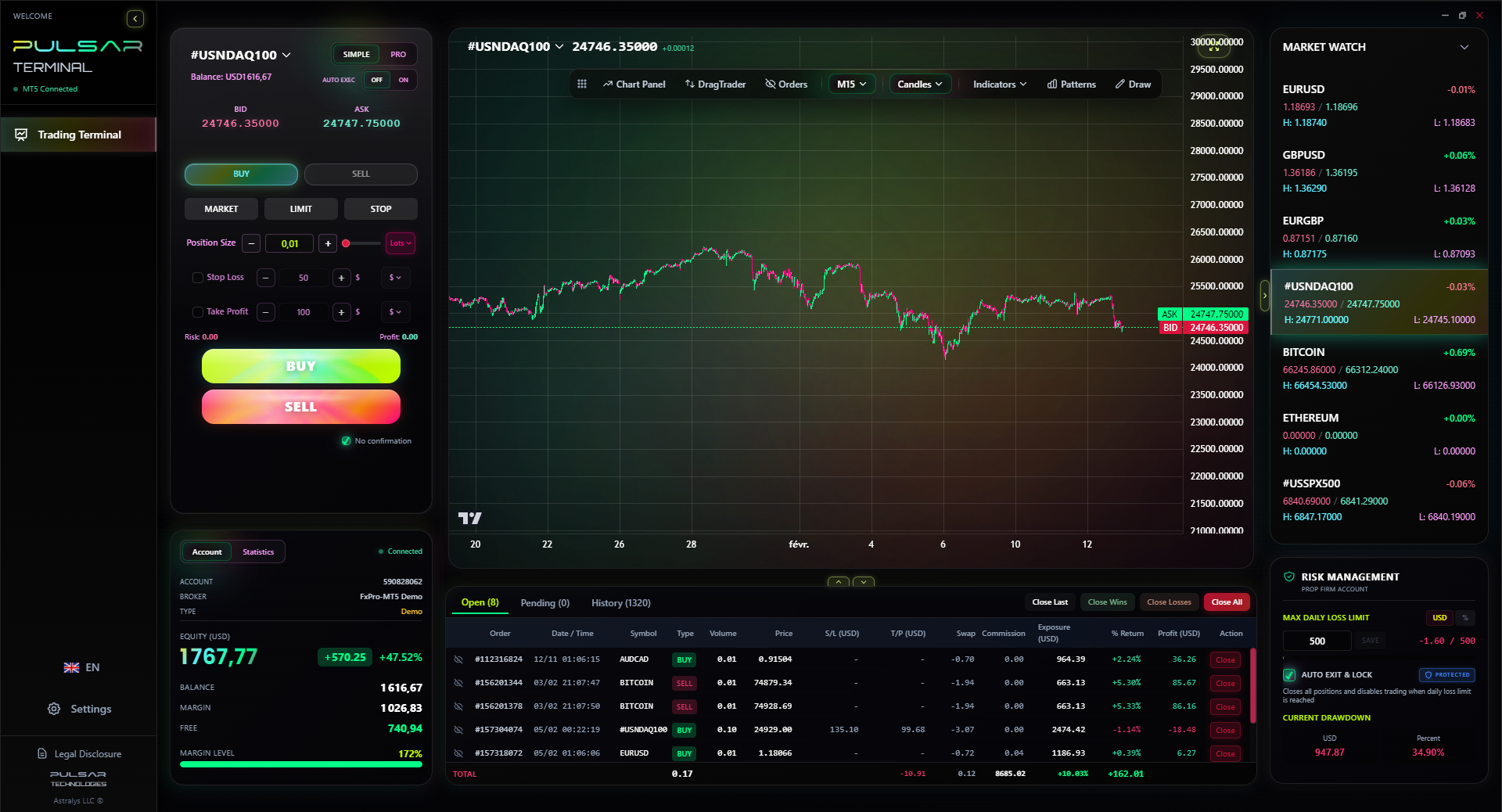
Managing a prop firm challenge requires iron-clad discipline on stops and targets, which is exactly what Pulsar Terminal's drag-and-drop order system and automated trailing stops are built for.
Pulsar Terminal
MT5一站式工具:拖拽下单、多重止盈/止损、追踪止损、网格交易、成交量分布图和自营交易保护。每日1000+交易者使用。
“Be a robot. Get funded. *Then* you can start building your real career with someone else's capital.”
This is the final boss. You're trading fake money with very real consequences. The pressure to avoid a margin call (or its prop firm equivalent) distorts everything.
I failed my second challenge because of this. I was up 8% on a $50k account, needing 10%. I had two weeks left. I took a larger position on a "sure thing" NFP trade, got whipsawed, and hit my daily loss in minutes. Game over. I broke my own rules because the finish line was in sight.
The only solution is systematic, mechanical trading. Write your plan down: entry criteria, exact position size, stop-loss placement in pips, take-profit level. Do not deviate. The challenge is a test of obedience, not brilliance. Your RSI indicator might be screaming overbought, but if your plan says no trade, you walk away. This is brutally hard. It's why 90% fail. They can't stand the boredom of winning slowly.
💡 Winston 小贴士
If a firm's name is plastered on every YouTube ad by 'gurus' showing Lamborghinis, be skeptical. The best firms are often quieter, with reputations built on trader forums, not influencer marketing.
Right now, in 2026, with regulation looming? Yes, but with caveats.
Treat it as a serious business expense. Allocate a budget for 2-3 challenge attempts. If you blow through that, you have a strategy problem, not a funding problem. Go back to demo.
View it as a paid apprenticeship. You're paying for structured, high-stakes practice with a potential payoff. The education you get about your own psychology under pressure is useful.
The clock is ticking. The easy, cheap challenges might not exist in two years. If you have a working strategy, now is the time to act.
, the prop firm competition is a filter. It filters out the impatient, the undisciplined, and the gamblers. Your job is to be the exception. Don't try to be a superstar trader in the eval. Be a robot. Get funded. Then you can start building your real career with someone else's capital. Just know the game you're really playing.
FAQ
Q1What's the single biggest mistake traders make in prop firm challenges?
Increasing position size after a loss to 'make it back quickly.' This violates every risk management principle and directly plays into the firm's statistical model for failure. A 0.5% risk per trade means 0.5% on trade 1 and trade 100, no matter your P&L.
Q2Are prop firms in the US legal?
Currently, most operate in a legal gray area by selling evaluation services, not managing client investments. This is changing fast. Increased SEC and CFTC scrutiny means regulations are coming, likely requiring registration as Commodity Trading Advisors (CTAs), which will bring stricter oversight.
Q3Can I use a scalping strategy in a prop firm challenge?
You must read the specific firm's rules. Many prohibit high-frequency scalping or holding trades under 2-5 minutes. Some restrict news trading. Violating these 'style' rules is an instant fail, even if you're profitable. Always assume your strategy is banned until you prove otherwise in their FAQ.
Q4How are payouts taxed in the United States?
Your profit share is considered ordinary income. The firm will likely issue a 1099-MISC or 1099-NEC. You are responsible for self-employment taxes (Social Security & Medicare) on this income. Talk to a tax professional; don't get surprised at year-end.
Q5What happens if I hit the profit target but violate a minor rule?
You fail. Full stop. There is no 'minor' rule. If you broke the daily loss, max drawdown, minimum day, or banned strategy rule, your challenge is void. They will not make exceptions. The rules are the contract.
Q6Should I start with a large or small account challenge?
Always start small. A $10k or $25k account challenge has a lower fee. The psychology and risk (in dollar terms) are easier to manage. Use it as a low-cost practice run. Passing a small account proves your process, then you can scale up to a $100k challenge with more confidence.
Q7Do prop firms manipulate spreads or slippage to make me fail?
Reputable firms have no need to. The failure rate from normal trading and rule violations is high enough. However, during major news events, liquidity vanishes everywhere. Expect wider spreads and slippage on any platform, which can trigger your stops. This is why many firms restrict news trading - it protects them and you.
Winston 教授的课程
要点总结:
- ✓Treat challenge fees as a business expense, not an investment.
- ✓Risk 0.5% max per trade during evals, no exceptions.
- ✓Static drawdown rules are far superior to trailing ones.
- ✓The regulatory landscape will be completely different by 2027.
这篇文章对您有用吗?
点击星星评分
每周交易洞察
免费每周分析与策略。无垃圾邮件。
关于作者
James Mitchell
高级交易分析师
常驻纽约,拥有超过9年的交易经验。专注于主要美元货币对、自营交易公司挑战和美国监管环境。
评论
风险提示
金融工具交易存在重大风险,可能不适合所有投资者。过往业绩不代表未来表现。本内容仅供教育目的,不构成投资建议。在交易前请务必自行研究。
您可能还喜欢

Cara Trading Forex Sukses: 7 Prinsip dari Trader Profesional
Cara trading forex sukses dengan 7 prinsip trader pro: manajemen modal, disiplin, journal trading, backtest. Data nyata, bukan janji profit palsu.
Jam Trading Forex Terbaik untuk Trader Indonesia: Panduan Lengkap dengan Tabel Waktu
Panduan jam trading forex untuk trader Indonesia. Tabel 4 sesi dunia, jam emas 20:00-00:00, sesi mana yang harus dihindari. Data akurat + tips dari trader berpengalaman.
Top 5 Sàn Forex Uy Tín Nhất 2026: Review Jujur dari Trader Indonesia
Top 5 sàn forex uy tín 2026 untuk trader Indonesia. Review jujur: spread, deposit, withdraw, dukungan lokal. Exness, XM, IC Markets & lebih.
