


Let's cut through the hype.

David van der Merwe
新兴市场交易员 ·  South Africa
☕ 11 分钟阅读
您将学到:
- 1Who is Shaun Benjamin, Really?
- 2The Rules of the Game: SA Forex Regulations
- 3The Real Costs of Trading in South Africa
- 4Picking Your Broker: A Local's Checklist
- 5Forget Copying: How to Build Your OWN Edge
- 6Pitfalls Every South African Trader Faces (And How to Dodge Them)
- 7Your Action Plan: Getting Started the Right Way
Let's cut through the hype. The story of Shaun Benjamin forex success is everywhere, promising a path from coal mines to millions. But here's the uncomfortable truth most gurus won't tell you: chasing a single person's blueprint is a surefire way to blow your account. I've been trading the ZAR for over a decade, and the real opportunity isn't in copying someone else's story - it's in understanding the unique, regulated, and often tricky South African market. This guide isn't about Shaun Benjamin. It's about giving you the facts, the numbers, and the hard-won lessons so you can build your own strategy that actually works here at home.
Alright, let's address the elephant in the room. Shaun Benjamin is a South African figure who's become synonymous with forex trading success here. His story - from financial struggles and working in coal blasting to reportedly becoming a millionaire by 21 through trading - is powerful. It's the kind of narrative that sells dreams.
He founded the Benjamin Forex Academy, which positions itself as a non-profit offering free training. The core message, from what I've seen, emphasizes discipline, patience, and technical analysis over get-rich-quick schemes. That part, I can get behind. The discipline part is 100% correct.
But here's my take, after watching this space for years. A personal success story, no matter how impressive, is not a universal trading system. What worked for one person in a specific market moment rarely translates directly to you, sitting at your desk in Johannesburg or Cape Town today. The real value isn't in the legend; it's in dissecting the principles he (and any good trader) advocates: risk management, continuous learning, and emotional control. Don't buy the story. Buy the methodology, and then adapt it fiercely to your own reality.

Warning: Be extremely wary of any educator or "academy" that focuses more on showing luxury lifestyles - cars, watches, cash - than on transparently teaching concrete risk management and journaling. That's marketing, not mentoring.
“The real value isn't in the legend of Shaun Benjamin; it's in dissecting the principles any good trader advocates: risk management, continuous learning, and emotional control.”
This is the boring but absolutely critical stuff. If you ignore this, you're playing with fire. In South Africa, the main referee is the Financial Sector Conduct Authority (FSCA). They're not there to spoil your fun; they're there to try and stop you from getting scammed.
The FSCA's Role
A broker regulated by the FSCA has to jump through serious hoops. They need a local office, professional insurance, and most importantly, they must keep your money in segregated accounts. That means your R10,000 deposit is held separately from the company's own cash. If the broker goes under (it happens), your funds should be safer. You can check a broker's FSCA license number on their website - always do this.
The SARB Allowance
Here's a uniquely South African twist. The South African Reserve Bank (SARB) controls how much money you can move offshore. As an individual, you get a single discretionary allowance of up to R1 million per year. Want to fund an international broker account? That typically falls under this allowance, and you'll need a Tax Compliance Status (TCS) pin from SARS. It's a bit of admin, but it's the legal way. Many local brokers are FSCA-licensed but hold your funds in ZAR, simplifying this.
The Big Risk
You can go sign up with an unregulated offshore broker offering crazy 1:1000 use. The FSCA begs you not to. I learned this the hard way early on. I sent $500 to a flashy broker based who-knows-where. When I tried to withdraw my profits? Endless delays, then radio silence. Poof. Gone. Stick with FSCA-regulated entities or reputable global brokers with solid oversight. It's the first rule of self-preservation.
I keep a list of vetted, regulated brokers I check annually. You can see my latest thoughts on some major players like Exness and XM, both of which have FSCA presence, to start your own research.

💡 Winston 小贴士
A demo account is for learning the platform. A live account, even with R500, is for learning yourself. The fear and greed you feel with real money is the only teacher that matters.
“A 100-pip profit target on EUR/USD is a completely different beast from 100 pips on USD/ZAR. Ignoring the spread is like ignoring the entry fee to a casino.”
Forget the "trade with R100" hype. Let's talk real numbers, because this is where profits go to die if you're not careful.
Spreads: This is your primary cost. On EUR/USD with a good broker, you might see 0.6 to 1.2 pips on a standard account. But watch out for the ZAR pairs! USD/ZAR spreads can be wild - I've regularly seen 40 to 100+ pips. That means the pair needs to move significantly just for you to break even. A pip definition is crucial to understand here.
Commissions: Some accounts have tight spreads but charge a commission per lot. It might be $5 per 100,000 units (a standard lot). You need to factor this into your profit targets.
The Hidden Killer: Swap Rates Holding a position overnight? You'll pay or earn a swap fee based on the interest rate difference between the two currencies. I once held a USD/ZAR sell position for two weeks during a quiet market, thinking I was being patient. The tiny move in my favor was completely wiped out by the negative swap charges. I actually lost money on a technically correct trade. Always check the swap rates in your platform before holding for multiple days.
A Real Example from My Journal:

Example: In 2023, I took a buy position on GBP/USD at 1.2200. My position size was 0.5 lots (50,000 units). My broker's spread was 1.4 pips on entry, so my immediate "cost" was 1.4 pips x 50,000 units = $7. I held for 3 nights. The daily swap fee was -$1.20. Total carry cost: $3.60. I exited at 1.2280 for an 80-pip gain. Gross profit: 80 pips x 50,000 = $400. Net profit: $400 - $7 - $3.60 = $389.40. The costs ate about 2.6% of my gross profit. If my gain had been only 20 pips, costs would have consumed over 50% of it.
This is why scalping strategy with high frequency can be so tough here - the costs stack up fast. A swing trading approach often makes more sense to absorb these fees.
“A 100-pip profit target on EUR/USD is a completely different beast from 100 pips on USD/ZAR. Ignoring the spread is like ignoring the entry fee to a casino.”
Your broker is your gateway. Choosing wrong adds friction and risk to every single trade. Don't just pick the one with the shiniest ads.
The Non-Negotiables:
- FSCA Regulation: Confirm the license number. No license, no deal. It's that simple.
- ZAR Accounts & Local Payments: Can you deposit and withdraw in Rands via EFT? Does the broker absorb any bank fees? This saves you a fortune in currency conversion costs. I use a broker that offers instant, fee-free FPS deposits from my local bank.
- Platform: MT4 or MT5 are the standards. They're reliable, and everyone knows how to use them. Some brokers like IC Markets or Pepperstone also offer cTrader, which is excellent for pure price action.
The Practicalities:
- Minimum Deposit: Yes, you can start with R500 on a micro account. But be realistic. With R500, a 2% risk per trade is R10. After spreads, you have almost no room for error. I advise a minimum of R5,000 to properly practice risk management. Use a position size calculator religiously.
- use: The FSCA caps use for major pairs at 1:30 for retail clients. This isn't a limitation; it's protection. I've seen 1:500 use wipe out an account in minutes. Trust me, 1:30 is plenty.
- Inactivity Fees: Read the fine print! Some brokers charge ~R1500 per month if your account sits idle. If you're taking a break, withdraw your funds.
My process? I have a small test account with a few brokers. I deposit a minimal amount, test their execution speed during news events (like SARB rate announcements), and crucially, I do a withdrawal test. If withdrawing is a hassle, I'm out.
💡 Winston 小贴士
Your first R10,000 in the market is tuition, not investment. Expect to pay it. The goal is to learn as much as you can before it's gone.
“Your edge won't be a secret indicator. It will be your unique combination of patience, discipline, and consistency.”
This is the heart of it. You can't be Shaun Benjamin. But you can be a profitable version of you. Here’s how to start crafting a strategy that fits your life and the SA market.
Start with the Instruments
Know your playground. For us, it's not just EUR/USD.
- USD/ZAR (Dollar/Rand): The most liquid local pair. It's volatile, news-driven (loadshedding, politics, commodity prices), and has wide spreads. Trade it with wider stop-losses.
- EUR/USD & GBP/USD: Cleaner charts, tighter spreads. Great for learning pure technical analysis. I have a dedicated EUR/USD guide that breaks down its rhythms.
- XAU/USD (Gold): A favorite hedge against uncertainty. South Africans often flock to gold. Understanding it is key. Check my thoughts on trading it in this XAU/USD guide.
Master One Setup
Don't try to learn 10 strategies. I spent two years just mastering pullbacks into key support/resistance on the 4-hour chart. I used the RSI indicator for confluence and the MACD indicator to gauge momentum. That's it. I knew that setup inside out - its win rate, its average loss, its optimal risk-reward. Find one thing that makes sense to you and grind it.
Journal Like Your Life Depends on It
Every trade. Entry, exit, reason, emotion. I review mine every Sunday. My biggest lesson came from a losing streak in 2021. My journal showed I was forcing trades outside my proven setup because I was "bored." The data doesn't lie. Your journal is your most valuable tool, far more than any signal service.

Pro Tip: Your edge won't be a secret indicator. It will be your unique combination of patience (waiting for your setup), discipline (sticking to your 1% risk rule), and consistency (executing your plan, win or lose). That's what the successful traders, local or global, all share.
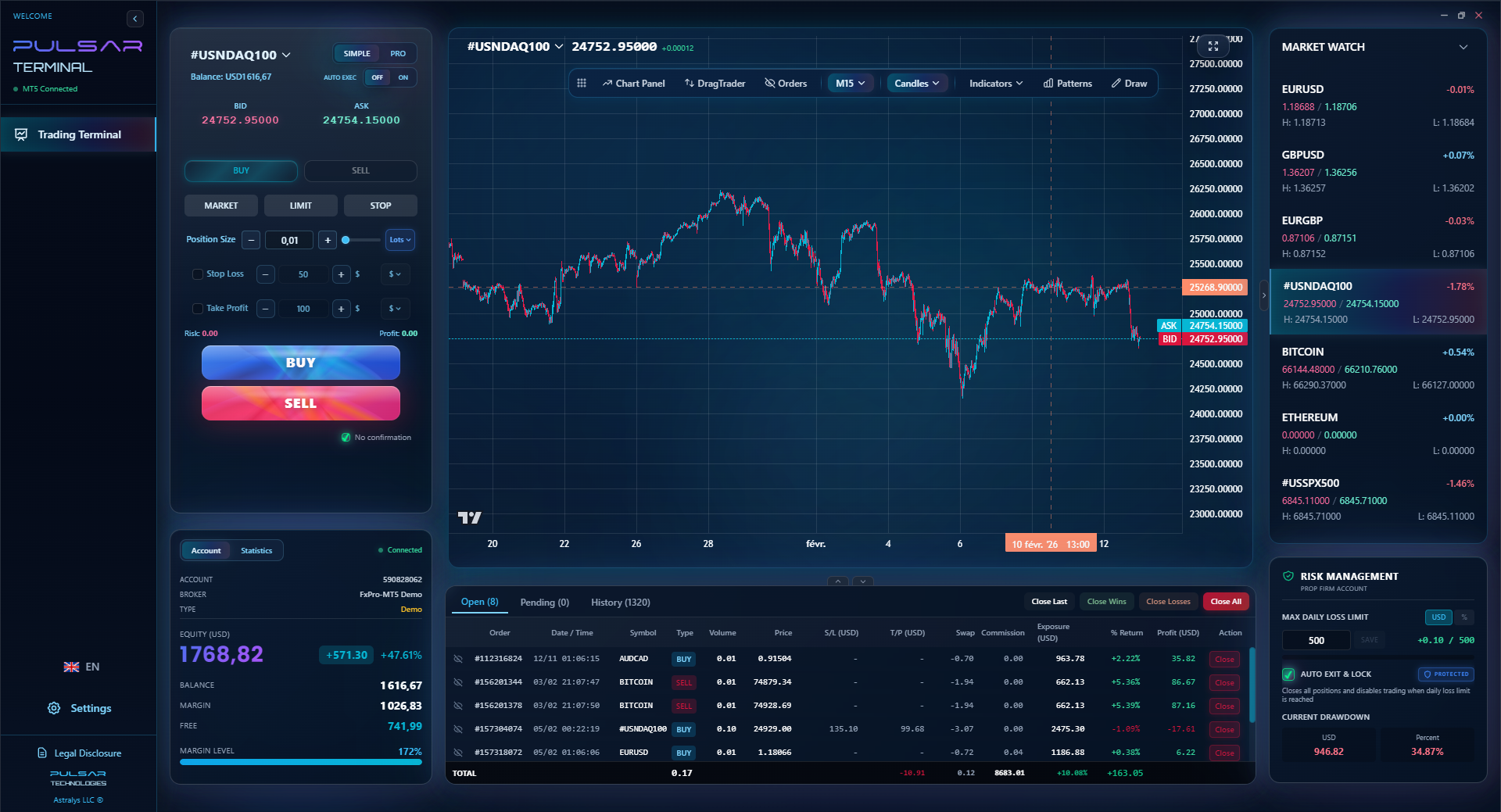
When you're refining your one core setup, having a toolkit that lets you quickly visualize orders and manage risk directly on your MT5 chart is a game-saver.
Pulsar Terminal
MT5一站式工具:拖拽下单、多重止盈/止损、追踪止损、网格交易、成交量分布图和自营交易保护。每日1000+交易者使用。
“Your edge won't be a secret indicator. It will be your unique combination of patience, discipline, and consistency.”
We face some unique challenges. Let's name them so you can beat them.
1. The "Quick Fix" Mentality: The promise of instant wealth is strong in a tough economy. Forex is not a quick fix. It's a skill. Treat it like learning to be an electrician or a coder. It takes time and deliberate practice.
2. Trading on SA News Without a Filter: SARB announcements, budget speeches, political drama - they move the Rand. But retail traders are the last to get the news. By the time you react, the move is often over. I got caught in a massive ZAR spike during a surprise cabinet reshuffle announcement. My stop-loss was hit before I could even blink. Now, I either avoid news events or widen my stops significantly around them.
3. Underestimating Costs on ZAR Pairs: As we covered, that 50-pip spread on USD/ZAR is a monster. Your profit target must be proportionally larger. A 100-pip profit target on EUR/USD is very different from 100 pips on USD/ZAR.
4. Ignoring the Tax Man (SARS): Profits from trading are generally considered income and are taxable. Keep clear records of all your trades, deposits, and withdrawals. Speak to a tax professional who understands trading. It's not worth the headache later.
5. Overleveraging to Compensate for Small Capital: This is the fastest route to a margin call. With R2,000 and 1:30 use, you control R60,000. A 3.3% move against you wipes you out. That can happen in an hour. Use use as a tool, not a crutch.
💡 Winston 小贴士
The most important line on your chart isn't a trendline. It's the horizontal line marking your predetermined stop-loss. Everything else is just conversation until that line is respected.
“The path isn't glamorous. It's repetitive, often boring, and requires brutal honesty with yourself.”
Let's wrap this up with a concrete, step-by-step plan. No fluff.
Phase 1: Education & Simulation (Weeks 1-8)
- Open a demo account with an FSCA-regulated broker. Use real-world conditions (start with R50,000 virtual capital).
- Learn your platform. Place orders, set stops, attach limits.
- Pick one currency pair (start with EUR/USD).
- Learn one simple strategy (like support/resistance bounce).
- Trade the demo with strict rules: 1% risk per trade, always use a stop-loss. Journal every trade.
Phase 2: Small Live Account (Months 3-6)
- Fund a live micro/cent account with money you can afford to lose. My suggestion: R2,000 - R5,000.
- Trade your one strategy with real money. The psychology is completely different. This phase is about controlling your emotions, not making profit.
- Focus on consistency, not profitability. Can you execute your plan 10 times in a row without deviating?
Phase 3: Scaling & Refinement (Month 6+)
- Once you have 3-6 months of consistent, disciplined trading in your journal, consider adding more capital.
- Gradually explore one additional instrument (maybe USD/ZAR or Gold).
- Continuously review and refine. The market changes. You must adapt.
The path isn't glamorous. It's repetitive, often boring, and requires brutal honesty with yourself. But it's the only path that leads to sustainable trading. Forget the shaun benjamin forex fairy tale. Focus on writing your own, one disciplined trade at a time.
FAQ
Q1Is Shaun Benjamin Forex Academy really free?
The Benjamin Forex Academy claims to be a non-profit offering free training. However, as with any educational service, it's crucial to do your own due diligence. Look for transparent information on curriculum, instructors, and what the "free" offering includes versus any potential upsells. Remember, the most valuable trading education often comes from self-study, disciplined practice on a demo account, and learning from your own carefully kept trade journal.
Q2What is the minimum amount I need to start forex trading in South Africa?
Technically, you can start with as little as R70-R150 using a micro account. But honestly, that's almost pointless for learning real risk management. A more practical and educational starting point is between R1,500 and R5,000. This allows you to meaningfully apply a 1-2% risk rule per trade and experience the market without being wiped out by a single small loss or the costs (spreads) themselves. Always use a position size calculator.
Q3Can I use international brokers like Exness or XM in South Africa?
Yes, many international brokers like Exness and XM are licensed by the FSCA to operate in South Africa. This is ideal because you get the security of local regulation combined with their global platforms. When using them, you can often fund your account in ZAR via local EFT. Always verify their current FSCA license status on the broker's website and the FSCA's official register before depositing any money.
Q4How do I avoid scams in the South African forex market?
Stick to FSCA-regulated brokers as your first and most important filter. Avoid any "investment managers" promising guaranteed weekly returns or asking you to send money to a personal account. Be skeptical of social media signal sellers with no verifiable track record. If an opportunity sounds too good to be true (e.g., "double your money in a month"), it almost certainly is. Your best defense is your own knowledge and skepticism.
Q5Are forex trading profits taxable in South Africa?
Yes. The South African Revenue Service (SARS) generally views consistent forex trading profits as income, which is taxable under normal income tax rules. It's not considered capital gains unless under very specific, infrequent trading circumstances. It is essential to keep detailed records of all your trades, deposits, withdrawals, and statements. Consult with a tax professional who understands financial trading to ensure you comply correctly.
Q6Why are the spreads on USD/ZAR so high?
Spreads on USD/ZAR (Dollar/Rand) are typically much higher than on major pairs like EUR/USD due to lower relative liquidity and higher volatility. The Rand is an emerging market currency, and the market for it is smaller and more sensitive to local and global news. Brokers widen the spread to compensate for this increased risk of sudden, large price gaps. As a trader, you must account for this by setting wider stop-losses and having larger profit targets to make the trade worthwhile.
Winston 教授的课程
要点总结:
- ✓FSCA regulation is non-negotiable for broker safety.
- ✓Treat your first R10k as tuition, not investment capital.
- ✓USD/ZAR spreads require wider stops and targets.
- ✓Journal every trade to find your personal flaws.
- ✓use is a tool, not a strategy. 1:30 is enough.
这篇文章对您有用吗?
点击星星评分
每周交易洞察
免费每周分析与策略。无垃圾邮件。
关于作者
David van der Merwe
新兴市场交易员
约翰内斯堡交易者,11年新兴市场货币经验。专注于ZAR货币对、FSCA监管交易和南非市场分析。
评论
风险提示
金融工具交易存在重大风险,可能不适合所有投资者。过往业绩不代表未来表现。本内容仅供教育目的,不构成投资建议。在交易前请务必自行研究。
您可能还喜欢

Cara Trading Forex Sukses: 7 Prinsip dari Trader Profesional
Cara trading forex sukses dengan 7 prinsip trader pro: manajemen modal, disiplin, journal trading, backtest. Data nyata, bukan janji profit palsu.
Jam Trading Forex Terbaik untuk Trader Indonesia: Panduan Lengkap dengan Tabel Waktu
Panduan jam trading forex untuk trader Indonesia. Tabel 4 sesi dunia, jam emas 20:00-00:00, sesi mana yang harus dihindari. Data akurat + tips dari trader berpengalaman.
Top 5 Sàn Forex Uy Tín Nhất 2026: Review Jujur dari Trader Indonesia
Top 5 sàn forex uy tín 2026 untuk trader Indonesia. Review jujur: spread, deposit, withdraw, dukungan lokal. Exness, XM, IC Markets & lebih.
