


Let's be brutally honest: most traders in Nigeria are drawing their trendlines like a toddler with a crayon.

Olumide Adeyemi
西非交易先驱 ·  Nigeria
☕ 11 分钟阅读
您将学到:
- 1What a Trendline Actually Is (And Isn't)
- 2How to Draw Trendlines for the Nigerian Market (Forget London Sessions)
- 3Trading the Breakout vs. Trading the Bounce
- 4The 3 Most Common (and Costly) Trendline Mistakes in Nigeria
- 5Managing Risk on a Trendline Forex Trade (Naira Edition)
- 6Pairing Trendlines with Other Tools (The Confluence Engine)
- 7Applying Trendlines to Gold (XAU/USD) and Oil
- 8Your 2-Week Trendline Practice Plan
Let's be brutally honest: most traders in Nigeria are drawing their trendlines like a toddler with a crayon. They slap a line on a chart, call it support or resistance, and then wonder why they get stopped out every single time. I see it constantly in the trading groups. The problem isn't the tool; it's the complete lack of understanding about what makes a trendline valid in the first place. In this guide, I'm going to show you the exact, no-nonsense method I use to identify high-probability trendline forex setups, why your current approach is probably costing you money, and how to apply this with the brokers and spreads you actually have access to in Nigeria.
Forget the textbook definition for a second. In practical terms, a trendline is a visual representation of market sentiment's speed limit. It shows you where buying or selling pressure has historically accelerated or decelerated. It's not a magic barrier. Price doesn't 'bounce' off it like a tennis ball off a wall. It's more like a zone where the market has collectively decided, "Okay, that's far enough for now."
Most new traders make two fatal errors. First, they connect random wicks, creating a line that has no statistical significance. Second, they treat the line as an absolute, placing their stop-loss right on the other side. That's a surefire way to get picked off by market makers. A valid trendline needs at least three touches. Two points define a line, but the third touch confirms that other market participants are actually respecting that level. If your line only has two touches, you're not trading a trendline; you're guessing.

Warning: Drawing a line from one major swing low to the next minor low is useless. The touches must be significant swing points where price clearly reversed. If you have to force the line to fit, it doesn't fit.
I learned this the hard way early on. I was trading GBP/JPY and drew a beautiful ascending trendline from two obvious lows. Price approached it for a third time, I bought, and placed my stop just below the line. The candle dipped, took out my stop by 3 pips, and then rocketed up 80 pips without me. I was furious, but it was my fault. I placed my stop in the obvious place where everyone else would have theirs. Now, I give it room - a buffer below (or above) the actual line.

💡 Winston 小贴士
A trendline is a hypothesis, not a fact. The market votes on its validity with every touch. If it breaks decisively, your hypothesis was wrong. Admit it, adjust, and move on. Arguing with the price action is a luxury you can't afford.
Nigerian traders aren't trading at 2 PM London time. We're often active in the late morning or evening our time, which overlaps with the European close or the US session. This matters because liquidity and volatility shift. A trendline drawn on the 1-hour chart during the Asian session might look solid, but it can vaporize when London or New York volume hits.
The Right Timeframe for the Right Job
Don't make the amateur mistake of drawing your primary trendline on a 5-minute chart. For swing trading ideas, start on the Daily or 4-Hour chart. Find your two major swing points. Zoom in to the 1-Hour chart to fine-tune the exact candle close or wick you're connecting to. This top-down analysis prevents you from getting lost in the noise.
Accounting for Naira Pairs and Spreads
When you're trading exotic pairs like USD/NGN (if available through a CFD) or even GBP/NGN, spreads are wider. A 50-pip spread on USD/NGN means your trendline breakout needs to be much more substantial to be profitable. A 10-pip break above the line means nothing; you're already in the red from the spread. For these pairs, I only consider trendline breaks on the Daily or Weekly chart where the potential move is 200+ pips. For major pairs like EUR/USD where spreads are tight (think 0.6 pips on XM or even 0.0 on Exness Raw Spread accounts), you can profitably trade breaks on the 1-Hour and 4-Hour charts.

Example: Let's say you're using a broker with a 3-pip spread on EUR/USD. You buy a breakout above a trendline at 1.0850. Your real break-even point is 1.0853. Your trendline breakout signal needs enough momentum to clear that cost hurdle immediately, or you're setting up a losing trade from the start.
“A valid trendline needs at least three touches. Two points define a line, but the third touch confirms the market is actually respecting it.”
This is the core decision. Do you buy/sell when price touches the trendline (the bounce), or do you wait for it to break (the breakout)? Most people choose one and stick to it dogmatically. That's a mistake.
Trading the Bounce (The 'Kiss'): This is a counter-trend entry within the larger trend. You're betting that the trendline will hold again. Risk is lower (your stop is just outside the line), but the failure rate is higher because you're trying to catch a falling knife or buy at a peak. You need strong confirming evidence - like a bullish pin bar or a divergence on the RSI indicator right at the trendline. I use this mostly on higher timeframes (4H/Daily) where the trend has proven resilient.
Trading the Breakout: This is a trend-following entry. You're betting the existing trend is accelerating or reversing. The potential reward is bigger, but so is the risk because of false breakouts (aka 'fakeouts'). Price will often break, suck in all the breakout traders, and then reverse violently. To filter these out, I use a close-based rule. I don't consider a trendline broken unless I see a full candle close on my chosen timeframe on the other side of the line. Even then, I might wait for a 'retest' of the broken trendline (which now acts as support/resistance) before entering.
Here's a real trade from last quarter. EUR/USD was in a clear downtrend on the 4H chart. It approached the descending trendline for what looked like a fourth touch. Instead of selling at the line, I waited. It broke above slightly, rallied about 15 pips (the fakeout), then slammed back down and closed below the trendline. That was my signal. I entered short on the next candle's open at 1.0722. I placed my stop above the recent swing high, and rode it down to 1.0650 for a 72-pip gain. The key was patience for the close.
After mentoring dozens of traders here, I see the same errors on repeat. Let's kill these habits now.
- Ignoring the Spread & Slippage: You see a perfect bounce on your chart and enter a market order. With the internet delays we sometimes face, combined with a 2-3 pip spread, your entry price is already several pips past the ideal trendline touch. Your risk/reward ratio is destroyed before the trade even starts. Use limit orders to enter at the trendline, not after it.
- Using Trendlines in a Ranging Market: This is the cardinal sin. Trendlines only work in trending markets. If EUR/USD is chopping between 1.0800 and 1.0900 with no clear direction, drawing a diagonal line through that mess is pointless. You need to identify the range first using horizontal support and resistance. Forcing a trendline onto a ranging chart will give you nothing but false signals. Learn the difference between swing trading trends and ranging markets.
- No Confluence, No Trade. A lone trendline is a weak signal. It needs backup. Is it aligning with a key Fibonacci level (like 61.8% retracement)? Is there a major moving average (like the 200 EMA) sitting right at the same point? Does the MACD indicator show slowing momentum as price approaches the line? The more factors that agree with your trendline, the stronger your edge. A trendline all by itself is just a pretty line on a screen.
💡 Winston 小贴士
Your first drawn trendline is usually wrong. Zoom out. Look for the obvious, major swing points that even a novice could spot. The most profitable lines are often the simplest ones.
“A lone trendline is a weak signal. It needs backup from other tools like horizontal levels or moving averages.”
This is where your account lives or dies. A perfect trendline setup means nothing if your position size is suicidal.
Stop-Loss Placement: Never, ever place your stop-loss right on the other side of the trendline. That's the most obvious place in the market. Place it beyond a recent swing point or give it a 10-15 pip buffer beyond the line. Yes, this means your risk per trade is larger, so you must reduce your position size accordingly. This is non-negotiable.
Position Sizing with Naira Accounts: Let's get real. If you're funding your Exness or IC Markets account with 50,000 NGN (about $33), you cannot afford to risk 5% (2,500 NGN) on a single trendline trade that needs a 20-pip stop. The math doesn't work. You'll get a margin call from a single bad trade. Use a position size calculator religiously. Input your account balance in USD, your risk percentage (I recommend 1% max for small accounts), your stop-loss in pips, and the pair you're trading. It will tell you the exact lot size. For a $33 account risking 1% ($0.33) on a EUR/USD trade with a 15-pip stop, your position size is micro lots (0.01) or less.

Pro Tip: Before you enter any trendline trade, know your exit. Where is your profit target? A good rule is to aim for a risk-reward ratio of at least 1:2. If your stop is 15 pips away, your take-profit should be 30 pips away. This means you can be wrong half the time and still break even.
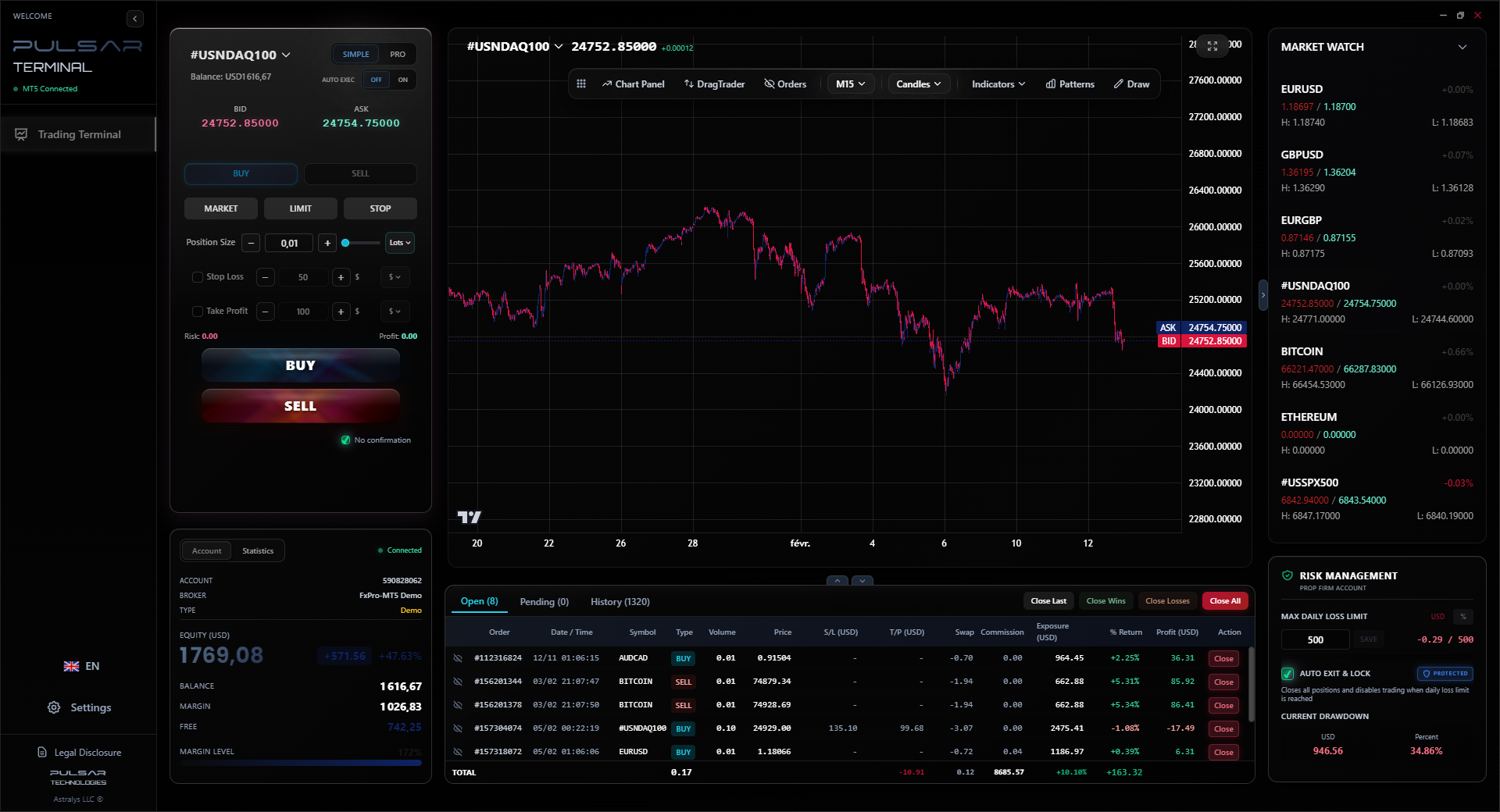
Manually moving stop-losses to breakeven and managing multiple take-profit levels across several trendline trades is a hassle; Pulsar Terminal automates these risk management tasks directly within your MT5 platform.
Pulsar Terminal
MT5一站式工具:拖拽下单、多重止盈/止损、追踪止损、网格交易、成交量分布图和自营交易保护。每日1000+交易者使用。
A trendline becomes powerful when it forms a cluster with other technical elements. Think of it as a committee vote. The more tools that vote 'yes,' the higher the probability of the trade working.
Trendlines & Horizontal Levels: This is the most potent combination. When a rising trendline meets a previous horizontal resistance level, you have a confluence zone. This is where a trend often ends or pauses significantly. The same goes for a descending trendline meeting horizontal support. These zones are high-probability areas for reversals or major breakouts.
Trendlines & Moving Averages: A common setup is a pullback in an uptrend where price dips to touch both the 50-period or 100-period EMA and the ascending trendline. This double layer of dynamic support makes for a much stronger bounce play than just the trendline alone.
Trendlines & Momentum Indicators: Look for divergence. If price is making a higher low along your ascending trendline, but the RSI is making a lower low, that's hidden bullish divergence. It suggests the selling pressure is weakening even as price dips to the trendline, signaling a potential strong bounce. I use this all the time to filter which trendline touch is worth trading.
“Never, ever place your stop-loss right on the other side of the trendline. That's the most obvious place in the market.”
Commodities like Gold and Crude Oil are trendline paradise. They trend hard and fast, often respecting channels beautifully. But they're also more volatile than major forex pairs.
Gold (XAU/USD): Gold loves clean, long-term trendlines. A trendline on the daily chart for gold can hold for months. However, because gold moves in $10-$50 increments quickly, your stop-loss buffer needs to be larger. A 5-pip buffer you use on EUR/USD will get obliterated on gold. Think in terms of dollars, not pips. A $10 buffer is common. For a deep dive on this, check our dedicated XAU/USD guide.
Crude Oil: Oil is news-driven and can gap. A trendline on oil is useful, but you must be aware of inventory report times (EIA Wednesday). A perfect trendline can be shattered by a headline in seconds. I use trendlines on oil more for the broader structure on the 4H or Daily chart, and I avoid holding positions over major news events if my trade is based on a trendline near the current price.
💡 Winston 小贴士
If you find yourself constantly redrawing a trendline to make it fit the latest price action, you're not analyzing; you're story-telling. The chart is right. You are wrong. Full stop.
Knowledge is useless without action. Here's what to do next.
Week 1: The Detective. Don't place a single trade. Go to your MT4/MT5 platform on a demo account. Pick three instruments: EUR/USD, GBP/USD, and Gold. Open the Daily chart for the last year. Your only job is to find the most obvious, multi-touch ascending and descending trendlines. Draw them. Then, zoom into the 4H chart and see how price reacted at those lines. Did it bounce? Break? Fake out? Write down 10 observations.
Week 2: The Paper Trader. Now, on the 1H chart, look for developing trendlines with at least two touches. Plan a hypothetical trade for the third touch. Write down: 1) Your entry price (at the line), 2) Your stop-loss (with buffer), 3) Your take-profit (for a 1:2 R:R), and 4) One piece of confluence you require (e.g., RSI > 30 for a bullish bounce). Follow these hypothetical trades for a week. See how many would have hit your stop vs. your target. This exercise costs nothing and will teach you more than any YouTube video.
Stick to this plan. By the end, you'll stop seeing random lines and start seeing the market's actual structure. That's when trendline forex trading starts to make real sense.
FAQ
Q1How many touches are needed for a valid trendline?
You need a minimum of three touches. Two points draw the line, but the third touch confirms the market is actually respecting that level. A line with only two touches is just a guess, not a tested level.
Q2Should I connect the wicks or the bodies of the candles?
There's no absolute rule, but be consistent. For intraday trends, connecting the extreme wicks (highs for resistance, lows for support) often works best as it shows where price was rejected. On longer timeframes, some traders prefer connecting closing prices. The key is that the touches must be clear, significant swing points, not minor fluctuations.
Q3Why do my trendlines keep failing on the 15-minute chart?
Because the 15-minute chart is mostly noise, especially for a beginner. Lower timeframes have more random volatility and false signals. Start your trendline analysis on the 1-Hour or 4-Hour chart to identify the real trend, then use lower timeframes for entry precision. A trendline on a 15-minute chart rarely has the significance to hold against larger market forces.
Q4What's the best way to trade a false breakout?
Don't try to predict it. Trade the confirmation. Wait for the price to break the trendline, then reverse and close back on the original side. This creates a 'fakeout' or 'spring' pattern. Your entry is on the close back inside the trend, with a stop-loss beyond the false breakout's extreme. It's a high-probability but lower-frequency setup.
Q5How do I calculate position size for a trendline trade?
You must use a position size calculator. First, decide what percentage of your account you'll risk (e.g., 1%). Then, measure the distance in pips from your entry to your stop-loss. The calculator will tell you the exact lot size. Never guess. For Nigerian traders with smaller accounts, this is critical to avoid blowing up your account on one trade. We have a free position size calculator you can use.
Q6Are trendlines effective on exotic pairs like USD/NGN?
They can be, but you have to be much more cautious. Exotic pairs have wider spreads and can be manipulated by local banks or central bank actions (like CBN interventions). Only use trendlines on the Daily or Weekly charts for exotics, where the potential move is hundreds of pips, justifying the large spread cost. For most retail traders, it's safer to stick to major pairs with tight spreads.
Winston 教授的课程
要点总结:
- ✓Three touches minimum for validity
- ✓Always account for spread & slippage on entry
- ✓Use higher timeframes (1H+) for analysis
- ✓Place stops beyond obvious levels
- ✓Seek confluence with other indicators
这篇文章对您有用吗?
点击星星评分
每周交易洞察
免费每周分析与策略。无垃圾邮件。
关于作者
Olumide Adeyemi
西非交易先驱
尼日利亚最活跃的外汇交易教育者之一。从拉各斯出发有8年交易经验。专注于低资金策略和面向非洲交易者的自营公司挑战。
评论
风险提示
金融工具交易存在重大风险,可能不适合所有投资者。过往业绩不代表未来表现。本内容仅供教育目的,不构成投资建议。在交易前请务必自行研究。
您可能还喜欢

Cara Trading Forex Sukses: 7 Prinsip dari Trader Profesional
Cara trading forex sukses dengan 7 prinsip trader pro: manajemen modal, disiplin, journal trading, backtest. Data nyata, bukan janji profit palsu.
Jam Trading Forex Terbaik untuk Trader Indonesia: Panduan Lengkap dengan Tabel Waktu
Panduan jam trading forex untuk trader Indonesia. Tabel 4 sesi dunia, jam emas 20:00-00:00, sesi mana yang harus dihindari. Data akurat + tips dari trader berpengalaman.
Top 5 Sàn Forex Uy Tín Nhất 2026: Review Jujur dari Trader Indonesia
Top 5 sàn forex uy tín 2026 untuk trader Indonesia. Review jujur: spread, deposit, withdraw, dukungan lokal. Exness, XM, IC Markets & lebih.
