


Let's be blunt: the 'Urban Forex' style of trading, as it's popularly understood in Nigeria, is a fast track to blowing up your account.

Olumide Adeyemi
西非交易先驱 ·  Nigeria
☕ 10 分钟阅读
您将学到:
- 1What 'Urban Forex' Really Means in Nigeria (It's Not What You Think)
- 2The Three Nigerian Urban Forex Killers: Why Accounts Go to Zero
- 3My $2,800 Mistake: A Case Study in Hubris
- 4How to Actually Make Urban Forex Concepts Work for You
- 5Essential Tools Beyond the Bare Chart
- 6Setting Realistic Profit Targets: The Naira Math
- 7Your Action Plan for the Next 90 Days
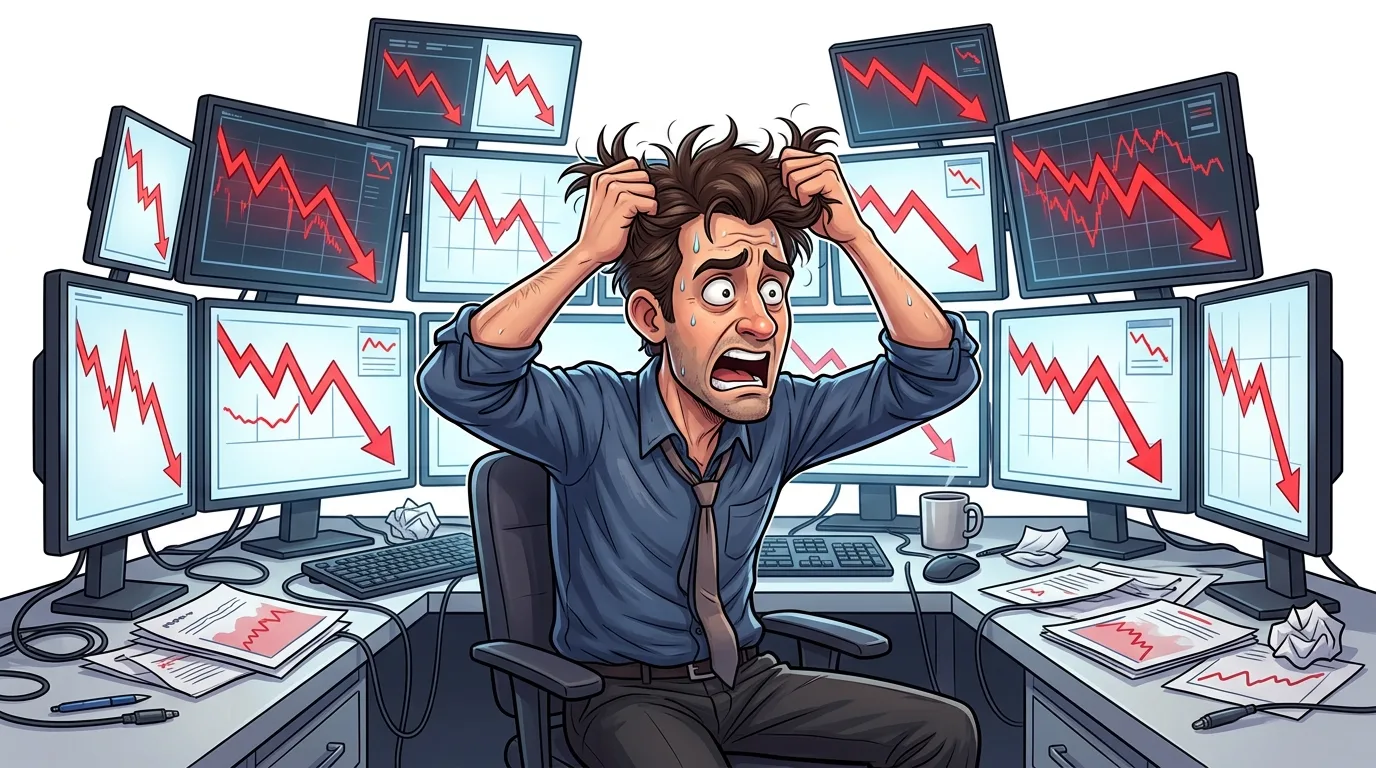
Let's be blunt: the 'Urban Forex' style of trading, as it's popularly understood in Nigeria, is a fast track to blowing up your account. I've seen it happen a thousand times. It's not that the core ideas are wrong, it's that the way they're applied by retail traders here - with Naira psychology, insane use, and zero risk management - is a recipe for disaster. I'm going to show you exactly why, using my own painful losses as examples, and then map out what you should actually be doing instead.
When you hear 'Urban Forex' in Lagos or Port Harcourt, you're not just hearing about a YouTube channel. You're hearing about a whole culture. It represents a specific, aggressive approach to the markets that has taken root here. It's characterized by a focus on pure price action (no fancy indicators), trading the London and New York sessions, and aiming for quick, high-probability setups. The problem? The original, disciplined method gets lost in translation.
In Nigeria, 'Urban Forex' has become shorthand for 'get rich quick with use.' The discipline of waiting for perfect setups is replaced by the frenzy of wanting to catch every move. I've been in Telegram groups where the chat is just a stream of 'BUY GBPUSD NOW!' with no rationale. That's not trading. That's gambling with a forex paint job.

Warning: The biggest misconception is that price action means 'no rules.' It actually means stricter, self-imposed rules because you have no indicator to blame when you're wrong.
The appeal is understandable. It feels pure. It feels like you're reading the market's mind. When I first discovered this style back in 2015, I felt like I had found the secret key. I stopped using my RSI indicator and MACD indicator and just stared at clean charts. My confidence soared. And that's when I made my first major mistake.
“The Urban Forex setup was correct; the trader (me) was the failure.”
1. Naira Psychology Meets Dollar Denomination
This is the silent killer nobody talks about. You fund your account with Naira, but your profit and loss are in USD. When you see a $50 loss on screen, your brain might convert it to ₦80,000 (at ₦1,600/$). That feels huge, and it triggers panic. Conversely, a $100 profit feels like ₦160,000, which creates overconfidence. This constant mental currency conversion destroys rational decision-making. You either cut winners short to 'secure the Naira' or let losers run because 'it's just dollars.' I've done both.
2. use Abuse with Local Brokers
Brokers like Exness, XM, and IC Markets offer high use, sometimes 1:2000, to attract Nigerian clients. In the Urban Forex mindset, where you're taught to trade with tight stops, use seems like a tool to amplify small wins. Here's the reality: it's a tool to amplify small losses into account-ending ones.
Let me give you a real example from 2019. I saw a 'perfect' pin bar rejection on EUR/USD. My analysis said short. With a $1,000 account, I used 1:500 use to open a 0.5 lot position. My stop loss was just 15 pips away, risking $75. Sounds controlled, right? The trade went against me by 14 pips, then spiked 30 pips in 10 seconds on a news headline I ignored. My $75 loss became a $250 loss in a blink. I got a margin call. That single 'high-probability' Urban Forex setup wiped out 25% of my account because I used use as a crutch for poor position sizing.
3. The Illusion of 'Simple' Price Action
Price action is simple to learn but brutally hard to master. It requires interpreting context: is this a pin bar in a strong trend, or just noise in a range? New traders see a textbook pattern and jump in, ignoring the larger market structure. They forget that the 'institutional order flow' the style often references is often playing a completely different game on a different time frame.

Example: You see a bullish engulfing candle on the 15-minute chart for Gold (XAU/USD). Looks great. But on the 4-hour chart, price is slamming into a massive resistance level that hasn't been broken in months. The 'setup' fails because you ignored context. Understanding this is key for any XAU/USD guide.

💡 Winston 小贴士
The market's only job is to prove you wrong. Your only job is to have a plan for when it does. A stop loss isn't a failure; it's the cost of admission.
“In Nigeria, 'Urban Forex' has become shorthand for 'get rich quick with use.'”
I need to show you my scars so you believe me. In early 2021, I was on a hot streak. I'd made 12 winning trades in a row using pure Urban Forex concepts on EUR/USD. My account was up to about $5,200. I felt invincible. I started calling myself a 'price action sniper.'
The 13th trade was a classic 'false break' setup. Price broke below a key support level on the 1-hour chart, then quickly reclaimed it. The Urban Forex playbook says to go long on the reclaim, expecting the break to fail. I entered long at 1.1820. My stop was at 1.1795 (25 pips). My target was 1.1880.
Price hovered around my entry for hours. Instead of seeing this as a warning (no momentum), I doubled down. I added another position at 1.1825, averaging my entry. I moved my stop to 1.1805, telling myself I was 'managing the trade.' I broke my number one rule: never add to a losing position.
The US session opened, and the dollar ripped higher. It wasn't a slow drift. It was a waterfall. My stop was hit at 1.1805. Total loss: $2,800 on a single idea. I had risked over 50% of my account on what I thought was a 'sure thing.' I was following the pattern but ignored market conditions (rising US yields that day). I broke every risk management rule because the methodology made me feel too confident. That loss took me 4 months of disciplined swing trading to recover. The Urban Forex setup was correct; the trader (me) was the failure.
“In Nigeria, 'Urban Forex' has become shorthand for 'get rich quick with use.'”
The core ideas are sound. You just need to build a bunker around them for survival. Here's the adaptation blueprint:
1. Redefine Your Time Frame: Forget 15-minute charts for your primary analysis. Start with the Daily chart to identify the trend. Then go to the 4-Hour to find key support/resistance. Only use the 1-Hour or 30-minute for your precise entry. This top-down approach provides the context that prevents you from buying into a monthly resistance level.
2. Implement Military-Grade Position Sizing: This is non-negotiable. Your maximum risk on any single trade must be 1% of your account balance. Not 2%, not 5%. 1%. Use a position size calculator for every single trade. If your stop is 30 pips away on EUR/USD, and you have a $1,000 account, your maximum loss is $10. Your position size should be a micro lot (0.03 lots) or less. This feels painfully small. That's the point. It keeps you in the game.
3. Treat use as a Regulatory Limit, Not a Tool: If your broker offers 1:500, set your platform's maximum use to 1:50. This forces you to trade with more capital per lot, which naturally reduces your lot size and risk. use should exist for flexibility, not for maximizing bets.
4. Factor in the Naira: Do your analysis in USD. Set your stops and targets in USD. Only convert to Naira when you withdraw profits. Mentally decouple your trading from the local currency to avoid emotional decisions.

Pro Tip: Before you enter any trade, write down the answer to this question: 'What price action would prove my idea wrong?' If you can't define the exact candle or level that invalidates your trade, you don't have a trade. You have a hope.
💡 Winston 小贴士
If you can't explain your trade setup in one simple sentence (e.g., 'buying the pullback to the 4H trend line'), it's too complicated and you don't understand it.

“Your goal is to be bored by the potential loss, not excited by the potential gain.”
The 'no indicators' mantra is misleading. You need tools, just not the lagging ones like stochastics. Here's what you actually need:
An Economic Calendar: Price action doesn't happen in a vacuum. A major news event (like US Non-Farm Payrolls) will obliterate your beautiful setup. Know when high-impact news is scheduled and avoid trading 30 minutes before and after.
A Reliable Broker with Tight Spreads: Your edge in scalping strategy or quick price action trades is eroded by wide spreads. If the spread on EUR/USD is 3 pips, you're already 3 pips in the red the moment you enter. This matters. Brokers like Pepperstone with Raw spreads can make a significant difference over 100 trades.
A Trading Journal (Not Optional): This is your most important tool. For every trade, screenshot your setup, note your rationale, your emotional state, and the outcome. Review it weekly. My journal showed me that 80% of my losses came from trades taken after 10 PM Nigeria time, when I was tired. I stopped trading then, and my performance improved overnight.
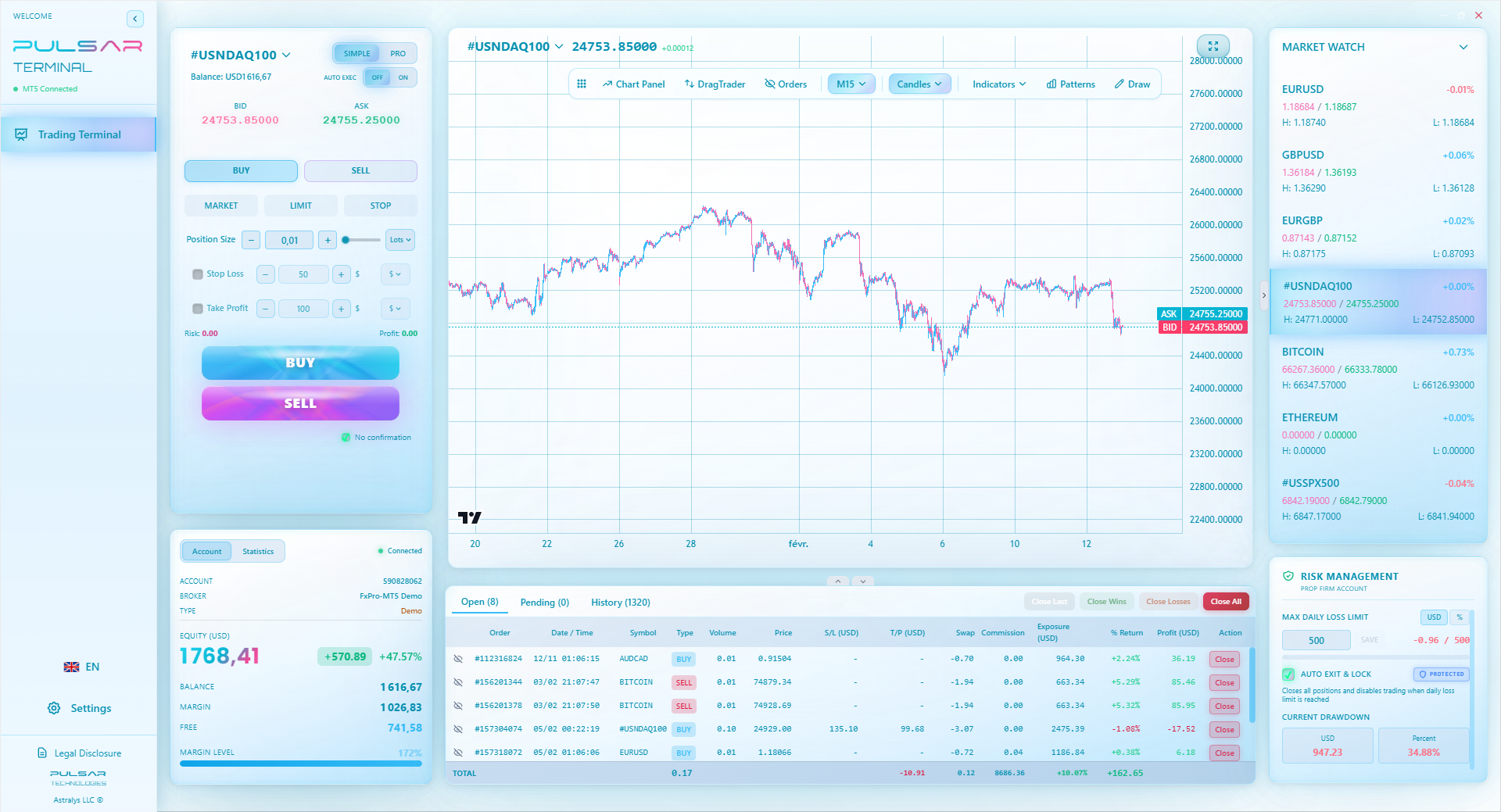
A Proper Terminal for Execution: Manually moving stops and calculating partial closes is where mistakes happen. You need a system that lets you execute complex risk management plans precisely and without emotion.

Manually managing multiple take-profit levels and moving stops to breakeven on fast-moving price action trades is where most Nigerian traders fumble; Pulsar Terminal automates this entire process on your MT5 platform.
Pulsar Terminal
MT5一站式工具:拖拽下单、多重止盈/止损、追踪止损、网格交易、成交量分布图和自营交易保护。每日1000+交易者使用。
“Your goal is to be bored by the potential loss, not excited by the potential gain.”
Let's kill the 'fund your lifestyle' fantasy. Let's do real math for a Nigerian trader with a Naira-denominated job.
Scenario: You have a $1,000 trading account (₦1.6 million). You are a disciplined price action trader risking 1% per trade ($10). Your win rate is 55% (which is excellent). Your average reward-to-risk ratio is 1.5:1 (you make $15 when you win, lose $10 when you lose).
- After 20 trades: 11 wins (11 x $15 = $165), 9 losses (9 x $10 = $90). Net profit = $75.
- That's ₦120,000.
Per month, if you take 20 trades, that's ₦120,000. That's a fantastic secondary income. It pays for fuel, some bills. It is not ₦5 million a month. It is not quitting your job.
To make ₦500,000 a month ($312) with the same stats, you need a $4,160 account (₦6.65 million). This is why funding your account gradually with profits is the only sustainable path. The Urban Forex promise of turning $500 into $50,000 is a story for the 0.01%. The rest of us build brick by brick.
Focus on the percentage growth of your USD account, not the Naira output. If you can grow your account by 5-10% per month consistently, you are in the top 5% of traders globally. Withdraw the profits periodically to enjoy in Naira, but let the core account compound slowly.
💡 Winston 小贴士
Your first profit target should always be to move your stop to breakeven. Making money is secondary to protecting capital. A breakeven trade is a successful trade.
“Survive first. Everything else is secondary.”
- Demolish and Rebuild: Go to your broker's platform right now and lower your maximum use to 1:50 or 1:30. It will feel limiting. Good.
- Paper Trade the Right Way: Open a demo account. Practice the top-down analysis (Daily -> 4H -> 1H). For one month, take only trades where all three time frames align. Journal every single one.
- Master One Pair: Stop jumping from Gold to EUR/JPY to NASDAQ. Pick one major pair. I recommend starting with EUR/USD guide as it has the most predictable behavior and lowest spreads. Learn every quirk of its price action.
- Implement the 1% Rule: On your next live trade, use the calculator. If your calculated position size feels embarrassingly small, you're doing it right. Your goal is to be bored by the potential loss, not excited by the potential gain.
- Find a Community (Carefully): Leave the 'signal shouting' Telegram groups. Find or create a small group of 3-5 serious traders who review each other's journals and discuss market structure, not hot tips.
The Urban Forex philosophy can be a foundation, but the Nigerian trading environment requires you to build stronger walls, a lower roof, and a much, much deeper bunker. Survive first. Everything else is secondary.
FAQ
Q1Is the Urban Forex YouTube channel bad for Nigerian traders?
Not at all. The educational content is solid. The problem is how traders implement it. They mimic the entries but ignore the foundational videos on risk management, psychology, and position sizing. It's like watching a football tutorial, learning the fancy step-over, but never practicing passing or fitness. You'll fail on the pitch.
Q2What's the best broker for this style of trading in Nigeria?
You need a broker with reliable execution (no requotes during fast markets), tight spreads, and easy local deposits/withdrawals. Based on my experience and consistent reviews, IC Markets and Pepperstone are top-tier for execution. For beginners, XM offers more educational resources. Always test with a demo first.
Q3Can I use Urban Forex strategies for scalping?
You can, but it's a higher difficulty level. Scalping requires even tighter risk control, faster execution, and a deep understanding of spread costs. The core price action principles are the same, but the time frame is compressed. I don't recommend it until you're consistently profitable on the 1-hour and 4-hour charts. See our scalping strategy guide for the specific pitfalls.
Q4How much money do I really need to start?
Realistically, you need enough so that 1% risk is a meaningful amount to trade with. If you start with $100 (₦160,000), 1% is $1. With a 20-pip stop on EUR/USD, that allows you to trade only 0.005 lots, which most brokers don't offer. A $500-$1,000 (₦800k-₦1.6m) starting capital is more practical. It allows for proper position sizing and absorbs a string of losses without a margin call.
Q5Why do I keep getting stopped out before price goes my way?
This is the most common frustration. Two reasons: 1) Your stop is placed at an obvious technical level where everyone else has their stop. Market makers can see liquidity pools and price often runs these stops before reversing. Try placing your stop just beyond a key support/resistance, not just the recent swing low/high. 2) Your time frame is too low. On a 5-minute chart, noise will stop you out. Move to a 1-hour chart, use wider stops (relative to your 1% risk by adjusting lot size down), and you'll be stopped out less by meaningless volatility.
Winston 教授的课程
要点总结:
- ✓Maximum risk per trade: 1%. No exceptions.
- ✓use is for flexibility, not for amplifying bets.
- ✓Analyze from Daily chart down, never from 5-minute up.
- ✓A trading journal is more important than any indicator.
这篇文章对您有用吗?
点击星星评分
每周交易洞察
免费每周分析与策略。无垃圾邮件。
关于作者
Olumide Adeyemi
西非交易先驱
尼日利亚最活跃的外汇交易教育者之一。从拉各斯出发有8年交易经验。专注于低资金策略和面向非洲交易者的自营公司挑战。
评论
风险提示
金融工具交易存在重大风险,可能不适合所有投资者。过往业绩不代表未来表现。本内容仅供教育目的,不构成投资建议。在交易前请务必自行研究。
您可能还喜欢

Cara Trading Forex Sukses: 7 Prinsip dari Trader Profesional
Cara trading forex sukses dengan 7 prinsip trader pro: manajemen modal, disiplin, journal trading, backtest. Data nyata, bukan janji profit palsu.
Jam Trading Forex Terbaik untuk Trader Indonesia: Panduan Lengkap dengan Tabel Waktu
Panduan jam trading forex untuk trader Indonesia. Tabel 4 sesi dunia, jam emas 20:00-00:00, sesi mana yang harus dihindari. Data akurat + tips dari trader berpengalaman.
Top 5 Sàn Forex Uy Tín Nhất 2026: Review Jujur dari Trader Indonesia
Top 5 sàn forex uy tín 2026 untuk trader Indonesia. Review jujur: spread, deposit, withdraw, dukungan lokal. Exness, XM, IC Markets & lebih.
