


My screen was a sea of red.

David van der Merwe
新兴市场交易员 ·  South Africa
☕ 11 分钟阅读
您将学到:
- 1Forex Basics: It's Just Buying and Selling Money
- 2The South African Forex Scene: Big Fish in a Growing Pond
- 3How Does Forex Trading Actually Work? Orders, Prices, and Platforms
- 4The Rules of the Game: SA Regulations You Must Know
- 5The Real Cost of Trading: It's More Than Just Spreads
- 6Your First Steps: How to Start Trading Forex in SA
- 7Potholes on the Road: Mistakes I Made (So You Don't Have To)
My screen was a sea of red. It was March 2020, and the USD/ZAR had just ripped through R18.50. News channels were panicking, but my trading platform showed a different story. A simple support level I'd marked at R17.80 had held for months, then broken. That break was my signal. I didn't know if the world was ending, but I knew the Rand was weakening. That trade, based on a clear price level rather than fear, taught me more about what forex really is than any textbook ever could. It's not just currencies. It's about people, panic, politics, and finding an edge when everyone else is losing their heads. Let's break down what this massive market is all about, especially for us here in Mzansi.
At its heart, forex is simple. You're buying one currency and selling another at the same time. That's it. The whole market is built on these paired transactions, like EUR/USD or USD/ZAR. You're betting on one currency getting stronger relative to the other.
The magic (and the risk) comes from scale and speed. Because currencies move in tiny increments called pips, you need to trade large amounts to see meaningful profit from small changes. That's where use comes in, letting you control a R1,000,000 position with maybe R33,333 of your own capital. Sounds great, right? It is, until the market moves against you. Then that use works in reverse, magnifying your losses just as fast.

Warning: Don't let the simplicity fool you. 'Just buying and selling money' is like saying rugby is 'just running with a ball'. The rules are simple, but the execution separates the pros from the amateurs.
Who's in this market? Everyone. Central banks like the SARB, commercial banks sending money overseas for businesses, multinational corporations, and speculators like you and me. We're the smallest players by volume, but thanks to online brokers, we have a front-row seat to the same price action as the big banks.
“Forex isn't just currencies. It's about people, panic, politics, and finding an edge when everyone else is losing their heads.”
You might not know it, but South Africa punches way above its weight in forex. We're the biggest market in Africa by a long shot. In April 2025, the average daily trading volume involving the ZAR hit nearly $21.39 billion. That's up from about $16 billion in 2022. To put that in perspective, that's more money flowing through the ZAR daily than the entire market cap of some JSE-listed companies.
We have between 190,000 and 200,000 active traders locally. Why so many? I think it's a combination of our entrepreneurial spirit, familiarity with currency volatility (we've all watched the Rand swing), and the accessibility of trading platforms. The ZAR itself is a major emerging market currency. In the global scheme, transactions involving the Rand make up about 1% of all global forex turnover. That might sound small, but in a $7.5 trillion-a-day market, 1% is a colossal amount of money.
Trading the ZAR Pairs
For South Africans, USD/ZAR is the main event. It's volatile, liquid, and reacts sharply to local politics, commodity prices (like platinum and gold), and global risk sentiment. But it's not the only game. EUR/ZAR and GBP/ZAR are also popular. A mistake I made early on was only watching USD/ZAR. I missed a huge move in GBP/ZAR during the Brexit saga because I was hyper-focused on one pair. Now, I keep a list of all the ZAR crosses. You can learn a lot about the XAU/USD (gold) market just by watching how USD/ZAR moves, given our gold exports.
The community here is vibrant. From WhatsApp groups to seminars in Sandton, there's a real culture of sharing (and sometimes, regrettably, boasting about) trades. Just remember, for every 'lambo' story, there are a hundred quiet stories of people re-evaluating their position size calculator settings after a bad week.

💡 Winston 小贴士
The market doesn't care about your opinion. It only cares about price. Trade what you see on the chart, not what you think *should* happen.
“For every 'lambo' story, there are a hundred quiet stories of people re-evaluating their position size after a bad week.”
You open a trading account with a regulated broker like Exness or IC Markets. You deposit funds - let's say R10,000. Your platform shows prices for currency pairs. For USD/ZAR, you'll see two prices: the Bid (the price you can sell at) and the Ask (the price you can buy at). The difference is the spread, which is how many brokers make their money.
If you think the Rand will strengthen against the Dollar, you'd BUY USD/ZAR (you're buying the pair). Wait, that seems backwards? It tripped me up too. Remember, you're trading the pair. 'Buy USD/ZAR' means you buy US Dollars and sell South African Rand. You want the first currency (USD) to go UP relative to the second (ZAR). If you think the Rand will weaken, you'd SELL USD/ZAR.
Let's use a real example from my journal. On October 25, 2023, I bought USD/ZAR at R18.92. My analysis showed the pair had bounced off a key support area. I used a 1:20 use (well under the SA limit), so my R10,000 stake controlled a R200,000 position. I set a stop loss at R18.75, risking R1700. I took half my position off at R19.20 for a R2800 profit and let the rest run with a trailing stop. The market eventually reversed and took me out at R19.05 on the remainder. Total gain: R3400. Not life-changing, but a solid 34% return on my risk capital by managing the trade in pieces.

Example:
- Trade: BUY USD/ZAR
- Entry: 18.92
- Position Size: R200,000 (with use)
- Stop Loss: 18.75 (Risk = 0.17 points)
- Risk in Rands: (0.17 / 18.92) * R200,000 = ~R1,797
- Take Profit 1: 19.20 (Profit on half = R2,959)
- Exit Remainder: 19.05 (Profit = R1,374)
- Total Profit: R4,333
This is where a platform's tools matter. Basic orders are market, limit, and stop. But advanced management, like setting multiple take-profit levels or a moving stop loss, is where you protect profits. I used to just set one take-profit and hope, often watching gains evaporate. Now, I always scale out.
“For every 'lambo' story, there are a hundred quiet stories of people re-evaluating their position size after a bad week.”
Trading forex in South Africa is 100% legal, but it's not the Wild West. We have one of the more sensible regulatory frameworks in the world, thanks to the Financial Sector Conduct Authority (FSCA). Ignoring these rules is the fastest way to lose your money before you even place a trade.
First, only use an FSCA-licensed broker. This isn't a suggestion. Check the FSCA's public register. A license means they have to follow strict rules, like keeping your money in a segregated bank account (so they can't use your deposit to run their office party). Brokers like XM and Pepperstone have local FSCA entities for this reason.
The big rule for retail traders is the use cap of 30:1. Since 2021, that's the maximum you can get. I remember the days of 500:1 being advertised. It was a trap. New traders would use maximum use, a tiny 20-pip move would wipe them out, and the broker would collect the spread. The 30:1 limit forces a bit of discipline. Honestly, it's a good thing. For most trades, I use between 10:1 and 20:1. It's enough to get a decent return without turning your account into a ticking time bomb.
Brokers must also give you clear risk warnings and have solid KYC (Know Your Customer) procedures. You'll need your ID, proof of address, and sometimes a bank statement to open an account. It's a hassle, but it protects the system from fraud and protects you.
Finally, remember the South African Reserve Bank (SARB) oversees cross-border flows. Moving large sums out of the country for trading with an international broker might need approval. Using an FSCA-licensed local entity of a global broker usually simplifies this, as the operation is considered local.
💡 Winston 小贴士
Your first profit target should always be to move your stop loss to breakeven. Protecting your capital is rule number one. Profits are a bonus.
“Your mission for the first six months is not to get rich. Your mission is to survive and execute your plan consistently.”
Nobody trades for free. If you don't know what you're paying, you're already at a loss. Here’s where your money quietly disappears.
The Spread: This is the main cost. It's the difference between the buy and sell price. On a standard account for USD/ZAR, the spread might be 50-80 pips (yes, pips, because it's quoted to two decimals, so 0.0050-0.0080). On a major pair like EUR/USD, it can be as low as 0.2 pips on a raw ECN account. You pay this spread on every single trade, the moment you open it. It's like a broker's instant commission.
Commission: ECN or 'Raw' accounts often have tight spreads but charge a commission per lot. Say $7 per standard lot (100,000 units). On a $200,000 trade, that's $14. You need to factor this into your profit target.
The Silent Killer: Swap Rates. This is the one that caught me early on. If you hold a trade overnight, you pay or earn a small interest fee based on the difference between the two countries' interest rates. This is the 'swap' or 'rollover'. Holding a USD/ZAR buy position (where you 'own' USD) overnight might cost you a few Rand per lot if US rates are lower than SA rates. I once held a swing trading position for three weeks and my decent profit was almost entirely eaten by negative swap fees. I didn't check the rate. Rookie error.
Other Fees: Inactivity fees (if you don't trade for 3-6 months), deposit/withdrawal fees (some brokers charge, many don't), and currency conversion fees if your account is in USD but you deposit in ZAR.

Pro Tip: Always look at the 'total cost' of a trade. A broker with a 1-pip spread but no commission might be cheaper for small trades. A broker with a 0.1-pip spread and a $5 commission is cheaper for large trades. Do the math before you fund your account.
“Your mission for the first six months is not to get rich. Your mission is to survive and execute your plan consistently.”
Okay, you're interested. Here's a safe, step-by-step path. I wish I had followed this.
- Educate First, Deposit Later. Spend a month learning. Not from 'get rich quick' gurus, but from the basics. Understand a pip definition, what a candlestick is, what support and resistance mean. Use YouTube, but be critical. Babypips.com is a free, classic starting point.
- Choose a Regulated Broker. I've mentioned the FSCA license. Compare a few like IC Markets or Exness for their local offerings, spreads on ZAR pairs, and deposit/withdrawal methods (EFT, Ozow, etc.).
- Open a Demo Account. Trade with virtual money for at least 2-3 months. Your goal isn't to make fake millions. Your goal is to lose fake money. I'm serious. Experience a margin call on demo. Blow up a demo account. It's the cheapest, most valuable lesson you'll ever get.
- Develop a Simple Plan. Start with one strategy. Maybe it's just trading bounces off a key moving average on the 4-hour chart. Maybe it's a basic MACD indicator crossover. Write down your rules: When do you enter? Where is your stop loss? Where is your take profit? How much will you risk (never more than 1-2% of your account per trade)?
- Start Live with Minimal Capital. When you go live, deposit an amount you are 100% comfortable losing. R2000, R5000. Your mission for the first six months is not to get rich. Your mission is to survive and execute your plan consistently. The profits will follow if your plan is any good.
- Keep a Trading Journal. Note every trade: entry reason, screenshot, outcome, emotional state. Review it weekly. This is how you improve. My journal showed me I lost 70% of my trades entered after 10 PM. I was tired and impulsive. I now have a hard rule: no new trades after 9 PM.
💡 Winston 小贴士
If you feel a strong urge to 'revenge trade' after a loss, close the platform. Go for a walk. The market will still be there tomorrow, but your account might not be.
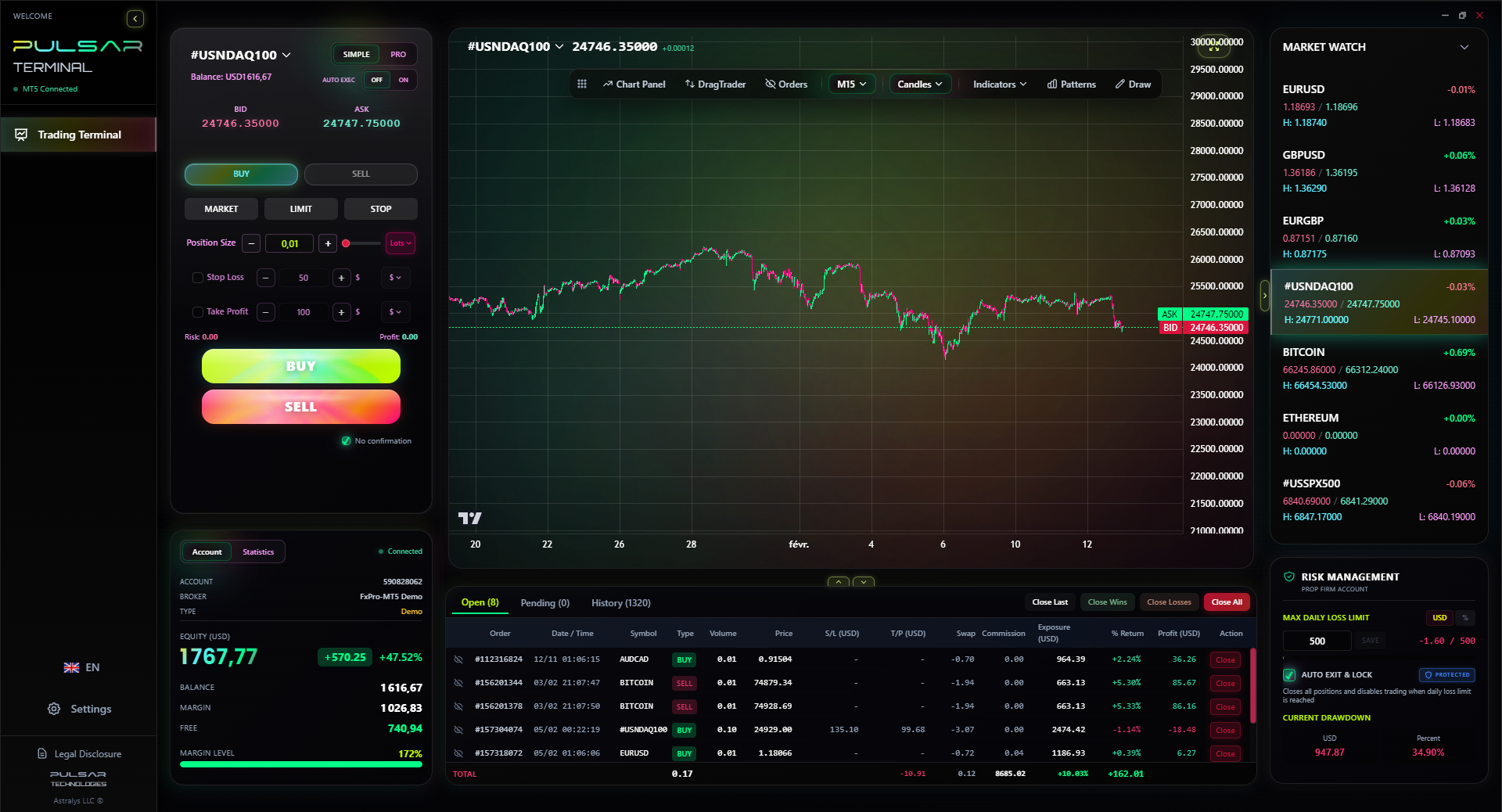
Managing multiple take-profit levels and moving stops to breakeven manually is stressful; Pulsar Terminal automates this directly on your MT5 platform, so you can focus on your next trade.
Pulsar Terminal
MT5一站式工具:拖拽下单、多重止盈/止损、追踪止损、网格交易、成交量分布图和自营交易保护。每日1000+交易者使用。
“A stop loss isn't a suggestion. It's a pre-planned exit that saves your account.”
Let's talk about failure. It's a better teacher than success.
Mistake 1: Over-leveraging. My first major loss. I used 50:1 use (pre-cap) on a USD/ZAR trade with my entire R5000 account. A 100-pip move against me - a normal daily swing - wiped out 50% of my capital in hours. I felt sick. The 30:1 cap now helps, but you can still over-use within it. Use a position size calculator for every single trade.
Mistake 2: Trading Without a Stop Loss. This is suicide. I once bought EUR/USD thinking it 'had to bounce'. It didn't. I watched it fall 200 pips, refusing to close the trade because that would 'make the loss real'. It eventually took me out at a 350-pip loss. A stop loss isn't a suggestion. It's a pre-planned exit that saves your account.
Mistake 3: Chasing the News. I used to try to trade SARB interest rate announcements or US Non-Farm Payrolls. The spreads would widen massively, the price would spike wildly in both directions, and I'd often get stopped out before the real move even started. Now, I either close my positions before major news or wait for the volatility to settle 15-30 minutes after the release before looking for a clean entry.
Mistake 4: Switching Strategies Like Socks. I'd try scalping strategy on Monday, swing trading on Tuesday, and then try some complex indicator-based system on Wednesday. I was constantly confused and losing money. Pick one approach that suits your personality and time commitment, and stick with it for at least 100 trades before you judge it. Consistency beats complexity every time.
The common thread in all these mistakes? Ego and impatience. Trading humbles you. Accept that you will be wrong often. Your job is to lose small and win big.
FAQ
Q1Is forex trading legal in South Africa?
Yes, it's completely legal. However, you must trade through a broker that is licensed by the Financial Sector Conduct Authority (FSCA). Trading with unregulated offshore brokers is risky and offers you little protection if something goes wrong.
Q2How much money do I need to start forex trading in South Africa?
You can start with very little. Some brokers allow you to open a live account with as little as R500 or $50. However, I strongly advise starting with a demo account first. When you go live, start with capital you can afford to lose completely - R2000 to R5000 is a common starting point for learning with real money without catastrophic risk.
Q3What is the best currency pair for South African beginners?
Start with the majors, not the ZAR pairs. EUR/USD or GBP/USD have much tighter spreads, more predictable liquidity, and tons of free analysis available. USD/ZAR is highly volatile and sensitive to local news, which can be overwhelming for a new trader. Learn the basics on the calmer majors first.
Q4Can I make a living from forex trading in SA?
A very small percentage of traders do. It's incredibly difficult and requires significant capital, discipline, and years of experience. For most people, it should be viewed as a speculative side activity, not a primary income source. Focus on consistent, risk-managed growth over years, not getting rich next month.
Q5What's the difference between a standard and an ECN forex account?
A standard account usually has no commission but wider spreads. An ECN (Electronic Communication Network) account gives you direct access to interbank prices with very tight spreads, but charges a commission per trade. For smaller trade sizes, standard accounts can be cheaper. For larger volumes, ECN accounts usually work out better. Always calculate the total cost.
Q6How are my forex trading profits taxed in South Africa?
In South Africa, profits from forex trading are generally considered capital gains if you're deemed to be an investor (holding trades longer-term), or income if you're deemed to be a trader (frequent, short-term trading). Capital gains are included in your taxable income with an annual exclusion (around R40,000). Trading income is taxed at your marginal income tax rate. It's crucial to keep detailed records of all trades and consult with a tax professional familiar with trading.
Winston 教授的课程
要点总结:
- ✓Forex is a $7.5 trillion/day market where you trade currency pairs.
- ✓South Africa's ZAR sees nearly $21 billion traded daily.
- ✓FSCA regulation caps use at 30:1 for your protection.
- ✓Costs include spreads, commissions, and overnight swap fees.
- ✓Always use a stop-loss and risk max 1-2% per trade.
这篇文章对您有用吗?
点击星星评分
每周交易洞察
免费每周分析与策略。无垃圾邮件。
关于作者
David van der Merwe
新兴市场交易员
约翰内斯堡交易者,11年新兴市场货币经验。专注于ZAR货币对、FSCA监管交易和南非市场分析。
评论
风险提示
金融工具交易存在重大风险,可能不适合所有投资者。过往业绩不代表未来表现。本内容仅供教育目的,不构成投资建议。在交易前请务必自行研究。
您可能还喜欢

Cara Trading Forex Sukses: 7 Prinsip dari Trader Profesional
Cara trading forex sukses dengan 7 prinsip trader pro: manajemen modal, disiplin, journal trading, backtest. Data nyata, bukan janji profit palsu.
Jam Trading Forex Terbaik untuk Trader Indonesia: Panduan Lengkap dengan Tabel Waktu
Panduan jam trading forex untuk trader Indonesia. Tabel 4 sesi dunia, jam emas 20:00-00:00, sesi mana yang harus dihindari. Data akurat + tips dari trader berpengalaman.
Top 5 Sàn Forex Uy Tín Nhất 2026: Review Jujur dari Trader Indonesia
Top 5 sàn forex uy tín 2026 untuk trader Indonesia. Review jujur: spread, deposit, withdraw, dukungan lokal. Exness, XM, IC Markets & lebih.
