


I lost 150,000 Naira in my first month.

Olumide Adeyemi
西非交易先驱 ·  Nigeria
☕ 9 分钟阅读
您将学到:
I lost 150,000 Naira in my first month. I thought I'd cracked the code on USD/NGN, piling into a trade because the Naira 'felt' weak. I didn't understand spreads, use, or that my local broker's platform was lagging 5 seconds behind the real market. The price moved, my stop-loss didn't trigger in time, and just like that, a month's salary was gone. That painful lesson is why we're talking. What is forex trading in Nigeria, really? It's not a quick-rich scheme. It's a global market you can access from your phone, but you need to understand the local realities, from broker choices to managing the volatile Naira.
At its core, forex trading is simply exchanging one currency for another, hoping the one you buy will strengthen against the one you sell. The global market is massive, open 24 hours a day during the week. For us in Nigeria, it's a way to speculate on international currencies, often using the US Dollar (USD) as a base pair.
But here's the local twist: you're trading from Nigeria, likely funding your account in Naira (NGN), and your internet stability, broker choice, and even economic news hits differently. A key pair for many beginners is EUR/USD because it's highly liquid and news is plentiful. You'll also see USD/JPY and GBP/USD. Understanding the pip definition is your first real step. A pip is the smallest price move. In EUR/USD, if it moves from 1.0850 to 1.0851, that's one pip. That movement is how you measure profit and loss.

Warning: Many local 'investment gurus' sell forex as a surefire escape from economic hardship. It's not. It's a skilled profession with high risk. That 150,000 Naira I lost? It bought me a brutal education in real risk, not a Lamborghini.
Your trading will revolve around currency pairs. A ‘buy’ on EUR/USD means you believe the Euro will rise against the Dollar. A ‘sell’ means you think it will fall. Your profit is the difference between your entry and exit price, multiplied by your trade size. It sounds simple, but the devil is in the details like the spread definition (the broker's fee built into the buy/sell price), which can eat into profits on small moves.

💡 Winston 小贴士
Your first profitable strategy should be boring. Master one currency pair, one timeframe, and one setup. Boring consistency beats exciting complexity every time.
“What is forex trading in Nigeria, really? It's not a quick-rich scheme. It's a global market you can access from your phone, but you need to understand the local realities.”
So, how do you actually do it? You need three things: a broker, a trading platform, and capital. Let's break it down for the Nigerian context.
Choosing a Broker in Nigeria
This is your most critical decision. You need a broker that accepts Nigerian clients, allows funding in Naira (or through accessible methods), and is reliable. International brokers like Exness, IC Markets, and XM are popular here because they offer competitive spreads and the trusted MetaTrader platforms. Always, and I mean always, check their regulatory status. A broker regulated by a reputable foreign authority (like CySEC, ASIC, or FCA) offers more client protection, even if you're trading from Nigeria.
The Trading Platform: MT4/MT5 is King
MetaTrader 4 (MT4) or MetaTrader 5 (MT5) is the standard. It's what 90% of serious retail traders use globally, and for good reason. It's stable, has countless indicators, and allows automated trading. You download it to your PC or phone, log in with your broker account details, and you're looking at live charts. Don't get swayed by fancy, proprietary platforms from obscure brokers. Stick with the standard.
Funding Your Account
This is where it gets local. Most international brokers don't have a direct Naira account. You'll fund in USD, EUR, or GBP. How? You use your Nigerian debit card (Mastercard/Visa) or a bank transfer. The broker converts your Naira at their rate. Some also accept cryptocurrency deposits, which can be faster. I started with a 50,000 Naira deposit (about $33 as of early 2026) on a broker with a low minimum. It was enough to learn without catastrophic loss.

Example: Let's say you deposit 100,000 Naira. Your broker converts it to USD at a rate of, say, 1500 Naira/$1. That gives you roughly $66.67 in your trading account. That's your starting capital. Never deposit money you can't afford to lose completely.
“I lost 150,000 Naira in my first month. That painful lesson is why we're talking.”
This is the concept that blows up most new Nigerian accounts. use lets you control a large position with a small amount of your own money (your margin). It magnifies both profits and losses.
Think of it like this: with 100:1 use, you can control a $10,000 position with just $100 of your own capital. If the price moves 1% in your favor, you make $100 (a 100% return on your margin). But if it moves 1% against you, you lose that entire $100. That's a 100% loss. I learned this the hard way early on. I used high use on a small account, a few bad trades wiped out my margin, and I got a margin call – a demand from my broker to add more funds or have my positions closed at a loss.

Pro Tip: For Nigerian traders starting out, I beg you: use low use. Start with 10:1 or even 5:1. It forces you to focus on good trade size and analysis, not gambling. A $10,000 position with 10:1 use still requires $1,000 of your margin. It teaches discipline that high use destroys.
Your broker's platform will show you your ‘Used Margin’ (the amount locked in open trades) and ‘Free Margin’ (what's left to open new trades or absorb losses). If your losses eat into your Free Margin too much, you’re at risk. Always use a position size calculator before every single trade. It’s the best habit you can build.
“For Nigerian traders starting out, I beg you: use low use. Start with 10:1 or even 5:1.”
You have a broker, a platform, and funded account. Now what? You need a plan. Don't just buy and sell based on a ‘feeling’ about the Naira. Here are two foundational approaches.
Price Action & Support/Resistance
This is reading the raw price chart without many indicators. You look for key levels where the price has historically bounced (support) or fallen from (resistance). The idea is to buy near support and sell near resistance. It requires patience and screen time. I made my first consistent profits using this on the EUR/USD guide, waiting for clear rejections at levels that had held multiple times before.
Indicator-Based Trading
This involves using mathematical tools on your chart. Two of the most common are:
- Moving Averages: These smooth out price data to show a trend. A common strategy is when a fast-moving average (like the 50-period) crosses above a slow one (like the 200-period), it can signal a potential uptrend.
- Oscillators like RSI: The RSI indicator measures whether a market is ‘overbought’ or ‘oversold.’ An RSI reading above 70 might suggest a pullback is due, while below 30 might suggest a bounce. I combine RSI with price action. If price hits a strong resistance level and RSI is above 70, that's a much stronger sell signal for me.
You can apply these for different timeframes. Scalping strategy aims for tiny profits over minutes, requiring intense focus. Swing trading holds trades for days or weeks, catching larger market moves. Start on the higher timeframes (like the 4-hour or daily chart) where ‘noise’ is less distracting.
💡 Winston 小贴士
Treat your trading capital like a sacred seed. Your job is to nurture it with patience, not to gamble it for a quick harvest. Risking 1% feels boring until you realize it's the only way to still be here in a year.
“For Nigerian traders starting out, I beg you: use low use. Start with 10:1 or even 5:1.”
Beyond the general market risk, we face specific hurdles. Ignoring these is a recipe for loss.
Volatility & Gaps: Major economic data or unexpected news (like a sudden CBN policy change) can cause prices to ‘gap’ – jump from one price to the next with no trading in between. If you have a stop-loss at the old price, it gets filled at the new, worse price. I’ve been caught in this on GBP/USD during UK election surprises.
Internet & Power Instability: A trade is going your way, then ‘NEPA takes light’ or your data drops. You can’t manage your position. Always use stop-loss orders on every trade, no exceptions. It’s an automated exit if the market moves against you.
Emotional Trading & Get-Rich-Quick Pressure: The pressure to ‘make it’ in a tough economy can lead to revenge trading after a loss or risking too much on one ‘sure’ idea. Your psychology is 80% of the game. Develop a routine, trade a plan, and walk away after a losing streak.
Regulatory Gray Areas: The local regulatory environment for forex brokers can be unclear. This is why using a well-regulated international broker is a form of self-protection. Your funds are held under a different jurisdiction's rules.
Currency Conversion Costs: Funding and withdrawing involve converting Naira to USD and back. Banks and payment processors charge fees and use their own exchange rates, which nibbles away at your capital. Factor this in.
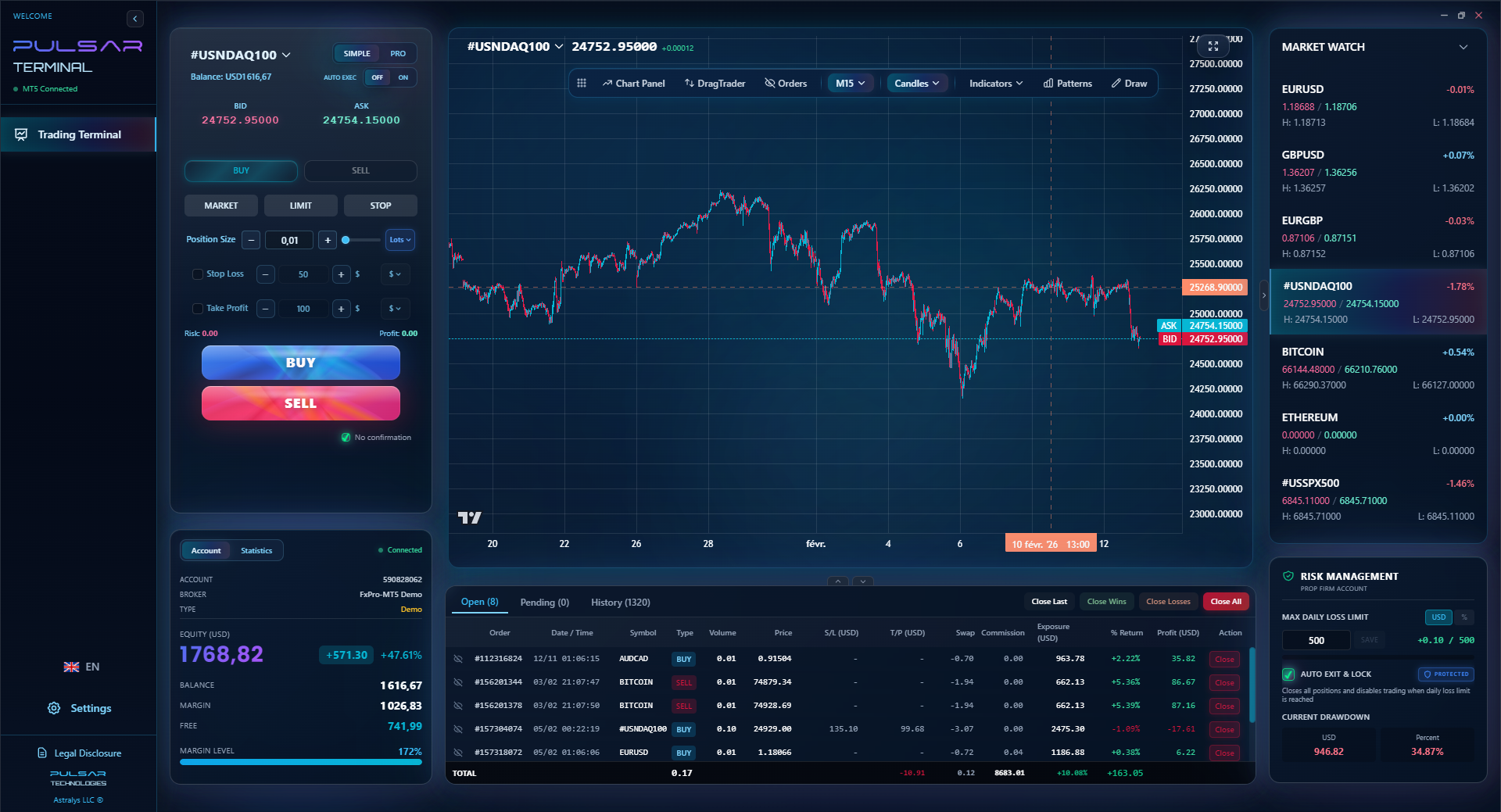
Managing risk and emotions is hard, but tools like Pulsar Terminal automate stop-loss and take-profit orders directly on your MT5 chart, so your plan executes even if your power or willpower fails.
Pulsar Terminal
MT5一站式工具:拖拽下单、多重止盈/止损、追踪止损、网格交易、成交量分布图和自营交易保护。每日1000+交易者使用。
“Your psychology is 80% of the game. Develop a routine, trade a plan, and walk away after a losing streak.”
Let's map out a realistic path from zero.
- Educate Yourself for Free First: Don't pay for a ‘secret strategy’ course. Use the vast free resources online. Babypips.com has a fantastic free ‘School of Pipsology.’ Understand terms, how orders work, and basic analysis.
- Open a Demo Account: Every major broker offers a free demo account with virtual money. Download MT5, open a demo with Pepperstone or another, and practice for at least 2-3 months. Test the strategies, get used to placing orders, and experience losing virtual money without sweat. My demo period was 4 months before I felt remotely ready.
- Develop a Simple Trading Plan: Write down your rules. What pairs will you trade? What timeframe? What’s your maximum risk per trade (I risk no more than 1-2% of my account on any single trade)? What indicators will you use? How will you manage winners and losers?
- Start Live with Minimal Capital: When you switch to live, start small. That 50,000 Naira I mentioned? That’s a good starting point. The goal of your first live account is not to get rich, but to survive and learn to handle real emotions tied to real money.
- Keep a Trading Journal: This is non-negotiable. Record every trade: entry, exit, reason, profit/loss, and most importantly, your emotional state. Review it weekly. You’ll see your mistakes repeat, and that’s how you fix them.
What is forex trading in Nigeria? It's a serious undertaking with unique local challenges. It can offer opportunity, but it demands respect, education, and relentless discipline. Start slow, risk little, and focus on the long-term game of consistent survival and gradual growth.
FAQ
Q1Is forex trading legal in Nigeria?
Yes, trading forex through international brokers is legal for individuals in Nigeria. However, the local regulatory landscape for brokers operating within Nigeria can be complex. Most Nigerian traders use internationally regulated brokers (like those licensed by CySEC, FCA, or ASIC) which is a standard and accepted practice.
Q2How much money do I need to start forex trading in Nigeria?
You can start with a very small amount. Some international brokers allow you to open a live account with as little as $10 (roughly 15,000 Naira, depending on the exchange rate). However, I strongly recommend starting with a larger demo account practice first, and then funding a live account with an amount you are completely prepared to lose, such as 50,000-100,000 Naira, to learn properly without excessive pressure.
Q3What is the best time to trade forex in Nigeria?
The most volatile and liquid sessions overlap with the European and US market hours. This is from about 1:00 PM to 10:00 PM Nigerian time (WAT). The London session (1 PM - 10 PM WAT) and the overlap with New York (3 PM - 10 PM WAT) typically see the highest volume and best trading opportunities for major pairs like EUR/USD and GBP/USD.
Q4Can I trade forex with my phone in Nigeria?
Absolutely. Most brokers offer full-featured mobile apps for MT4 or MT5. You can analyze charts, place trades, and manage your account from your smartphone. This is incredibly common, but be mindful of internet data costs and stability. Always use a stop-loss order in case you lose connection.
Q5How do I withdraw my profits from forex trading in Nigeria?
You withdraw through the same method you used to deposit, generally. If you funded with a debit card, profits are returned to that card. If by bank transfer, you initiate a withdrawal to your Nigerian bank account. The broker will send USD (or another currency), and your bank will convert it to Naira. This process can take 1-5 business days and involves conversion fees.
Q6What's the most common mistake new Nigerian traders make?
Using excessive use is the number one account destroyer. The temptation to turn a small amount into a large sum quickly leads to outsized risk. A single bad trade with 100:1 or 200:1 use can wipe out an account. The second biggest mistake is trading without a plan, reacting to emotions or tips from social media.
Winston 教授的课程
要点总结:
- ✓Start with a demo account for 2-3 months minimum.
- ✓Never risk more than 1-2% of your account on a single trade.
- ✓Use low use (10:1 or less) to survive your learning phase.
- ✓Choose an internationally regulated broker, not just a local one.
- ✓A trading journal is your most valuable tool for improvement.
这篇文章对您有用吗?
点击星星评分
每周交易洞察
免费每周分析与策略。无垃圾邮件。
关于作者
Olumide Adeyemi
西非交易先驱
尼日利亚最活跃的外汇交易教育者之一。从拉各斯出发有8年交易经验。专注于低资金策略和面向非洲交易者的自营公司挑战。
评论
风险提示
金融工具交易存在重大风险,可能不适合所有投资者。过往业绩不代表未来表现。本内容仅供教育目的,不构成投资建议。在交易前请务必自行研究。
您可能还喜欢

Cara Trading Forex Sukses: 7 Prinsip dari Trader Profesional
Cara trading forex sukses dengan 7 prinsip trader pro: manajemen modal, disiplin, journal trading, backtest. Data nyata, bukan janji profit palsu.
Jam Trading Forex Terbaik untuk Trader Indonesia: Panduan Lengkap dengan Tabel Waktu
Panduan jam trading forex untuk trader Indonesia. Tabel 4 sesi dunia, jam emas 20:00-00:00, sesi mana yang harus dihindari. Data akurat + tips dari trader berpengalaman.
Top 5 Sàn Forex Uy Tín Nhất 2026: Review Jujur dari Trader Indonesia
Top 5 sàn forex uy tín 2026 untuk trader Indonesia. Review jujur: spread, deposit, withdraw, dukungan lokal. Exness, XM, IC Markets & lebih.
