


I remember staring at my screen in 2015, watching a GBP/USD trade go completely against me.

Olumide Adeyemi
西非交易先驱 ·  Nigeria
☕ 11 分钟阅读
您将学到:
I remember staring at my screen in 2015, watching a GBP/USD trade go completely against me. I was down over 400 pips, a loss of nearly $2,000 on a single, over-leveraged position. I was trying to trade like the 'gurus' I saw online - big risks for big rewards. That painful lesson cost me a month's salary and taught me a brutal truth: chasing the ghost of being the next 'richest forex trader' is a surefire way to blow up your account. The real question isn't just who has the most money, but how they built it in a market like ours.
So, who actually holds the title? Based on public estimates and track records, Uche Paragon is widely considered the richest forex trader in Nigeria, with a net worth believed to be between $16 million and $20 million. He started back in 2007, which is ancient history in our fast-moving scene. What's key here isn't just the number, but the structure he built around it. He didn't just trade; he founded CCI Traders and the Paragon Forex Academy. His wealth isn't just from pips, it's from building a sustainable business around trading education.
Other big names have followed similar paths, blending trading with education. Dapo Willis, with an estimated $10 million net worth, founded Willis University. Ejimi Adegbeye, worth around $5 million, is known for a famously conservative style. Then you have the younger guns like Damilare Ogundare (HabbyFX), who started in 2017 and is already worth an estimated $5 million. The pattern is clear: the traders who build lasting wealth here often stop relying solely on the charts. They create systems, teach others, and diversify their income. It's a lesson I learned the hard way after that GBP/USD disaster - you need more than one source of returns in this game.

Example: Let's break down that $20 million figure. If Uche Paragon made an average 5% monthly return (which is stellar), he'd need a starting capital of over $1.6 million to reach that in 10 years through compounding alone. This shows that initial capital, smart scaling, and business ventures are almost always part of the story.
Here's where you need to put on your skeptic's hat. When you hear "net worth," especially in the Nigerian trading space, you've got to ask: what's actually in that number? Is it all liquid cash from trading profits? Almost never.
What "Net Worth" Really Means
For these top traders, their stated net worth is usually a combination of:
- Trading Capital: The actual money in their live accounts.
- Business Equity: The value of their academies, signal services, or broker affiliates (like CCI Traders or Habby Forex Trading Academy).
- Assets: Real estate, cars, and other investments bought with trading profits.
- Brand Value: Their social media following and personal brand, which can be monetized.
I once met a trader who claimed a $500k portfolio. Turns out, $450k of that was the estimated value of his training website and a Toyota Land Cruiser. His actual trading bankroll was just $50k. There's a big difference. The lesson? Don't compare your chapter 2 to someone's highlight reel of chapter 10. Your focus should be on growing your own consistent, liquid trading profits, not an inflated net worth figure. Use a position size calculator to manage what you actually have in your account, not what you wish you had.

💡 Winston 小贴士
A 'net worth' figure is a story. A trading journal with 100 consecutive trades is a fact. Trust the facts.
“Don't compare your chapter 2 to someone's highlight reel of chapter 10.”
Forget the Lamborghini photos for a second. Let's talk about the common threads in their actual trading approaches. These aren't secrets, but they're disciplines most people ignore.
First, risk management is their religion. Ejimi Adegbeye's conservative style isn't a marketing gimmick; it's how you survive decades in markets. They rarely, if ever, risk more than 1-2% of their capital on a single trade. That means a string of losses doesn't knock them out of the game. I didn't understand this early on. I was risking 5% per trade trying to get rich quick. It only took one bad week to wipe out 25% of my account.
Second, they specialize. Uche Paragon started with binary options and crude oil. Dapo Willis is a technical analysis specialist. They find an edge in a specific market or style and master it, instead of jumping from scalping strategy to gold to crypto every week.
Third, they use use as a tool, not a crutch. While brokers here offer crazy use like 1:2000, the pros use maybe 1:10 or 1:20 for their core positions. High use is for amplifying small, high-probability moves, not for turning $100 into $10,000 overnight. That path usually leads to a margin call.

Warning: A trader flashing high use profits on social media is often showing you the one trade that worked, not the ten that failed and wiped him out. use is a double-edged sword that cuts much faster on the downside.
Trading here isn't like trading in London or New York. We have our own unique setup, rules, and hassles. Knowing this is half the battle.
Regulations & Taxes
Forex trading is legal for individuals. The main watchdogs are the Central Bank of Nigeria (CBN) and the Securities and Exchange Commission (SEC). Here's the crucial bit: the online retail forex space isn't heavily regulated by them yet. This means you're largely responsible for picking a reputable broker yourself. Most Nigerian traders use international brokers regulated abroad (like the UK's FCA or Cyprus's CySEC). The SEC's main rule is clear: if someone is soliciting public funds to trade for you without a license, that's illegal. Keep your money in your own account.
On taxes, you're supposed to pay Capital Gains Tax on your trading profits. The rate is typically 10% of your gross profits, payable to the Federal Inland Revenue Service (FIRS). Keep a clean record of your trades. It's not fun, but it's part of being a professional.
Costs & Funding
Your main cost is the spread. For a major pair like EUR/USD, expect an average spread around 0.6 pips on a good ECN account. Funding your account can be a puzzle because of CBN restrictions on Naira cards for large international payments. The workaround? Most serious traders I know use domiciliary accounts (USD accounts with Nigerian banks) or e-wallets like Neteller. Some brokers, like HFM, even offer Naira-denominated accounts to simplify things.
| Broker Feature | What It Means For You |
|---|---|
| High use (e.g., 1:1000) | Available, but use with extreme caution. Not a badge of honor. |
| Low Minimum Deposit (e.g., $10) | Good for starting, but don't expect to build serious wealth from it. |
| NGN Accounts | Simplifies deposits/withdrawals, but watch the conversion spreads. |
| International Regulation | Non-negotiable for safety. Look for FCA, ASIC, CySEC licenses. |
💡 Winston 小贴士
If your strategy doesn't work with 1:10 use, it will explode with 1:1000. Master the market first, then carefully add use.
“High use is for amplifying small, high-probability moves, not for turning $100 into $10,000 overnight.”
You can't build a house with a spoon. Picking the right broker and platform is foundational. Based on what works for the community and my own experience, here's the lay of the land.
Popular Brokers in Nigeria: You'll hear a lot about Exness for its unlimited use (be careful!) and low minimum deposit. XM is huge here for its educational resources and $5 minimum. For raw, low-cost trading, IC Markets and Pepperstone are favorites among more experienced traders for their tight spreads and reliable execution. HFM is popular for its local presence and Naira accounts. The key is to pick one regulated by a top-tier authority. Don't get dazzled by bonus offers; get assured by regulatory licenses.
Platforms: MetaTrader 4 (MT4) is still the king in Nigeria. It's everywhere, everyone knows it, and it just works. MetaTrader 5 (MT5) is gaining ground, especially for trading stocks and commodities alongside forex. Some brokers like XTB have fantastic proprietary platforms (xStation 5), but MT4/5's universal appeal means you can easily switch brokers if you need to without relearning everything.
My mistake early on was jumping between platforms chasing the 'best' one. I lost more time learning software than studying price action. Pick MT4 or MT5, learn it inside out, and stick with it. All the top Nigerian traders I've spoken to mastered one platform first.
You're probably not going to start a multi-campus academy tomorrow. So what practical lessons can you take from the richest forex trader in Nigeria and apply on Monday morning?
1. Education Before Investment. Every single one of them spent years learning before they saw consistent profits. Uche Paragon started in 2007. Dapo Willis is a technical analysis master. Their first investment was in their own knowledge. Don't deposit money you can't afford to lose into a live account because you saw a signal on Telegram.
2. Process Over Profits. Focus on executing your trading plan correctly every single time. Did you wait for your RSI indicator to confirm the trend? Did you place your stop-loss immediately? The money follows the process. I used to close trades early if they were in profit, breaking my own rules. The result was inconsistent, unpredictable returns.
3. Build a Community, Not Just a Portfolio. Even if you don't want to run an academy, engage with other traders. Discuss ideas, share losses (yes, losses), and hold each other accountable. The isolation of trading is a killer. The pros have networks.
4. Sustainability is Key. Their wealth was built over 10-15 years, not 10-15 months. Adopt a swing trading mindset for your career: look for steady growth, not overnight moonshots. A 5-10% return per month, compounded, is life-changing over a decade. A 100% return in a month is usually followed by a 100% loss soon after.

Pro Tip: Instead of asking "What's your net worth?" ask a successful trader "What's your average risk per trade?" and "What's your win rate?" The answers to those questions will teach you infinitely more about their real strategy.
“You will make stupid mistakes. The difference is persistence and the willingness to learn from every single error.”
Let me save you some pain and money by sharing the traps I and many others fell into, often while trying to emulate the 'rich trader' image.
The Prop Firm Hustle: Prop firm challenges are everywhere now. They can be a great way to access larger capital, but they're a specific skill test. Many traders blow multiple challenges trying to hit profit targets quickly, not realizing the goal is consistent, low-risk growth. Passing requires iron-clad discipline, something tools can help enforce by automating risk rules.
Signal Seller Dependency: Paying for signals is often a shortcut to dependency. You learn nothing and are forever tied to someone else's schedule and skill. The richest traders developed their own edge. Spend that money on books or a proper course instead.
Neglecting Local Context: Trading XAU/USD (Gold) during London hours without understanding how CBN policies might affect your ability to withdraw profits is a disconnect. Always factor in funding logistics, tax obligations, and local market sentiment into your overall plan.
Mistaking Activity for Achievement: Placing 20 trades a day doesn't make you a pro. It often means you're overtrading and paying too much in spread. The pros might place only 2-3 high-conviction trades a week. Quality over quantity, every time.
💡 Winston 小贴士
The only 'get rich quick' scheme in trading is selling the dream to others. Focus on getting consistently better, not just quickly rich.
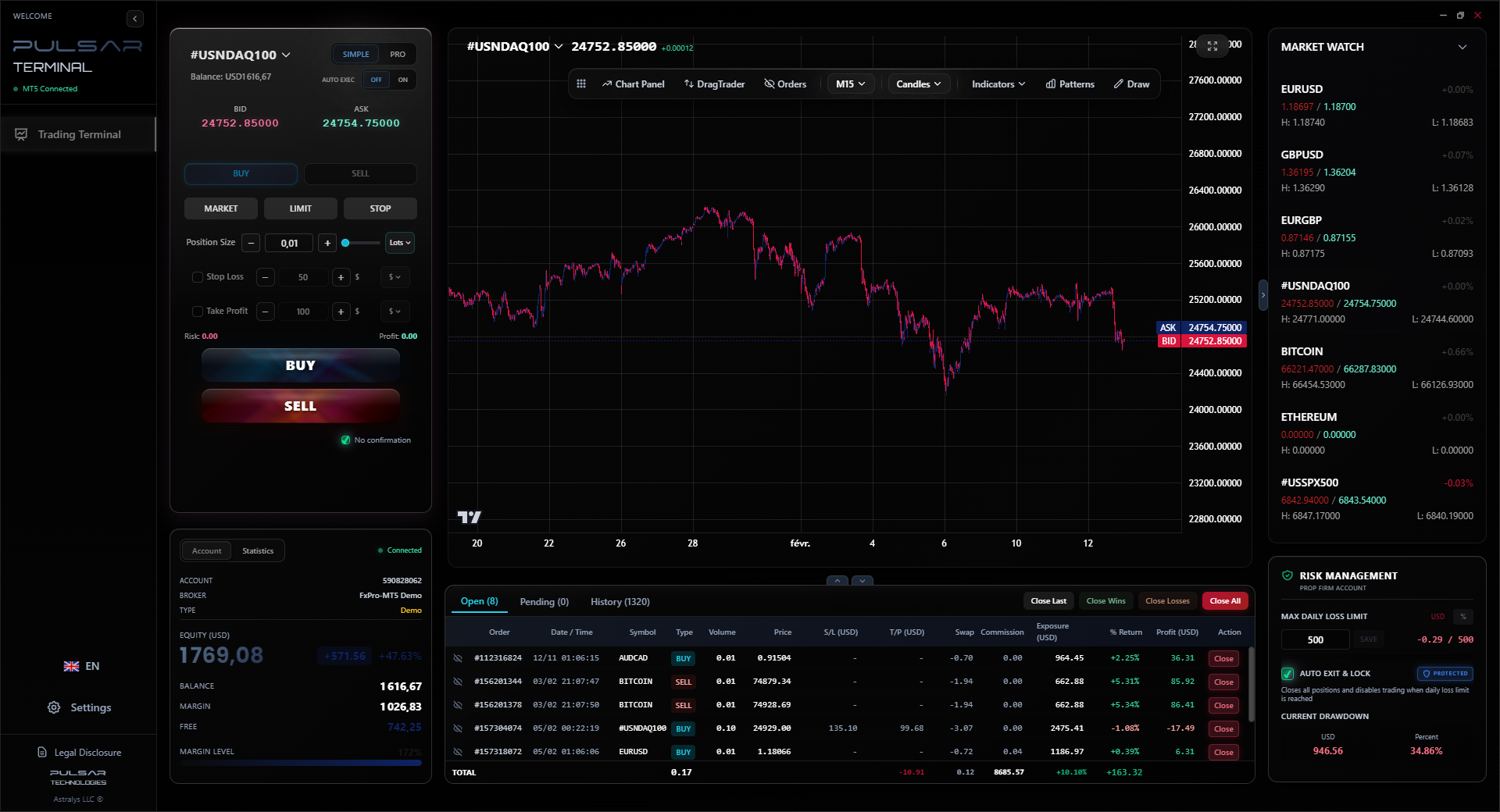
Managing the strict rules of a prop firm challenge or your own risk limits requires flawless discipline, which is where automation tools like Pulsar Terminal for MT5 become a trader's best friend.
Pulsar Terminal
MT5一站式工具:拖拽下单、多重止盈/止损、追踪止损、网格交易、成交量分布图和自营交易保护。每日1000+交易者使用。
So, where does this leave you? Knowing who the richest forex trader in Nigeria is should be inspiration, not intimidation. Their journey maps a possible path, but your feet have to do the walking.
Start by defining what success means for you. Is it a consistent secondary income? Replacing your 9-to-5? Building a financial education business? Your goals will dictate your strategy. If you want to trade full-time, you'll need a much larger safety net and proven track record than if you're just swing trading on the weekends.
Build your foundation brick by brick. Master one market, one strategy, one platform. Document every trade in a journal - why you entered, your emotional state, why you exited. This journal will be more valuable than any signal service.
Finally, be patient with yourself. Uche Paragon has been at this since 2007. You will have losing streaks. You will make stupid mistakes (I once bought EUR/USD when I meant to sell it. Cost me 50 pips before I noticed). The difference between those who make it and those who don't is persistence and the willingness to learn from every single error.
The title of 'richest forex trader' will pass to someone else one day. The timeless principles of discipline, risk management, and continuous learning won't. Focus on mastering those, and you'll build something far more valuable than just a number in your account - you'll build a sustainable skill for life.
FAQ
Q1Is forex trading legal in Nigeria?
Yes, forex trading is legal for individuals in Nigeria. The main regulatory bodies are the Central Bank of Nigeria (CBN) and the Securities and Exchange Commission (SEC). However, the online retail forex trading space is not heavily regulated locally, so most Nigerian traders use international brokers regulated by authorities like the UK's FCA or Cyprus's CySEC for safety.
Q2How much tax do forex traders pay in Nigeria?
Forex trading profits are generally subject to Capital Gains Tax, which is typically 10% of your gross profits. You are responsible for declaring this and paying it to the Federal Inland Revenue Service (FIRS). It's crucial to keep detailed records of all your trades for tax purposes.
Q3What is the best broker for forex trading in Nigeria?
There's no single 'best' broker, as it depends on your needs. Popular and reputable choices among Nigerian traders include Exness, XM, IC Markets, Pepperstone, and HFM. The critical factor is choosing a broker regulated by a top-tier international authority. Look for FCA, ASIC, or CySEC licenses, and consider features like spreads, use, and ease of deposits/withdrawals in Naira.
Q4Can I start forex trading with 10,000 Naira?
Technically, yes. Some brokers have minimum deposits as low as $5 or even $1. However, starting with a very small amount (like 10,000 Naira, roughly $6-7) is more for learning the platform and practicing execution in a live environment. It's extremely difficult to generate meaningful, sustainable income from such a small capital base due to position sizing and risk management constraints.
Q5Do I need a domiciliary account to trade forex?
It's highly recommended. Due to CBN restrictions on using Naira cards for large international transactions, a USD or EUR domiciliary account with a Nigerian bank is one of the most reliable ways to fund your international trading account. E-wallets like Neteller and Skrill are also common alternatives.
Q6What's more important for success: strategy or psychology?
Psychology, by a long shot. You can have the best strategy in the world, but if you lack the discipline to follow it, you'll fail. The mental game - managing fear, greed, and frustration - is what separates consistent traders from the rest. All the successful Nigerian traders emphasize mindset and discipline over any secret indicator.
Winston 教授的课程
要点总结:
- ✓Wealth in trading is built on business systems, not just charts.
- ✓Real net worth includes illiquid assets, not just trading capital.
- ✓Never risk more than 2% of your account on a single trade.
- ✓Master one market and one strategy before expanding.
- ✓Focus on the 10% monthly return, not the 100% moonshot.
这篇文章对您有用吗?
点击星星评分
每周交易洞察
免费每周分析与策略。无垃圾邮件。
关于作者
Olumide Adeyemi
西非交易先驱
尼日利亚最活跃的外汇交易教育者之一。从拉各斯出发有8年交易经验。专注于低资金策略和面向非洲交易者的自营公司挑战。
评论
风险提示
金融工具交易存在重大风险,可能不适合所有投资者。过往业绩不代表未来表现。本内容仅供教育目的,不构成投资建议。在交易前请务必自行研究。
您可能还喜欢

Cara Trading Forex Sukses: 7 Prinsip dari Trader Profesional
Cara trading forex sukses dengan 7 prinsip trader pro: manajemen modal, disiplin, journal trading, backtest. Data nyata, bukan janji profit palsu.
Jam Trading Forex Terbaik untuk Trader Indonesia: Panduan Lengkap dengan Tabel Waktu
Panduan jam trading forex untuk trader Indonesia. Tabel 4 sesi dunia, jam emas 20:00-00:00, sesi mana yang harus dihindari. Data akurat + tips dari trader berpengalaman.
Top 5 Sàn Forex Uy Tín Nhất 2026: Review Jujur dari Trader Indonesia
Top 5 sàn forex uy tín 2026 untuk trader Indonesia. Review jujur: spread, deposit, withdraw, dukungan lokal. Exness, XM, IC Markets & lebih.
