


I remember staring at the Finviz heatmap, watching the entire currency market glow red.

Olumide Adeyemi
西非交易先驱 ·  Nigeria
☕ 11 分钟阅读
您将学到:
- 1What Exactly is www.finviz.com Forex?
- 2What Finviz is Good For (And Where It Falls Short for Nigerians)
- 3Making It Work: Integrating Finviz with Your Nigerian Reality
- 4From Screen to Trade: Real Examples with Numbers
- 5The Nigerian Rules: Regulation, Taxes, and Your Profits
- 6Building a Better Setup: Beyond the Browser Tab
- 7Mistakes I've Made So You Don't Have To
I remember staring at the Finviz heatmap, watching the entire currency market glow red. 'This is it,' I thought, 'a major risk-off move.' I slammed a sell order on EUR/USD, confident the panic would deepen. I didn't check the Nigerian banking stocks or the CBN's latest circular. An hour later, the Naira found unexpected support, European markets shrugged, and my trade was stopped out for a $280 loss. That trade taught me a hard lesson about www.finviz.com forex: it's a powerful window to the world, but if you're trading from Nigeria, you can't ignore what's happening outside that window.
Let's clear this up first, because there's a lot of confusion. Finviz.com is not a broker. You can't deposit your Naira there or place a trade. Think of it more like a financial news channel with supercharged data visuals. Its 'forex' section is a snapshot of the global currency market.
For us in Nigeria, its core value is speed and visualization. While your trading platform might show you charts, Finviz shows you relationships. Its signature heatmap turns currency strength into an intuitive color-coded grid - red for weak, green for strong. You can see at a glance if the US Dollar (USD) is broadly strong (lots of green) or if commodity currencies like the Australian Dollar (AUD) are getting hammered.

Warning: The data on Finviz is real-time, but it's generic. It won't tell you about the specific spreads your broker offers on USD/NGN pairs, or if there's a liquidity crunch affecting withdrawals in Lagos that day. It's a global tool, and you are a local trader. That gap is where you need to be smart.
I use it as my opening ritual. Before I even look at my MT5 charts, I open Finviz to get the 'mood' of the day. Is it a risk-on day (stocks up, JPY weak) or risk-off (gold up, USD strong)? This 30-second check prevents me from trying to buy the Aussie dollar on a day when global sentiment is clearly fearful.
Its Real Strengths
Market Sentiment at a Glance: This is its killer feature. No other free tool I've found aggregates forex, futures, and stock market movements so visually. When the heatmap is overwhelmingly one color, it's a strong signal. I once avoided a long GBP/USD trade because, despite a nice chart setup, Finviz showed the British Pound was the weakest major currency that session. The pair dropped 50 pips soon after.
Correlation Checks: You're thinking of selling USD/JPY. A quick look at Finviz shows the S&P 500 futures are deep green (risk-on). Historically, USD/JPY often rises with stocks. That might give you pause about your sell idea. It adds a crucial layer of context.
News Integration: The latest headlines are right there. If you see a big red move on the Euro and a headline about a surprise ECB statement pop up, you instantly know the cause.
Where It Lets Nigerian Traders Down
No Naira Data: This is the biggest hole. The most important currency in your life, the Naira (NGN), isn't on their forex heatmap. You won't see USD/NGN or GBP/NGN. The entire local market context - CBN policies, parallel market rates, local liquidity - is absent. Relying solely on Finviz is like planning your Lagos commute using only a map of London.
It's a Snapshot, Not a Strategy: The data is descriptive, not predictive. It tells you what IS happening, not what WILL happen. I learned this the hard way early on by chasing moves that were already over.
No Broker Integration: You can't click and trade. You have to take the insight, switch to your broker's platform (like Exness or IC Markets), and then execute. In fast markets, that delay matters.

Pro Tip: Use Finviz to ask the right question, not to find the answer. If the heatmap shows a suddenly strong Swiss Franc (CHF), your job is to ask 'Why?' and then check your own charts for a EUR/USD entry, not to blindly sell EUR/CHF.

💡 Winston 小贴士
A green heatmap on Finviz tells you who is winning the battle right now. Your job is to figure out if the war is over, or if it's just beginning. Never confuse reaction with strategy.
“Finviz shows you what institutional money has already done. Use it to plan your next move, not to join the last one.”
This is the crucial part. You can't just copy what you see on Finviz. You have to filter it through the Nigerian lens. Here's my daily workflow.
Step 1: The Global Pulse (Finviz) I open Finviz. I note the strongest and weakest currencies. I see if gold (XAU/USD) is moving with or against the Dollar. This gives me the global backdrop.
Step 2: The Local Reality Check I then immediately check my local sources. What's the CBN doing? Is there news about dollar liquidity for BDCs? What's the parallel market rate doing? This step tells me if global moves are likely to be amplified or muted locally. If Finviz shows a weak USD but the CBN is intervening to support the Naira, the USD/NGN move might be limited.
Step 3: Broker-Specific Analysis Now I go to my trading platform. I look at the actual spreads and liquidity on the pairs I want to trade. A pair might look volatile on Finviz, but if my broker's spread on it is 15 pips, the trade is dead on arrival. I use my position size calculator here, factoring in the real costs.
Step 4: The Final Decision Only after these three steps do I consider a trade. For example: Finviz shows risk-off (USD strong, stocks red). Local news says forex scarcity is worsening. My broker shows a tight spread on USD/NGN. That's a confluence. Maybe I look for a short-term scalping opportunity to buy the dollar against the Naira, with a very tight stop because CBN intervention is always a risk.
The Tool Stack: Finviz + Local Financial News (Nairametrics, BusinessDay) + Your Broker's Platform + Your Own Chart Analysis. That's the complete picture.
Let me walk you through two concrete examples from my own journal.
Example 1: The Divergence Play (Winner)
- Finviz Signal: A quiet Tuesday afternoon. The heatmap showed all majors in a tight range, but the Canadian Dollar (CAD) was steadily turning greener, showing strength. Oil prices (WTI) were ticking up on the futures sidebar.
- Local Context: No major Nigerian news. Stable Naira.
- My Action: I switched to my Pepperstone MT5. USD/CAD was testing a key support level at 1.3200. The RSI indicator was showing bullish divergence on the 1-hour chart - price making lower lows, but RSI making higher lows. The Finviz strength gave me the fundamental clue for the divergence.
- The Trade: I bought USD/CAD at 1.3205. Stop loss at 1.3170 (35 pips). Target at 1.3270.
- Result: Oil pulled back slightly, CAD weakness followed. Price hit my target in about 5 hours. Profit: 65 pips, or about $162 on my 0.25 lot position.
Example 2: The Ignored Context (Loser)
- Finviz Signal: Major risk-off. US indices deep red, JPY bright green (strong). Classic 'safe-haven' flow.
- Local Context: I ignored it. I was focused on the 'obvious' JPY strength.
- My Action: I sold AUD/JPY at 95.40, expecting the JPY strength to continue.
- The Mistake: I didn't check the correlation. The Australian Dollar (AUD) is a risk currency, so selling AUD/JPY on a risk-off day seemed right. But I was late. The big move had already happened. I sold into a minor bounce.
- Result: The market stabilized. My stop loss at 95.90 was hit. Loss: 50 pips, or $125. The Finviz signal was correct, but my timing - entering after the move was already displayed - was terrible. I used it as a confirmation bias tool, not a timing tool.
💡 Winston 小贴士
If a move on Finviz is so obvious it makes you want to slam the 'buy' or 'sell' button immediately, take a breath. The easiest money to see is often the hardest to catch. The crowd is usually already there.
“The biggest hole in Finviz for a Nigerian trader is the one where the Naira should be.”
Trading with international brokers using Finviz for analysis is legal for individuals in Nigeria. But the landscape is changing, and you must be aware.
The new Investments and Securities Act (ISA) 2025 is a game-changer. It gives the SEC power to regulate online forex trading platforms. This means the days of completely unregulated operations are numbered. It's for your protection - to stop scams and 'fund managers' from disappearing with people's money.
If you're just trading your own capital from your laptop in Ikeja, you're fine. But if you start pooling money from friends and family to trade for them, you're stepping into territory that now requires a license. Don't do that.
Now, the part everyone ignores until it's too late: Tax.
The FIRS doesn't care if your broker is in Seychelles or your money is in a USD account. If you're a Nigerian resident and you make a profit, that's a capital gain. The rate is 10% on your gross profits.
Let's say you make a net profit of 500,000 NGN from trading in a year. You owe 50,000 NGN in tax. You need to declare this. I know traders who've been trading for years and have never considered this. It's a ticking clock. Keep simple records: your statements from brokers like XM or IC Markets are your proof. Talk to a small-scale accountant. The peace of mind is worth the fee.
Relying on a browser tab for critical market data has flaws. Page refreshes, internet lag, distractions. For a serious Nigerian trader, you need to level up.
Step 1: Get a Real Trading Platform MetaTrader 5 (MT5) is the standard for a reason. It's where you execute, manage risk, and do your deep chart analysis. Your broker provides it. The charts, indicators like the MACD, and your trade execution all happen here. This is your cockpit.
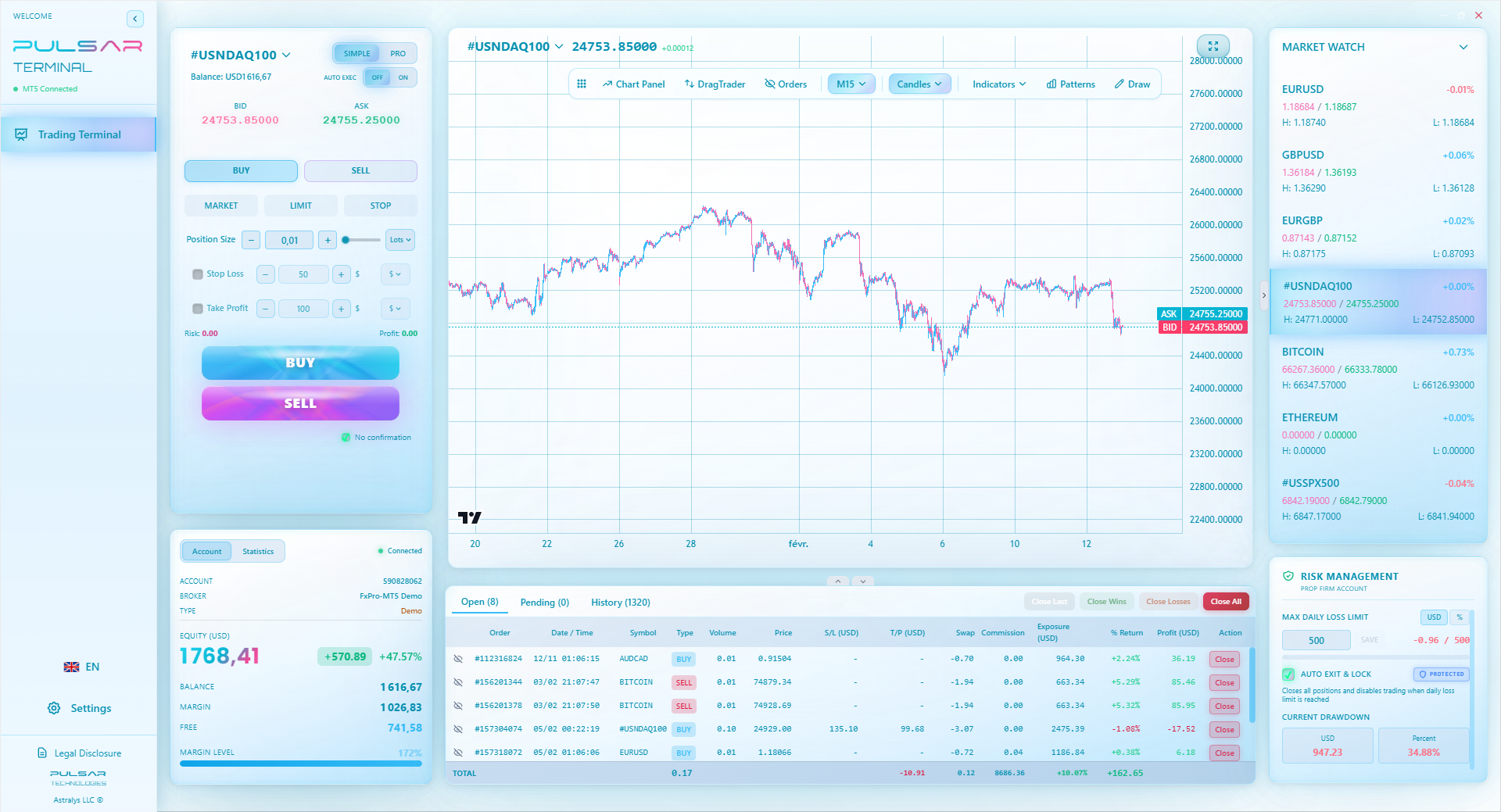
Step 2: Use a Professional Market Scanner This is where tools like Pulsar Terminal come in. Think of it as a power-up for your MT5. It sits on top of your platform and can give you Finviz-like visualization (like a real-time market heatmap) directly inside your trading software. No switching tabs. Even better, it has tools for advanced order management that MT5 lacks.
Step 3: Automate Your Workflow Why manually draw support and resistance every day? Use a tool that can recognize chart patterns automatically. Why calculate your position size for every trade? Use a calculator that integrates with your platform. The goal is to remove manual, repetitive tasks so you can focus on decision-making.
Step 4: Local Data Feed Subscribe to a reliable local news feed for CBN and economic updates. Have it as a notification, not something you have to go searching for. The first trader to understand a new CBN circular has an edge.
The modern Nigerian trader's desk isn't just a laptop with Finviz open. It's an integrated system: MT5 for execution, a terminal like Pulsar for market scanning and advanced orders, a local news feed, and a solid internet connection. That's how you compete.
💡 Winston 小贴士
Your trading edge isn't in seeing the same data as everyone else on Finviz. It's in interpreting that data through the unique lens of your local market knowledge. That's your home-field advantage.
Managing multiple trades and advanced orders across different pairs—like those you spot on Finviz—is far easier with a tool like Pulsar Terminal, which brings professional-grade trade management directly into your MT5 platform.
Pulsar Terminal
MT5一站式工具:拖拽下单、多重止盈/止损、追踪止损、网格交易、成交量分布图和自营交易保护。每日1000+交易者使用。
“Your trading edge isn't in seeing the same data as everyone else; it's in interpreting it through your local market knowledge.”
Let me save you some money and frustration.
1. Chasing the Heatmap: You see the Euro turn bright red and plummeting. You rush to sell EUR/USD. By the time your trade is filled, the big move is over, and you're selling into a consolidation or a retracement. You're late. Finviz shows you what institutional money has already done. Use it to plan your next move, not to join the last one.
2. Overcomplicating with Too Many Pairs: Finviz shows 30+ currency pairs moving. You feel like you need to be in on the action. You take a trade on USD/CHF, another on GBP/AUD, and maybe one on EUR/NZD. Suddenly you're overexposed, correlated without knowing it, and stressed. Pick 2-3 major pairs that align with the clear Finviz theme and your local context. Master those.
3. Ignoring the Time Zone: The Finviz heatmap is most actionable during overlapping major market sessions (London, New York). If you're checking it at 11 PM Lagos time, you're looking at the thin, volatile Asian session. The moves can be misleading and whippy. I've taken bad scalping trades based on late-night noise that reversed at London open.
4. Forgetting the Spread: You see a nice 10-pip move on the Finviz chart for an exotic pair. You think, 'easy money.' You go to your platform and the spread is 25 pips. You're already in a massive hole before the trade even starts. Always, always check the real cost on your broker's platform first. A high spread turns a good idea into a guaranteed loser.
5. Letting It Dictate Your Bias: You plan a swing trading buy on GBP/USD based on your weekly chart analysis. You open Finviz and it's slightly red for the day. You hesitate, you second-guess, you miss your entry. Don't let a short-term snapshot override your longer-term, well-researched plan. Use it as context, not as a veto.
FAQ
Q1Is www.finviz.com forex free for Nigerian traders?
Yes, the basic Finviz.com website with its forex heatmap, charts, and news is completely free to use. They have a paid 'Elite' version with more features, but the free version is more than enough to get started. You don't need to pay to access the core visualization tools that are most useful.
Q2Can I trade forex directly on Finviz from Nigeria?
No, absolutely not. Finviz is a market analysis and visualization website, not a brokerage. You cannot open an account, deposit Naira, or execute trades on it. To trade, you must use a licensed international or local broker that provides a trading platform like MT4/MT5.
Q3Why doesn't Finviz show the Nigerian Naira (NGN) rates?
Finviz focuses on the major global forex markets traded on international exchanges. The USD/NGN pair is primarily traded over-the-counter (OTC) in Nigeria and is subject to local controls and a different liquidity pool. For Naira rates, you need to check your broker's platform, local bank rates, or parallel market sources.
Q4Do I have to pay tax on forex trading profits in Nigeria?
Yes. According to Nigerian law, profits from forex trading are considered capital gains and are subject to a 10% tax. This applies regardless of whether you use an international broker. It's your responsibility to declare this income to the Federal Inland Revenue Service (FIRS).
Q5What's the biggest mistake Nigerian traders make with Finviz?
The biggest mistake is using Finviz in isolation. They see a strong trend on the heatmap and trade it without checking: 1) The specific spread and liquidity on their broker's platform, and 2) The local Nigerian context (CBN news, Naira liquidity). This leads to entering trades too late or getting stopped out by local market noise.
Q6Are there better tools than Finviz for forex trading?
Finviz is excellent for free, quick visualization. For a more professional and integrated setup, dedicated trading terminals that connect directly to your MT4/MT5 platform are better. These can provide similar heatmaps and scanners without leaving your trading software, and often include advanced risk management tools like automatic trailing stops and breakeven functions, which are crucial for managing a trade once you're in it.
Winston 教授的课程
要点总结:
- ✓Use Finviz for global sentiment, not trade signals.
- ✓Always filter Finviz data through local Nigerian context.
- ✓Check your broker's real spread before acting on any idea.
- ✓A 10% capital gains tax applies to your forex profits.
这篇文章对您有用吗?
点击星星评分
每周交易洞察
免费每周分析与策略。无垃圾邮件。
关于作者
Olumide Adeyemi
西非交易先驱
尼日利亚最活跃的外汇交易教育者之一。从拉各斯出发有8年交易经验。专注于低资金策略和面向非洲交易者的自营公司挑战。
评论
风险提示
金融工具交易存在重大风险,可能不适合所有投资者。过往业绩不代表未来表现。本内容仅供教育目的,不构成投资建议。在交易前请务必自行研究。
您可能还喜欢

Cara Trading Forex Sukses: 7 Prinsip dari Trader Profesional
Cara trading forex sukses dengan 7 prinsip trader pro: manajemen modal, disiplin, journal trading, backtest. Data nyata, bukan janji profit palsu.
Jam Trading Forex Terbaik untuk Trader Indonesia: Panduan Lengkap dengan Tabel Waktu
Panduan jam trading forex untuk trader Indonesia. Tabel 4 sesi dunia, jam emas 20:00-00:00, sesi mana yang harus dihindari. Data akurat + tips dari trader berpengalaman.
Top 5 Sàn Forex Uy Tín Nhất 2026: Review Jujur dari Trader Indonesia
Top 5 sàn forex uy tín 2026 untuk trader Indonesia. Review jujur: spread, deposit, withdraw, dukungan lokal. Exness, XM, IC Markets & lebih.
