


Over 190,000 South Africans trade forex daily, and a huge chunk of them are under 30.

David van der Merwe
新兴市场交易员 ·  South Africa
☕ 9 分钟阅读
您将学到:
- 1Why South Africa's Youth Are Flocking to Forex (And Why It's Dangerous)
- 2FSCA Rules and use: The Real Limits You Must Know
- 3The Real Costs of Trading in ZAR (It's Not Just the Spread)
- 4Trading the ZAR: USD/ZAR and Local Market Sentiment
- 5Building a Survival Plan: Your First R10,000
- 6Pitfalls I Fell Into (So You Don't Have To)
- 7Essential Tools and the Right Mindset
Over 190,000 South Africans trade forex daily, and a huge chunk of them are under 30. The dream of financial freedom is powerful, especially with youth unemployment sitting above 30%. I get it. But here's the brutal number they don't show you in the ads: a staggering percentage of new accounts are gone within 12 months. This isn't a get-rich-quick guide. It's a survival manual written by someone who's made every mistake you're about to make, so you don't have to.
The pull is undeniable. A smartphone, some data, and you're in. Compared to traditional paths blocked by unemployment or needing capital to start a business, trading feels like a backdoor. Platforms like MT4 and MT5 are free. Brokers advertise minimum deposits as low as R200. It looks accessible.
But that accessibility is a double-edged sword. The very ease of entry is why so many fail. There's no barrier, so there's no forced education. I've seen it firsthand mentoring young traders from Joburg to Cape Town. They treat it like a lottery, not a business. The intense marketing from brokers targeting first-time depositors doesn't help - it sells the dream, not the risk management.

Warning: High unemployment doesn't make you a trader. It makes you desperate. And desperation is the fastest way to a margin call. Trading to pay next month's rent is a strategy doomed from the start.
The growth is real. Trading apps are top downloads. Universities are running courses. But this mainstream move can create a false sense of security. Just because everyone's doing it doesn't mean everyone's doing it right. The market doesn't care about your circumstances. It only cares about your decisions.
“use doesn't make you a better trader. It just makes your mistakes more expensive, faster.”
Let's get regulatory. The Financial Sector Conduct Authority (FSCA) is your first line of defense. Trading with an FSCA-licensed broker isn't just advice, it's critical. It means client funds are segregated, and you have a local recourse if things go south. Always check their public register.
The use Trap
This is where young traders get slaughtered. Currently, use for retail clients is capped at 30:1. But listen closely - plans are in motion to potentially raise this to 1:200 for major pairs by early 2026. You might think, 'Great! More power!'
It's not great. It's a trap.
I learned this the hard way early on. With a R10,000 account, I used high use on USD/ZAR, thinking I'd found a shortcut. A 50-pip move against me wiped out 40% of my capital in hours. use amplifies losses faster than it amplifies gains. For a volatile pair like USD/ZAR, which can swing 200 pips in a day, high use is a recipe for an instant blow-up.
Taxes and SARS
Another reality check: SARS wants its share. Your net trading profits are taxable income. Keep a detailed log of all trades, wins, and losses. You can deduct legitimate expenses (data, trading courses, platform fees). Don't ignore this. It's part of running a real business.

Pro Tip: Before you even think about higher use, master trading with 5:1 or 10:1. If you can't make money with low use, you'll only lose faster with more. Use a position size calculator religiously for every single trade.

💡 Winston 小贴士
Laduma! You scored a big win? Fantastic. Now withdraw your initial stake. Trade only with the house's money. It changes the psychology completely.
“Your 'local knowledge' of the Rand is utterly irrelevant against a global macro trend.”
Brokers advertise 'low spreads,' but your total cost is more. Let's break down a real trade I took recently.
I entered a EUR/USD trade on a 'raw spread' account. The spread was 0.1 pips. Great. But I paid a $3.50 commission per lot, per side. So my round-turn cost was $7. On a 1-lot trade (100,000 units), that's 0.7 pips total cost. On a standard account with a 1.2-pip spread and no commission, the cost is 1.2 pips. You need to know which model suits your scalping strategy or swing trading style.
Local Broker Cost Comparison (Sample)
| Broker Type | Avg. EUR/USD Spread | Commission | Min. Deposit | ZAR Account? |
|---|---|---|---|---|
| Int'l Broker (Raw) | 0.1 pips | $3.5 per side | $100 | Sometimes |
| Local Broker (e.g., Khwezi) | 0.4 pips | Zero | R500 | Yes |
| Major Global (e.g., XM) | 0.6 pips | Zero | $5 | Yes |
Then there's the swap fee. If you hold a USD/ZAR position overnight and you're long the Rand (short USD), you might actually earn a small positive swap. If you're short the Rand, you'll pay. These fees add up over time.
Finally, funding. Using a ZAR account with local EFT is cheapest. Funding a USD account with your Rand card often incurs a 1-1.5% conversion fee from your bank. That's R150 gone on a R10,000 deposit before you even place a trade. I use brokers like XM or FP Markets that offer local ZAR deposits for this reason.
“Your 'local knowledge' of the Rand is utterly irrelevant against a global macro trend.”
Many young South African traders are drawn to USD/ZAR. You follow the local news, you understand the politics. It feels familiar. But this familiarity is deceptive. USD/ZAR isn't just a South African story, it's a global risk sentiment story.
What Moves the Rand?
The ZAR is a classic 'risk-on, risk-off' emerging market currency. When global investors are optimistic, money flows into markets like South Africa, boosting the Rand. When fear hits (think US Fed hikes, global recessions), money flees to the safety of the USD, and the ZAR tanks.
Local factors matter too: Eskom loadshedding stages, political announcements, commodity prices (we're a big gold and platinum exporter). A strong gold price can support the ZAR. But never underestimate the global tide.
I got caught in 2022. Local news was mildly positive. I went long ZAR (short USD/ZAR). But I ignored the screaming strength in the US Dollar index (DXY) and hawkish Fed talk. The pair ripped 1500 pips against me over a few weeks. My 'local knowledge' was utterly irrelevant against the macro trend. It was a R12,000 lesson.

Example: If USD/ZAR is at 18.5000, a 1-pip move is 0.0001 ZAR. A 500-pip rally to 19.0000 is a 2.7% move in the pair. With use, that's catastrophic or hugely profitable, depending on your side.
If you trade this pair, you must watch the US Dollar index, US interest rate expectations, and global equity markets AS MUCH as you watch SA headlines. Tools like the MACD indicator on the weekly chart can help identify these larger trends before the news explains them.
💡 Winston 小贴士
The 'South African discount' on spreads from local brokers is often an illusion. Add in all costs - spread, commission, swap, bank fees - to find your true cost per trade. The cheapest headline isn't always the cheapest trade.
“A well-managed loss is a successful trade. A poorly managed win is a failure.”
Let's be practical. You've saved R10,000. Here's exactly what I wish I'd done.
Step 1: The Unbreakable Rule. Risk a maximum of 1% of your account per trade. For R10,000, that's R100. Not R500, not R1000. R100. This rule alone will keep you in the game long enough to learn.
Step 2: Position Sizing is Everything. How does that R100 risk translate to a trade? You need a position size calculator. Let's say you want to buy EUR/USD at 1.0850, with a stop loss at 1.0820 (a 30-pip risk).
Your risk in Rands: R100 Risk in pips: 30 Pip value for a standard lot: $10 Current USD/ZAR rate: 18.50 (to convert)
You'd calculate a position size of roughly 0.06 lots. This precision is non-negotiable.
Step 3: The Journal. Every trade gets logged. Entry, exit, why you took it, your emotional state. I review mine every Sunday. My biggest losing month ever (R15,000 down) had one common thread in the journal: 'Felt bored, took a trade.' Boredom is an expensive emotion.
Step 4: Start on a Demo, But Not Forever. Demo trade for 2-3 months until you have a consistent, written plan. Then switch to a live account with the smallest possible deposit - maybe R2000. The psychological shift is real. You need to feel that risk without jeopardizing your entire stake. A broker like IC Markets or Exness offers these micro accounts.
This plan isn't sexy. It won't buy you a BMW in month two. But it will give you a fighting chance to see month 13.
“A well-managed loss is a successful trade. A poorly managed win is a failure.”
Let me be brutally honest about my failures. It's more educational than my successes.
Pitfall 1: Chasing Prop Firm Payouts. The allure of trading 'someone else's money' is huge. I poured over R20,000 into various challenge fees over two years. The pressure to hit targets without a single losing day warped my strategy. I'd deviate from my plan, take oversized risks, and blow the account. I finally passed one by treating it like my own capital, with the same 1% risk rule. The tool that saved me? Automated daily loss protection. Having a system that could physically prevent me from over-trading after a loss was a game-changer for my psychology.
Pitfall 2: Overcomplicating the Charts. I had 12 indicators on my screen. Moving averages, Bollinger Bands, three different oscillators. They all contradicted each other. I was paralyzed. Now I use price action, one or two moving averages for context, and maybe the RSI indicator for divergence. Clean charts lead to clear decisions.
Pitfall 3: Ignoring the Timezone. The London/New York overlap (3pm - 5pm SAST) is the most liquid, volatile time. I used to trade the dead Asian session (early morning SAST) out of convenience. The spreads were wider, the moves were slow and choppy. I was fighting for scraps. Align your trading with the market's rhythm.
Pitfall 4: Going It Alone. I was too proud to seek a mentor or join a community. My learning was 100% from my own losses - the most expensive tuition possible. Find a level-headed group or mentor who focuses on process, not profits.
💡 Winston 小贴士
Your first R10,000 is tuition, not capital. Your goal for that first year is not to make more money. Your goal is to not lose that R10,000. If you end the year with R9,500 and a solid, tested plan, you are in the top 10% and have paid the cheapest tuition possible.
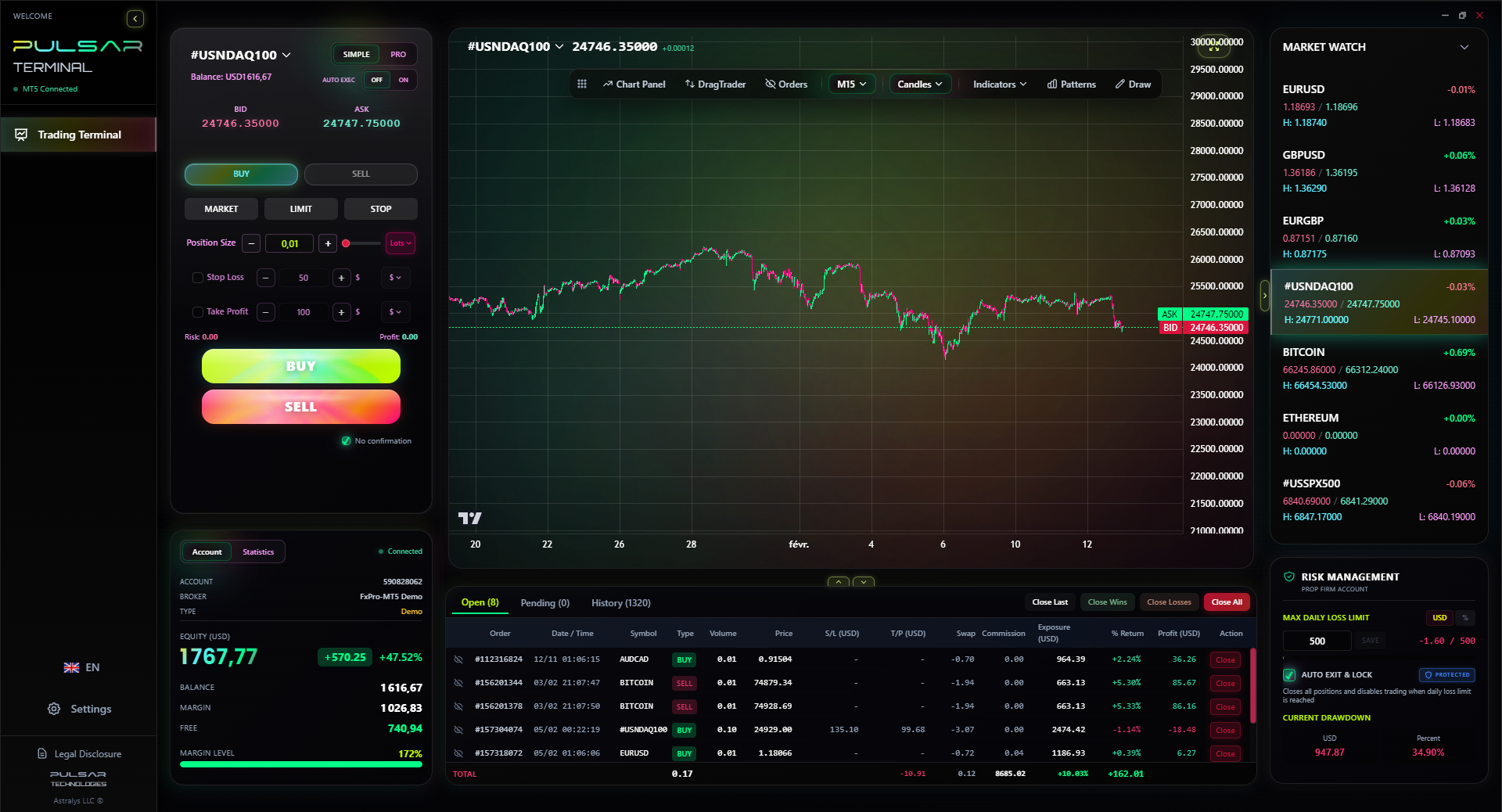
Managing the intense psychology of prop firm challenges requires iron-clad rules, which is where automating your daily loss limits and trade management with a tool like Pulsar Terminal becomes not just helpful, but essential for survival.
Pulsar Terminal
MT5一站式工具:拖拽下单、多重止盈/止损、追踪止损、网格交易、成交量分布图和自营交易保护。每日1000+交易者使用。
“Your first R10,000 is tuition, not capital. Don't try to graduate in a week.”
Trading is 30% strategy, 70% psychology and logistics.
Platforms: MT4/MT5 are industry standards for a reason. They're strong. But the native platforms lack advanced order management. Early on, I missed countless optimal exits because manually moving a stop-loss or taking partial profits was too slow and emotional.
The Mindset Shift: You are a risk manager first, a trader second. Your goal isn't to be right on every trade. Your goal is to execute your plan perfectly, whether that trade wins or loses. A well-managed loss is a successful trade. A poorly managed win is a failure.
Continuous Learning: Don't just watch price. Understand the macro. Why is the Fed raising rates? What does China's GDP mean for commodity demand? This context turns random price moves into narratives you can potentially anticipate.
Finally, have an exit strategy - for the day, and for the career. Set daily loss limits (e.g., -3% of account) and daily profit targets where you walk away. And always ask yourself: 'If I lost everything in this account, would my life change fundamentally?' If the answer is yes, you're trading with too much money. This is a marathon of consistency, not a sprint to a single payday.
FAQ
Q1What is the minimum amount I need to start forex trading in South Africa?
Technically, you can start with as little as R200 with some brokers. But realistically, you need enough to survive your learning phase. I'd strongly suggest a minimum of R5,000 - R10,000. This allows for proper position sizing (risking 1% or R50-R100 per trade) and can withstand a string of losses without blowing up. Starting with R200 often leads to taking reckless, oversized risks just to see meaningful profit.
Q2Can I use international brokers, or must I use an FSCA-regulated one?
You can use international brokers, but it comes with significant risk. If you have a dispute with an unregulated offshore broker, the FSCA cannot help you. Your funds may not be segregated. Always prioritize brokers with a strong regulatory license, preferably the FSCA or a top-tier authority like ASIC (Australia) or CySEC (Cyprus). Many like IC Markets or Pepperstone hold multiple licenses.
Q3How do I pay tax on my forex trading profits to SARS?
Forex trading profits are considered income from a business or speculative activity. You must declare your net profit (total profits minus total losses and allowable expenses) in your annual tax return. Keep careful records of every trade, all platform statements, and receipts for expenses like internet, trading software, and education. It's wise to consult a tax practitioner familiar with trading income.
Q4Is USD/ZAR the best pair for South African beginners to trade?
Absolutely not. Its volatility is extreme. A beginner is likely to be stopped out quickly by normal market noise. Start with major pairs like EUR/USD or GBP/USD. They have lower spreads, higher liquidity, and more predictable movements during major sessions. Once you have a solid grasp of risk management, you can then cautiously explore USD/ZAR.
Q5What's the biggest mistake young South African traders make?
Using excessive use, especially on the Rand. They see a potential 200-pip move on USD/ZAR and think of the profit, not the loss. They use 50:1 or 100:1 use, and a normal 100-pip move against them wipes out 50-100% of their account. They treat use as a profit multiplier, when it's primarily a risk amplifier.
Q6How long should I demo trade before going live?
Trade on demo until you have a written trading plan and can follow it consistently for at least two consecutive months with a positive expectancy. Not just two months of winning, but two months of executing your rules perfectly - including stop losses, take profits, and position sizing. The moment you break your own rules on demo, the clock resets. This isn't about learning the platform; it's about disciplining your mind.
Winston 教授的课程
要点总结:
- ✓Risk max 1% per trade, no exceptions.
- ✓FSCA regulation is non-negotiable for broker choice.
- ✓Master low use (5:1) before even considering high.
- ✓USD/ZAR is a dangerous beginner's trap.
这篇文章对您有用吗?
点击星星评分
每周交易洞察
免费每周分析与策略。无垃圾邮件。
关于作者
David van der Merwe
新兴市场交易员
约翰内斯堡交易者,11年新兴市场货币经验。专注于ZAR货币对、FSCA监管交易和南非市场分析。
评论
风险提示
金融工具交易存在重大风险,可能不适合所有投资者。过往业绩不代表未来表现。本内容仅供教育目的,不构成投资建议。在交易前请务必自行研究。
您可能还喜欢

Cara Trading Forex Sukses: 7 Prinsip dari Trader Profesional
Cara trading forex sukses dengan 7 prinsip trader pro: manajemen modal, disiplin, journal trading, backtest. Data nyata, bukan janji profit palsu.
Jam Trading Forex Terbaik untuk Trader Indonesia: Panduan Lengkap dengan Tabel Waktu
Panduan jam trading forex untuk trader Indonesia. Tabel 4 sesi dunia, jam emas 20:00-00:00, sesi mana yang harus dihindari. Data akurat + tips dari trader berpengalaman.
Top 5 Sàn Forex Uy Tín Nhất 2026: Review Jujur dari Trader Indonesia
Top 5 sàn forex uy tín 2026 untuk trader Indonesia. Review jujur: spread, deposit, withdraw, dukungan lokal. Exness, XM, IC Markets & lebih.
