
Leverage

LEH-vuh-rij (American) or LEE-vuh-rij (British)since Early 1990s interbank forex eraLeverage — like a financial magnifying glass — it lets you control huge market positions with just a small deposit, amplifying both your wins and losses.
§1So, what IS leverage anyway?
Okay, picture this: you're at a carnival and you want to win that giant stuffed owl (what? I like owls). You've only got $10 in your pocket, but the game costs $100 to play. Leverage is like your rich friend saying, 'Here, borrow my $90 — we'll split the prize if you win!' Suddenly, you're playing a $100 game with just $10 of your own money. That's exactly what leverage does in trading. It's borrowed capital from your broker that lets you control positions WAY bigger than your actual account balance. Think of it as a financial superpower — you can move mountains with just a teaspoon of your own effort. But here's the catch, my friend: just like that carnival game, if you lose, you lose your $10 AND you owe your friend. I've seen traders blow accounts over this, so let's get this right from the start.
§2The math (don't run away — it's simpler than it looks!)
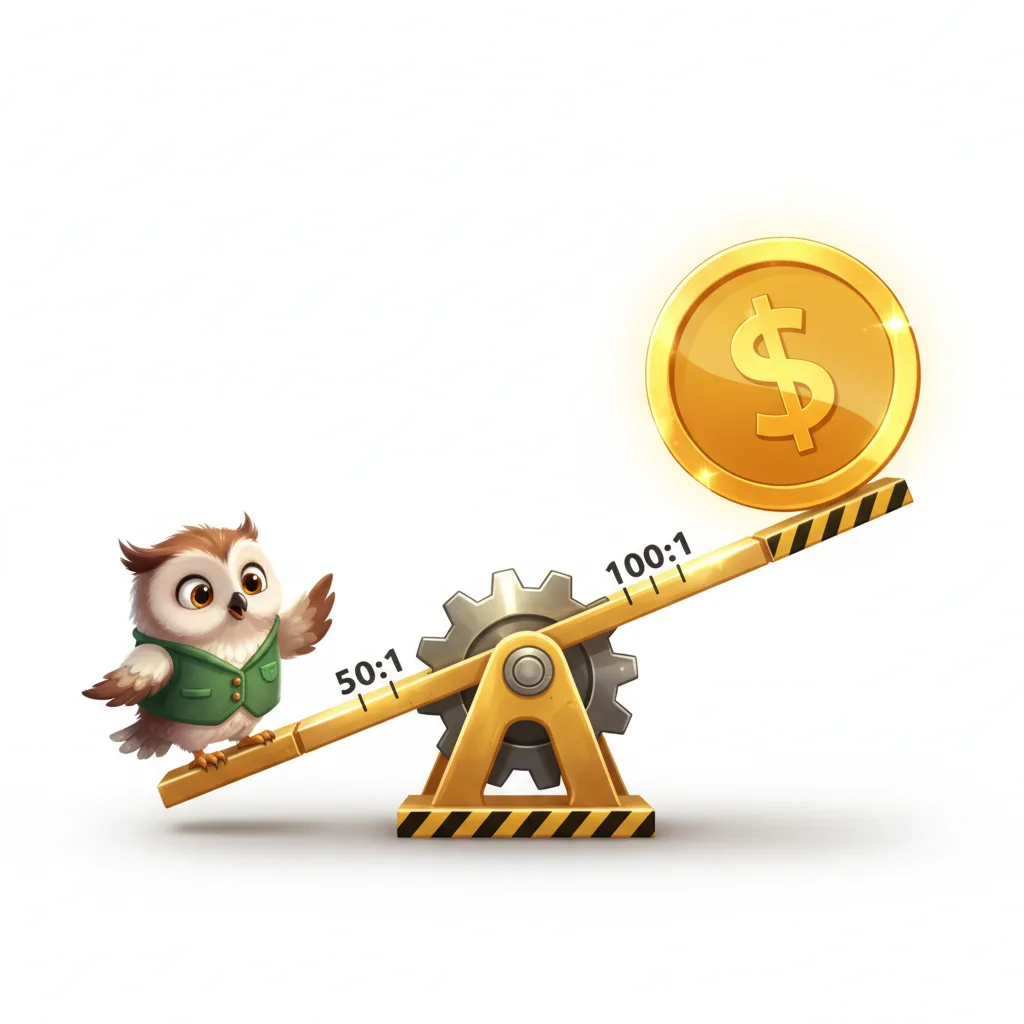
Alright, let's make this painless. Leverage is usually shown as a ratio like 50:1 or 100:1. Here's the magic formula: Required Margin = Position Size ÷ Leverage Ratio. See? Not so scary! If you want to control a $100,000 position with 50:1 leverage, you'd need $100,000 ÷ 50 = $2,000 of your own money as margin. That margin is your skin in the game — it's collateral, not a fee. Think of it like a security deposit on an apartment. The higher the leverage ratio, the less margin you need. 100:1 means you only need 1% of the position value. 500:1? That's just 0.2%! But remember — the flip side is that tiny price movements become huge percentage moves on your margin. A 1% market move with 50:1 leverage becomes a 50% gain or loss on your deposit. Yikes!
§3Let's walk through this step-by-step
Let's say you're eyeing EUR/USD at 1.0800. You want to buy 1 standard lot (that's 100,000 euros). Without leverage, you'd need $108,000! But with 30:1 leverage, you only need $108,000 ÷ 30 = $3,600 as your margin deposit. Now here's where it gets exciting. If EUR/USD moves just 10 pips to 1.0810, you make 10 pips × $10 per pip = $100 profit. That's a sweet 2.8% return on your $3,600 in minutes! But if it moves against you by 10 pips to 1.0790, you lose that same $100. See how leverage amplifies everything? Let's try gold: at $4,127.80 per ounce, one standard lot (100 ounces) is worth $412,780. With 20:1 leverage, you need $20,639 margin. A mere 1% price move gives you a $4,127.80 profit or loss — that's 20% of your margin! It's like riding a rollercoaster with the safety bar only halfway down.
§4The weird exceptions nobody warns you about
Now, here's where things get quirky. First, those fancy 500:1 or 1000:1 leverage ratios you see advertised? Those are usually from offshore brokers with less regulation. In regulated markets like the EU and UK, caps keep things safer: 30:1 for major pairs, 20:1 for gold, 10:1 for commodities, 5:1 for stocks, and just 2:1 for cryptocurrencies (because crypto is already wild enough!). Also, some brokers use 'dynamic leverage' — the bigger your trade, the lower your leverage. It's like a parent saying 'you can borrow the car, but only if you promise to drive slowly.' And don't get me started on JPY pairs — while most currencies count pips at the fourth decimal (0.0001), yen pairs use the second decimal (0.01). It's like everyone agreeing to measure in inches except that one friend who insists on centimeters.

§5Three examples that'll make it click
Let's look at some real scenarios:
| Scenario | Instrument | Entry Price | Exit Price | P&L on Margin |
|---|---|---|---|---|
| EUR/USD win | EUR/USD | 1.0800 | 1.0810 (+10 pips) | +$100 on $3,600 margin (+2.8%) |
| EUR/USD loss | EUR/USD | 1.0800 | 1.0790 (-10 pips) | -$100 on $3,600 margin (-2.8%) |
| Gold 1% move | XAU/USD | $4,127.80 | $4,169.08 (+1%) | +$4,127.80 on $20,639 margin (+20%) |
Imagine you bought EUR/USD at 1.0800 because you thought the Euro would strengthen. With 30:1 leverage, that 10-pip move to 1.0810 gives you $100 — not bad for a small market wiggle! But if you guessed wrong and it dropped to 1.0790, you'd lose that same $100. My first year trading, I learned this the hard way when I used 100:1 leverage on a tiny account. A 20-pip move against me wiped out 40% of my capital. Trust me, start small!
§6Where this thing even came from
The concept of 'leverage' comes from the physical lever — you know, that thing Archimedes said could move the world with a long enough stick? In finance, it's been around forever, but in retail forex trading, high leverage became widely available in the 1990s and 2000s. Suddenly, regular folks could trade like big banks! But here's the problem: many traders got burned. They'd use 500:1 leverage, make a wrong move, and poof — account gone. Regulators stepped in. In 2018, ESMA (European Securities and Markets Authority) said 'enough!' and capped leverage for retail traders. Now in the EU and UK, you're looking at 30:1 max for major pairs. The FCA followed suit. It was like putting training wheels on a motorcycle — still powerful, but less likely to send beginners flying into a tree.
§7Key takeaways
- Leverage is a double-edged sword — it amplifies BOTH profits AND losses, so respect it!
- Start with low leverage (10:1 to 30:1) while learning — you'll thank me later.
- Always calculate your required margin: Position Size ÷ Leverage Ratio = Your Risk.
- Regulated brokers offer caps (30:1 max for majors) and negative balance protection — use them!
§8Frequently asked questions
QWhat's a good leverage ratio for beginners?
QCan you lose more than your initial deposit with leverage?
QWhat's the difference between leverage and margin?
QHow does leverage magnify profits and losses?
QIs high leverage always risky?
§See also
§References
- ESMA Leverage Caps Regulation — European Securities and Markets Authority
- Forex Leverage Guide — The Trading Mentor