

Risk-Reward Ratio
Risk-Ree-ward Ray-shee-ohsince Mid-20th century with Modern Portfolio Theory formalizationRisk-Reward Ratio — It's the simple measure of how much you might win versus how much you could lose on a trade — your trading profit-to-loss compass.
§1So, what IS this Risk-Reward Ratio thing?
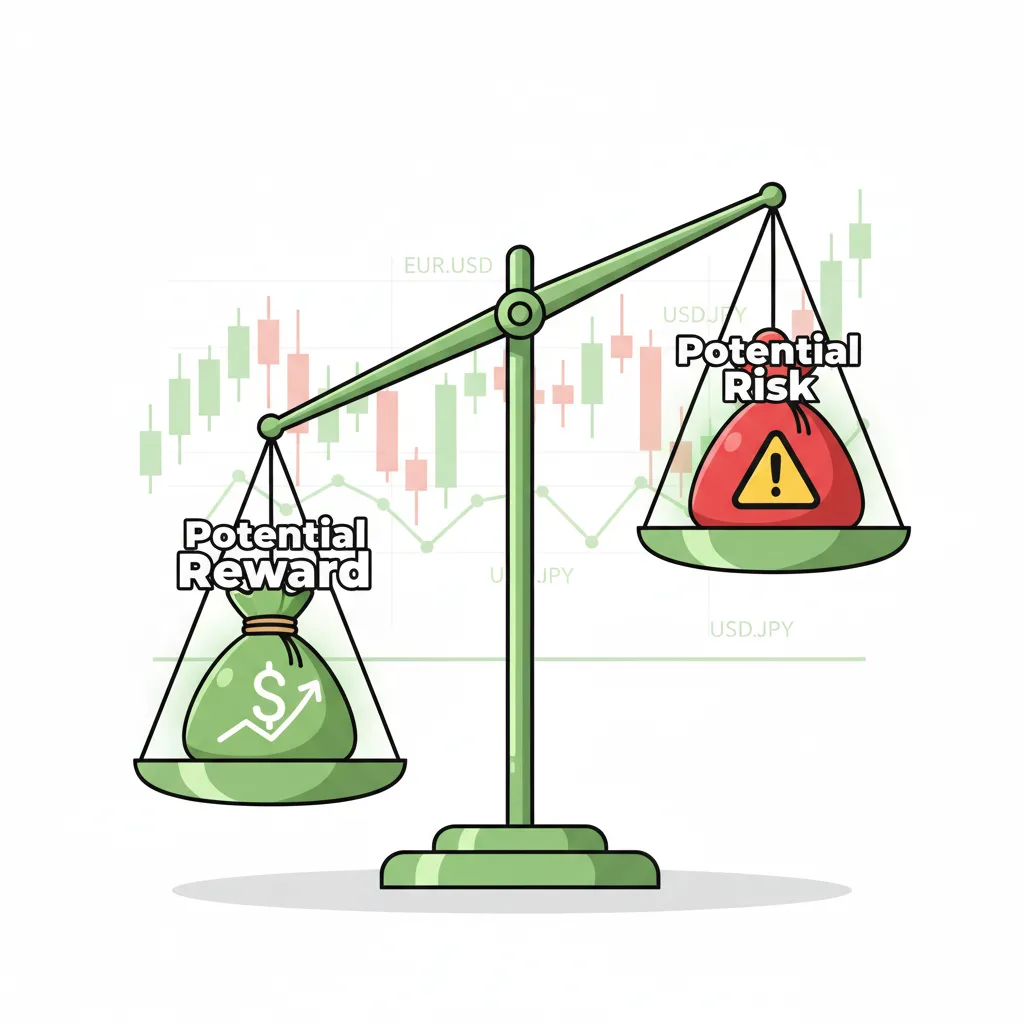
Okay, picture this: you're at a carnival game. You pay $1 to toss a ring, and if you win, you get a $3 stuffed owl (my favorite!). That's a 1:3 risk-reward ratio right there — you're risking one buck to potentially make three. In trading, it's the exact same concept, just with more zeros and fewer carnival smells. It's your trading profit-to-loss compass, telling you whether a trade is worth taking before you even click 'buy' or 'sell'. I've seen traders blow accounts over ignoring this simple ratio, thinking they could just 'feel' their way through. Trust me, you can't. Your emotions will lie to you; the R/R ratio won't. It's that objective friend who says, 'Hey, is this really worth it?' before you do something you'll regret.
§2The math (don't run away — it's simpler than it looks!)
Here's the secret formula that sounds fancy but is actually kindergarten math: Risk-Reward Ratio = Potential Loss ÷ Potential Profit. That's it! You're just dividing what you might lose by what you hope to gain. Some folks flip it (Reward ÷ Risk) and call it 1:X — same difference. To get those numbers, you need your entry price, your stop-loss (where you'll admit defeat), and your take-profit (where you'll take your winnings and run). For a long trade: Potential Loss = Entry Price - Stop-Loss. Potential Profit = Take-Profit - Entry Price. See? No advanced calculus required. It's just measuring distances on your chart. The magic happens when you express it as a clean ratio like 1:3, which instantly tells you the trade's potential efficiency.
§3Let's walk through a real trade together
Imagine you're eyeing EUR/USD. The price is sitting at 1.1200, and your analysis says it might climb. You decide: 'I'll buy here, but if it drops to 1.1150, I'm out — that's my stop-loss.' That's 50 pips of risk (1.1200 - 1.1150 = 0.0050). Now, where's your profit target? Let's say 1.1350 looks like a solid resistance level. That's 150 pips of reward (1.1350 - 1.1200 = 0.0150). Do the division: 50 pips risk ÷ 150 pips reward = 1/3, or a 1:3 Risk-Reward Ratio. Beautiful! For every dollar you're risking, you're aiming to make three. If you're trading a standard lot where 1 pip = $10, that's risking $500 to potentially make $1,500. Now that's a trade setup that lets you sleep at night.
§4The weird exceptions nobody warns you about
First up: JPY pairs. They're the quirky cousin in the forex family. While most pairs like EUR/USD use four decimal places (where 0.0001 = 1 pip), JPY pairs like USD/JPY use two (where 0.01 = 1 pip). Don't worry — your trading platform does the math, but it's good to know why the numbers look different. Then there's leverage — oh, leverage. In the U.S., you're capped at 50:1 for major pairs, but some offshore brokers offer crazy levels like 500:1. Higher leverage amplifies everything, making your R/R ratio even more critical. One wrong move with high leverage and poor risk-reward? That's how accounts vanish. Also, market conditions matter. Aiming for 1:3 in a choppy, range-bound market might be like trying to surf in a kiddie pool — unrealistic. Sometimes 1:1.5 is the smart play.

§5Three examples that'll make it click
Let's look at some concrete setups. First, that EUR/USD long we just walked through: Entry 1.1200, Stop 1.1150 (50 pips risk), Take-Profit 1.1350 (150 pips reward) = 1:3 R/R. Second, a short USD/JPY trade: You sell at 147.80, with a stop at 148.30 (50 pips risk) and a target at 146.30 (150 pips reward). Again, 50 ÷ 150 = 1:3. See the pattern? Now, what about a not-so-great trade? Imagine buying GBP/USD at 1.2800 with a stop at 1.2750 (50 pips risk) but only targeting 1.2850 (50 pips reward). That's 50 ÷ 50 = 1:1. You're risking as much as you hope to gain — basically flipping a coin. Most pros avoid these like expired milk.
| Scenario | Pair | Entry | Stop | Target | R/R Ratio | Verdict |
|---|---|---|---|---|---|---|
| Solid Trend Play | EUR/USD | 1.1200 | 1.1150 | 1.1350 | 1:3 | 👍 Great setup |
| Range Trade | GBP/USD | 1.2800 | 1.2750 | 1.2850 | 1:1 | 👎 Avoid (gambling territory) |
| JPY Short | USD/JPY | 147.80 | 148.30 | 146.30 | 1:3 | 👍 Excellent risk-reward |
§6Where this whole 'managing risk' idea even came from
People have been trying to manage risk since ancient times — think Mesopotamians storing grain for bad harvests. But the formal finance stuff? That kicked off in the 1950s when Harry Markowitz gave us Modern Portfolio Theory, showing how to balance risk and reward mathematically. Fast forward to the 1990s: banks hired physicists and mathematicians (the original 'quants') who created tools like Value-at-Risk. Then 2008 happened. The financial crisis was a brutal reminder that ignoring risk management is like building a house on sand. Regulations tightened, and risk management evolved from an end-of-day report to a real-time, gotta-watch-it-every-second function. Today, with AI and big data, we're better equipped than ever — but the core principle remains: know what you're risking before you hope to gain.
§7Key takeaways
- Always aim for at least a 1:2 Risk-Reward Ratio — risking $1 to make $2 keeps the odds in your favor.
- Combine your R/R ratio with position sizing: risk only 1-2% of your account per trade to survive the inevitable losing streaks.
- With a 1:3 ratio, you only need a 25% win rate to break even — profitability isn't about being right most of the time.
- Your stop-loss and take-profit define your ratio; place them before you enter, not while you're sweating over price movements.
§8Frequently asked questions
QWhat's a good Risk-Reward Ratio for trading?
QHow do I actually calculate the Risk-Reward Ratio?
QWhy is this ratio so important?
QCan I be profitable with more losses than wins?
QDoes this work for scalping too?
§See also
§References
- Modern Portfolio Theory (Markowitz, 1952) — Journal of Finance
- RiskMetrics Technical Document (J.P. Morgan, 1996) — J.P. Morgan