


I lost ₹4.5 lakh in 2021.

Rajesh Sharma
Senior Forex Analyst ·  India
India
☕ 10 min read
What you'll learn:
- 1The Aarudhra Scam Unpacked: How It Worked and Why It Hooked So Many
- 2Legitimate Gold Trading Avenues in India: From SGBs to MCX
- 3Taxes and Regulations You Must Know (It's Not Simple)
- 4Choosing a Safe Broker or Platform: Red Flags vs. Green Lights
- 5My Gold Trading Framework (Post-Aarudhra)
- 6Staying Informed with REAL News (Not Hype)
- 7Final Thoughts: Protecting Your Capital is Your #1 Job

I lost ₹4.5 lakh in 2021. Not to a bad trade, but to a promise. A friend's cousin swore by Aarudhra Gold Trading, talking about 30% monthly returns, gold coin gifts, and a 'can't lose' system. I ignored every red flag because the greed was too loud. I transferred the money. For two months, I got my 'interest.' Then, silence. The website vanished, the numbers disconnected. That's when the real Aarudhra Gold Trading news hit the papers: a Ponzi scheme, over one lakh victims, ₹2,438 crore gone. This article isn't just about that scam. It's about what I learned the hard way, and how you can trade gold in India without getting robbed.
Let's be clear: Aarudhra Gold Trading was never a trading platform. It was a brilliantly packaged lie. Operating from Chennai, they promised the moon: 25-30% monthly interest. Do the math. That's 300-360% per year. In a country where fixed deposits give you 7%, that number alone should trigger alarms. But they layered on legitimacy. They had offices, agents (over 49 were arrested), and a sophisticated referral program paying 2% commissions. They gave out physical gold coins as 'bonuses,' making the whole operation feel tangible and real.
The scheme ran from September 2020 to its collapse in May 2022. The Economic Offences Wing (EOW) and later the Enforcement Directorate (ED) stepped in. The main accused, V Rajasekar, was finally detained in Abu Dhabi in late 2023. The ED has been attaching assets, including ₹22 lakh in cash and property documents worth over ₹1.5 crore seized in late 2025 searches. This is a classic Ponzi: pay old investors with money from new ones until the music stops.

Warning: Any 'investment' offering guaranteed monthly returns above 12-15% in India is almost certainly a scam. Legitimate trading involves risk and volatility, not fixed, extravagant payouts.
My mistake was not asking how they generated these returns. A real gold trader knows the margins. Even with use, consistent 30% monthly gains are a fantasy reserved for storybooks, not brokerage statements. The promise of a referral bonus also clouded my judgment; it turned investors into recruiters, creating a viral loop of trust based on personal relationships, not due diligence.

💡 Winston's Tip
If a gold 'opportunity' requires an explanation more complex than a lemonade stand's finances, it's not an opportunity. It's a confusopoly designed to separate you from your money.
“The promise of a referral bonus clouded my judgment; it turned investors into recruiters, creating a viral loop of trust based on personal relationships, not due diligence.”
After my Aarudhra disaster, I went back to the basics. India has strong, regulated channels for gold exposure. You just need to know where to look.
Sovereign Gold Bonds (SGBs): Issued by the RBI, these are my go-to for long-term, set-and-forget gold exposure. You don't own physical metal, but a bond denominated in grams of gold. The minimum is 1 gram. The killer feature? A 2.5% annual interest paid semi-annually. Capital gains on maturity (8 years) are tax-free. The interest, however, is taxable. I started a laddering strategy with SGBs, buying a bit every new tranche. It's boring, safe, and effective.
Gold ETFs and Mutual Funds: These are SEBI-regulated funds that track domestic gold prices. You buy and sell units on the stock exchange just like a stock. The expense ratios are low (around 0.5-1%). This is perfect for a tactical, shorter-term trade without the hassle of physical storage. I use a simple swing trading approach with Gold ETFs, using the RSI indicator on weekly charts to spot overbought or oversold conditions.
Trading Gold Futures on MCX: This is for the serious trader. The Multi Commodity Exchange (MCX) offers gold futures contracts. This is leveraged, derivative trading - high risk, high reward. You're speculating on price movements. The contract size is 1 kg for the primary contract, but there are mini (100 gm) and micro (1 gm) versions now, making it more accessible.
Digital Gold: Platforms like MMTC-PAMP or SafeGold let you buy fractional, 24K digital gold starting from ₹1. It's convenient, but listen up: it sits in a regulatory grey area. SEBI has warned advisors against selling it. Your holding is only as safe as the platform's custodian. I use it for tiny, incremental savings, never for a core position.
| Method | Regulator | Best For | Key Risk |
|---|---|---|---|
| Sovereign Gold Bonds (SGBs) | RBI | Long-term investors | Interest rate risk, lock-in period |
| Gold ETFs | SEBI | Short-to-medium term traders | Market price volatility |
| MCX Futures | SEBI | Experienced, leveraged traders | High use, margin call risk |
| Digital Gold | Grey Area | Micro-savings, convenience | Counterparty/custodian risk |

“A 15% gain on paper can be a 7% gain in your pocket after STCG tax and spreads.”
Trading gold profitably means keeping what you earn after taxes. Get this wrong, and the IT department becomes your worst trade.
Capital Gains Tax is King:
- Short-Term Capital Gains (STCG): Sell any gold asset (physical, ETF, etc.) within 3 years of purchase? The profit gets added to your annual income and taxed at your slab rate. Could be 30%+.
- Long-Term Capital Gains (LTCG): Hold for over 3 years? The gain is taxed at 20% with indexation benefit. Indexation adjusts your purchase price for inflation, significantly reducing your taxable profit. This is a huge advantage for long-term holders.
The SGB Exception: Remember, SGBs have unique tax treatment. Redemption at 8-year maturity is totally tax-free. The 2.5% annual interest is taxable as per your slab.
GST on Purchase: When you buy physical gold or jewellery, you pay 3% GST on the gold value + 5% GST on making charges. This upfront cost immediately puts you in a hole; the price needs to rise just for you to break even.

Pro Tip: Always calculate your post-tax, post-cost return. A 15% gain on paper can be a 7% gain in your pocket after STCG tax and spreads. Use a position size calculator that factors in transaction costs to see your real break-even point.
Recent Regulatory Shifts (2025-2026): The landscape is changing. SEBI now requires mutual funds to value physical gold using Indian exchange spot prices, not London (LBMA) benchmarks. More importantly, from April 2026, the RBI restricted using gold bars and Gold ETF units as loan collateral. This aims to de-risk the system but affects liquidity for some loan structures. Staying updated on such aarudhra gold trading news from legitimate regulatory bodies (RBI, SEBI) is part of the job.
💡 Winston's Tip
Your first calculation on any gold trade should be the post-tax, post-cost return. The price on the screen is a lie until you factor in GST, brokerage, and the taxman's share.
“A 15% gain on paper can be a 7% gain in your pocket after STCG tax and spreads.”
My Aarudhra loss taught me to vet platforms with paranoid intensity. Here's my checklist.
Green Lights (What to Look For):
- SEBI or RBI Registration: This is non-negotiable. For trading Gold ETFs or MCX futures, your broker must be registered with SEBI. For SGBs, you buy through banks or recognized stock exchanges. Check the regulator's website for the entity's name.
- Transparent Fee Structure: Clear listing of brokerage, GST, STT, stamp duty, and spread. If the fee page is vague, run.
- Established Track Record: How long have they been operating? A decade is a good baseline.
- Segregated Client Accounts: Your money and gold holdings should be held in separate, trust-managed accounts, not mixed with the company's operational funds.
Red Flags (Run Away):
- Guaranteed Returns: The biggest one. Repeat after me: No legitimate market participant guarantees profits.
- Urgency & Secrecy: "Offer closing soon!" "This exclusive deal can't be discussed publicly." Pressure and secrecy are tools of fraud.
- Complex or Opaque Payouts: If you can't easily understand how and when you get your money or profits, it's a trap.
- Payment to Personal Accounts: Legitimate companies have corporate bank accounts. Never transfer funds to an individual's savings account.
For international brokers offering XAU/USD (gold vs US dollar), which I sometimes use for a different market angle, I only use those with top-tier global regulation and a strong presence. I've had reliable execution with Exness for their flexible account types and IC Markets for their raw spreads. Always start with a small, test deposit.

“News confirms the trend, but it shouldn't dictate your entry.”
This is what I built after picking up the pieces. It's not glamorous, but it's kept me in the game.
The 70-20-10 Allocation Rule
- 70% Core (SGBs): This is my foundation. Bought systematically, held to maturity. It's for wealth preservation, not speculation.
- 20% Tactical (Gold ETFs): This is my trading pool. I use technical analysis on the ETF charts. A simple moving average crossover (50-day and 200-day) helps me gauge the medium-term trend. I might use a scalping strategy on international XAU/USD during high-volatility sessions, but that's a small part of this bucket.
- 10% Speculative (MCX Mini): This is my 'high-conviction' play money. I only deploy this when I see a very clear chart pattern or a fundamental macro trigger (like a sharp drop in the rupee). The use here is dangerous, so my stop-losses are tight and non-negotiable.
Entry, Exit, and the Pain of Being Wrong
I don't try to catch the exact bottom. I scale in. For a tactical ETF trade, I might buy 50% of my planned position at a support level, and the other 50% if it holds and starts to bounce. My exit is based on a risk-reward ratio. If I risk 5 points (₹5 per gram), I want a target of at least 15 points. I use the MACD indicator on the daily chart to watch for momentum shifts that might signal an early exit.
I got burned on MCX in early 2025. Gold was in a strong uptrend, and I went long on a mini contract at ₹81,500 per 10gm, expecting the rally to continue. I placed a stop-loss at ₹80,800. A sudden, sharp dollar rally hit commodities. My stop was triggered. Loss: about ₹7,000 on the contract. It stung, but it was 1.4% of my total gold portfolio. The old me from the Aarudhra days would have 'averaged down' and watched the loss balloon. The new me took the hit, stepped back, and re-evaluated. The discipline saved me from a much larger disaster as gold dipped further.
💡 Winston's Tip
When trading MCX gold futures, your position size isn't about how much you can make. It's about how much you can afford to lose without it affecting your next trade or your sleep. Under-use is a skill.
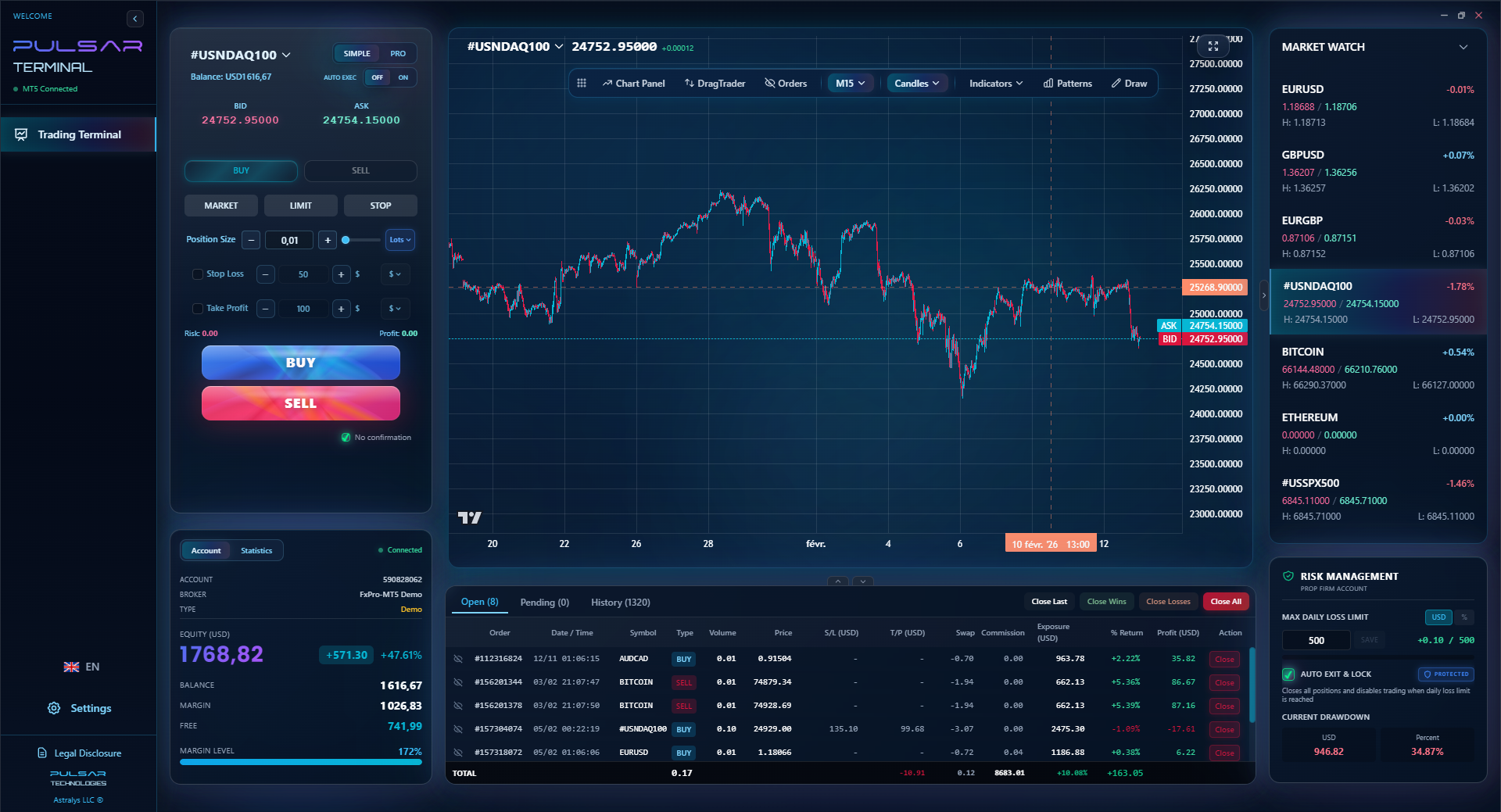
Managing multiple gold positions across SGBs, ETFs, and MCX requires precision; Pulsar Terminal's drag-and-drop order management on MT5 lets you set multi-level take-profits and stop-losses for each leg of your strategy in seconds.
Pulsar Terminal
The all-in-one MT5 companion: drag-and-drop orders, multi-TP/SL, trailing stop, grid trading, Volume Profile, and prop firm protection. Used by 1,000+ traders daily.
“News confirms the trend, but it shouldn't dictate your entry.”
Filtering signal from noise is critical. You need to ignore the '30% return' newsletters and focus on data.
Trusted Sources:
- Regulatory Websites: SEBI and RBI press releases. Dull? Yes. Essential? Absolutely.
- MCX Official Site: For domestic futures data, settlement prices, and circulars.
- Macroeconomic Data: RBI policy rates, US Fed decisions, INR/USD trends, and global crude prices (they often correlate with gold).
- Financial News (Skeptically): Reputed business newspapers. I read headlines for events, but I never take trading advice from them.
What I Ignore:
- Telegram channel 'tips.'
- YouTube videos with sensational thumbnails promising 'secret gold strategies.'
- Any message that uses the phrase 'gold trading news' in a way that feels like marketing instead of reporting.
The recent aarudhra gold trading news about the ED's ongoing asset seizures is a reminder that scams have long tails. Following this story isn't about gossip; it's a periodic vaccination against greed, reminding you of the consequences when vigilance fails.

Example: In Jan 2025, MCX Gold was at ~₹81,000. By Jan 2026, it hit ~₹1,67,000. A 106% move in a year. The hype was everywhere. But buying at the peak in Jan '26 because of FOMO would have led to a ~10% drawdown in the following weeks. News confirms the trend, but it shouldn't dictate your entry.
“Your capital is your army. Don't send it into a warzone based on a rumour.”
The Aarudhra scam, and my own ₹4.5 lakh lesson, boils down to one thing: the suspension of disbelief in pursuit of easy money. Trading gold - or anything - legitimately is a grind. It's about managing risk more than chasing reward.
Your capital is your army. Don't send it into a warzone based on a rumour. Deploy it in secure, regulated territories. Diversify your tactics (long-term SGBs, tactical ETFs). And for the love of all that's holy, understand the tax implications before you trade.
Gold will always be a part of the Indian portfolio. The question is, will it be a source of wealth, or a story of loss? That choice comes down to the platform you choose, the news you trust, and the discipline you keep. Let my expensive lesson be your free one. Start small, think long-term, and verify everything twice. The market will give you plenty of opportunities. Your job is to make sure you're still solvent to take them.
FAQ
Q1What was the Aarudhra Gold Trading scam?
It was a massive Ponzi scheme based in Chennai that defrauded over 100,000 investors of roughly ₹2,438 crore between 2020 and 2022. The company promised impossible monthly returns of 25-30%, paid early investors with money from new ones, and collapsed when the inflow stopped. It was not a legitimate trading platform.
Q2What are the safest ways to invest in gold in India?
The safest, regulated methods are: 1) Sovereign Gold Bonds (SGBs) from the RBI (tax-free gains at maturity, plus interest), 2) SEBI-regulated Gold ETFs traded on the stock exchange, and 3) Gold Mutual Funds. Avoid unregulated schemes promising fixed, high returns.
Q3How are gold trading profits taxed in India?
If you sell within 3 years of purchase, profits are added to your income and taxed at your slab rate (Short-Term Capital Gains). If held for over 3 years, a 20% tax with indexation applies (Long-Term Capital Gains). SGBs redeemed at 8-year maturity are completely tax-free.
Q4Can I trade international gold (XAU/USD) from India?
Yes, through internationally regulated brokers that accept Indian clients. It involves trading in USD, so you're exposed to both gold price moves and USD/INR fluctuations. It's considered speculative and carries higher risk. Always use brokers with strong global regulation, like those reviewed on our site.
Q5What is a major red flag for a gold trading scam?
The biggest red flag is a guaranteed return, especially a high monthly one (e.g., 2-3% per month). Legitimate trading has inherent risk and volatility. Other flags include pressure to invest quickly, complex payout structures, and requests to transfer money to personal bank accounts.
Q6What happened to the main accused in the Aarudhra case?
V Rajasekar, the Managing Director of Aarudhra Gold, was detained by Interpol in Abu Dhabi in December 2023. The Enforcement Directorate (ED) continues to investigate and attach assets under the Prevention of Money Laundering Act (PMLA), with recent seizures in late 2025.
Q7Is digital gold safe to buy in India?
It's convenient but sits in a regulatory grey area. SEBI has warned against it. Your safety depends entirely on the custodian platform's integrity. It's fine for micro-savings, but don't use it for significant investment amounts. Prefer regulated options like SGBs or ETFs.
Prof. Winston's Lesson
Key Takeaways:
- ✓Guaranteed high returns are guaranteed fraud.
- ✓Always verify SEBI/RBI registration first.
- ✓Calculate returns after tax and costs.
- ✓Use SGBs for core, ETFs for tactical plays.
How useful was this article?
Click a star to rate
Weekly Trading Insights
Free weekly analysis & strategies. No spam.
About the Author
Rajesh Sharma
Senior Forex Analyst
Trading Indian and South Asian markets for over 10 years. Started with NSE currency derivatives before moving to international forex. Specializes in USD/INR and emerging market pairs.
Comments
Risk Disclaimer
Trading financial instruments carries significant risk and may not be suitable for all investors. Past performance does not guarantee future results. This content is for educational purposes only and should not be considered investment advice. Always conduct your own research before trading.
You Might Also Like

Cara Trading Forex Sukses: 7 Prinsip dari Trader Profesional
Cara trading forex sukses dengan 7 prinsip trader pro: manajemen modal, disiplin, journal trading, backtest. Data nyata, bukan janji profit palsu.
Jam Trading Forex Terbaik untuk Trader Indonesia: Panduan Lengkap dengan Tabel Waktu
Panduan jam trading forex untuk trader Indonesia. Tabel 4 sesi dunia, jam emas 20:00-00:00, sesi mana yang harus dihindari. Data akurat + tips dari trader berpengalaman.
Top 5 Sàn Forex Uy Tín Nhất 2026: Review Jujur dari Trader Indonesia
Top 5 sàn forex uy tín 2026 untuk trader Indonesia. Review jujur: spread, deposit, withdraw, dukungan lokal. Exness, XM, IC Markets & lebih.
Get Pulsar Terminal
All these calculators are built into Pulsar Terminal with real-time data from your MT5 account. One-click position sizing, automatic risk management, and instant calculations.
Get Pulsar Terminal