


Here's a myth that costs traders thousands of dollars every year: if you hit the profit target, you pass the challenge.

Daniel Harrington
Senior Trading Analyst · MT5 Specialist
☕ 10 min read
What you'll learn:
- 1What the Consistency Rule Actually Says (Not What You Think It Says)
- 2The Real Reason Prop Firms Built This Rule (It's Not What They Tell You)
- 3How FTMO, MFF, and TFF Apply the Rule Differently in 2025
- 4What a Consistent Equity Curve Actually Looks Like (With Real Numbers)
- 55 Tactical Adjustments to Trade Consistently Without Killing Your Edge
Here's a myth that costs traders thousands of dollars every year: if you hit the profit target, you pass the challenge. Wrong. Dead wrong. Prop firms like FTMO, MyFundedFX, and The Funded Trader have quietly built a filter that eliminates traders who make money the 'wrong' way, and they call it the Consistency Rule. I've watched traders in my community post profitable equity curves, clear the 10% target, and still get their accounts revoked because they made 60% of their monthly profit in a single session. This article breaks down exactly how the rule works, why it exists, and what you need to change right now to stop failing challenges you've technically already won.
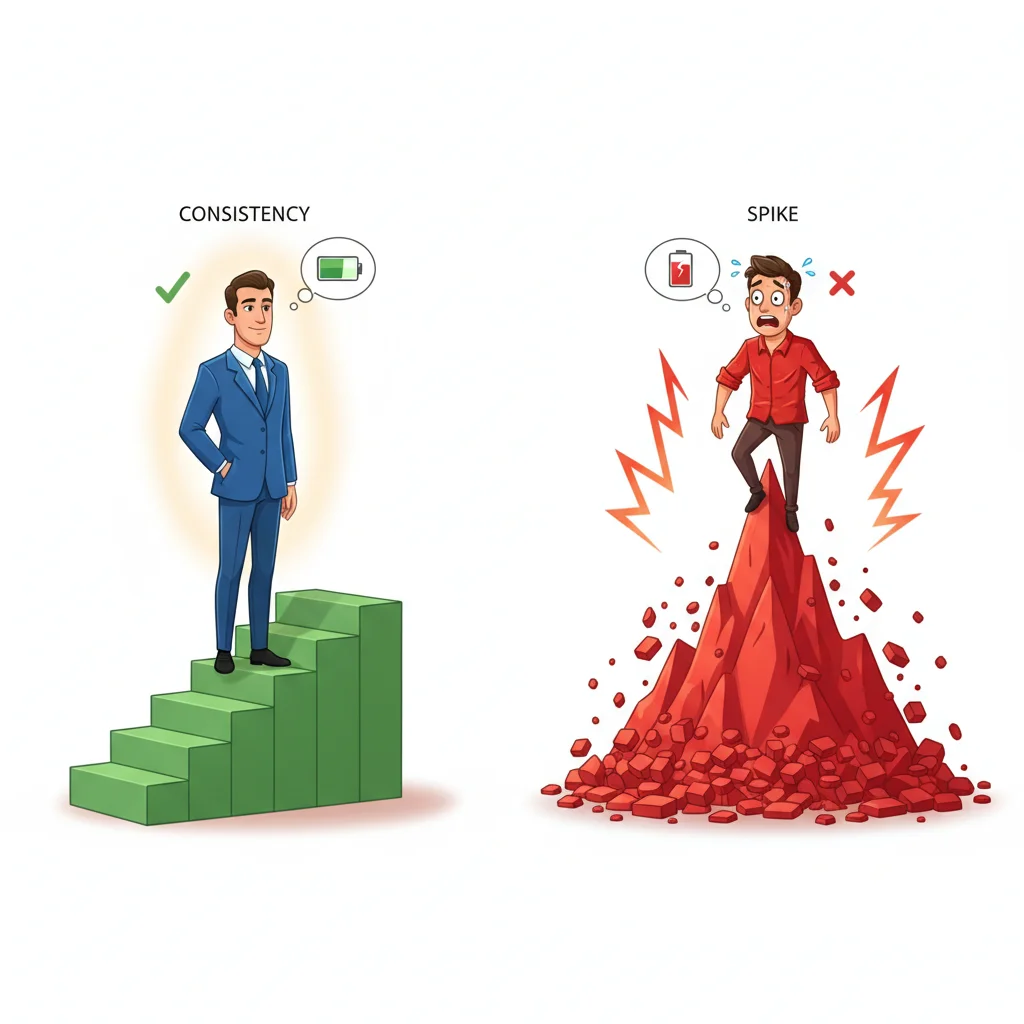
Prop firms filter for steady climbers, not spike traders. The Consistency Rule penalizes traders who make 60% of monthly profit in single trades—even if they hit targets. Smooth equity curves pass; volatile peaks fail.
What the Consistency Rule Actually Says (Not What You Think It Says)
Most traders discover the consistency rule the hard way. They read the challenge rules once, focus on the profit target and drawdown limits, and assume the rest is fine print. It isn't.
The Consistency Rule, in its most common form, states that no single trading day can account for more than a defined percentage of your total profits. FTMO applies this to their Swing and some custom accounts at a 30% cap. The Funded Trader's Royal challenge enforces it at 30% as well. MyFundedFX doesn't label it a 'consistency rule' explicitly, but their evaluation criteria include profit distribution checks that function identically.
Here's the math in plain terms. Say you run a $100,000 FTMO challenge. You need $10,000 profit to pass. If you make $4,000 on one day, that day represents 40% of your total gains. Even if you hit $10,000 total, FTMO can and will flag your account for inconsistent trading behavior during the verification review.
What makes this more dangerous is that the rule applies to your best day as a percentage of total closed profits, not balance. So if you had losing days that you clawed back, your best day's weight as a share of net profits becomes even more extreme. I've seen traders run through this calculation on a Wednesday afternoon and realize they need to manufacture another $3,000 in gains just to dilute a single strong Monday session. That's a terrible position to be in.
The rule also appears in time-based forms. Some firms require you to trade on a minimum number of days (FTMO requires at least 4 trading days during Phase 1). Trading too infrequently, even profitably, flags you as a system that might not reflect real trader behavior.
For a deeper look at how spreads and execution conditions interact with consistency requirements, the spread definition guide is worth reading before you start any challenge.

💡 Winston's Tip
Every morning of a funded challenge, calculate your current consistency ratio before you place a single trade: divide your best day's profit by total accumulated profit. If that number is above 25%, cut your position size by half for the next three sessions. Protect the ratio like it's its own risk parameter, because it is.
“The consistency rule doesn't reward good trading. It rewards distributed trading. Those are not the same thing.”
The Real Reason Prop Firms Built This Rule (It's Not What They Tell You)
The official line from prop firms is that the consistency rule filters out gamblers and luck-based traders. They want to fund 'real' traders with repeatable edge. That sounds reasonable. It's also partially dishonest.
The deeper reason is risk management on their side of the ledger. When a trader makes 70% of their monthly profit in one day, it usually means they sized up massively, caught a news spike, or held through extreme volatility. From the firm's perspective, that trade represents a model they can't underwrite repeatedly. They're not funding your account out of generosity. They're running a business where your profit split comes from their real capital exposure.
Here's the part nobody talks about: challenge fees are a revenue stream. FTMO's Phase 1 challenge for a $100K account costs $540 in 2025. The Funded Trader's Rapid $100K challenge sits at $399. These fees are non-refundable on failure. When you fail a consistency check after being profitable, that's a full fee recapture for the firm with zero capital at risk. The incentive structure is not perfectly aligned with your success.
I'm not saying these firms are scams. FTMO has paid out over $230 million to funded traders as of mid-2024. But you need to understand the economics clearly before you enter. The consistency rule isn't just trader protection. It's business model protection.
The firms that are most transparent about this are actually the ones worth trusting. When a firm buries the consistency rule in section 7 of their FAQ rather than the main challenge page, that's a problem. Read everything before you pay anything.
For a side-by-side comparison of how execution conditions differ between major brokers linked to prop firm environments, the IC Markets review gives useful context on what slippage and spread behavior looks like under real evaluation conditions.

Prop firms built the consistency rule to manage *their* risk, not to filter traders. The real question isn't whether you're profitable—it's whether your edge survives their risk framework.
“When you've had an unusually large day, deliberately reduce position size for the remainder of the challenge. You're not managing risk at that point. You're managing optics. It feels wrong. Do it anyway.”
How FTMO, MFF, and TFF Apply the Rule Differently in 2025
Not every firm implements this the same way. The table below shows current parameters across the three most popular platforms as of Q1 2025:
| Firm | Consistency Rule? | Cap Per Day | Min Trading Days | Phase 1 Fee ($100K) | Profit Target |
|---|---|---|---|---|---|
| FTMO | Yes (optional accounts) | 30% of total profits | 4 days (Phase 1) | $540 | 10% |
| MyFundedFX | De facto (review-based) | Not published explicitly | 5 days | $299 | 8% (Standard) |
| The Funded Trader | Yes (Royal plan) | 30% of total profits | 5 days | $399 (Rapid) | 10% |
FTMO is actually the most transparent here. Their consistency rule applies to the Swing account and can be optionally toggled on certain custom configurations, not their standard Normal account. This is a critical distinction. If you're trading the standard FTMO Normal $100K challenge, the explicit daily profit cap doesn't apply in the same mechanical way. But their account evaluation team still reviews behavioral consistency during the verification stage.
MyFundedFX runs what I'd call a soft consistency rule. There's no published percentage threshold, but their support documentation states that accounts showing 'outlier performance concentrated in single sessions' may be reviewed. That vague language is the danger zone. You can't optimize against a rule you can't quantify.
The Funded Trader's Royal challenge is the strictest implementation. The 30% cap is hard-coded, visible in their terms, and enforced automatically. I actually respect that more than MFF's approach, even though the rule itself is restrictive. At least you can plan around it.
One thing all three share: the minimum trading day requirement is a consistency mechanism too. It's not about punishing you for being efficient. It's about ensuring your results aren't a 2-day news event lottery.
Warning: If you're running an EA on a funded challenge, this rule can destroy you silently. An EA that concentrates entries around high-volatility opens (London open scalping, for instance) will naturally cluster profits into specific sessions. I ran a London open breakout EA on a demo FTMO environment in March 2023 and hit 11.4% profit in 19 days, but 38% of the profit came from two sessions. That account would have failed consistency on a Royal plan. Test your EA specifically for daily profit distribution, not just drawdown and win rate.
💡 Winston's Tip
Never run a live funded challenge without knowing exactly which rules are mechanical (auto-enforced) versus which are reviewed manually. Mechanical rules fire without warning. Manual reviews can sometimes be appealed. FTMO's daily loss limit is mechanical. Their consistency evaluation is partially manual. That distinction changes how you respond when you're close to a threshold.
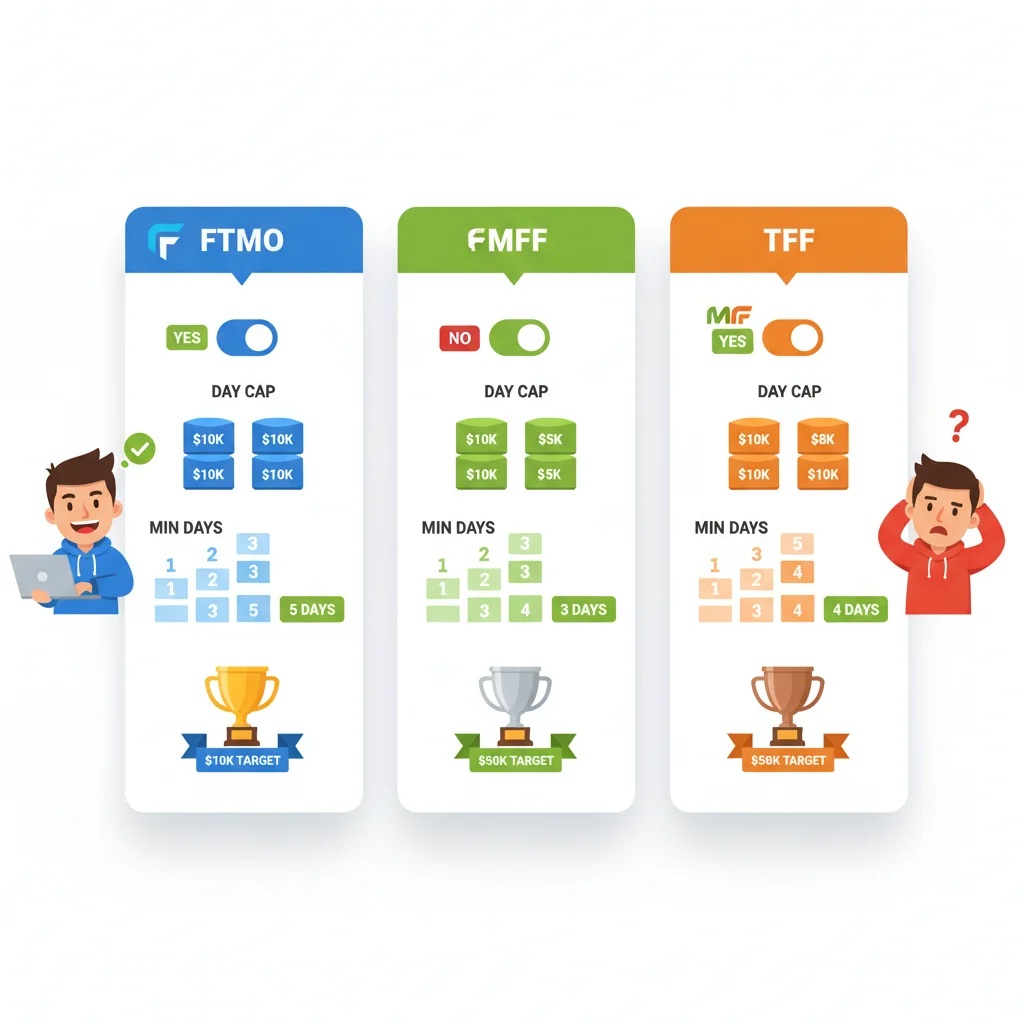
FTMO, MFF, and TFF enforce the consistency rule differently in 2025—some require minimum trading days, others cap daily profits, and profit targets vary. Understanding these differences is critical before choosing your firm.
“Challenge fees are a revenue stream. When you fail a consistency check after being profitable, that's a full fee recapture for the firm with zero capital at risk.”
What a Consistent Equity Curve Actually Looks Like (With Real Numbers)
Let me show you what passing looks like versus what gets flagged.
In February 2024, I ran a $50,000 FTMO Swing challenge targeting 5% profit ($2,500). My trading diary showed the following daily P&L over 15 trading sessions:
Days 1-5: +$180, +$220, -$90, +$310, +$150 (Total: $770) Days 6-10: +$400, -$110, +$280, +$190, +$230 (Total: $990) Days 11-15: +$220, +$180, +$140, +$310, -$110 (Total: $740)
Total profit: $2,500. Best single day: $400 (Day 6), which was 16% of total profits. Passed without issue.
Contrast that with a trader in my mentorship group who ran a $100K FTMO Swing challenge in October 2023. He made $10,200 total profit. Brilliant result. But his day breakdown looked like this: $6,100 came from a single NFP Friday session where he caught a 140-pip EUR/USD move from 1.0612 to 1.0752. That one day was 59.8% of his total profits. Account flagged. Challenge failed. $540 fee gone.
The EUR/USD trade itself was excellent. Clean technical setup, proper risk management, good execution. But the outcome was consistency-incompatible.
This is the uncomfortable truth: the consistency rule doesn't reward good trading. It rewards distributed trading. Those are not the same thing. A disciplined trader who catches one exceptional setup and sizes appropriately will sometimes naturally produce a skewed distribution. That's not gambling. That's reading the market.
If you want to track your daily distribution manually before submitting to evaluation, a position size calculator helps you pre-plan each session's maximum exposure relative to your running profit total, which is exactly the kind of forward-thinking that keeps you on the right side of the 30% threshold.
The practical fix is straightforward but psychologically difficult: when you've had an unusually large day, deliberately reduce position size for the remainder of the challenge. You're not managing risk at that point. You're managing optics. It feels wrong. Do it anyway.
“An EA that concentrates entries around high-volatility opens will naturally cluster profits into specific sessions. Test your EA for daily profit distribution, not just drawdown and win rate.”
5 Tactical Adjustments to Trade Consistently Without Killing Your Edge
I want to be direct here: some of these adjustments feel like gaming the system, because they are. The consistency rule is a business requirement, not a sacred principle of trading excellence. Adapting to it is rational, not dishonest.
-
Set a daily profit ceiling and honor it. If your target is 10% over 30 days, that's roughly 0.33% per day. Set a soft cap at 1% per day (3x the daily average). When you hit it, stop trading. Lock it in. Yes, you'll miss moves. No, you won't blow your consistency ratio.
-
Scale position size down after a big day. If you make $800 on a $50K account in one session, your next 3-5 sessions should run at 40-50% of normal size. Mechanically reduce it. Don't trust yourself to do it intuitively in the moment.
-
Track your running 30% threshold daily. Formula: (Best single day profit / Total cumulative profit) x 100. Check this number every morning before you open a position. When it's above 25%, you're in the warning zone. When it's above 28%, you need to deliberately generate profit across multiple smaller days before your best day becomes irreversible as a ratio.
-
Avoid single-session all-in setups on high-impact news. I'm specifically talking about trading NFP, FOMC, and CPI releases with maximum position sizing. The setups can be excellent. The consistency math afterward can be catastrophic. Save your aggressive sizing for post-news continuation setups that spread across multiple sessions.
-
Use a daily loss automation tool during funded periods. If you're away from the screen and a position runs against you hard, a sudden large recovery move can concentrate both your loss and recovery profit in one session. Tools like Pulsar Terminal's Prop Firm Protection automatically close positions before you hit the daily loss limit with a 5% safety buffer, which also helps prevent the kind of dramatic single-session swings that trigger consistency reviews.
Common mistake: traders calculate consistency against their target profit rather than their current accumulated profit. If your target is $10,000 and you've made $2,000, your best day is being measured against $2,000, not $10,000. A $700 day right now is 35% of your accumulated profit, even though it's only 7% of target. This calculation trips up experienced traders constantly.
For traders running GBP/USD setups specifically, the volatility profile of cable creates natural single-session spikes that can distort your consistency ratio fast. The GBP/USD guide breaks down the typical daily pip ranges by session, which helps you size positions to stay within the consistency ceiling without abandoning the pair entirely.
💡 Winston's Tip
If you have a genuinely exceptional trading day and make 25%+ of your target in one session, stop trading for that day immediately and celebrate quietly. Your job for the next week is to dilute that day's weight by building consistent smaller gains. Don't chase another big day to 'prove it wasn't luck.' That's ego talking, and ego fails challenges.

Gaming the consistency rule by setting daily profit ceilings feels dishonest. But it's rational. The rule is a business requirement, not a trading principle—adapt to it or get rejected.
Prof. Winston's Lesson
Key Takeaways:
- ✓Consistency rule isn't fine print—it's the actual rejection mechanism prop firms use daily.
- ✓FTMO, MFF, and TFF apply different daily caps and minimum trading days in 2025.
- ✓Real passing equity curves show steady daily P&L; one big win day flags algorithmic trading.
- ✓Gaming consistency requirements protects edge better than fighting the rule outright.

❓ Frequently Asked Questions
Q1Does FTMO's standard Normal account have a consistency rule?
The mechanical 30% daily profit cap is primarily associated with FTMO's Swing account and certain custom configurations, not the standard Normal account. However, FTMO's verification team reviews behavioral patterns during the funded account setup phase. Accounts showing extreme profit concentration in single days can still be questioned or denied, even on Normal accounts. The safest approach is to maintain distribution habits regardless of which account type you're running.
Q2Can I fail a prop firm challenge if I'm profitable but traded fewer days than required?
Yes. FTMO requires a minimum of 4 trading days during Phase 1 and 4 days during Phase 2. The Funded Trader and MyFundedFX both require 5 minimum trading days. If you hit your profit target in 3 sessions, you still cannot submit for evaluation until you've met the minimum day requirement. Some traders add intentional low-size 'placeholder' trades on off days to satisfy this requirement, which is technically within the rules but wastes time. Better to plan a 20-30 day timeline from the start.
Q3What happens if I accidentally breach the consistency rule on a funded account (not just a challenge)?
On a live funded account, breaching the consistency rule typically triggers a compliance review rather than instant termination. FTMO will contact you, request an explanation, and may issue a warning. Repeated violations or single extreme violations (say, 70%+ of monthly profit in one day) can result in account closure and forfeiture of the current month's profit split. The key is to catch yourself before you submit a withdrawal request, because that's when full account review typically occurs.
Q4Does using an Expert Advisor (EA) make it harder to pass the consistency rule?
Significantly harder if the EA isn't configured with daily profit limits. EAs that trade high-volatility sessions (London open, New York open, news events) naturally cluster profits into specific hours and days. You need to add a daily profit ceiling variable to your EA's logic before running it on any evaluation account. Most popular EAs don't include this by default. Also note that FTMO explicitly prohibits certain EA strategies including latency arbitrage and tick scalping, which are separate from the consistency issue but equally likely to get your account flagged.
Q5Is the consistency rule the same as the maximum daily loss rule?
No, these are completely separate rules and traders confuse them constantly. The maximum daily loss rule (typically 5% of account balance at FTMO, 4% at MFF) caps how much you can lose in a single calendar day. The consistency rule caps how much of your total profits a single winning day can represent. You can have a great day that violates the consistency rule while never touching the daily loss limit. They operate independently and you need to monitor both simultaneously.
Q6Are there reputable prop firms that don't use a consistency rule?
Yes. Firms like Apex Trader Funding and Topstep (primarily futures-focused) don't apply a daily profit cap in the same way. In the forex space, firms like FundedNext's Stellar accounts and E8 Funding don't publish an explicit consistency percentage cap on their standard challenges as of early 2025. However, all funded programs conduct behavioral reviews, and extremely skewed distributions can still raise flags during manual verification. 'No consistency rule' doesn't mean 'no consistency review.' Research each firm's exact terms before paying a challenge fee.
How useful was this article?
Click a star to rate
Comments
Stay ahead of the markets
Get weekly market analysis, trading strategies, and MT5 tips delivered to your inbox. No spam, unsubscribe anytime.
About the Author
Daniel Harrington
Senior Trading Analyst
Daniel Harrington is a Senior Trading Analyst with a MScF (Master of Science in Finance) specializing in quantitative asset and risk management. With over 12 years of experience in forex and derivatives markets, he covers MT5 platform optimization, algorithmic trading strategies, and practical insights for retail traders.
Get Pulsar Terminal
All these calculators are built into Pulsar Terminal with real-time data from your MT5 account. One-click position sizing, automatic risk management, and instant calculations.
Get Pulsar TerminalYou Might Also Like

Risk Disclaimer
Trading financial instruments carries significant risk and may not be suitable for all investors. Past performance does not guarantee future results. This content is for educational purposes only and should not be considered investment advice. Always conduct your own research before trading.