


March 12th, 2024.

Daniel Harrington
वरिष्ठ ट्रेडिंग विश्लेषक · MT5 specialist
☕ 8 मिनट पढ़ने
आप क्या सीखेंगे:
March 12th, 2024. EUR/USD had just broken through 1.0920 on the London open and I was sitting on a 60-pip profit. I did nothing. No trailing stop, no manual adjustment. Thirty minutes later, price whipped back to my entry and I closed breakeven. Sixty pips just... gone. That's the exact moment most traders realize that knowing how to enter a trade is only half the battle. Protecting what the market gives you is the other half, and trailing your stop loss properly is the skill that separates traders who grind accounts sideways from traders who actually compound.

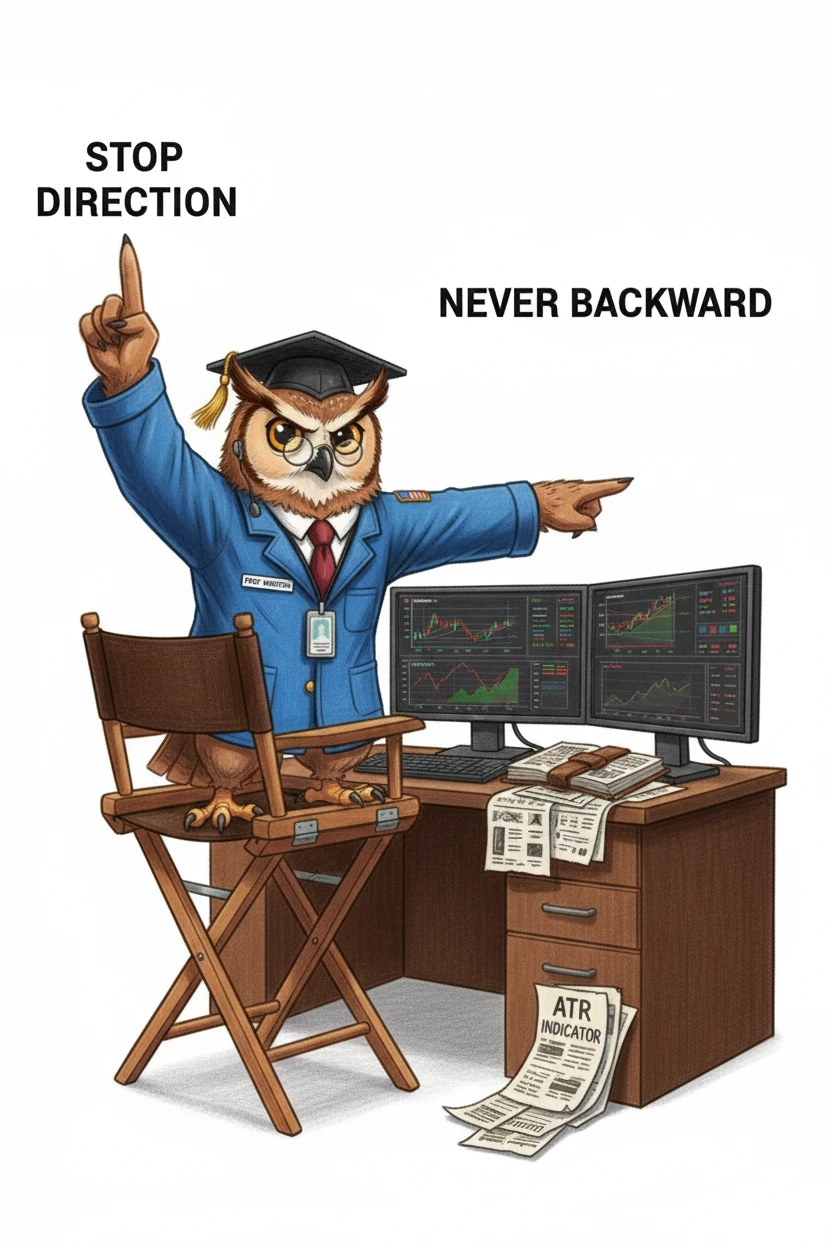
The core difference between losing 60 pips and protecting them: moving your stop loss WITH price momentum, not against it. The three methods illustrated—ATR-based, structure-based, and built-in tools—all share one principle: trailing only when the trade is winning.
Why Most Traders Trail Their Stop Loss Wrong
The most common mistake I see is traders moving their stop to breakeven the second they're up 10 pips. Then they wonder why they get stopped out on normal market noise before the trade even has a chance to breathe.
Here's the reality: a stop loss has one job when you're in a winning trade. It's not to guarantee profit on every trade. It's to protect a meaningful portion of the unrealized gain while still giving the position room to run.
Moving your stop too tight, too fast is just as damaging as not moving it at all. You're basically turning a potentially great trade into a scratch. I did this for the first three years of my trading career. Constantly.
There's also the opposite problem: traders who never touch their stop. They watch a 90-pip gain evaporate back to a 20-pip loss and call it "trusting the setup." That's not discipline. That's just not having a plan. You need a scalping strategy or a swing trading strategy with a trailing methodology baked in from the start, not decided in the heat of the moment.

💡 विंस्टन की सलाह
Write your trailing rule on a sticky note before you enter the trade. 'I will move stop to breakeven at 1R, then trail by ATR x 1.5 after each new swing high.' If you can't write it down in one sentence, your plan isn't clear enough to execute under pressure.

Most traders move their stop to breakeven too fast because they're afraid of normal pullbacks. That hesitation? It costs you winning trades.
“Moving your stop too tight, too fast is just as damaging as not moving it at all. You're turning a potentially great trade into a scratch.”
Method 1: The ATR-Based Trailing Stop
This is my personal default method for most trades. The ATR indicator (Average True Range) tells you how much a currency pair actually moves on average, which means your trailing stop breathes with the market instead of fighting it.
The formula is simple: Trailing Stop Distance = ATR(14) x Multiplier
For trending markets, I use a 1.5x multiplier. For choppy conditions, I push it to 2.0x or 2.5x.
Here's a worked example using GBP/USD:
- Check the ATR(14) on your 4H chart. Let's say it reads 65 pips.
- Multiply: 65 x 1.5 = 97.5 pips. Round to 98 pips.
- As price moves in your favor, your stop follows at exactly 98 pips below the current high (for a long trade).
- The stop only moves UP, never down. This is critical.
So if you entered long at 1.2650 and price climbs to 1.2800:
- New stop = 1.2800 minus 0.0098 = 1.2702
- You're now locking in 52 pips minimum
If price continues to 1.2900:
- New stop = 1.2900 minus 0.0098 = 1.2802
- Now you're locking in 152 pips minimum
The beauty of this approach is that wider ATR periods naturally widen the stop, so you're not getting shaken out by a 30-pip retracement on a pair that moves 100 pips a day. Check the GBP/USD guide if you want to understand typical ATR ranges for that pair before applying this.
Pro tip: Recalculate your ATR trailing distance every time a new candle closes. The ATR value shifts as volatility changes, and your protection should shift with it. Set a reminder or use a simple alert.

The ATR-based method automatically scales your stop loss to match market volatility—larger moves get wider stops, smaller moves get tighter protection. This keeps your risk proportional to what the market actually does.
“Stops only move in the direction of the trade. Never against it. The moment you widen a trailing stop after the fact, you've created a rule with no edge whatsoever.”
Method 2: The Structure-Based Manual Trailing Stop
This one requires more screen time but it's the most precise method when you're watching a trade live. The idea is dead simple: your stop goes just below the most recent swing low (for longs) or just above the most recent swing high (for shorts).
No formula needed. Just read the chart.
Here's how I execute this step by step on MT5:
- Go to View → Terminal → Trade tab (or press Ctrl+T)
- Right-click your open position in the Trade tab
- Select "Modify or Delete Order"
- Update the Stop Loss field to your new price level
- Hit "Modify", done
Now, what counts as a valid swing low? For a 4H trend trade, I want to see a clear pivot: a candle with at least two lower lows on both sides. The stop goes 8 to 12 pips below that low, not directly at it. Price tests those levels with a wick sometimes, and you don't want to get swept out by a 5-pip deviation.
Real example from a trade I took on XAU/USD in late January 2024:
- Entry: 2,018 long
- First swing low after entry formed at 2,009. Stop moved to 2,006 (13 pips below structure, accounting for gold's wider spread).
- Second swing low at 2,031. Stop moved to 2,028.
- Third swing low at 2,049. Stop moved to 2,046.
- Price eventually reversed at 2,065 and stopped me out at 2,046 for a 28-dollar-per-ounce gain.
With a 0.5 lot position, that's $1,400. Not bad for a trade I almost exited manually at $600 profit because I was impatient.
The XAU/USD guide breaks down typical swing structure for gold if you want to calibrate those buffer distances more accurately. Gold has wider swings and higher spreads, so your buffer below structure needs to be bigger than on a major forex pair.
💡 विंस्टन की सलाह
When you're trailing a position and price accelerates hard in your favor (like a news spike), tighten your ATR multiplier from 1.5x down to 1x immediately. Big fast moves often snap back just as fast, and you want to lock in as much of that move as possible before the reversal.
“If your position size is wrong, no trailing method will save you. Trail your stop from a position where your maximum loss is 1-2% of account balance.”
Method 3: MT5's Built-In Trailing Stop (And When Not to Use It)
MT5 has a native trailing stop feature and it's both useful and dangerous depending on how you use it.
Here's how to activate it:
- Open View → Terminal → Trade tab
- Right-click your open position
- Hover over "Trailing Stop"
- Select your trailing distance in points (not pips, 10 points = 1 pip on most 5-digit brokers)
So if you want a 50-pip trailing stop on EUR/USD, select 500 points.
How it works: Once the trade moves 50 pips in your favor, the stop loss kicks in at breakeven. After that, every pip the price moves forward, the stop follows exactly 50 pips behind.
The math: Entry at 1.0850 long, trailing stop at 500 points (50 pips).
- Price hits 1.0900 (50 pips profit) → stop activates at 1.0850
- Price hits 1.0930 → stop moves to 1.0880
- Price hits 1.0960 → stop moves to 1.0910
- Price pulls back to 1.0910 → you're stopped out with 60 pips profit
Clean. Automated. No babysitting required.
BUT. There's a critical limitation that burned me early on: the MT5 trailing stop only works when your terminal is open and connected. If your computer shuts down or internet drops, the stop freezes at its last position. It does NOT run on the broker's server.
For automated trailing, you need an EA (Expert Advisor) that runs on a VPS, or you need to manage it manually. This is worth knowing before you set a trailing stop and walk away from your desk for the day.
I use the fixed trailing stop method mostly for scalping sessions where I'm glued to the screen anyway. For swing trades that run overnight, I stick to Methods 1 or 2 and set a hard stop manually.
“If your position size is wrong, no trailing method will save you. Trail your stop from a position where your maximum loss is 1-2% of account balance.”
Position Sizing Before You Trail Anything
Here's something most trailing stop tutorials skip entirely: if your position size is wrong, no trailing method will save you.
Before you think about where to trail, use the position size calculator to confirm your initial risk is correct. Trail your stop from a position where your maximum loss on the initial stop is 1-2% of account balance. If you're starting from an oversized position, trailing becomes a damage-control exercise instead of a profit-protection exercise.
Once your position is correctly sized, you can split it across multiple targets. I often close 50% of my position at the first target (usually 1.5R to 2R), then trail the remaining 50% aggressively using the ATR method. This way the first half books real profit and removes emotional pressure, while the second half rides the trend as long as it goes.
Tools like Pulsar Terminal handle this naturally with Pulsar Terminal's Smart SL/TP, where you can set your stop in dollar amounts or pips AND split your exit across multiple TP levels, so the math on partial closes is handled automatically instead of you doing it under pressure mid-trade.
Always know your dollar risk before you trail. If you moved your stop to breakeven and then widen it again because "the trade needs room"... you've broken your own rules. Don't do that.
💡 विंस्टन की सलाह
Never trail a stop during the first 30 minutes after a major news event. The spread widens, price can spike 20-30 pips in both directions in seconds, and you'll get stopped out on noise. Let the volatility settle before you start moving anything.

Position sizing is your foundation—get it wrong and no trailing method can fix it. Use a position size calculator to ensure your initial risk is correct (typically 1-2% per trade) before deciding where to trail your stop.
“Knowing how to enter a trade is only half the battle. Protecting what the market gives you is the other half.”
The One Rule All 3 Methods Share
Stops only move in the direction of the trade. Never against it.
This sounds obvious but I've seen experienced traders break this rule under pressure. Price pulls back 30 pips, they think the setup is still valid, they widen the stop "just this once." That's not trailing. That's hoping.
If your analysis says the trade is still valid despite the pullback, fine. But your stop stays where it is or moves forward. The moment you start widening trailing stops after the fact, you've created a rule that has no edge whatsoever. You're saying "I'll take my profits when the market gives them and I'll expand my losses whenever I feel like it." That's a losing formula regardless of your win rate.
Set your trailing method before entry. Write it down. Then execute it mechanically. The RSI indicator or MACD indicator can help you identify when momentum is fading and tighten your trail proactively, but the direction rule never changes.
Disclaimer: This article is for educational purposes only and does not constitute investment advice. Trading forex and CFDs carries significant risk of loss. Past performance is not indicative of future results. Always do your own research and consider your financial situation before trading. Never risk money you cannot afford to lose.
प्रो. विंस्टन का पाठ
:
- ✓Moving stop to breakeven at 10 pips profit causes premature exits from normal market noise.
- ✓ATR-based trailing stops adapt to actual currency pair volatility, not arbitrary pip distances.
- ✓Structure-based manual stops placed below recent swing lows offer maximum precision for active traders.
- ✓Position size must be correct before trailing any stop loss, or method selection becomes irrelevant.
❓ अक्सर पूछे जाने वाले प्रश्न
Q1What's the best trailing stop distance for EUR/USD on the 1-hour chart?
On the 1H EUR/USD chart, the ATR(14) typically reads between 12 and 20 pips depending on the session. A solid starting point is 1.5x ATR, which gives you 18 to 30 pips of trailing distance. During the London-New York overlap, EUR/USD can move 40-60 pips in a single hour, so tighten your trail to 1x ATR if you want to capture more of that move. Avoid anything under 10 pips on the 1H, you'll just get stopped out on normal spread fluctuation.
Q2Does MT5's built-in trailing stop work when the terminal is closed?
No. This is one of the most important things to know about MT5's native trailing stop: it runs locally on your machine, not on the broker's server. If your terminal closes, your internet cuts out, or your computer restarts, the trailing stop freezes at whatever level it last moved to. It won't continue trailing. For trades you need to manage overnight or across multiple sessions without babysitting, you need either a VPS running MT5 continuously or a trailing stop EA that handles the logic server-side through your broker's infrastructure.
Q3Should I move my stop to breakeven as soon as a trade goes positive?
No, and this is one of the most overused 'rules' in retail trading that actually kills performance. Moving to breakeven at +5 pips or +10 pips means you're getting stopped out by normal market noise constantly. A better rule: only move to breakeven after price has reached at least 1x your initial risk (1R). So if you risked 30 pips, wait until you're up 30 pips before moving to breakeven. This preserves the statistical edge of your setup and stops you from scratching trades that would have been winners given room.
Q4How do I trail my stop on MT5 for a partial position after closing half my trade?
After you close 50% of a position in MT5, the remaining portion becomes either a new independent position or stays in the original ticket depending on how your broker handles partial closes. Go to View → Terminal → Trade tab, right-click the remaining position, and use Modify or Delete Order to update the stop loss manually to your new trailing level. If you activated the automated trailing stop on the original position, you'll need to reactivate it on the remaining portion after the partial close, since the original trailing stop settings may not carry over.
Q5What's the difference between a trailing stop and a chandelier exit?
A chandelier exit is actually a specific type of ATR-based trailing stop developed by Chuck LeBeau. The formula is: Chandelier Exit = Highest High since entry minus (ATR x 3). The key difference from a standard ATR trail is that the chandelier exit anchors to the highest point reached since entry, not the most recent price. This gives trades more room to breathe through short-term pullbacks while still locking in gains from the peak. In MT5, you can't set this natively, but you can replicate it manually by tracking the highest high on your trade and recalculating after each new candle.
Q6Can I use the same trailing stop method for both forex and gold (XAU/USD)?
The ATR-based method works for both, but you need to recalibrate your multiplier. Gold typically has an ATR(14) of 15 to 25 dollars on the 4H chart, which translates to 150-250 pips in MT5 notation (since gold is quoted to 2 decimal places with 1 pip = $0.01 per ounce). Using a 1.5x multiplier on gold can mean trailing stops of 20+ dollars per ounce, which is necessary given gold's volatility. On a 1-lot gold position (100 oz), that's a $2,000 trailing buffer. If that feels too wide, reduce your lot size rather than tightening the stop below what the market structure demands.
यह लेख कितना उपयोगी था?
रेट करने के लिए स्टार पर क्लिक करें
टिप्पणियाँ
बाज़ार से आगे रहें
साप्ताहिक बाज़ार विश्लेषण, ट्रेडिंग रणनीतियाँ और MT5 टिप्स पाएँ। कोई स्पैम नहीं, कभी भी सदस्यता रद्द करें।
लेखक के बारे में
Daniel Harrington
वरिष्ठ ट्रेडिंग विश्लेषक
Daniel Harrington एक वरिष्ठ ट्रेडिंग विश्लेषक हैं जिनके पास MScF (मास्टर ऑफ साइंस इन फाइनेंस) की डिग्री है, जो मात्रात्मक संपत्ति और जोखिम प्रबंधन में विशेषज्ञता रखते हैं। फॉरेक्स और डेरिवेटिव बाजारों में 12 वर्षों से अधिक के अनुभव के साथ, वे MT5 प्लेटफॉर्म अनुकूलन, एल्गोरिदमिक ट्रेडिंग रणनीतियों और खुदरा व्यापारियों के लिए व्यावहारिक अंतर्दृष्टि को कवर करते हैं।
All these calculators are built into Pulsar Terminal with real-time data from your MT5 account. One-click position sizing, automatic risk management, and instant calculations.
आपको यह भी पसंद आ सकता है
