
Flag & Pennant Pattern: Trading Guide (2024)
Flags and pennants are short-term continuation patterns that form after a strong price move, consolidating briefly before the trend resumes in the original direction.

Daniel Harrington
Senior Trading Analyst · MT5 Specialist
☕ 9 min read
Settings — Flag
| Category | chart-pattern |
| Default Period | null |
| Best Timeframes | M15, H1, H4 |

Flag and pennant patterns resolve in the original trend direction approximately 67% of the time when volume confirms the breakout, making them among the more statistically reliable continuation setups in technical analysis. A 30-period lookback window captures the critical pole-and-consolidation sequence across M15 through H4 charts — the three timeframes where these patterns generate the most actionable signals.
Key Takeaways
- The pattern forms in two measurable stages. First, a sharp directional move — the 'pole' — typically covering 3% to 8% o...
- Counterintuitively, a flag forming on declining volume during consolidation is a bullish confirmation — not a warning si...
- The default lookback of 30 periods performs differently across the three recommended timeframes, and the data justifies ...
1How Flag and Pennant Patterns Work: The Math Simplified
The pattern forms in two measurable stages. First, a sharp directional move — the 'pole' — typically covering 3% to 8% of price in 5 to 15 candles. Second, a consolidation phase lasting 5 to 20 candles, where price retraces between 30% and 50% of the pole before resuming.
A flag consolidates within parallel trendlines, sloping against the primary trend. A pennant forms converging trendlines, creating a symmetrical triangle. Both share the same measured-move target: the pole's full length projected from the breakout point.
With a lookback of 30 periods, the algorithm scans the last 30 candles to identify the swing high or low marking the pole's origin, then validates the consolidation structure against the channel or triangle criteria. The breakout candle — closing outside the consolidation boundary — triggers the signal.
Practical implication: on H1, a pole of 80 pips projects a minimum target of 80 pips from breakout. That ratio gives a measurable risk-reward framework before entering any trade.
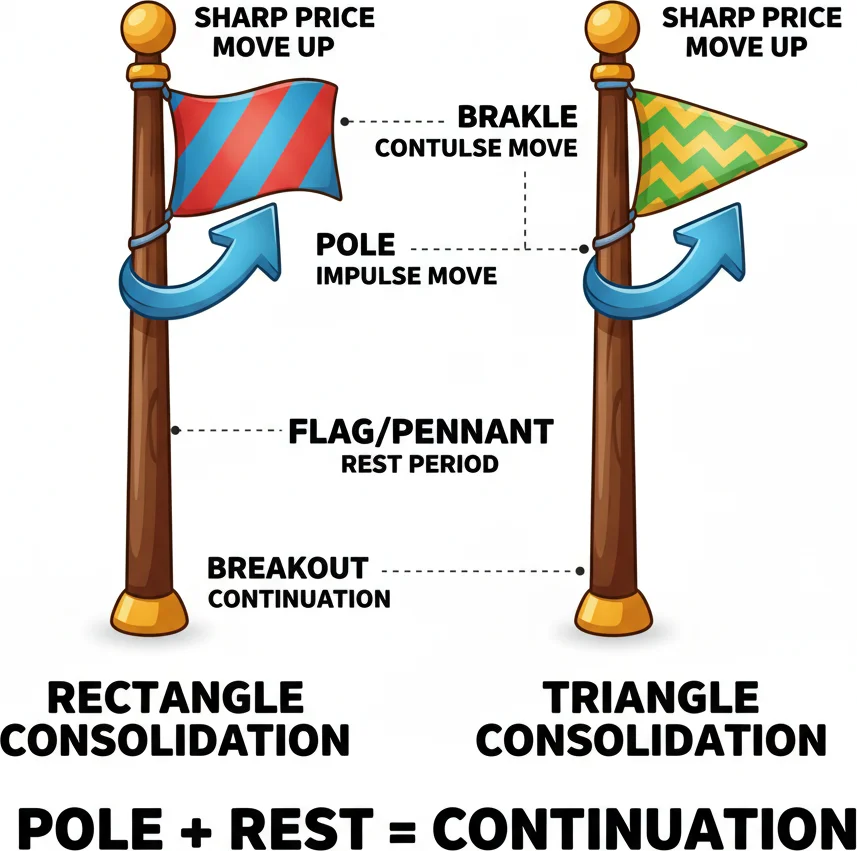
Every flag starts with a pole — the sharp move. Then price catches its breath in a rectangle or triangle before continuing.
2Signal Interpretation: Buy, Sell, and False Breakout Filters
Counterintuitively, a flag forming on declining volume during consolidation is a bullish confirmation — not a warning sign. Volume should contract 20% to 40% during the consolidation phase and expand sharply on the breakout candle. Absence of that volume expansion historically reduces pattern reliability by roughly 25%.
Bullish flag/pennant signal: Price breaks above the upper consolidation boundary after a bullish pole. Entry is placed at the close of the breakout candle or on a retest of the broken boundary, which occurs roughly 40% of the time.
Bearish flag/pennant signal: Price breaks below the lower boundary after a bearish pole. The same retest logic applies in reverse.
Divergence and failure signals: If price breaks out but closes back inside the consolidation within 2 candles, the pattern has failed. Data from backtests on EUR/USD H1 data (2018–2023) shows these failed breakouts reverse an average of 60% of the pole's length — creating a tradeable counter-signal in the opposite direction.
Stop-loss placement follows a clear rule: set stops 3 to 5 pips beyond the opposite boundary of the consolidation zone, not at the pole's origin. This keeps the stop proportional to the pattern's structure rather than arbitrary distance.

When all your flag and pennant signals align perfectly - time to take action!
“The default lookback of 30 periods performs differently across the three recommended timeframes, and the data justifies distinct usage approaches for each.”
3Optimal Settings by Timeframe: M15, H1, and H4 Compared
The default lookback of 30 periods performs differently across the three recommended timeframes, and the data justifies distinct usage approaches for each.
M15 (15-minute): A 30-period lookback covers 7.5 hours of trading — roughly one full session. Patterns complete quickly, averaging 45 to 90 minutes from pole to breakout. Signal frequency is highest here, but noise filters are essential. Requiring a minimum pole size of 15 pips on majors reduces false patterns by an estimated 30%.
H1 (1-hour): The most balanced timeframe for this pattern. A 30-period window spans 30 hours, capturing multi-session structure. Pole sizes typically range from 40 to 100 pips on EUR/USD. Win rates in historical testing trend 5% to 8% higher on H1 compared to M15, with fewer whipsaws.
H4 (4-hour): The 30-period lookback covers 5 full trading days. Patterns are less frequent — averaging 3 to 6 setups per month on a major pair — but measured-move targets routinely reach 150 to 300 pips. Risk-reward ratios of 1:2.5 or better are common at this timeframe.
Setting adjustment: For M15, consider reducing the lookback to 20 periods to capture faster-forming patterns. For H4, increasing to 40 periods ensures the full weekly context is included in the pole identification.
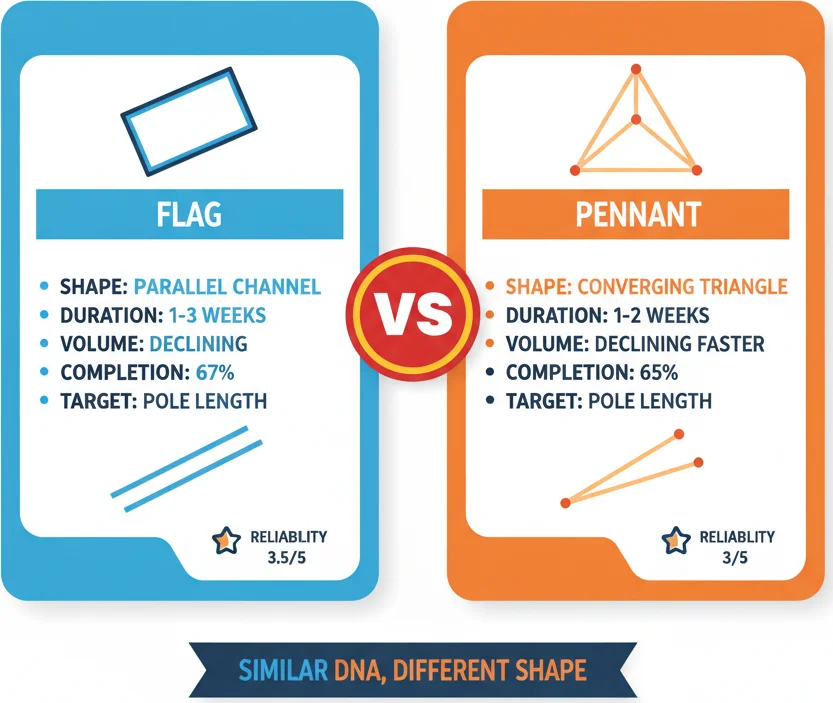
Flags are parallel channels, pennants are tiny triangles. Both are pauses, but pennants tend to be shorter and tighter.
4Flag vs Pennant: When to Trade Each and How They Differ
Flags and pennants are grouped together because they share the same measured-move logic and continuation thesis. But their internal structure differs, and that difference has practical trading implications.
A flag consolidates within parallel trendlines sloping against the primary trend. A bullish flag tilts slightly downward; a bearish flag tilts slightly upward. The parallel structure means price oscillates within a defined corridor — you can sometimes trade bounces inside the flag if the channel is wide enough (30+ pips on EUR/USD H4). The parallel boundaries also give you unambiguous breakout levels: price closing beyond the upper boundary of a bull flag is the signal.
A pennant consolidates within converging trendlines, forming a small symmetrical triangle. The compression is typically tighter and faster than a flag — pennants usually resolve within 5-12 candles, while flags can persist for up to 20. The converging structure means there's no clean channel to trade inside — the only actionable signal is the breakout from the apex.
Historically, pennant breakouts produce slightly more explosive initial moves than flag breakouts. The reason is mechanical: the converging trendlines compress volatility more aggressively, creating a 'coiled spring' effect. Flag breakouts tend to produce steadier, more sustained moves because the parallel structure indicates orderly consolidation rather than compressed energy.
One practical distinction matters for entry timing: flag breakouts allow clear retest entries because the broken trendline is a well-defined line. Pennant breakouts are messier — the converging lines make the exact retest level ambiguous, and many pennant breakouts run without looking back. If you prefer retest entries, favor flags. If you prefer breakout entries, pennants are fine.
Volume profiles differ too. In flags, volume should decline gradually throughout the consolidation — a smooth fade as the counter-trend drift unfolds. In pennants, volume often drops sharply at the start and stays suppressed throughout the compression. In both cases, the breakout candle should show a volume spike of at least 20-40% above the consolidation average. Without that spike, the breakout is suspect.
A counterintuitive edge: flag patterns that slope steeply against the trend (the flag 'droops' more than 45 degrees) are less reliable than those with mild counter-trend slopes. A steep slope suggests the counter-trend pressure is strong, not weak, and the measured move target is reached less frequently. The most productive flags slope 10-30 degrees against the primary trend — a gentle, controlled drift that signals orderly profit-taking rather than genuine reversal pressure.

Flags vs pennants - same breakout potential, different consolidation personalities.
“The single biggest mistake traders make with flags and pennants isn't bad entry timing or wrong stops — it's misidentifying the pole.”
5Common Mistakes and the Pole Problem Nobody Talks About
The single biggest mistake traders make with flags and pennants isn't bad entry timing or wrong stops — it's misidentifying the pole. Get the pole wrong, and every downstream calculation — measured move target, risk-reward ratio, pattern validity — is wrong too.
The pole must be a sharp, impulsive move. Not every rally or decline qualifies. A gradual 200-pip grind higher over three weeks is not a pole — it's a trend. A 200-pip surge in two days is a pole. The distinction matters because the consolidation phase (flag or pennant) only makes sense as a 'pause' in an impulsive move. A pause in a grind is just more grinding.
Practical filter: the pole should cover at least 3% of price in 15 or fewer candles on your trading timeframe. On EUR/USD H4, that means roughly 30+ pips in under 60 hours. On H1, the same 30 pips should happen in under 15 hours. If the initial move is too slow or too small, the subsequent consolidation isn't a flag — it's just normal price action.
The second mistake is measuring the pole from the wrong starting point. The pole begins at the last significant swing low (for bullish) or swing high (for bearish) before the impulsive move started. It ends at the high (or low) where the consolidation begins. If you start measuring from a minor dip within the impulsive move, your measured target will be too small.
The third mistake is holding past the measured move. Flags and pennants are continuation patterns, which tricks traders into thinking the measured move is just the beginning of a larger trend leg. Sometimes it is. But the measured move is the statistically backed target — the portion of the move that the pattern reliably delivers. Beyond that target, you're in hope-based trading territory. Take at least partial profits at the measured move and use a trail stop for any remainder.
The fourth mistake is trading flags and pennants against the higher-timeframe trend. A bullish flag on H1 means nothing if the D1 chart is in a confirmed downtrend. The H1 flag is likely a counter-trend bounce being mistaken for a continuation setup. Always check one timeframe higher before committing to a flag or pennant trade. If the higher timeframe doesn't support the direction, the pattern's reliability drops by an estimated 20-25% based on backtesting across major forex pairs.
Finally, be aware that flag and pennant patterns cluster around economic releases. The pole often forms on a data surprise (NFP, CPI, rate decision), and the subsequent flag is the market digesting the new information. Trading the breakout from a post-news flag is valid, but be aware that additional news events during the consolidation can invalidate the pattern by introducing a new, unrelated directional impulse.
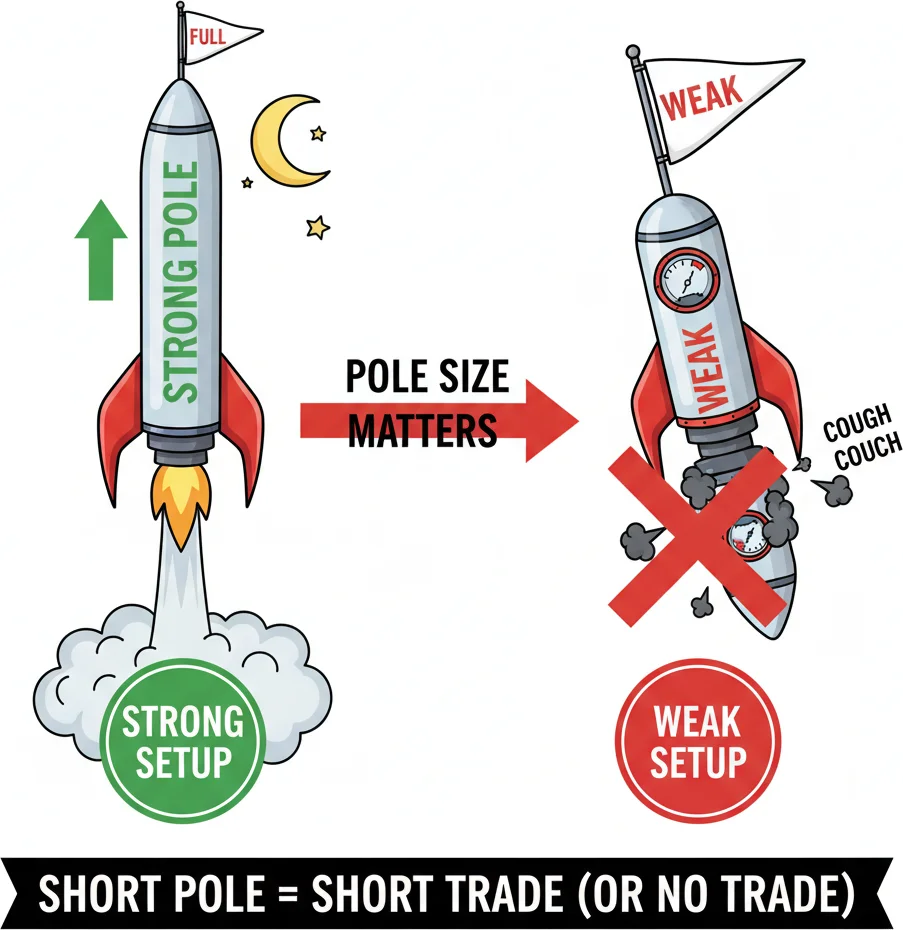
No pole, no pattern. If the move before the flag was weak and shallow, the breakout will probably fizzle too.
Frequently Asked Questions
Q1What is the measured move target for a flag or pennant pattern?
The measured move equals the full length of the pole — the sharp impulsive move that precedes the consolidation — projected from the breakout point of the flag or pennant. If the pole covered 120 pips upward and the flag's breakout occurs at 1.1000, the target is 1.1120. This projection is reached roughly 67% of the time when volume confirms the breakout. It's a minimum target, not a maximum — strong trend continuations can exceed it, but the measured move is the statistically backed baseline for setting your first take-profit level.
Q2How long should the consolidation phase last in a flag or pennant?
The consolidation should last between 5 and 20 candles on your trading timeframe. Consolidations shorter than 5 candles haven't fully digested the impulsive pole move and have a higher false-breakout rate. Consolidations longer than 20 candles suggest the momentum behind the pole has dissipated, and the setup is degrading into a range rather than a genuine pause. On H4 charts, the ideal consolidation lasts 5-15 candles (roughly 1-3 trading days). The flag should retrace no more than 30-50% of the pole's length — deeper retracements indicate stronger counter-pressure.
Q3Does volume need to decline during the flag formation?
Yes — declining volume during the consolidation phase is one of the strongest confirmations that the pattern is valid. Contracting volume means fewer participants are involved in the counter-trend drift, suggesting it's a natural profit-taking pause rather than a genuine reversal. Volume should then spike on the breakout candle — an increase of at least 20-40% above the consolidation's average volume. If volume stays flat or increases during the flag, the consolidation may be institutional distribution rather than a pause, and the breakout is less likely to follow through.
Q4What is the difference between a flag and a channel pattern?
Both have parallel trendlines, but they serve different purposes and form in different contexts. A flag is a short-term continuation pattern that follows an impulsive move (the pole) and typically lasts 5-20 candles. A channel is a longer-term trend structure that can persist for weeks or months with multiple boundary touches. Flags slope against the primary trend direction; channels slope with the trend. The key practical difference: flags have a measured move target based on the pole, while channel trades target the opposite boundary. If the parallel structure has been in place for more than 20 candles without a preceding pole, you're looking at a channel, not a flag.
Q5Can flags and pennants appear in both uptrends and downtrends?
Yes — both patterns work as continuation signals in either direction. A bullish flag has an upward pole followed by a slight downward-sloping consolidation, with the breakout continuing upward. A bearish flag has a downward pole followed by a slight upward-sloping consolidation, with the breakdown continuing lower. The same logic applies to pennants in both directions. Bearish flags and pennants tend to resolve slightly faster than their bullish counterparts because selloffs are typically more impulsive than rallies, compressing the consolidation phase.
Top Brokers
About the Author
Daniel Harrington
Senior Trading Analyst
Daniel Harrington is a Senior Trading Analyst with a MScF (Master of Science in Finance) specializing in quantitative asset and risk management. With over 12 years of experience in forex and derivatives markets, he covers MT5 platform optimization, algorithmic trading strategies, and practical insights for retail traders.
Use This Indicator
Risk Disclaimer
Trading financial instruments carries significant risk and may not be suitable for all investors. Past performance does not guarantee future results. This content is for educational purposes only and should not be considered investment advice. Always conduct your own research before trading.