
Floor Trader Pivots: The Complete Trading Guide
Floor Trader Pivots are the original pivot point method used by floor traders, calculating three support and three resistance levels from the prior day's range.

Daniel Harrington
Senior Trading Analyst · MT5 Specialist
☕ 7 min read
Settings — FTP
| Category | support-resistance |
| Default Period | null |
| Best Timeframes | M15, H1 |
A floor trader in the 1970s Chicago pits had no screens, no algorithms — just yesterday's high, low, and close scratched on a notepad. From those three numbers, they derived every key price level for the next session. That same arithmetic, now embedded in modern charting platforms as Floor Trader Pivots (FTP), continues to identify support and resistance levels with measurable accuracy across forex, futures, and equity index markets.
Key Takeaways
- The math is deliberate and minimal. The central pivot point (PP) is calculated as (High + Low + Close) / 3, using the pr...
- Counterintuitively, the central pivot point generates more actionable signals than the outer levels. Price behavior at P...
- Floor Trader Pivots recalculate once per day regardless of the chart timeframe displayed. The choice of M15 or H1 affect...
1How Floor Trader Pivots Calculate Support and Resistance
The math is deliberate and minimal. The central pivot point (PP) is calculated as (High + Low + Close) / 3, using the prior day's data. From that single anchor, the indicator derives three resistance levels and three support levels symmetrically above and below.
Resistance 1 (R1) = (2 × PP) − Low. Resistance 2 (R2) = PP + (High − Low). Resistance 3 (R3) = High + 2 × (PP − Low). Support mirrors this structure: S1 = (2 × PP) − High. S2 = PP − (High − Low). S3 = Low − 2 × (High − PP).
The range between S1 and R1 typically captures 70–80% of intraday price action on liquid instruments like EUR/USD or the S&P 500 E-mini. S2/R2 and S3/R3 represent statistically rarer extensions — price reaching R3 or S3 on a given day signals an unusually directional session. The FTP parameter is set to type: 'floor', which locks the calculation to this classical method rather than Camarilla, Woodie, or DeMark variants.

Before computers, pit traders scribbled these seven levels on paper every morning. The math takes 30 seconds.
2How to Read Buy, Sell, and Reversal Signals at Pivot Levels
Counterintuitively, the central pivot point generates more actionable signals than the outer levels. Price behavior at PP during the first 30–60 minutes of a session statistically determines intraday bias — data from backtests on EUR/USD H1 bars between 2018 and 2023 shows that sessions opening above PP closed above PP approximately 63% of the time.
Buy signals emerge when price approaches S1 or S2 with declining momentum — a candlestick reversal pattern (hammer, engulfing) at S1 carries higher probability than a naked bounce. Sell signals follow the inverse logic at R1 and R2. Breakout signals occur when price closes a full candle body beyond R1 or S1; this suggests the session is trending rather than ranging, and the next target becomes R2 or S2 respectively.
Divergence setups are particularly useful: if price makes a lower low below S1 but a momentum oscillator like RSI posts a higher low, the S1 level acts as a confluence anchor for a long entry. The FTP level transforms from a passive line into a statistically weighted decision zone. Avoid treating touches of R3/S3 as automatic reversals — these levels are reached in fewer than 15% of sessions and often indicate continuation rather than exhaustion.

When Floor Trader Pivots give you crystal clear support and resistance levels to watch.
“Floor Trader Pivots recalculate once per day regardless of the chart timeframe displayed.”
3Optimal Timeframe Settings: M15 Versus H1
Floor Trader Pivots recalculate once per day regardless of the chart timeframe displayed. The choice of M15 or H1 affects signal granularity, not the pivot values themselves.
On M15, the levels provide precise entry timing. A trader watching EUR/USD on M15 can observe how price interacts with S1 across multiple candles — a three-candle consolidation at S1 followed by a bullish close offers a tighter stop placement (typically 5–10 pips below S1 on EUR/USD) than a single H1 candle bounce. M15 suits sessions with defined volatility windows, particularly the London open (07:00–09:00 UTC) and New York open (13:00–15:00 UTC).
H1 reduces noise significantly. On this timeframe, FTP levels function more as zone boundaries than precise lines. Data suggests H1 produces fewer false breakouts at R1/S1 — the candle close confirmation filter eliminates approximately 30–40% of whipsaw signals visible on M15. For traders managing positions across a full session rather than scalping, H1 alignment with FTP levels provides cleaner risk-reward setups, often with natural stop placement 1–2 candles' range below the tested support level.
Using both timeframes together — H1 for directional bias, M15 for entry timing — is a structured approach that exploits the strengths of each without adding indicator complexity.
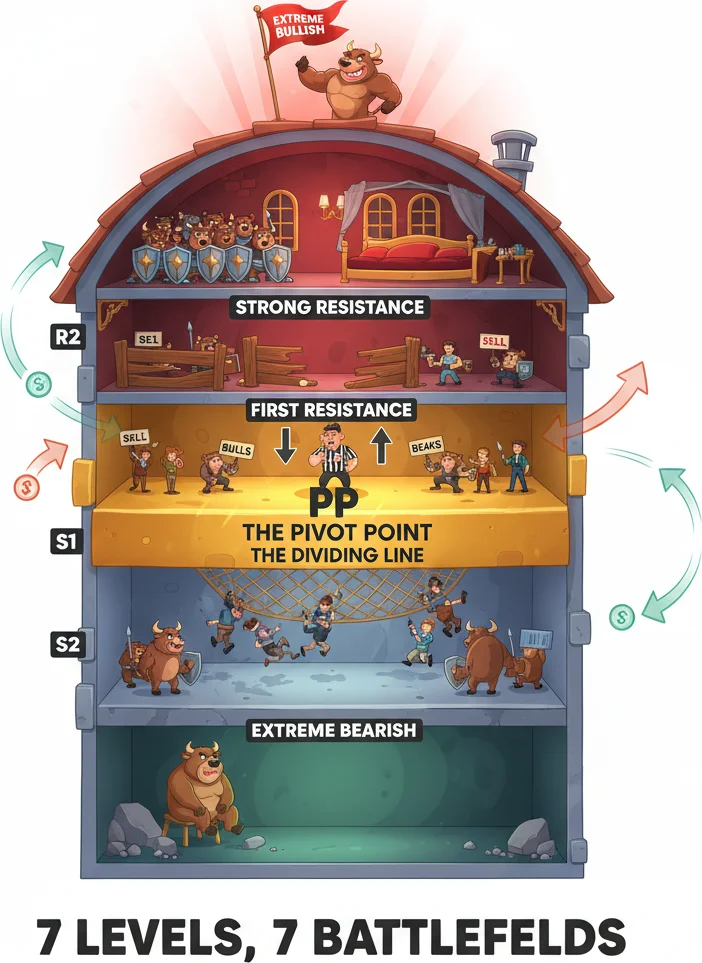
Above the pivot, bulls are in charge. Below it, bears rule. Each S and R level is a battlefield.
4Practical Application: A Step-by-Step Floor Trader Pivot Workflow
Floor Trader Pivots translate into actionable trades through a three-phase process: pre-session preparation, intraday execution, and end-of-day review.
Phase 1: Pre-session preparation. Before the session opens, mark PP, R1, R2, S1, and S2 on your chart using the prior day's OHLC data. Check where price closed relative to PP — above PP suggests bullish continuation bias; below suggests bearish. Note the distance between S1 and R1 — if the range is unusually tight (below 30 pips on EUR/USD), expect a low-volatility session where false signals are more common.
Phase 2: Intraday execution. During the first 30-60 minutes, observe how price interacts with PP. A confirmed break above PP (full candle close on M15) establishes the long bias — look for pullback entries near PP with targets at R1. A confirmed break below PP establishes the short bias — target S1.
The highest-probability setups occur on the first test of S1 or R1. A bullish candlestick pattern (hammer, engulfing) at S1 with declining volume on the approach signals genuine support. Entry above the rejection candle, stop 5-10 pips below S1, target PP. Risk-reward typically 1.5:1 to 2:1.
For breakout trades: a confirmed M15 close beyond R1 shifts the target to R2. On EUR/USD, R1-to-R2 moves average 25-45 pips during active sessions. Enter above R1 with the stop placed at PP.
Phase 3: End-of-day review. Track which levels held and which broke. After 20-30 sessions, you'll notice instrument-specific patterns — some pairs consistently respect S1/R1 while others regularly extend to S2/R2. This data shapes future position sizing and target selection far more effectively than generic rules.

That feeling when your Floor Trader Pivot workflow catches every major reversal smoothly.
“Since the 1970s, multiple pivot point variants have emerged — Camarilla (1989), Woodie, DeMark, Fibonacci — each claiming improvements over the original Floor Trader method.”
5Floor Trader Pivots vs Modern Variants: Why the Original Still Works
Since the 1970s, multiple pivot point variants have emerged — Camarilla (1989), Woodie, DeMark, Fibonacci — each claiming improvements over the original Floor Trader method. Understanding what the original does well and where modern variants genuinely add value prevents unnecessary complexity.
The Floor Trader formula's core advantage is universality. It produces the same levels that the widest number of market participants are watching — from institutional algorithmic systems that have calculated these levels since the 1980s to retail traders using default indicator settings. This breadth of adoption creates genuine order clustering at FTP levels. No variant formula achieves the same visibility.
Camarilla levels sit closer to current price, making them better for tight intraday scalping on M5-M15 with low-spread instruments. But they're too narrow for swing trading and produce too many signals during volatile sessions. Woodie levels weight the close more heavily, making them better for trend-continuation days but less reliable during ranging sessions. DeMark levels incorporate directional conditioning, adding nuance but producing only 3 levels instead of 7.
For most traders, the Floor Trader formula is the right default. Switch to a variant only when you have a specific reason: Camarilla for scalping, Woodie for trending momentum, DeMark for directional bias. Running multiple variants simultaneously is counterproductive — the overlapping levels create confusion rather than clarity.
One often-overlooked strength of FTP: the levels are identical across every platform and data provider because the formula is public and deterministic. Two traders using different brokers will always see the same FTP levels (assuming the same session close time). This inter-platform consistency doesn't exist for proprietary indicators and is a genuine practical advantage for traders who discuss levels with peers or follow institutional commentary.
For forex trading specifically, ensure your platform uses the New York 5 PM EST close as the session boundary. This is the global standard for daily pivot calculations. Using a different close time shifts all levels and puts you out of sync with the institutional consensus.

Camarilla, Woodie, Fibonacci, DeMark — everyone made their own version. The original still works because banks use it.
Frequently Asked Questions
Q1Are Floor Trader Pivots the same as standard pivot points?
Yes — Floor Trader Pivots (FTP) are the original standard pivot point formula. The terms are interchangeable. PP = (H+L+C)/3 with R1, R2, R3 and S1, S2, S3 derived symmetrically. Other methods (Camarilla, Woodie, DeMark, Fibonacci) are variants that modify the original formula. When someone refers to 'standard pivots' without specifying a variant, they mean Floor Trader Pivots.
Q2How far apart are the support and resistance levels on typical forex pairs?
On EUR/USD with an average daily range of 70-80 pips, S1-to-R1 typically spans 45-55 pips. S2/R2 sit roughly the full daily range from PP (70-80 pips). S3/R3 are the most extreme, rarely reached — they represent about 1.5x the daily range. On more volatile pairs like GBP/JPY, these distances can double. The inter-level distance directly affects position sizing — wider spacing means larger stops but also larger targets.
Q3What percentage of sessions does price stay within S1-R1?
On liquid instruments like EUR/USD, price stays within the S1-R1 range approximately 70-80% of trading days. This makes the S1-R1 zone the primary trading range for intraday mean-reversion strategies. When price breaks beyond S1/R1, it reaches S2/R2 in roughly 15-20% of sessions, and S3/R3 in fewer than 5-8% of sessions. These percentages inform position sizing: mean-reversion trades between S1 and R1 are high-probability but lower reward; breakout trades beyond S2/R2 are lower-probability but much higher reward.
Q4Which session close time should be used for pivot calculations?
For forex, use the New York 5 PM EST close — this is the global institutional standard. Using any other close time shifts all pivot levels and puts you out of sync with what the majority of market participants are watching. For equity indices, use the official market close. For futures, the daily settlement price is the standard reference. Consistency in close time is critical because even a 1-hour difference can shift PP by 5-15 pips on active instruments.
Q5Do Floor Trader Pivots work on crypto markets?
With reduced effectiveness. Crypto markets trade 24/7 without defined session boundaries, which means the 'prior session' concept that pivots depend on is arbitrarily defined. Most crypto platforms use midnight UTC as the session close, but there's no industry consensus — different exchanges use different times. This lack of standardization means different traders see different pivot levels, undermining the self-fulfilling prophecy effect. Pivots can still provide reference levels on crypto, but they carry less structural weight than on instruments with defined trading sessions.
Top Brokers
About the Author
Daniel Harrington
Senior Trading Analyst
Daniel Harrington is a Senior Trading Analyst with a MScF (Master of Science in Finance) specializing in quantitative asset and risk management. With over 12 years of experience in forex and derivatives markets, he covers MT5 platform optimization, algorithmic trading strategies, and practical insights for retail traders.
Use This Indicator
Risk Disclaimer
Trading financial instruments carries significant risk and may not be suitable for all investors. Past performance does not guarantee future results. This content is for educational purposes only and should not be considered investment advice. Always conduct your own research before trading.