


On March 12, 2025, a student of mine blew a $100K FTMO challenge account in 4 hours.

Daniel Harrington
वरिष्ठ ट्रेडिंग विश्लेषक · MT5 विशेषज्ञ
☕ 9 मिनट पढ़ने
आप क्या सीखेंगे:
- 1Why 'Difficulty' Matters More Than Payout Splits
- 21. The Funded Trader (TFT) — Easiest Entry Point for Beginners
- 32. MyForexFunds (MFF) Successor Situation — What Beginners Must Know
- 43. FTMO — The Gold Standard That's Actually Hard to Pass
- 54. Topstep and Apex (The Futures Alternative Beginners Ignore)
- 6The One Rule That Gets Beginners Killed — Daily Loss Limits and Automation
On March 12, 2025, a student of mine blew a $100K FTMO challenge account in 4 hours. EUR/USD dropped 180 pips on a surprise CPI print, he was overleveraged, and the 10% max drawdown rule killed him before lunch. He'd spent $540 on the challenge fee and had no idea the rule applied to floating losses, not just closed ones. That's the gap between prop firm marketing and prop firm reality, and it's exactly why picking the right firm as a beginner isn't about prestige. It's about surviving long enough to actually get funded.

Why 'Difficulty' Matters More Than Payout Splits
Most beginner guides rank prop firms by profit split percentages. That's the wrong metric. A 90% split means nothing if you fail the challenge three times before passing.
The real ranking criterion is challenge difficulty, which combines the profit target, the drawdown limit, the minimum trading days, and how the firm measures those drawdowns. Some firms measure drawdowns on your equity (including open floating losses). Others only count closed P&L. That single difference can end your challenge while you're still technically profitable on paper.
I spent about six months in 2023 systematically testing challenge rules across eight firms using MT5 demo accounts before I put real money into any of them. The firms with the most aggressive marketing were usually the hardest to pass. The ones with less flashy websites were often far more forgiving for someone building confidence.
One formula I teach all my students: Effective Risk Per Day = Daily Loss Limit / Minimum Trading Days. If a firm gives you a 5% daily loss limit and requires 10 minimum trading days, your effective daily risk budget is 0.5% of the account, not 5%. That's the number you should be planning around, not the headline drawdown figure.
For example: a $10,000 challenge account with a 5% daily loss limit gives you a $500 daily ceiling. But if you also need to hit an 8% profit target ($800) in at least 10 days, you need to average $80/day with no single day losing more than $500. That's a very specific performance profile, and most beginners don't map it out this clearly before buying in. Use a position size calculator to model these scenarios before you commit to a challenge.

💡 विंस्टन की सलाह
Before you pay for any challenge, run the profit target and drawdown limits through this calculation: daily profit needed = (account size × profit target %) / minimum trading days. If that number requires more than 0.5% daily return consistently, your strategy better have a proven track record at that return rate — not just a good week.
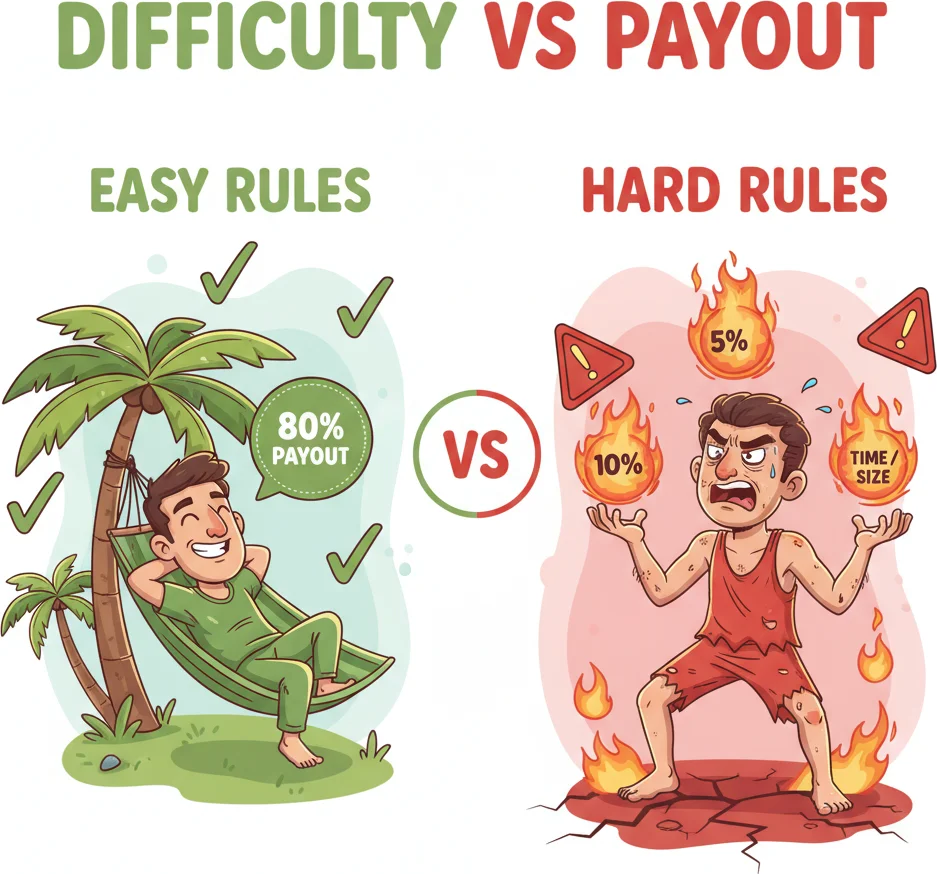

Challenge difficulty matters because easy targets breed overconfidence. The real ranking criterion separates traders who grind through Phase 1 from those who quit after failing three times. Pick a firm that challenges you, not one that lets you coast.
“A 90% profit split means nothing if you fail the challenge three times before passing.”
1. The Funded Trader (TFT) — Easiest Entry Point for Beginners
The Funded Trader runs what they call their "Standard" and "Royal" challenges. For beginners, the Standard is the one to look at.
Current 2026 numbers for a $25,000 Standard account:
- Challenge fee: approximately $147
- Phase 1 profit target: 8%
- Phase 2 profit target: 5%
- Max daily loss: 5%
- Max overall drawdown: 10% (trailing on balance, not equity)
- Minimum trading days: 4 per phase
- Profit split: 80%, scaling to 90%
The trailing drawdown on balance (not equity) is the key detail here. It resets at end of day based on your closing balance, not your peak equity during the session. That's significantly more forgiving than equity-based trailing drawdowns, which can trigger during a trade you're still managing.
Why it's ranked first for beginners: the 4-day minimum is low enough that you're not forced into overtrading to hit a day count. Most beginners overtrade when they're anxious about meeting daily minimums. TFT removes a lot of that pressure.
The catch? Their evaluation process can feel slower than FTMO, and customer support has had inconsistency issues that I've seen reported across forums in 2024-2025. Don't expect instant responses if you have a dispute.
“Your challenge survival depends on having redundant systems, not just discipline. Discipline fails when you're tired or away from your desk. Systems don't.”
2. MyForexFunds (MFF) Successor Situation — What Beginners Must Know
MyForexFunds was seized by regulators in August 2023. It's gone. I'm including it here because beginners constantly ask me about it after seeing old YouTube videos ranking it highly.
Don't chase a dead firm. But the reason MFF was popular tells you something useful: their "Rapid" program had no minimum trading day requirement, which removed one of the biggest beginner failure points. If you're building a list of features that make a prop firm beginner-friendly, "no minimum day requirement" belongs near the top.
Several firms have absorbed some of MFF's former traders. Firms like Apex Trader Funding (primarily futures) and The5ers have picked up some of that audience. The lesson from MFF's collapse is also a risk management one, if you're scaling capital with a prop firm, don't keep all your funded accounts at one firm.
This isn't paranoia. It's the same logic as not keeping all your savings in a single bank. Diversify across two or three funded accounts at different firms once you're consistently profitable. The prop firm industry is still relatively young and regulatory scrutiny is increasing.
💡 विंस्टन की सलाह
Use FTMO's free trial before paying for the challenge. Two weeks of treating it like real money will reveal more about your weaknesses than six months of demo trading ever will. The rules are identical — there's no reason to skip this step.
“The firms with the most aggressive marketing were usually the hardest to pass. The ones with less flashy websites were often far more forgiving.”
3. FTMO — The Gold Standard That's Actually Hard to Pass
Let's be honest about FTMO. It has the best reputation in the industry, the slickest platform, and the strongest payout history. It's also one of the harder challenges for a beginner to pass without serious preparation.
Current 2026 FTMO numbers for a $100,000 account:
- Challenge fee: $540
- Phase 1 profit target: 10%
- Phase 2 profit target: 5%
- Max daily loss: 5% (equity-based, not balance-based)
- Max overall drawdown: 10%
- Minimum trading days: 4 per phase
- Profit split: 80%, scaling to 90%
The equity-based daily drawdown is what catches beginners. If your $100K account drops to $98K intraday on open positions, you've already used $2,000 of your $5,000 daily allowance, even if you close those positions at breakeven. My student who blew his account in March 2025 didn't understand this. He thought he had more room because his closed trades were positive.
FTMO does offer a free trial account before you pay for a challenge, which I actually recommend using for at least two weeks. Trade it like it's real money. Log every trade. Check your rules violations daily. The free trial has identical rule mechanics to the paid challenge, so you get real feedback about whether your strategy is challenge-compatible.
For strategy compatibility, your ATR indicator settings matter more than most beginners realize. I run ATR(14) on the H4 chart to size positions relative to daily volatility. If ATR on EUR/USD is 60 pips and my daily loss limit is $500 on a $10K account, I can't responsibly trade more than 0.08 lots on a trade expecting 60 pips of movement without violating my own risk rules.
Here's the worked calculation: $500 daily risk / 60 ATR pips = $8.33 per pip max. On EUR/USD with standard lot sizing, 0.08 lots = $8 per pip. So 0.08 lots keeps me within my daily budget even if the trade hits full ATR range against me. That's how you use actual math to size positions inside challenge rules, not gut feel.
If you're targeting FTMO specifically, study the EUR/USD guide, it's the most liquid pair with the tightest spreads, which matters a lot when challenge rules count floating losses in real time.

“The firms with the most aggressive marketing were usually the hardest to pass. The ones with less flashy websites were often far more forgiving.”
4. Topstep and Apex (The Futures Alternative Beginners Ignore)
Forex isn't the only market where prop firms operate, and for some beginners, futures prop firms are actually easier to pass.
Topstep and Apex Trader Funding run challenges on CME futures (ES, NQ, CL, GC). The mechanics differ from forex challenges in a few key ways:
- No currency conversion risk on your P&L
- Fixed contract sizes make position sizing more straightforward
- Trailing drawdown is typically calculated on your highest closed P&L balance, not equity
Apex's $50,000 combine (their challenge) costs $167/month as a subscription rather than a one-time fee. You can take as long as you want to pass. For a beginner who needs more time to develop consistency, that subscription model removes the panic of a ticking clock.
Topstep's $50K plan runs around $165/month with a profit target of $3,000 and a trailing drawdown of $2,000. Their rules have become stricter in 2025, they added consistency requirements that cap your single best day at no more than 30% of your total profits. So if you hit a $1,500 windfall day early in your evaluation, it counts against your consistency ratio. That's worth knowing before you celebrate a big day.
I'll be straight with you: I don't trade futures as my primary market. I've tested these platforms but my personal edge is in forex. If you're already comfortable with swing trading strategy on currency pairs, switching markets just to chase an easier challenge usually backfires.
💡 विंस्टन की सलाह
Stop sizing your prop firm positions based on what feels right and start sizing them based on the ATR of the pair you're trading relative to your daily loss limit. It takes five minutes to calculate before each session and it's the single fastest way to stop dying on rule violations.
“Build the system first, then rely on discipline as the backup layer — not the other way around.”
The One Rule That Gets Beginners Killed — Daily Loss Limits and Automation
Almost every beginner who fails a prop challenge fails for the same reason: they step away from the screen while holding positions and come back to a blown account.
You took a trade, it went 40 pips against you while you were making coffee, the spread widened, and the daily drawdown rule triggered. Challenge over. This is not a discipline problem, it's a systems problem. You need something watching your account when you can't.
This is where tools like Pulsar Terminal's Prop Firm Protection are worth knowing about. It automatically closes all positions before you hit the daily loss limit, with a 5% safety buffer built in. Meaning if your daily limit is $500, it starts closing at $475 of drawdown. You don't blow the challenge because you stepped away. That kind of automation isn't cheating, it's the same logic as using a stop loss on a trade. You're just applying it to the account level.
The broader principle here: your challenge survival depends on having redundant systems, not just discipline. Discipline fails when you're tired, stressed, or physically away from your desk. Systems don't. Build the system first, then rely on discipline as the backup layer, not the other way around.
One more thing I want to address directly: beginners often ask me if they should use an EA (Expert Advisor) to pass a challenge. Some firms allow it, some don't. Read the rules on algorithmic trading before you run anything automated. FTMO permits EAs but prohibits certain high-frequency strategies and tick scalping. The Funded Trader prohibits trading during news events in their standard rules. Violations on these points get accounts terminated, not just warned.
Disclaimer: This article is for educational purposes only and does not constitute investment advice. Trading forex and CFDs carries significant risk of loss. Past performance is not indicative of future results. Always do your own research and consider your financial situation before trading. Never risk money you cannot afford to lose.
MT5 trailing stops die the moment you close your laptop. You left a 50-pip winner running on a daily loss limit. One bad spread expansion while you're away, and your drawdown rule triggers. The market doesn't pause for coffee breaks — your account does.
प्रो. विंस्टन का पाठ
:
- ✓Start with the easiest firm (TFT) to build confidence — you can always upgrade to FTMO later
- ✓Payout splits don't matter if you can't pass the challenge — difficulty is the real filter
- ✓Futures prop firms (Topstep, Apex) have no time limits — perfect for part-time beginners
- ✓Never risk real money on your first challenge — use free trials or the cheapest account size

❓ अक्सर पूछे जाने वाले प्रश्न
Q1What is the cheapest prop firm challenge for beginners in 2026?
The Funded Trader's $25,000 Standard challenge runs around $147 and has a 4-day minimum trading requirement, making it one of the lowest-cost and lowest-barrier options. Apex Trader Funding offers a subscription model at roughly $167/month for their $50K futures combine, which removes the one-time fee pressure. If cost is your primary constraint, the subscription model is worth comparing to one-time fees, especially if you expect to take more than 30 days to pass.
Q2Can a complete beginner pass an FTMO challenge?
Technically yes, but statistically most don't on their first attempt. FTMO's internal data from 2023 suggested a pass rate below 15% on Phase 1. The equity-based daily drawdown rule catches most beginners because it counts floating losses, not just realized ones. If you're a true beginner, use FTMO's free trial account for at least two full weeks before paying for the challenge. Track your results against the challenge rules manually every day. If you're violating rules during the free trial, you'll violate them during the paid challenge too.
Q3Do prop firms allow news trading?
It varies by firm. FTMO generally permits news trading but prohibits strategies designed purely to exploit slippage or spread manipulation around news events. The Funded Trader's Standard challenge explicitly restricts trading during certain high-impact news releases. Topstep and Apex on the futures side are more permissive since futures markets have tighter regulation around fair execution. Always read the specific terms under 'prohibited trading practices' before your first challenge, not after you get flagged.
Q4What's the difference between balance-based and equity-based trailing drawdowns?
A balance-based trailing drawdown calculates your maximum allowable loss based on your closing account balance at the end of each session. So if you close a day at $10,500 on a $10,000 account, your new floor moves up with your balance, but only at day's end. An equity-based trailing drawdown moves in real time with your open positions, if your account dips to $9,600 during a trade that later recovers to $10,200, the equity-based system counted that $400 intraday dip against your limit. That's why equity-based rules are significantly stricter and why beginners blow challenges on trades they think they managed properly.
Q5How many prop firm accounts should a beginner start with?
One. Don't split your focus across multiple challenges when you're still learning the rules and testing your strategy. Pass one challenge, get funded, trade it for 90 days minimum, and collect at least two payouts before adding a second account. The temptation to run multiple challenges simultaneously is a way to lose challenge fees faster, not a way to grow capital faster. Once you're consistently profitable across different market conditions, adding a second funded account at a different firm for diversification makes sense.
यह लेख कितना उपयोगी था?
रेट करने के लिए स्टार पर क्लिक करें
टिप्पणियाँ
बाज़ार से आगे रहें
साप्ताहिक बाज़ार विश्लेषण, ट्रेडिंग रणनीतियाँ और MT5 टिप्स पाएँ। कोई स्पैम नहीं, कभी भी सदस्यता रद्द करें।
लेखक के बारे में
Daniel Harrington
वरिष्ठ ट्रेडिंग विश्लेषक
Daniel Harrington एक वरिष्ठ ट्रेडिंग विश्लेषक हैं जिनके पास MScF (मास्टर ऑफ साइंस इन फाइनेंस) की डिग्री है, जो मात्रात्मक संपत्ति और जोखिम प्रबंधन में विशेषज्ञता रखते हैं। फॉरेक्स और डेरिवेटिव बाजारों में 12 वर्षों से अधिक के अनुभव के साथ, वे MT5 प्लेटफॉर्म अनुकूलन, एल्गोरिदमिक ट्रेडिंग रणनीतियों और खुदरा व्यापारियों के लिए व्यावहारिक अंतर्दृष्टि को कवर करते हैं।
All these calculators are built into Pulsar Terminal with real-time data from your MT5 account. One-click position sizing, automatic risk management, and instant calculations.
आपको यह भी पसंद आ सकता है
