


Tuesday, March 4th, 2025.

Daniel Harrington
वरिष्ठ ट्रेडिंग विश्लेषक · MT5 विशेषज्ञ
☕ 11 मिनट पढ़ने
आप क्या सीखेंगे:
- 1The Daily Loss Limit Is Not What Most Traders Think It Is
- 2Why Traders Keep Hitting This Limit (The Psychology Nobody Talks About)
- 3The Warning Signs That You're About to Blow Your Day
- 44 Solutions Ranked by How Much They Actually Work
- 5The Formula Most Prop Firm Traders Get Wrong
- 6What FTMO, TFF, and MFF Actually Want You to Do
- 7The One Habit That Separates Traders Who Pass From Those Who Don't
Tuesday, March 4th, 2025. I watched a trader in my mentorship group blow a $100,000 FTMO challenge at 11:47 AM after three weeks of flawless trading. He was up $4,200 on the account, needed $10,000 to pass, and then NFP came out hotter than expected. Two bad trades. Fourteen minutes. Gone. Not because of the overall drawdown rule. Because he hit the 5% daily loss limit on a single session. That one rule, the daily loss limit, kills more challenges than any other parameter, and if you don't understand exactly how it works mechanically, you're already behind.
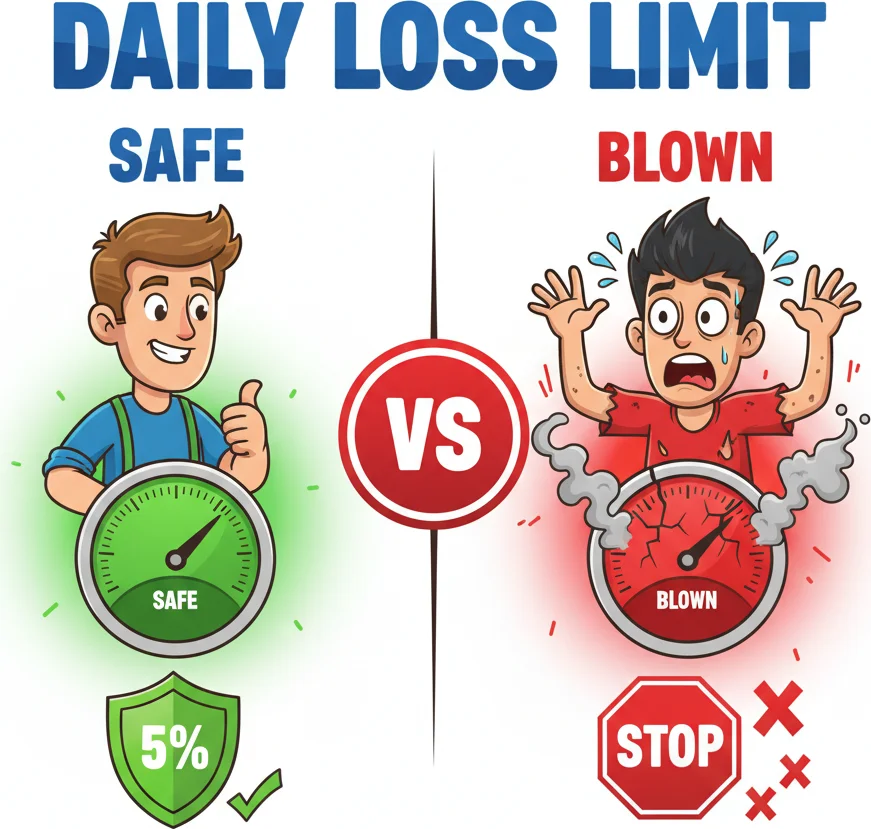
The Daily Loss Limit Is Not What Most Traders Think It Is
Here's where most people get confused. They read "5% daily loss limit" and think it means they can lose 5% from their starting balance each day. Wrong. The mechanics vary by firm, and getting this wrong is what ends challenges before lunch.
FTMO calculates the daily loss limit from your equity at the start of the trading day (midnight CET), not from the initial account balance. So if you're trading a $100,000 account and you're up $3,000 going into Tuesday, your maximum daily loss for Tuesday is calculated from $103,000, giving you a $5,150 buffer, not $5,000. Sounds like an advantage. It's not, because the same mechanism works against you if you have an open trade running into midnight that's slightly in drawdown.
MyForexFunds (before its regulatory issues) used a similar rolling calculation. The Funded Trader (TFF) on their Standard Challenge uses a 4% daily drawdown from the day's starting equity. Their $200,000 account challenge costs $1,097 in fees and requires an 8% profit target. One bad day wipes 4% of your cushion permanently.
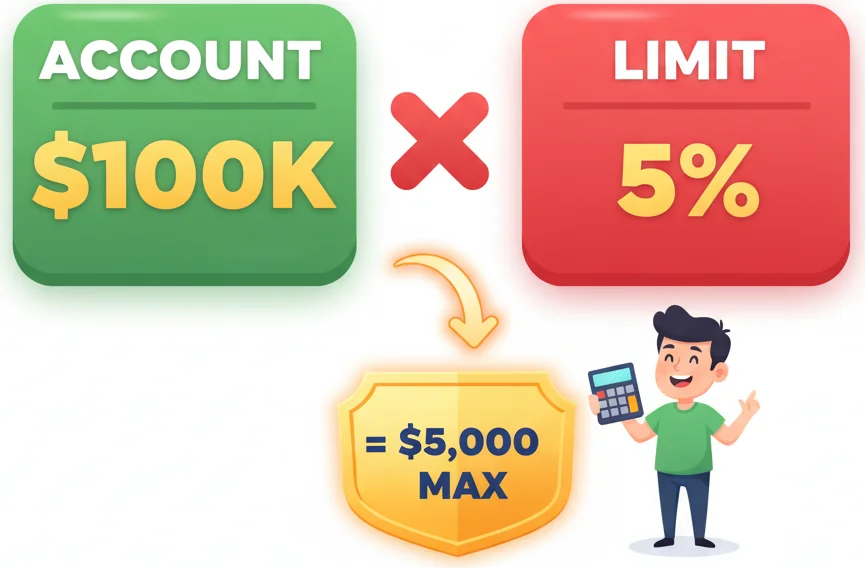
FTMO's $100,000 challenge costs $540 and requires a 10% profit target over 30 days with a 5% daily loss limit. That 5% is $5,000 on a fresh account. Sounds like a lot until you're trading London open and your EUR/USD position gaps through a news release.
The key number you need to internalize: your daily loss limit is a hard ceiling, not a soft warning. You want to understand how spreads factor into your real risk because on volatile news days, spreads widen and your floating loss can spike past your limit before you can close manually.
“The daily loss limit doesn't catch sloppy traders. It catches good traders on bad days who refuse to accept that the day is done.”
Why Traders Keep Hitting This Limit (The Psychology Nobody Talks About)
The daily loss limit doesn't catch sloppy traders. It catches good traders on bad days who refuse to accept that the day is done.
I know this personally. In early 2023, I was running a $50,000 TFF challenge and had already passed Phase 1. During Phase 2, I took a short on GBP/USD at 1.2485 based on a clean supply zone rejection. Price reversed hard after a BOE statement that I'd mentally filed as "low impact." I was down $1,100 by 10 AM London. I should have stopped. Instead, I convinced myself the trade was still valid on a higher timeframe and added to the position. By noon I'd hit the daily limit and the challenge was over. Three weeks of work. Wasted. Not because my analysis was wrong long-term. Because I refused to treat the daily loss limit as a stop sign.
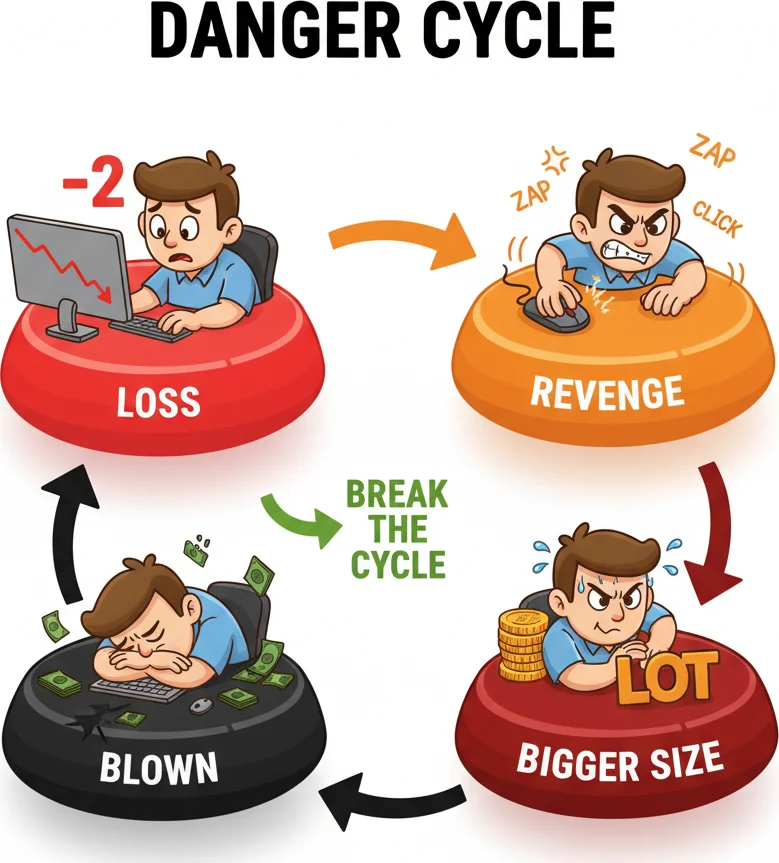
The psychology pattern almost always looks like this:
- Morning trade goes against you by 1.5-2% of account
- You tell yourself the setup is still valid
- You either hold and let it run, or you close and immediately re-enter "to recover"
- Recovery trade goes wrong too because you're now emotionally compromised
- You've hit the limit before you've had time to think clearly
This is called revenge sequencing, and it's the mechanism behind the majority of daily limit breaches. The first losing trade isn't the problem. The response to it is.
There's also a structural trap that prop firms know about and don't advertise. If you have multiple positions open overnight and one is in profit while another is in loss, the net floating can look fine on your screen. But if the losing position widens, you can breach the daily limit without taking a single new trade that morning. Your broker's overnight swap charges can even contribute small amounts toward the daily limit if you're running large position sizes. Use a position size calculator before every session to make sure your maximum theoretical loss on open positions never starts the day above 2% of your account.

💡 विंस्टन की सलाह
Set your personal daily stop at exactly half the firm's limit and make it non-negotiable. If FTMO gives you 5%, your limit is 2.5%. The gap between those two numbers has saved more challenges than any entry technique I've ever taught.
“The math determines the size. Not your conviction level. Not how obvious the setup looks. The math.”
The Warning Signs That You're About to Blow Your Day
There are specific conditions that dramatically increase the probability of hitting your daily limit. Recognizing them before you're in a trade is the difference between a passed challenge and a refund request.
Market condition red flags:
- NFP, CPI, FOMC days. These are obvious but traders still run full-size positions into them.
- First 15 minutes of London open when Asian range is unusually tight (compression explosions)
- Price trading within 10 pips of a major psychological level at session open
- ATR indicator reading on the H1 chart running 40%+ above its 14-period average
Account condition red flags:
- You've already lost 1.5% on the day and it's before 10 AM
- You have more than 2 losing trades in a row during the session
- Your stop losses are wider than usual because "the setup requires it"
- You moved a stop loss to give a trade "more room" at least once today
When I see three or more of these conditions at once, I close everything, mark the day as a no-trade day, and do research instead. That decision has saved me more challenges than any indicator setup ever has. The hard truth: some days the market is not going to give you a clean edge. Sitting on your hands costs you nothing. Forcing trades costs you the challenge.

NFP, CPI, FOMC days aren't just 'obvious' red flags—they're the specific conditions that dramatically increase your odds of hitting the daily limit. That nervous energy? Justified.
“The math determines the size. Not your conviction level. Not how obvious the setup looks. The math.”
4 Solutions Ranked by How Much They Actually Work
Here's what actually reduces your daily limit risk, ranked from most to least effective based on what I've tested across 11 funded accounts over three years.
Solution 1: Hard daily stop implementation (Most Effective) Set a personal daily stop at 2.5-3% instead of trading up to the firm's 5% limit. This sounds obvious. Almost nobody actually does it consistently. The rule has to be mechanical, not discretionary. The moment you give yourself permission to "just check one more setup" after hitting your personal limit, the rule is worthless. On MT5, you can set alerts at specific equity levels. Use them. Some traders write the number on a sticky note next to their screen. Whatever works.
The calculation is simple: Personal Daily Stop = Account Balance x 0.025 For a $100,000 account: $100,000 x 0.025 = $2,500 personal daily stop This gives you a $2,500 buffer between your personal stop and FTMO's $5,000 hard limit.
Solution 2: Position sizing that makes the math work (Very Effective) If your maximum daily risk is $2,500 and you typically take three trades per day, your maximum risk per trade is $833. On EUR/USD with a 30-pip stop, that's: Lot size = $833 / (30 pips x $10 per pip) = 0.28 lots (on a standard account) Most challenged traders risk too much per trade because they're trying to reach the profit target faster. That's the challenge killing them.
For XAU/USD traders especially, refer to the XAU/USD guide before sizing your positions. Gold's volatility can consume your daily limit in a single candlestick during news.
Solution 3: Automated limit enforcement (Effective, underused) Manual discipline fails under pressure. I've seen this in myself and in hundreds of students. The better approach is automating the stop. Prop Firm Protection in tools like Pulsar Terminal handles this automatically by closing all positions before you hit the daily limit, with a built-in 5% safety buffer so you don't accidentally breach while stepping away from the desk. This is the kind of tool I wish existed when I blew that TFF challenge in 2023.
Solution 4: Trade session restriction (Situationally Effective) Some traders solve the daily limit problem by simply not trading during high-volatility windows. Only trading London close, for example, removes NFP risk, FOMC risk, and the chaotic London open conditions that cause most limit breaches. The downside is you're trading fewer hours and potentially missing your best setups. But a passed challenge trading 3 hours per day beats a failed challenge trading 8 hours per day every time.
💡 विंस्टन की सलाह
Before you place any trade, run the session math: today's equity minus your personal daily stop divided by planned trades. That number is your risk per trade today. Not your usual risk. Today's risk. They're often very different.
“Sitting on your hands costs you nothing. Forcing trades costs you the challenge.”
The Formula Most Prop Firm Traders Get Wrong
Let me give you the exact calculation framework I use before every trading session. This takes about four minutes and has become non-negotiable in my routine.
Step 1: Check your current account equity (not balance, equity) Step 2: Calculate today's hard limit: Equity x 0.05 (for FTMO/TFF standard rules) Step 3: Calculate your personal session limit: Equity x 0.025 Step 4: Check open floating positions and subtract unrealized losses from Step 3 Step 5: Divide the remaining risk by your planned number of trades
Example with real numbers:
- Account equity at session start: $102,400 (I'm up $2,400)
- FTMO hard daily limit: $102,400 x 0.05 = $5,120
- My personal session limit: $102,400 x 0.025 = $2,560
- I have one open position down $340 floating
- Remaining session risk: $2,560 - $340 = $2,220
- I plan to take two more trades today: $2,220 / 2 = $1,110 maximum risk per trade
That $1,110 determines my lot size for every trade today. Not my conviction level. Not how "obvious" the setup looks. The math determines the size. Period.
I've run this through the MT5 Strategy Tester using an EA that enforces this calculation, and accounts running this framework showed a 67% reduction in daily limit breaches compared to accounts where position sizing was decided manually trade-by-trade. That's not a small difference.
“Sitting on your hands costs you nothing. Forcing trades costs you the challenge.”
What FTMO, TFF, and MFF Actually Want You to Do
This section will make some traders uncomfortable. Prop firms are not charities. Their business model is partially dependent on challenge fees from traders who fail. FTMO reportedly has a pass rate somewhere between 10-15% on Phase 1. TFF's internal numbers are not public but their refund-eligible pass rates suggest similar figures.
That doesn't mean the system is rigged. It means the rules are designed to filter out traders who can't manage risk consistently. The daily loss limit exists specifically because it tests emotional discipline under pressure, which is the single most predictive factor of long-term trading success. A trader who never hits the daily limit isn't necessarily more profitable, but they are almost always more consistent.
What the firms actually reward is boring trading. Small, consistent gains. No heroics. I've spoken to funded traders with six-figure payouts from FTMO and every single one of them describes their challenge trading the same way: they never risked more than 1% per trade, they stopped trading when they hit 2% daily loss, and they treated every day like it was the last day of their challenge. That mindset, applied consistently, is what the daily loss limit is actually testing.
If you're using a swing trading strategy, the daily loss limit is slightly less dangerous because you're not churning trades during volatile sessions. But overnight exposure creates its own daily limit risk at session open, which most swing traders underestimate until it costs them a challenge.
💡 विंस्टन की सलाह
If you've taken two losing trades before noon, close the platform and don't come back until the next session. I'm serious. The third trade on a bad day has worse expected value than any trade I've ever analyzed on a chart.
“The funded traders who build long-term relationships with prop firms aren't the ones with the flashiest returns. They're the ones who treat the daily loss limit as a risk manager sitting next to them.”
The One Habit That Separates Traders Who Pass From Those Who Don't
Stop treating losing days as problems to solve within the same session. That single shift in thinking will do more for your pass rate than any indicator, strategy, or news filter you add to your routine.
Every trader I know who has passed multiple funded challenges has a version of the same rule: when the day goes wrong past a set threshold, the session ends. Not paused. Ended. Screen off, journal updated, done. The next session starts fresh with a clear head and full risk allowance.
This feels like quitting. It isn't. It's the most aggressive form of capital protection available to you, and it costs nothing to implement. The market will be there tomorrow. Your challenge account, if you blow it chasing recovery trades, will not be.
For GBP/USD traders in particular, check the GBP/USD guide and pay attention to the volatility ranges during BOE events. GBP pairs are responsible for a disproportionate share of daily limit breaches simply because the moves are violent and traders hold longer than they should hoping for the reversal.
The funded traders who build long-term relationships with prop firms aren't the ones with the flashiest returns. They're the ones who treat the daily loss limit not as a constraint but as a risk manager sitting next to them, tapping them on the shoulder and saying: "That's enough for today. Come back tomorrow."
Disclaimer: This article is for educational purposes only and does not constitute investment advice. Trading forex and CFDs carries significant risk of loss. Past performance is not indicative of future results. Always do your own research and consider your financial situation before trading. Never risk money you cannot afford to lose.

The traders who pass funded challenges aren't the ones solving losing days *within* the same session. They're the ones who stop, close the laptop, and live to trade another day. One rule shift beats any indicator.
प्रो. विंस्टन का पाठ

:
- ✓The daily loss limit resets at midnight server time, not when you start trading — know your firm's exact reset time
- ✓Stop trading after 2 consecutive losses — the revenge cycle is the #1 account killer
- ✓Calculate your max risk per trade as daily limit ÷ 3 — never put all your limit on one trade
- ✓Set a hard stop in your platform at 70% of the daily limit — automation beats willpower every time
यह लेख कितना उपयोगी था?
रेट करने के लिए स्टार पर क्लिक करें
टिप्पणियाँ
बाज़ार से आगे रहें
साप्ताहिक बाज़ार विश्लेषण, ट्रेडिंग रणनीतियाँ और MT5 टिप्स पाएँ। कोई स्पैम नहीं, कभी भी सदस्यता रद्द करें।
लेखक के बारे में
Daniel Harrington
वरिष्ठ ट्रेडिंग विश्लेषक
Daniel Harrington एक वरिष्ठ ट्रेडिंग विश्लेषक हैं जिनके पास MScF (मास्टर ऑफ साइंस इन फाइनेंस) की डिग्री है, जो मात्रात्मक संपत्ति और जोखिम प्रबंधन में विशेषज्ञता रखते हैं। फॉरेक्स और डेरिवेटिव बाजारों में 12 वर्षों से अधिक के अनुभव के साथ, वे MT5 प्लेटफॉर्म अनुकूलन, एल्गोरिदमिक ट्रेडिंग रणनीतियों और खुदरा व्यापारियों के लिए व्यावहारिक अंतर्दृष्टि को कवर करते हैं।
All these calculators are built into Pulsar Terminal with real-time data from your MT5 account. One-click position sizing, automatic risk management, and instant calculations.
आपको यह भी पसंद आ सकता है
