


I blew a $100,000 FTMO challenge on day three.

Daniel Harrington
Senior Trading Analyst · MT5 specialist
☕ 9 min read
What you'll learn:
- 1Why the Daily Loss Limit Kills More Traders Than Bad Entries Do
- 2Strategy 1: The 50% Daily Budget Rule (The One Most Traders Ignore)
- 3Strategy 2: Session-Based Position Splitting
- 4Strategy 3: The News Buffer Block (This One Surprises People)
- 5Strategy 4: Automated Hard Stops at the Account Level
- 6Strategy 5: The Two-Strike Rule for Consecutive Losing Days
I blew a $100,000 FTMO challenge on day three. Not because I couldn't trade, but because I had no system around the daily loss limit and let one bad morning spiral into a full account reset. That experience cost me the $672 challenge fee and, more painfully, a week of solid prep work. What I'm sharing here aren't theories pulled from a forum. These are the five strategies I and other funded traders actually run to protect the one number that ends your challenge faster than anything else: the daily drawdown.
Why the Daily Loss Limit Kills More Traders Than Bad Entries Do
Most traders think they blow prop firm challenges because they can't pick direction. That's usually not the reason.
The real killer is the daily loss limit. FTMO's standard $100k account carries a 5% daily loss limit, meaning $5,000 in a single trading day ends your challenge immediately. MyFundedFirm (MFF) runs the same 5% daily limit. The Funded Trader (TFF) typically sets it between 4-5% depending on the account tier. On a $25k account, that's $1,250 before you're done for the day.
Here's the part most people miss: the daily limit isn't just about losing trades. Spreads, swap fees, and slippage all count toward that number. I've seen traders hit their daily limit without a single deliberate loss, just by running too many positions overnight with wide spreads on exotic pairs.
Understanding your exact dollar threshold before you open MT5 is non-negotiable. Write it on a sticky note. Set an alert. Do whatever it takes, because the account dashboard refreshing to show you've failed is a uniquely awful experience. Use a position size calculator every single morning to know exactly how much room you have before positions go live.

💡 Winston's Tip
Before you open a single trade on a prop firm account, calculate your exact dollar limit for the day and set a phone alarm for when you're 50% through it. The alarm doesn't mean stop trading. It means stop and check yourself.

FTMO's 5% daily loss limit ($5,000 on a $100k account) is a brick wall, not a guideline. One bad session and your challenge is over. This GIF captures the casual acceptance of a catastrophic problem.
“Most traders think they blow prop firm challenges because they can't pick direction. That's usually not the reason.”
Strategy 1: The 50% Daily Budget Rule (The One Most Traders Ignore)
This is the most effective and least followed rule in prop firm trading. Simple premise: you never risk more than 50% of your daily loss limit in a single session.
On a $100k FTMO account, your daily limit is $5,000. You cap your total risk exposure for the day at $2,500. Full stop. This does a few things at once.
First, it prevents the revenge trading spiral. Once you've lost $2,500, you're done. No more trades. You still have $2,500 buffer between you and account failure, which means a bad overnight swap or a spread widening during news can't suddenly push you over the edge while you're sleeping.
Second, it gives you a psychological exit ramp. The hardest moment in trading is accepting a loss and walking away. Having a hard rule that's set before the trading day means the decision is already made. You don't have to argue with yourself at 2pm about whether to take one more trade.
I started running this rule after blowing that first FTMO challenge. For the next challenge, a $200k account that cost $1,099 at the time, I set my daily cap at $5,000 (50% of the $10,000 limit). I passed without coming close to failing a single day. The profit target was $16,000 over 30 days. I hit it in 19 days, averaging $842 per day with a maximum daily exposure of $5,000.
The math formula for this is straightforward:
Daily Budget = Account Balance x Daily Limit % x 0.5
Example: $50,000 account, 5% daily limit $50,000 x 0.05 x 0.5 = $1,250 maximum daily risk
If you're trading the EUR/USD with 10 pip stops, that tells you exactly how many lots you can have running simultaneously.
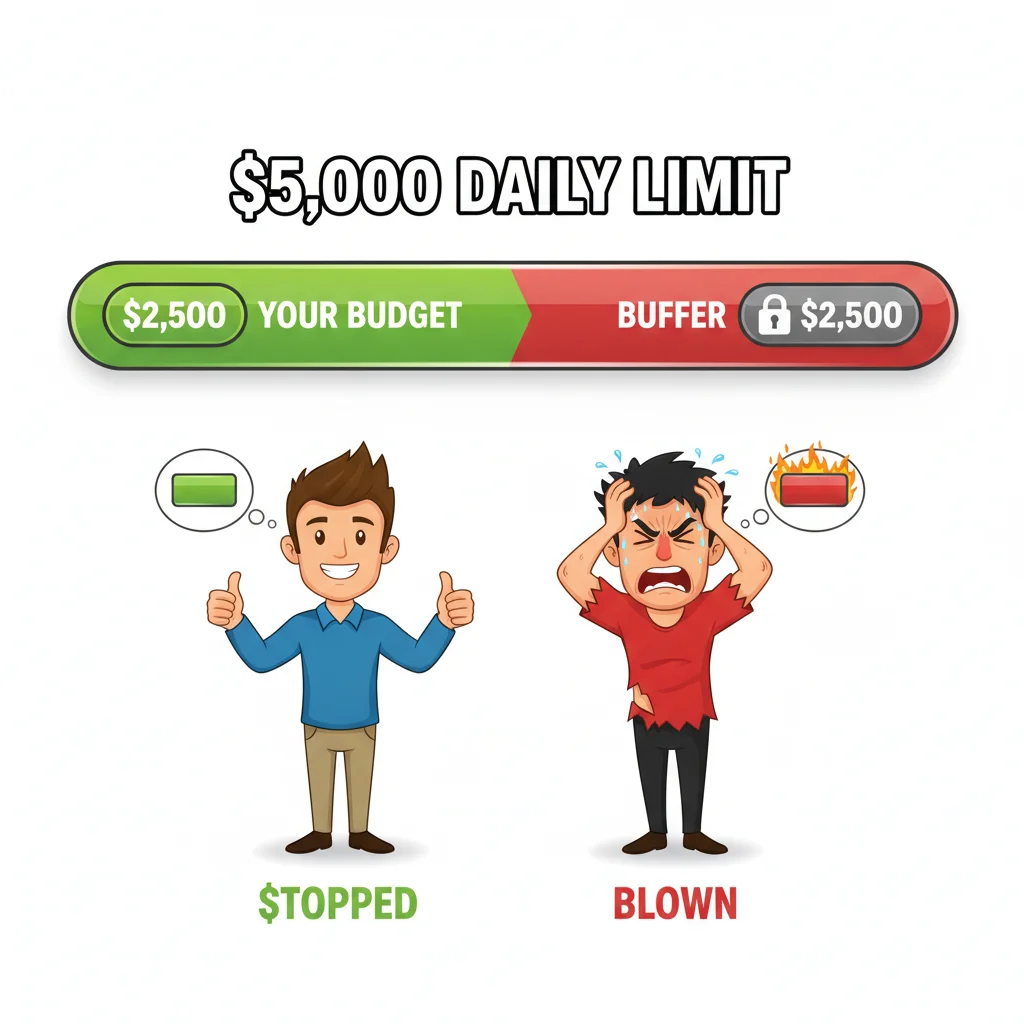
The simplest rule that saves the most accounts: cap your daily risk at 50% of your loss limit. On a $100K FTMO account, that means stopping at $2,500 — not $5,000.
“Manual discipline fails. You're tired, frustrated, or convinced the market is about to reverse. This is where automation becomes the only reliable answer.”
Strategy 2: Session-Based Position Splitting
Don't allocate your entire daily budget to one session. Split it across London, New York, and Asian sessions with pre-assigned maximums.
A practical split for a $100k account (working with that $2,500 daily budget from Strategy 1):
| Session | Allocation | Maximum Lots (EUR/USD, 10-pip stop) |
|---|---|---|
| Asian (Tokyo) | $500 | 0.5 lots |
| London Open | $1,200 | 1.2 lots |
| New York Open | $800 | 0.8 lots |
The logic: London and New York opens are where the real moves happen. You want the most capital available during those windows. Asian session gets a smaller allocation because it's typically lower volatility and you're often trading against chop.
This also prevents what I call session bleeding. That's when a bad London trade eats your entire budget and you can't participate in a clean New York setup three hours later. I've watched traders take a 15-pip loss on a London open fakeout, then double down to recover it, and by 10am EST they've hit their daily limit and missed the actual trend move.
The ATR indicator is useful here. Set it to a 14-period ATR on the H1 chart. If the average true range for the day is already 60% exhausted by London close, consider cutting your New York allocation. The market has already moved. Chasing the remaining 40% usually means entering into reversal territory.
Common mistake: Setting allocations but not actually tracking them in real time. Use a simple spreadsheet or your broker's trading history tab in MT5. Check your running P&L against your session budget every 30 minutes.
💡 Winston's Tip
Session allocation isn't just about spreading risk. It's about keeping you psychologically in the game. A trader who burns their full budget at London open has nothing to trade at New York open, and that frustration is exactly when rules get broken.
“Two consecutive heavy loss days almost never happen because the market is impossible. They happen because something in your process has broken down.”
Strategy 3: The News Buffer Block (This One Surprises People)
Here's the contrarian one. Most traders think news events are opportunities. In the context of prop firm daily limits, they're landmines.
The strategy: 30 minutes before any high-impact news event (NFP, CPI, FOMC, ECB rate decision), you close or reduce all open positions to 50% of their original size, regardless of where the trade is in profit or loss.
Why? Because spreads on EUR/USD can jump from 0.1 pips to 5-8 pips during news. On a 1-lot position, that's a $50-80 hit to your P&L before the price even moves. On five positions? You could absorb $250-400 in spread costs alone in under a minute. That counts toward your daily limit.
I tested this on a GBP/USD position during the September 2023 BOE meeting. I was up 45 pips on a 2-lot position, felt confident, and held through. The spread spiked to 12 pips the moment the statement dropped. I gave back 24 pips of profit in 8 seconds, not because the market moved against me, but purely due to spread widening. On a prop firm account, that kind of invisible cost is dangerous.
For FTMO traders specifically: check the economic calendar at the start of every session. FTMO's news trading policy has been tightening. As of 2025, some account types restrict positions within 2 minutes of high-impact news. Violating this is grounds for a rules breach, separate from the daily limit entirely.
Block out your calendar. Set MT5 alerts. Treat high-impact news as a potential daily-limit trap, not just a volatility event.

Thirty minutes before NFP, CPI, or FOMC: close or halve your positions. The spread spike alone can wipe your daily limit in seconds.
“Two consecutive heavy loss days almost never happen because the market is impossible. They happen because something in your process has broken down.”
Strategy 4: Automated Hard Stops at the Account Level
Manual discipline fails. You're tired, frustrated, or convinced the market is about to reverse. You don't close the trade when you should. This is where automation becomes the only reliable answer.
MT5 has a built-in global stop loss mechanism, but it's clunky. A better approach is using an EA (Expert Advisor) that monitors your floating P&L and closes all positions once you hit a predefined drawdown threshold. You set it to your daily budget figure from Strategy 1, and it handles the rest.
For traders running prop firm challenges, tools like Pulsar Terminal's Prop Firm Protection automate exactly this, closing all positions before you hit the daily loss limit with a 5% safety buffer, so you don't blow your challenge while you're away from the screen or mid-distraction.
The reason this matters more than it sounds: prop firm daily limits often reset at midnight server time, but that doesn't mean positions opened yesterday are exempt from today's calculation. Your equity at midnight is the baseline. Any drawdown from that point counts against today's limit. If you held a gold position overnight and it gaps down 80 pips at the open, that loss hits your current day's limit. Without automation, by the time you wake up and check your phone, the damage may already exceed 5%.
Warning: Don't set your automated stop exactly at the daily limit. Set it at 80% of the limit. If your daily limit is $5,000, set the EA to close everything at $4,000. That $1,000 buffer protects you from slippage during the automated closure, especially if you're trading XAU/USD where spreads can be 30-40 pips in illiquid conditions.
💡 Winston's Tip
The two-strike rule only works if you actually enforce it on yourself. Tell someone. Your trading partner, your partner, anyone. Accountability is the only substitute for discipline you don't have yet.
“Treat high-impact news as a potential daily-limit trap, not just a volatility event.”
Strategy 5: The Two-Strike Rule for Consecutive Losing Days
This one is behavioral, not technical. And in my experience, it's what separates traders who keep funded accounts for years from those who get funded and refunded in cycles.
The rule: if you hit 70% of your daily loss limit two days in a row, you take a mandatory 24-hour break from trading. No exceptions.
Here's the rationale. Two consecutive heavy loss days almost never happen because the market is impossible. They happen because something in your process has broken down. You're forcing trades in a ranging market, you're sizing up to recover losses, or your edge has a specific market condition it fails in (mine fails badly in low-volatility holiday weeks, learned that the hard way in December 2022 during a dead EUR/USD market).
The two-strike rule forces a pattern interrupt. During that 24-hour break, you do one thing: review the last two days in MT5's strategy tester or journal. Specifically look at:
- Average time held per losing trade (if it's longer than winning trades, you're letting losses run)
- Trade entry time relative to session (are you overtrading the Asian session?)
- Spread at entry time (are you entering during low-liquidity windows?)
- Whether you took any revenge trades after the first loss
This review isn't optional. It's the condition for returning to trading the next day.
FTMO's challenge data (which they've published in annual reports) shows that over 70% of failed challenges fail within the first 5 trading days. The two-strike rule directly addresses this. It slows you down exactly when you're most likely to compound a bad start into a blown account.
One more practical note: if you're on MFF's Stellar account or TFF's Standard Challenge, both of which carry profit targets of 8-10% in Phase 1 (2025-2026 pricing), you have roughly 30 trading days to hit the target. Missing two full trading days hurts. But missing two days beats losing the $549-$649 challenge fee on a bad streak.
Disclaimer: This article is for educational purposes only and does not constitute investment advice. Trading forex and CFDs carries significant risk of loss. Past performance is not indicative of future results. Always do your own research and consider your financial situation before trading. Never risk money you cannot afford to lose.

The Two-Strike Rule isn't negotiable: hit 70% of your daily limit twice in a row, and you take 24 hours off. Traders who obey this rule stay funded for years. Those who ignore it get caught in revenge-trading spirals.
Prof. Winston's Lesson
Key Takeaways:
- ✓Risk only 50% of your $2,500 daily limit per session—$1,250 maximum per trade setup.
- ✓Split daily budget across London, New York, and Asian sessions with pre-assigned maximums.
- ✓Avoid trading 30 minutes before high-impact news events to prevent daily limit blowouts.
- ✓Activate hard stops at account level; manual discipline fails when frustrated or fatigued.

How useful was this article?
Click a star to rate
Comments
Stay ahead of the markets
Get weekly market analysis, trading strategies, and MT5 tips delivered to your inbox. No spam, unsubscribe anytime.
About the Author
Daniel Harrington
Senior Trading Analyst
Daniel Harrington is a Senior Trading Analyst with a MScF (Master of Science in Finance) specializing in quantitative asset and risk management. With over 12 years of experience in forex and derivatives markets, he covers MT5 platform optimization, algorithmic trading strategies, and practical insights for retail traders.
Get Pulsar Terminal
All these calculators are built into Pulsar Terminal with real-time data from your MT5 account. One-click position sizing, automatic risk management, and instant calculations.
Get Pulsar TerminalYou Might Also Like

Risk Disclaimer
Trading financial instruments carries significant risk and may not be suitable for all investors. Past performance does not guarantee future results. This content is for educational purposes only and should not be considered investment advice. Always conduct your own research before trading.