


Over 80% of traders who attempt a prop firm challenge fail, and most of them fail not because they can't trade, but because they don't understand the specific ruleset they signed up for.

Daniel Harrington
Senior Trading Analyst · MT5 specialist
☕ 9 min read
What you'll learn:
- 11. Know the Exact Numbers Before You Place a Single Trade
- 22. Trade the Challenge Like You'd Trade a Live Account — Not Like a Test
- 33. Pick the Right Account Size (The $200K Trap Is Real)
- 44. The Daily Drawdown Rule Will Kill You on Fridays — Here's Why
- 55. Why Your Win Rate Is Probably Wrong — and What to Actually Track
- 66. Don't Trade News Events — Ever — During a Challenge
- 77. The Minimum Trading Days Rule Is a Gift — Use It Strategically
Over 80% of traders who attempt a prop firm challenge fail, and most of them fail not because they can't trade, but because they don't understand the specific ruleset they signed up for. That number should make you pause. You can have a profitable strategy, decent risk management, and still blow your FTMO $100K challenge because you didn't account for the daily drawdown on a Friday afternoon when your positions were sitting in the red. I've passed four funded challenges in the last two years, and I've also failed two, one of them embarrassingly preventable. These tips are everything I wish someone had handed me before I started.
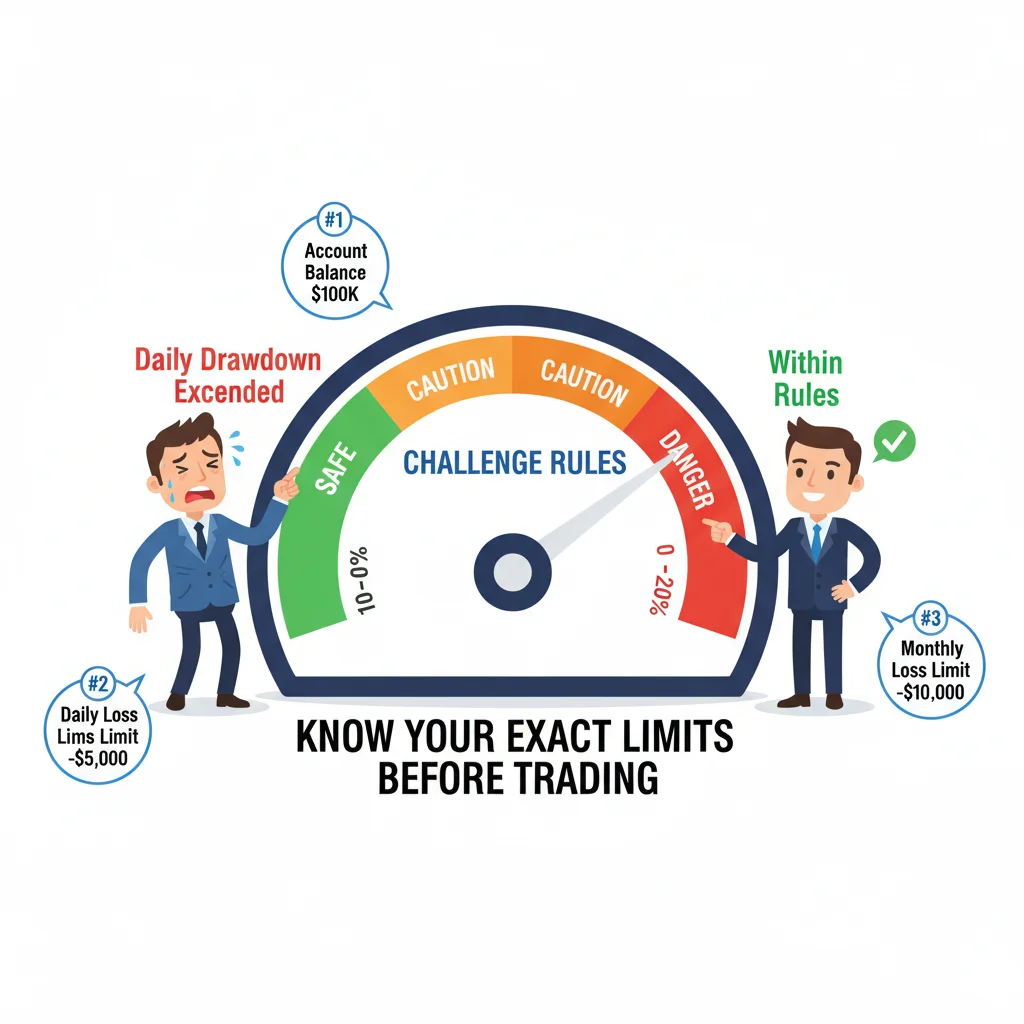
Over 80% of traders fail prop firm challenges not because they can't trade, but because they don't understand the exact ruleset—especially daily drawdown limits that can kill your account on a single Friday afternoon. Knowing your numbers before you place a trade is the difference between funding and failure.
1. Know the Exact Numbers Before You Place a Single Trade
This sounds obvious. It isn't. Most traders skim the challenge rules and think they understand them. They don't.
Here's what the major firms actually require in 2025-2026. FTMO's $100K Standard Challenge costs $540, requires a 10% profit target ($10,000) in Phase 1, 5% in Phase 2, with a 5% daily drawdown limit and 10% maximum drawdown. My Forex Funds (MFF), before their legal issues forced restructuring, ran a similar model. The Funded Trader (TFF) offers its Standard Challenge at $399 for a $100K account, with an 8% profit target, 5% daily loss limit, and 10% overall drawdown. These numbers aren't interchangeable. Trading FTMO rules on a TFF account, or vice versa, is how you get caught off guard.
The daily drawdown is where most people get tripped up. On FTMO, the 5% daily loss is calculated from your equity high of that trading day, not from your starting balance. So if you start Monday at $100,000 and run your account up to $103,000 by noon, your daily loss limit is now $5,150 from that $103K peak, not $5,000 from the starting balance. That's a moving target. I've seen traders blow challenges at 3pm because they didn't realize their morning profits shifted the floor.
Before you open MT5 and place trade one, write down: your profit target in dollars, your daily drawdown ceiling in dollars (recalculate it every morning), and your total maximum drawdown. Post it next to your screen. Old school? Yes. Does it work? Absolutely.
For sizing your trades correctly from day one, use a position size calculator, because eyeballing lot sizes on a funded account is how challenges die quietly.

💡 Winston's Tip
Set a hard stop on your challenge day — if you're down 3% before noon, close the platform and walk away. Protecting a bad day from becoming a blown challenge is worth more than any afternoon recovery trade.
FTMO $100K = $540 entry, 10% Phase 1 profit = $10,000 target. Most traders skim these numbers and wonder why they fail.
“You can have a profitable strategy, decent risk management, and still blow your FTMO $100K challenge because you didn't account for the daily drawdown on a Friday afternoon.”
2. Trade the Challenge Like You'd Trade a Live Account — Not Like a Test
This is the most contrarian thing I'll say in this article: the traders who fail most often are the ones who treat the challenge as a performance. They size up, they push harder, they take setups they'd normally skip. That psychological shift is lethal.
When I passed my first FTMO $50K challenge back in late 2023, I was trading EUR/USD with the exact same 1% risk per trade I use on my personal account. No hero trades, no doubling up after a loss. Entry at 1.0712 on a London session breakout, target at 1.0780, stop at 1.0692. Clean 3.4R trade that took six hours to play out. Boring. Funded.
The traders who blow challenges are usually the ones who think 'I need to hit 10% in 30 days, so I should risk 3% per trade to get there faster.' Do the actual math. At 1% risk with a 55% win rate and a 1.8R average, you hit 10% in roughly 12-15 trades. That's two weeks of normal trading. You don't need to rush. See our EUR/USD guide if you want setup ideas that work in the London-New York overlap.
Consistency is what evaluators want to see in your trading journal too, some firms will flag accounts where one trade made 70% of the total profit, even if you passed technically.

The psychological shift from 'testing' to 'proving' is lethal. Treat the challenge exactly like a live account—no heroics, no ego sizing.
“Trading with urgency is the single fastest way to self-destruct a challenge that was otherwise going fine.”
3. Pick the Right Account Size (The $200K Trap Is Real)
Bigger account, bigger profits, right? Not how this works.
The $200K challenges cost roughly double, FTMO charges $1,080 for their $200K Standard. The profit target is the same percentage (10%), which means you need $20,000 in profit. That's not easier just because the numbers are larger. Your risk per trade in dollar terms doubles, your emotional pressure on losing days doubles, and your margin for error on daily drawdown doesn't change percentage-wise.
I'd argue the $25K or $50K challenge is where most traders should start. FTMO's $25K challenge costs $167 and requires $2,500 profit. If you can't pass that, you're not ready for the $100K. Simple.
One thing nobody talks about: scaling plans. FTMO's scaling plan lets you grow from $100K to $200K if you hit 10% profit in four months and stay rule-compliant. Starting at $100K and scaling to $200K through performance is a fundamentally different risk profile than purchasing a $200K challenge upfront. You're playing with house money at that point.

Bigger account ≠ easier money. $200K challenges still require the same 10% profit target. Your risk per trade scales up. The trap is thinking scale = safety.
“Trading with urgency is the single fastest way to self-destruct a challenge that was otherwise going fine.”
4. The Daily Drawdown Rule Will Kill You on Fridays — Here's Why
Friday is statistically the most dangerous day in prop challenges. I'm not guessing. I've watched it happen repeatedly in trading communities, and I've felt it personally.
Here's the mechanics. You've had a good week. You're sitting on $4,200 in profit Thursday evening. Friday opens with a decent setup, you take it, it goes against you. You're down $1,800 from that trade. Your account equity is now roughly $102,400, still profitable for the week. So you take another trade to recover. That one goes $2,000 against you before stopping out. Now you're down $3,800 from Friday's equity peak. You have $1,200 left before hitting the daily limit. You take one more trade. It doesn't work.
This is the Friday spiral. The problem isn't your strategy. It's that you were trying to defend weekly profits on a day when volatility thins out after the New York session and spreads widen. I now have a personal rule: no new positions after 12pm EST on Fridays. Positions that are already running, fine, let them breathe. But no new entries in that graveyard slot.
The ATR indicator (14-period) is useful here. On most major pairs, ATR drops measurably in the two hours before the New York close. If ATR is reading below its 5-day average on Friday afternoon, I'm flat. The potential reward doesn't justify challenging the daily limit with degraded conditions.
For anyone running a prop challenge while working another job or sleeping through certain sessions: tools like Pulsar Terminal handle this with Prop Firm Protection, which automatically closes all positions before you hit the daily loss limit with a 5% safety buffer, exactly the kind of safety net that prevents a sleeping mistake from ending a funded account.
💡 Winston's Tip
Track your R-multiples on paper after every single trade during the challenge. If your average winner drops below 1.5R over 10 consecutive trades, reduce size by 50% until your edge re-establishes itself.

Friday at 5% daily drawdown rule: spreads widen, volatility spikes, your $4,200 Thursday profit dies in one bad Friday trade. Most challenges end here.
“I was winning more trades and losing money. The streak hid the problem.”
5. Why Your Win Rate Is Probably Wrong — and What to Actually Track
Most traders track win rate obsessively. Win rate is nearly useless without the accompanying R-multiple data.
Here's a trader with a 65% win rate: average winner 0.8R, average loser 1.4R. Net expectancy: (0.65 × 0.8) - (0.35 × 1.4) = 0.52 - 0.49 = 0.03R per trade. That's breakeven with variance. During a challenge, that variance will eat you alive.
Here's a trader with a 42% win rate: average winner 2.1R, average loser 1.0R. Net expectancy: (0.42 × 2.1) - (0.58 × 1.0) = 0.882 - 0.58 = 0.302R per trade. That's a legitimate edge.
Before you start any challenge, you need a minimum of 50 trades (preferably 100+) from your own live or demo history with proper R-multiple tracking. Not pip tracking. Not dollar tracking. R-multiples, where 1R equals your initial risk on that trade. If your backtest or forward test doesn't include this, you don't actually know if your system has edge. You're hoping.
I use a spreadsheet with five columns: date, pair, entry, stop, exit, R-result. Takes 90 seconds to update after each trade. After 100 trades you'll know more about your actual trading than any course will ever teach you. Check the RSI indicator if you're looking for a filter that can genuinely improve R-multiple consistency on mean-reversion setups.
The honest moment I promised you: I failed a TFF $50K challenge in early 2024 because I started it two weeks after a 30-trade winning streak. I thought I was on form. I wasn't tracking that my average winner had shrunk to 1.1R while my average loser crept to 1.3R. I was winning more trades and losing money. The streak hid the problem. Don't be me.

65% win rate with 0.8R winners and 1.4R losers = breakeven. Win rate without R-multiple data is a lie traders tell themselves.
“I was winning more trades and losing money. The streak hid the problem.”
6. Don't Trade News Events — Ever — During a Challenge
This is not negotiable. Not for high-impact news. Not for NFP, not for CPI, not for FOMC. Not even if your gut says the trade is obvious.
Here's why. During major news, spreads on EUR/USD can spike from 0.1 pips to 8-15 pips in milliseconds. Your stop loss, which looked like 20 pips of risk, becomes a 30-pip loss before price even moves directionally. That instantaneous slippage can punch through your daily drawdown limit in a single tick. It has happened to funded traders on FTMO. I know one personally, his stop was at 1.0890, NFP hit, the platform filled him at 1.0876. He lost 14 pips more than planned. It didn't blow his challenge, but it cost him two days of progress.
Filter the economic calendar every morning. Mark red-folder events. Flatten everything 15 minutes before. Wait 15 minutes after. Miss the trade entirely if you have to. There will be another setup tomorrow. There won't be another challenge if you blow this one.
For a deeper breakdown of news behavior on specific pairs, the GBP/USD guide covers how Cable reacts to BOE and CPI data, worth reading before you trade sterling during challenge week.
💡 Winston's Tip
Once you hit your profit target early, switch to 0.01 lots and just keep logging trading days. Boring is funded. Exciting is a refund email.
NFP spreads spike from 0.1 to 15 pips in milliseconds. Your 20-pip stop loss becomes a 50-pip guaranteed loss. News trading = account liquidation.
“Your win rate is nearly useless without the accompanying R-multiple data.”
7. The Minimum Trading Days Rule Is a Gift — Use It Strategically
FTMO requires a minimum of 4 trading days in Phase 1 and 4 in Phase 2. TFF requires 5 minimum trading days per phase. This is not a hurdle, it's protection.
Some traders hit their profit target in two or three monster days and then sit on their hands, terrified of giving it back. That's actually the right instinct, but it creates a waiting problem. Here's the optimal approach: if you hit your profit target early, scale your position sizes down to micro. Keep trading, keep your account active, don't take meaningful risk. A $5 winner on a 0.01 lot micro trade counts as a valid trading day. You're satisfying the rule without threatening your progress.
Don't try to finish the challenge in 3-5 days with outsized risk. Don't quit trading entirely because you're scared. Small positions, active account, time passing. That's the formula once you've hit your target ahead of schedule.
The maximum challenge period for FTMO Phase 1 is 30 calendar days. TFF gives you 35. You have time. Trading with urgency is the single fastest way to self-destruct a challenge that was otherwise going fine.
Disclaimer: This article is for educational purposes only and does not constitute investment advice. Trading forex and CFDs carries significant risk of loss. Past performance is not indicative of future results. Always do your own research and consider your financial situation before trading. Never risk money you cannot afford to lose.

4 trading days minimum is protection, not a hurdle. Hit your profit target in 2 days? Sit tight. The drawdown rule exists to separate greedy traders from funded ones.
Prof. Winston's Lesson

Key Takeaways:
- ✓Read challenge rules completely—most traders skim and misunderstand exact profit targets and drawdown limits.
- ✓Trade challenges identically to live accounts: avoid oversizing, revenge trading, and forced setups on Fridays.
- ✓Track R-multiples with win rate—a 65% win rate means nothing without average winner/loser ratios.
- ✓Skip all major news events (NFP, CPI, FOMC) during challenges; spreads spike beyond risk management.
❓ Frequently Asked Questions
Q1What is the cheapest prop firm challenge to attempt in 2025?
FTMO's $10K Standard Challenge costs $89 and requires a 10% profit target ($1,000) with the same 5% daily / 10% max drawdown rules. The Funded Trader's Starter plan at $25K runs about $119. These are viable starting points to test whether your strategy holds up under challenge conditions before committing to larger fees. Don't start at $200K just because the profits look bigger on paper.
Q2Can I use an EA (Expert Advisor) on a prop firm challenge?
Most firms allow EAs, but with restrictions. FTMO explicitly bans high-frequency trading, latency arbitrage, and account copying from other funded accounts. TFF has similar prohibitions. If your EA trades on tick data or exploits broker latency, it will likely get your account flagged. Trend-following and grid EAs that respect normal market conditions are generally fine, but read the specific firm's trading rules before deploying automation. When in doubt, email their support with your EA's strategy description before you fund.
Q3How many trades do I need to pass a prop firm challenge?
There's no minimum trade count for most challenges (beyond the minimum trading day requirement). However, statistically, the fewer trades you take, the higher your variance. A 10% profit target achieved in 2 trades is vulnerable to a single bad day wiping it out. Most professional challenge passes I've seen involved 20-40 trades spread across 2-4 weeks, giving the statistical edge time to play out. Think of it as needing enough sample size for your edge to show up.
Q4What happens if I fail a prop firm challenge? Is my money gone?
Your challenge fee is gone, yes. FTMO and TFF both offer a free retry if you pass certain conditions, on FTMO, if you end Phase 1 above your starting balance but didn't hit the profit target, you get a free retry. Outside of that, you pay again. Some traders budget for 2-3 challenge attempts as part of their trading capital allocation, which is reasonable. What you should never do is add more risk to 'make back' a failed challenge fee. That's how a $540 loss turns into a $2,000 loss.
Q5Should I trade exotic pairs or just stick to major pairs during a challenge?
Stick to majors. EUR/USD, GBP/USD, USD/JPY, XAU/USD. Exotic pairs carry wider spreads, thinner liquidity, and higher overnight swap costs, all of which eat into your profit target margin. On a $100K challenge where you need $10,000 profit, paying an extra 15 pips in spread on each exotic trade is a material drag. The consistency principle also applies here: trade what you know best. A challenge is the wrong time to experiment with USD/ZAR or USD/TRY setups you've never live-traded before.
Q6How do prop firms detect cheating or rule violations?
More thoroughly than most traders assume. Firms use automated flagging for: trade times that correlate with known news events (some firms explicitly ban trading 2 minutes either side of major news), identical trade entries shared across multiple accounts (copy trading their own funded accounts), positions sized to exploit swap rates (swap hunting), and abnormal drawdown patterns. FTMO's risk team reviews accounts manually when flagged. Getting funded and then violating rules retroactively costs you the payout. It's not worth it, legitimate consistent trading is the only approach that holds up.
How useful was this article?
Click a star to rate
Comments
Stay ahead of the markets
Get weekly market analysis, trading strategies, and MT5 tips delivered to your inbox. No spam, unsubscribe anytime.
About the Author
Daniel Harrington
Senior Trading Analyst
Daniel Harrington is a Senior Trading Analyst with a MScF (Master of Science in Finance) specializing in quantitative asset and risk management. With over 12 years of experience in forex and derivatives markets, he covers MT5 platform optimization, algorithmic trading strategies, and practical insights for retail traders.
Get Pulsar Terminal
All these calculators are built into Pulsar Terminal with real-time data from your MT5 account. One-click position sizing, automatic risk management, and instant calculations.
Get Pulsar TerminalYou Might Also Like

Risk Disclaimer
Trading financial instruments carries significant risk and may not be suitable for all investors. Past performance does not guarantee future results. This content is for educational purposes only and should not be considered investment advice. Always conduct your own research before trading.